People in Manhattan loved to call me “self-made.” They tossed the phrase around at cocktail parties like a garnish — a way to make my presence in their circles feel gritty and authentic.
I was Gavin Kessler. The boy from Queens who clawed his way into the skyline.
They admired the suit, the watch, the work ethic that never made the magazine profiles. But they didn’t know the architecture of my survival. They didn’t know that without Evelyn Kessler, I would have been nothing more than a statistic.
My mother raised me above a laundromat in Queens. The air was always thick with detergent and exhaust. My father left when I was five — a goodbye note on a napkin, a bank account that echoed. Evelyn didn’t crumble. She hardened, but only on the outside. She cleaned corporate offices at night, scrubbing floors she wasn’t allowed to walk on during the day. She packed my lunches before sunrise and sat beside me during homework hours, her hands red and chapped from bleach, pointing out math errors in a soft, patient voice.
I built my empire on the foundation of her fatigue.
So when my first tech logistics company went public, I didn’t buy a penthouse. I bought a brownstone in Brooklyn. Quiet. Sunlit kitchen. A small backyard for the garden she’d always wanted. A master bedroom on the ground floor so she wouldn’t have to fight the stairs as her knees began to fail.
Then came Sloane.
When I got engaged to Sloane Mercer, my peers slapped me on the back and said I had finally “arrived.” Sloane was beautiful in a terrifyingly curated way — hair that never frizzed, a smile that looked trademarked, a social calendar that resembled a battle plan. She talked about our future like it was a brand launch: charity galas, Vanity Fair features, a wedding photographed by aerial drones.
I was intoxicated by her polish. I didn’t see the jagged edges underneath.
“She’s quaint,” Sloane had said the first time she met my mother — the way you might describe a chipped teacup at a garage sale. Charming, but ultimately useless.
Evelyn tried. God, she tried. She complimented Sloane’s cooking even when the catered food tasted like sterile perfection. She asked gentle questions about Sloane’s childhood in Connecticut, only to be met with polite, clipped answers — eyes never leaving her phone, treating my mother’s warmth like an unscheduled appointment.
I didn’t notice the fractures. I was too busy believing in the life I thought I’d earned. I let Sloane redecorate the townhouse, replacing my mother’s knick-knacks with beige sculptures and abstract art.
“It’s just an update, Gavin,” Sloane had said, her hand light on my chest. “We need the house to reflect us. Your mother collects dust.”
I laughed — uncomfortable, compliant — and let the movers take my mother’s favorite armchair away.
The hairline cracks were there. I was just too busy staring at the penthouse view to feel the ground trembling beneath my feet.
It was a Thursday in late October, the kind of day where autumn light hits the city like gold dust.
A merger meeting I had dreaded for weeks ended three hours early. For the first time in months, my calendar was blank.
Sitting in the back of my town car, loosening my tie, a sudden fierce wave of nostalgia hit me. I missed the smell of yeast and sugar. I missed the sound of my mother humming.
“Stop at Morelli’s Bakery,” I told the driver.
I bought four warm poppy seed rolls and a box of lemon cake — the kind with the thick sugary glaze she used to buy us once a year on my birthday when we couldn’t afford presents. Walking up the steps of the Brooklyn townhouse, I felt lighter than I had in years.
I reached for my keys, but the heavy oak door pushed open under my hand.
That was wrong.
Evelyn was vigilant about locks. Growing up in a bad neighborhood does that to you. She locked the door even when taking out the trash.
I stepped into the foyer.
The house was silent, but it wasn’t a peaceful silence. It was pressurized. Charged. The kind of stillness that comes right before a storm breaks.
I walked softly down the hallway, the cake box dampening in my grip.
“You’re useless.”
It was Sloane’s voice. But not the voice she used at galas. Not the sultry, sophisticated tone she used when asking for my credit card. This was guttural. Sharp. Dripping with venom.
Then came a thud — heavy, dull, like meat hitting wood.
I froze. My blood turned to slush.
“Please…” My mother’s voice followed, small and trembling, a sound I hadn’t heard since the days debt collectors used to bang on our apartment door. “I’m trying, Sloane. I didn’t mean to spill it.”
“You never mean to,” Sloane hissed. “Look at this mess. You’re disgusting.”
A scraping sound — a chair dragged violently across tile.
I moved. I didn’t think. I just moved.
The distance from the hallway to the kitchen felt like miles, my heartbeat slamming against my ribs like a trapped animal.
I stopped in the doorway.
The scene before me shattered every illusion I had built over the last two years.
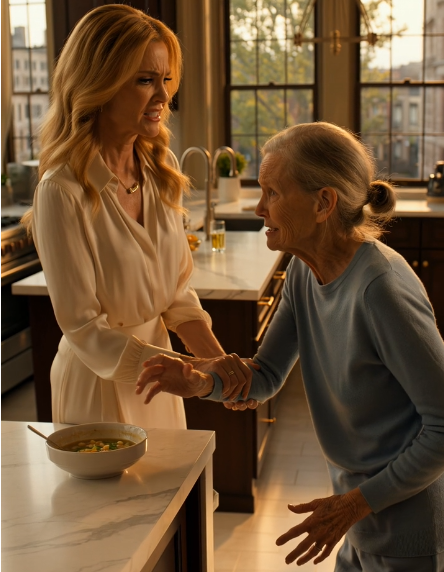
Sloane was standing over my mother. Evelyn was half-crouched near the granite island, one hand braced on the cabinet door as if her legs had given out. A ceramic soup bowl lay in shards on the floor, tomato bisque spreading like a crime scene across the white tile Sloane had insisted on installing.
But it wasn’t the soup that stopped my heart.
It was Sloane’s hand.
My fiancée — the woman who chaired the Children’s Hope Foundation, who smiled from the covers of charity brochures — had her manicured fingers wrapped tight around my mother’s frail wrist. She was twisting it. I could see the torque. The unnatural angle. The way Evelyn’s skin looked papery and pale under the pressure.
“How many times do I have to tell you?” Sloane whispered, leaning down, her face contorted into something I had never seen and could never unsee. “You are embarrassing. You are a burden. You ruin everything Gavin builds.”
Evelyn didn’t fight back. She just looked down, tears dripping silently into the spilled soup, accepting the pain as if she had earned it.
The cake box slipped from my hand. It hit the floor with a soft whump.
Sloane whipped around.
For one split second, her face was a rictus of raw rage. Then, seeing me, the mask slammed back into place. The transition was so fast it was nauseating. Eyes widened. Lips curved. She released my mother’s wrist as if she had simply been checking her pulse.
“Gavin!” she chirped. “You’re home early! We had a little accident.”
I looked at the red welts blooming on my mother’s arm. I looked at the fear in the eyes of the woman who had scrubbed toilets so I could go to college.
“What did you just do to my mother?” I asked, my voice coming from somewhere far below me.
Sloane blinked. She laughed — a nervous, tinkling sound. “Don’t be dramatic, darling. She dropped the bowl. The soup went everywhere. I was just helping her up.”
“You were twisting her arm.”
“I was stabilizing her!” She crossed her arms, shifting instantly from startled to indignant. “She’s clumsy, Gavin. She’s getting senile. Honestly, I don’t know how you expect me to manage the wedding planning when I’m babysitting a geriatric toddler.”
I walked past Sloane as if she were furniture.
I knelt beside my mother, ignoring the soup soaking into the knees of my suit. I took her hand — the one Sloane had held — and turned it over. Four distinct red fingerprints were rising on the thin skin.
“Mom,” I said, my voice cracking. “Has she done this before?”
Evelyn pulled her hand away and hid it in her lap. She wouldn’t look at me. “It’s my fault, Gavin. I’m clumsy. Sloane likes things clean.”
“Look at me.” I kept my voice steady by sheer force of will. “Has she hurt you before?”
Evelyn’s lip trembled. She glanced at Sloane, then back at me, terror swimming in her eyes.
“Only when she’s stressed,” she whispered. “She grabs me. She pushes me sometimes. When you’re traveling.”
The heat that rose in my chest was blinding. It wasn’t anger. It was older than anger. It was the protective fury of every night she had stayed up waiting for me to come home safe. Of every lunch she packed with chapped, bleach-burned hands. Of every dream she had quietly folded and shelved so mine could breathe.
I stood up slowly and turned to Sloane.
“Get out.”
Sloane rolled her eyes. “Oh, stop it. You’re going to kick me out because your mother is a liar? She’s playing the victim. She’s been jealous of me since day one. She’s been trying to drive a wedge between us from the start.”
“I saw you,” I said, stepping into her space. “I saw your face. I heard what you called her.”
“I called her a burden because she is one!” Sloane’s composure finally fractured, her voice climbing. “Look at her! She sits in this expensive house while we’re out building a legacy. I am trying to shape your life into something elite, and she is an anchor dragging you back to Queens!”
“That anchor,” I said quietly, “is the only reason I’m standing here. She’s the only reason I have a single dime.”
“You think your friends accept you because of her?” Sloane laughed — cold and cutting. “They accept you because of me. Because I polished you. If you throw me out, Gavin, I will tell everyone you’re unstable. I’ll tell them your mother is demented and violent. I will ruin your reputation before the morning papers run.” She stepped closer, smelling of expensive perfume and something rotten underneath. “You need me.”
I looked at her — really looked at her — and saw nothing but a stranger.
“I don’t need you,” I said. “And I don’t care about the reputation. I care about the woman sitting on that floor.”
I pulled out my phone.
“You have ten minutes to pack a bag and leave. If you’re still here, I’m calling the police and filing assault charges. I’ll have a forensic photographer document every bruise on her arm.”
Sloane’s face went pale. She knew I had the lawyers to do it. She knew that even with her connections, a domestic abuse charge against a frail elderly woman would obliterate her social standing.
“You’re making a mistake,” she hissed, grabbing her purse off the counter. “You’re choosing a dying old woman over a future with me.”
“That’s the easiest choice I’ve ever made.”
“You’ll regret this,” she spat, turning on her heel. “You’ll be alone.”
“I’d rather be alone than with a monster.”
She stormed out. The front door slammed so hard the windows rattled.
The silence that followed was heavy, but clean. It was the silence of a tumor being removed.
For a long time, neither of us moved. The soup was cold on the floor.
“I didn’t want to ruin your happiness,” Evelyn sobbed into her hands. “You looked so proud with her. Everyone said you were a power couple. I thought… I thought I could take it.”
I sat down on the kitchen floor beside her, amidst the shattered porcelain. I wrapped my arms around her small, trembling shoulders and held her tighter than I had since I was a child.
“You didn’t ruin anything,” I managed, tears finally breaking through. “I did. I was so desperate to prove I belonged in her world that I forgot where I actually came from.”
That night was a blur of logistics and heartbreak.
I cleaned the kitchen floor on my hands and knees. I made tea. I called a locksmith at 11 PM. I moved a chair into the hallway outside her bedroom and sat there through the night, watching the door, some primitive part of me terrified she would come back.
The fallout started by noon the next day.
Sloane didn’t go quietly. She posted vague victim-blaming content on social media about “escaping toxic family dynamics.” Mutual friends — people I had vacationed with, whose children I had sent birthday gifts to — called to ask why I had “snapped” at her. She spun a narrative: I was controlling, my mother was violent and senile, she had fled for her own safety.
It hurt. I won’t lie. It hurt to watch people I respected take her side without asking for mine.
My lawyer Harrison wanted blood. “Defamation suit, Gavin. We can crush her.”
I looked out the window at Evelyn, who was sitting in the garden staring at a patch of withered basil, looking exhausted in the way only truly frightened people look.
“No war,” I told him.
“She’s destroying your brand.”
“Let her talk. If I go to war, my mother has to testify. She gets dragged through every filthy detail in a deposition. I won’t do that to her.”
Instead, I did something harder and quieter. I told the truth to the people who actually mattered — my board, my oldest friends. I showed them the photographs of Evelyn’s wrist. I said simply: “She hurt my mother. It’s over.”
The fake friends fell away. The real ones stayed. It was a painful pruning, but necessary — like cutting diseased branches off a tree you actually want to live.
The real work was at home.
Evelyn was jumpy. She flinched at dropped silverware. She apologized constantly for existing — “I’m sorry I’m in the way,” she’d say if I had to step around her in the hallway.
“You are the way,” I told her one night, grabbing her shoulders gently. “Mom, this house is yours. I just live here.”
I started leaving the office at 4 PM. I fired the “perfect” housekeeper Sloane had hired. On Saturdays, Evelyn and I cleaned the house ourselves, blasting Motown records the way we used to in the old apartment above the laundromat. I stopped trying to curate my life and started actually living it.
I realized, slowly and with some pain, that money hadn’t fixed our problems. It had just dressed them up in cashmere. I had built a fortress to keep her safe, then invited the enemy inside because she looked good on a gala invite.
Six months later.
The Brooklyn townhouse smelled of roasted garlic, oregano, and laughter.
I walked in from the garage, tie already undone, and stopped at the kitchen archway.
The scene before me was everything Sloane would have hated.
It was messy. It was loud. It was imperfect in every way that mattered.
Evelyn was at the island, apron covered in flour, instructing three neighbors — women whose names I was embarrassed to admit I hadn’t bothered learning for two full years. They were making gnocchi. A bottle of cheap red wine sat open on the counter. A cloud of flour hung suspended in the late afternoon sunlight.
“You have to be gentle with the dough,” Evelyn was saying, her voice strong and certain. “If you fight it, it gets tough. You have to coax it.”
Mrs. Higgins from next door laughed. “Like my husband.”
They erupted. Evelyn threw her head back in a deep, genuine belly laugh that erased ten years from her face in an instant. She didn’t look frail. She didn’t look like a victim. She looked like the queen of her own domain.
She spotted me in the doorway.
Her eyes didn’t widen in fear. They crinkled at the corners.
“Gavin! Wash your hands. We need a taste tester.”
I walked to the sink, rolling up my sleeves. The bruises on her wrist were long gone, faded into memory. But the lesson they had burned into me was permanent.
I had lost the “power couple” status. Lost the Met Gala invitations. Lost the approval of people who only liked me because of my net worth. But standing there eating misshapen, imperfect, extraordinary pasta while my mother wiped flour off my cheek — I understood I had won the only coup that actually mattered.
I had overthrown the tyrant of perception.
Sloane had been right about one thing: I was a boy from Queens. And thank God for that. Because the boy from Queens knew that loyalty wasn’t a line item on a spreadsheet, and love wasn’t something you curated for an audience.
Using the money I would have spent on a lavish wedding, Evelyn and I launched the Silver Shield Initiative — not a glamorous charity, not a gala circuit cause, but unglamorous, necessary work. We funded legal advocacy for elderly people trapped in abusive situations, often by their own family members. We helped them find safety, housing, and the language to name what had been done to them.
Evelyn became the face of it.
She spoke at community centers — not with polished speeches or media coaches, but with raw, unvarnished honesty. She told her story. She told her audiences that silence protects the abuser, never the victim.
She packed those rooms.
Last week, I saw a photograph of Sloane in the paper. She was draped on the arm of a hedge fund manager, looking perfect, glossy, and cold. I felt a twinge of something — not regret, not longing. Pity, maybe. Quiet pity for the man beside her who didn’t yet know what lived behind that smile.
I put the paper down and looked out into the garden.
Evelyn was there on her knees in the dirt, planting marigolds, her voice carrying a soft, tuneless song through the open window.
I had built a fortune. She had built me. And the morning I walked into that kitchen carrying lemon cake and chose her — loudly, without hesitation, at the cost of everything I had been told to want — that was the only day in my life I had ever truly arrived.
