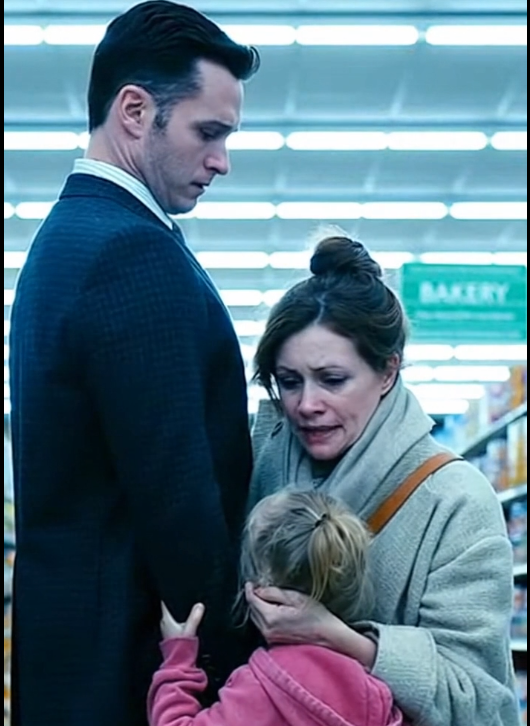
A little girl asked a stranger in a grocery store to be her daddy for one day… But he said yes — and three lives were never the same again.
It was an ordinary Tuesday when Ethan Grant’s entire life cracked open in the cereal aisle.
He was standing at a register, suit pressed, jaw tight, complaining about the wrong brand of water. The line behind him stirred. He didn’t care. In Ethan’s world, everything ran on schedule or it ran wrong.
Then a small voice floated up from somewhere near his elbow.
“Mister, could you be my daddy? Just for one day?”
He turned.
She was maybe six. Curly blonde hair, mismatched socks, worn sneakers. And eyes — deep blue and completely unafraid — that looked at him as though she’d already decided.
Her mother rushed over, cheeks flushed, hand pulling the girl close. She was apologizing before she’d even caught her breath. Ethan barely heard her. He was still looking at the child.
Lily, the mother said. That was her name. And tomorrow was Father’s Day at school.
Ethan stood there in a city of three million people and felt suddenly, strangely alone.
He heard himself say it before he understood why: “Tomorrow. Ten o’clock. Riverside Elementary.”
The mother — Rachel — froze. Lily, however, lit up like a lamp switched on.
“You’re really going to come?” she breathed.
He gave one short nod. Then walked out, leaving the water bottle unpaid on the counter.
That night, Ethan stood at his floor-to-ceiling window on the 37th floor. The skyline glittered. His phone showed no appointments until noon the next day.
He thought about a little boy named James, who used to ask why rainbows didn’t fall to the ground.
He thought about a school volcano project he never attended.
He thought about a corner called 8th Street.
By 9:58 the next morning, his car was parked outside Riverside Elementary.
Lily came running before he’d reached the gate, white dress flying, two uneven pigtails tied with yellow ribbons. She grabbed his hand without hesitation, the way children do when they’ve already made up their minds about a person.
She marched him to the front of her classroom, stood tall in front of twenty curious faces, and announced: “This is my dad. Just for today.”
A paper crown, pink and wobbly, was placed on his head with ceremony. He wore it.
They drew rainbows. He added a sun. His hand trembled slightly — not from nerves, but from something older, something he’d kept locked under years of quarterly reports and empty hotel rooms.
At the reading corner, Lily climbed into his lap and pressed a picture book into his hands. His voice started formal, stiff — boardroom cadence. But she leaned her head against his chest, and something in him gave way. His voice softened. Slowed. Followed the rhythm of her breathing.
He read three chapters. She asked for a fourth.
That afternoon the three of them ended up at a small diner called Willoughby’s. Yellow light, worn brick walls, Lily drawing the Rainbow Kingdom on a napkin.
She looked up without warning and whispered, “Daddy reads better than my teacher.”
Rachel started to correct her. Ethan raised one hand. Let it be, he said softly.
A silence settled — not the awkward kind, but the kind that happens when something true gets said out loud for the first time.
He told them about James then. About Elise. About the volcano project and the meeting he chose instead and the corner of 8th Street where everything ended.
He told it quietly, eyes on the window. No performance. Just a man finally putting a thing down that had been too heavy for too long.
Rachel didn’t offer comfort. She just placed her hand over his. Still. Present. No judgment in it.
Lily crawled across the seat and pressed herself against his arm.
“So you came today,” she said, “because of me.”
“Yes,” Ethan said. “Because of you.”
Weeks became a shape. A rhythm.
Lily called him Daddy by the third week — not out of confusion, but out of certainty. He tied her shoelaces, always too tight the first time. She made him redo them. He never complained.
Rachel started at the Grant Initiative Foundation, matching language programs to underserved kids, doing the work she’d studied for and then set aside to survive. Ethan passed her desk each day not to check her work but to offer a look that said: You belong here.
They didn’t name what was happening between them. They didn’t need to. Lily named it for everyone else.
That’s my daddy, she told a woman in the elevator. My mommy works here too. We’re a team.
Then the fever came.
A call from school on a Friday afternoon — Lily hadn’t eaten, cheeks flushed, gone limp in art class. Rachel was running before she hung up. Ethan left a board meeting mid-sentence.
They brought her home to Rachel’s small apartment and laid her on the bed. The fever climbed fast and fierce. Rachel worked with the efficiency of a mother who had weathered these nights alone before. Ethan sat beside the bed, useless and refusing to leave.
Lily stirred once, half-asleep, and whispered: “Don’t leave me like everyone else.”
The words hit him like a hand pressed flat against the chest.
He leaned down. “Daddy’s here,” he said. “I’m not going anywhere.”
He held her until her breathing slowed. He was still there at 2 a.m. At 4. When Rachel came to the doorway and saw him — holding her daughter the way a man holds something he is terrified to lose — she didn’t say a word. She just sat beside him in the dark.
By morning the fever broke.
Ethan looked up at Rachel, voice rough, eyes red. I once lost a child because I didn’t know how to stay, he said. This time, I’m not going anywhere.
The peace lasted until a Sunday in November, when Daniel Monroe arrived.
Sharp suit. Cold eyes. The face of a man who had not visited his niece in six years but had arrived now with a custody petition and a lawyer on speed dial.
“She needs real family,” he said. “Blood. Not a temporary attachment to a man she barely knows.”
Rachel’s hand clenched at her side. She said nothing about the six years of silence. Nothing about the empty birthdays and the unanswered calls.
The hearing was set for a cold December morning. The courtroom was all hard surfaces and fluorescent light. Daniel stood and argued fluently — bloodlines, stability, tradition. He pointed at Ethan and called him an outsider. A wealthy man playing house.
No one spoke. No one had anything to say.
Then a small voice from the back of the room.
“Can I say something?”
Every head turned.
Lily walked forward in her cream-colored dress, hair slightly uneven, chin up. She stood in the center of that room full of adults who had been speaking about her life as if she weren’t in it.
“My name is Lily Monroe,” she said, clear as a bell. “And I’ve already chosen my daddy.”
Daniel went still.
“My daddy reads to me every night,” she continued. “He doesn’t yell. He doesn’t leave. He’s not blood. But he’s the only one who stayed. When I had a fever. When my drawings were bad. When I was sad.”
She looked directly at Ethan.
“That’s my daddy.”
The judge was quiet for a long moment. Then:
“The court recognizes the stable and loving relationship between this child and Mr. Ethan Grant. The custody petition is denied.”
Daniel Monroe left the building without speaking to anyone. He did not look back.
Rachel exhaled — a long, shuddering release of everything she’d been holding since that Sunday morning. Lily ran to Ethan and he caught her, this man who had once stood in a grocery store line complaining about still water and could not have imagined, not in any version of his life, that a six-year-old in mismatched socks would walk into a courtroom and call him home.
Six weeks later, on a crisp Saturday morning, the little house smelled of jasmine and sound.
There was no grand venue. No quarterly-report guest list. Just the people who had been there for the quiet chapters — the diner booth, the fever night, the paper crown.
Lily walked the aisle first, tossing petals with theatrical flair, waving to guests as though she were the one getting married. Ethan watched her and felt something in his chest that had no word for it. Something only possible after a very long winter.
When Rachel appeared in the doorway, he didn’t hold his breath at her dress. He held it at her face — the look of a woman who had walked through enough to know what real looked like.
They didn’t read from paper.
“There was a time I believed I had missed everything,” Ethan said. “You and your daughter showed me it’s never too late to begin again.”
Rachel smiled. “I used to think love meant sacrifice,” she said. “You showed me sometimes it just means someone choosing to stay. Every single day.”
Lily stepped between them and grabbed both their hands.
“So now I’ve got two people who love me for real,” she announced to the room. “Right?”
Laughter rolled through every corner of that house.
That evening, no band played. Just a small radio in the living room putting out a tune no one could quite name. Lily pulled Ethan’s hand, then her mother’s, and the three of them turned slowly on the rug where so many hard nights had been survived.
No choreography. No performance. Just three people, hands held, laughing through the broken lyrics.
Lily rested her head on Ethan’s shoulder.
“I picked the right one, didn’t I, Daddy?”
He looked at Rachel — her head against him, her eyes closed, smiling in the soft light.
“The right one,” he said quietly, “at exactly the right time.”
None of them had been born into this family.
They had chosen it. One day, one promise, one paper crown at a time.
And the man who once stood in a grocery store line, ice-cold and untouchable, had learned at last what every broken heart eventually needs to know: it only takes one small hand — reaching up without hesitation — to crack open a life that had almost decided it was done.
