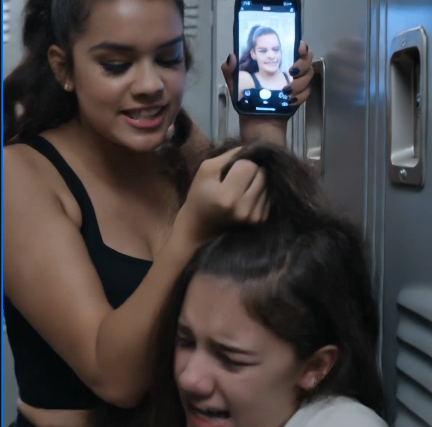
The locker room smelled of cheap body spray and chlorine, the kind of smell that clung to everything — the benches, the tiles, the inside of your nose for hours after you left. Maya Chen had learned to move through it quickly, efficiently, the way she moved through most of this school: head down, invisible, grateful.
She had eleven minutes between the end of swim practice and the start of AP Chemistry. She had calculated this. Eleven minutes to change, to gather her things, to be gone before the locker room filled with the girls from Varsity Volleyball who always arrived loud and sudden, like a weather event.
She had miscalculated by one minute.
“Oh my God.”
Maya heard her before she saw her. Brittany Calloway’s voice had a particular frequency — bright and carrying, designed to fill spaces, to be heard from across cafeterias and football fields and parking lots. She was framed in the doorway with two of her friends flanking her like parentheses, and her eyes were fixed on Maya with the particular brightness of someone who has just found something useful.
“Your hair,” Brittany said. “Maya, your hair is insane.”
Maya reached up instinctively. Her hair was her one vanity — thick and black, reaching the small of her back, the kind of hair her grandmother used to braid on Sunday mornings while telling her stories about a village in Fujian Province that no longer existed. She had never cut it.
“It’s fine,” Maya said, and moved toward the door.
Brittany stepped sideways. Casually. The way you’d step to block a shot in a game, so practiced it barely looked intentional.
“I mean it as a compliment,” she said. “It’s just so long. Right, Jade? Don’t you think it’s so long?”
Jade, who had the hollow eyes of someone who had long ago outsourced her opinions, nodded. “So long.”
“I’ve been watching these makeover videos,” Brittany continued, producing her phone from her jacket pocket with the smooth motion of someone who had rehearsed this. The camera light was already on. Already red. “And I thought — wouldn’t it be so cool to do one? Like a real one? And then I saw you, and your hair, and I thought—”
“No,” Maya said.
The word came out cleaner than she expected. She had practiced saying it — her therapist at the community center, the one she saw on the scholarship program’s dime, had told her that no was a complete sentence. But it still felt insufficient against Brittany’s smile, which did not flicker even slightly.
“It’ll be fun,” Brittany said. “You’d look so cute with a lob. Like, really cute. The long hair is giving very before.“
“I need to get to class.”
“You have time.” She said it with authority, as if she had also calculated the eleven minutes. As if she owned them. She probably believed she did. Brittany Calloway had been told yes by the world so many times and in so many ways that other answers had simply stopped registering as real.
Maya tried to step around her again. This time Jade moved, and the third girl — Courtney, who Maya knew only as a face and a name on the honor roll — drifted to the side, and suddenly Maya was not moving toward the door but away from it, back toward the sinks, her spine finding the cold tile wall without her meaning to retreat there.
Brittany held the phone up. The little red eye watched.
“Okay, so we’re here with Maya,” Brittany said to the camera, her voice shifting into the bright, performative register of someone playing a character. “And we are giving her the glow-up she deserves. She has this beautiful hair, but it’s kind of giving, like, sad. You know? So we’re going to fix that.”
From somewhere — her bag, a jacket pocket, Maya couldn’t track it — Brittany produced a pair of orange-handled craft scissors. The kind from the art room. Small blades, meant for construction paper and cardstock.
Maya’s heart did something terrible and lurching.
“I’m not going to let you do that,” she said. Her voice came out quieter than she wanted.
“It’s just a trim,” Brittany said, moving closer. “God, you’re so dramatic. It’s hair. It grows back.”
“Don’t.”
But Brittany was already reaching for her, fingers closing around a long rope of Maya’s hair, gathering it with surprising gentleness, the way you’d hold something you were about to break carefully so it didn’t break wrong. She lifted the scissors.
The blade touched the hair.
Something cracked open in Maya’s chest — some held, pressurized thing she had been managing for four years at this school, some sealed container of every sideways comment and every cafeteria table she had not been invited to and every time she had made herself small so that girls exactly like Brittany Calloway would leave her alone. It didn’t come out as crying. It came out as absolute, white-hot clarity.
“Stop.”
The voice was not Maya’s.
All four of them turned.
Ms. Patricia Osei-Bonsu, who taught AP Chemistry and had been at this school for nineteen years and had the patient, exhausted authority of someone who had seen every variety of teenage cruelty and still, still chose to show up every morning, was standing in the doorway.
She had a hall pass in one hand. She had come looking for Maya because Maya was never late, and when a student who is never late does not arrive, a certain kind of teacher notices.
Ms. Osei-Bonsu took in the scene with the rapid, clinical efficiency of someone who did not need it explained. Her eyes moved from the scissors to the phone to Maya’s face — which was, despite everything Maya was doing to prevent it, beginning to betray her — and then to Brittany Calloway, who in the space of one second transformed from confident to uncertain to afraid, and had the presence of mind to lower the phone, though not to turn it off.
“Brittany,” Ms. Osei-Bonsu said. She said nothing else for a moment, and somehow that silence was louder than anything Brittany could have filled it with. “Put those down and come with me.”
“We were just—”
“I know what you were doing.”
“It was a makeover thing. For social media. Maya didn’t—”
“I watched from the doorway for forty-five seconds,” Ms. Osei-Bonsu said. Her voice was not raised. It was something more effective than raised — it was absolutely, pressurized quiet. “I saw what Maya said. I saw what you did when she said it. So I know what you were doing, and I need you to understand that I know, because I want you to be very clear about what happens next.”
Jade and Courtney had already migrated toward the door, performing invisibility, becoming very interested in the middle distance. Brittany’s hand, finally, let go of Maya’s hair.
Maya pressed herself against the sink and took a breath that came out shakier than she’d intended.
Ms. Osei-Bonsu looked at her. “Are you all right?”
The question was so direct, so unexpectedly kind, that Maya had to look at the ceiling for a moment. The fluorescent lights swam a little. “Yes,” she said.
“The scissors didn’t—”
“No. She didn’t—” Maya reached up and touched her hair. All of it still there. Heavy and whole. “I’m okay.”
“Okay.” Ms. Osei-Bonsu nodded, once. Then she returned her attention to Brittany with the unhurried focus of someone returning to unfinished work. “Phone. Give it to me.”
“The video isn’t—”
“I’m not asking about the video. I’m asking you to hand me the phone.”
Brittany handed it over. Her face had rearranged itself into something calculating — Maya recognized it, the rapid reassessment, working out the angles. “This is a misunderstanding,” she started. “My mom is—”
“Your mother is on the school board,” Ms. Osei-Bonsu said pleasantly. “I’m aware. I’ve worked with her. She’s very committed to the school’s anti-bullying initiative. I imagine this conversation will be interesting for her.”
The calculation behind Brittany’s eyes flickered and went out.
What followed was the particular institutional unpleasantness of a school taking something seriously that schools often did not take seriously. There were meetings. There was documentation. There was a video — still on Brittany’s phone, delivered to the vice principal — that showed forty-five seconds of footage Brittany had not intended as evidence but had accidentally created anyway.
Brittany received a three-day suspension and a mandatory conflict resolution program. Jade and Courtney received formal warnings and letters placed in their files. Brittany’s mother, who did sit on the school board, said all the right things in the meetings and spent the rest of the semester slightly cold to everyone involved, which was fine. Everyone could survive cold.
Maya was offered counseling through the school, in addition to what she was already receiving. She accepted, because she was practical and because she understood that being offered resources and refusing them was a kind of stubbornness she could not afford.
She did not become friends with Brittany Calloway. That was not the kind of story this was.
But something shifted in the school’s ecosystem in the quiet, sideways way that ecosystems shift — not dramatically, not with announcement. The two or three girls who had been watching Brittany’s orbit for an opening, calculating whether it was safe to be kind to Maya, decided it was. A girl named Simone started sitting with her at lunch, initially because they were both in AP Chemistry and had a project due, and then because it turned out that they both loved old movies and both found the school’s ventilation system suspiciously loud and both had complicated feelings about the concept of success.
Maya did not cut her hair.
She kept it long for years afterward, past graduation, past the scholarship she used to leave the city and study biochemistry at a university where no one knew what her hair looked like or what it signified. When people asked about it — and they did, because it was remarkable, because it fell to her waist by then, thick and black and impossible to ignore — she said simply that her grandmother had loved it.
Sometimes, when she told that story, she thought about a pair of orange-handled scissors and a red camera light and a woman standing in a doorway who had been looking for her. Who had noticed she was missing before she had even had time to register that she needed to be found.
She thought about that more than she ever thought about Brittany Calloway — the fact of being noticed. The fact of someone keeping count.
She thought about what it meant to be a person whose absence is registered, whose well-being someone tracks, who is worth a hall pass and a walk down a corridor on a Thursday morning.
She thought about how the smallest form of dignity is someone knowing your name and noticing when you don’t arrive, and how that small thing had, in a particular moment in a locker room that smelled of chlorine, been the exact size and shape of salvation.
