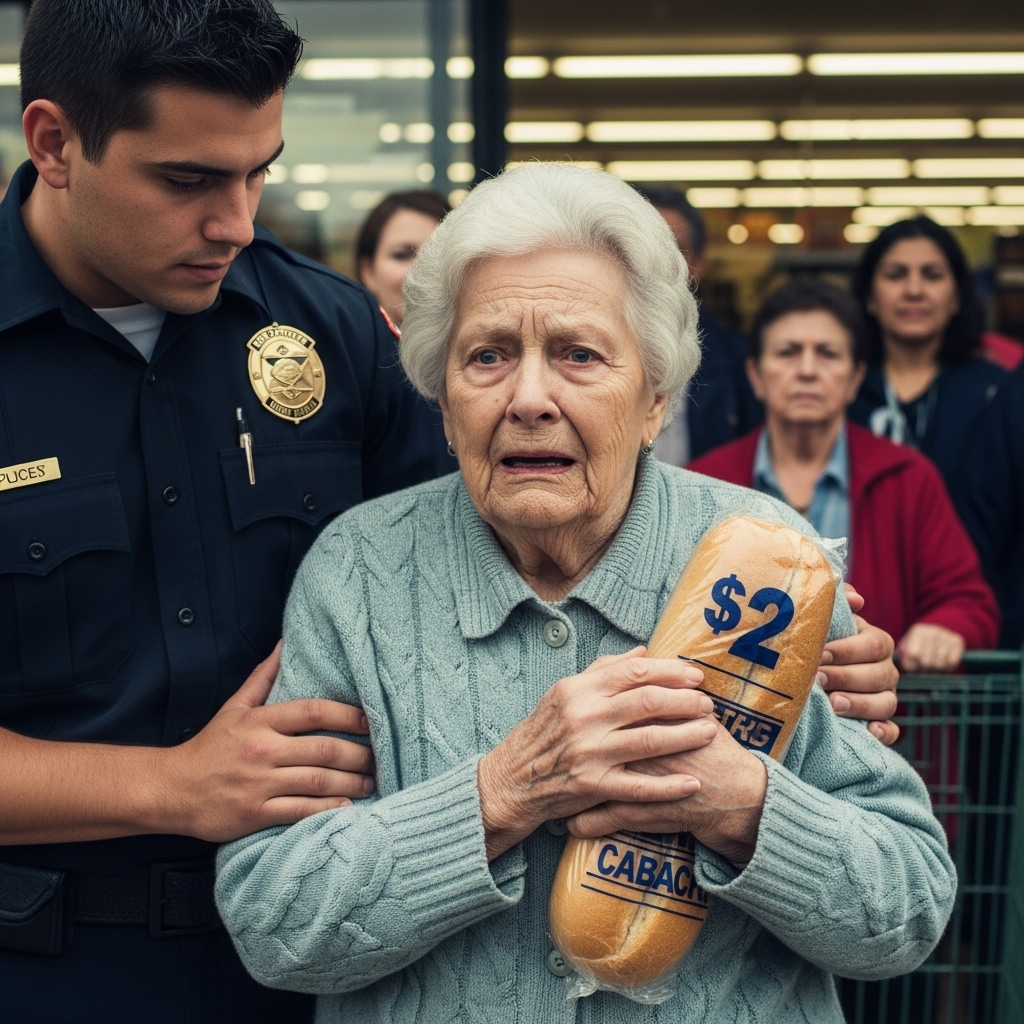
“If you want to arrest someone, officer… arrest hunger, not me.”
Those words didn’t come from a young activist, or a protest sign, or some fiery political speech.
They came from an 89-year-old woman with trembling hands, a thin winter coat that had seen too many seasons, and a $2 loaf of bread pressed to her chest like something she was trying to protect—not steal.
For a moment, even the automatic doors of the supermarket seemed to freeze in place.

Her name was Eleanor.
Most people in town knew her only vaguely—“the quiet widow on Maple Street,” the one who still hung laundry in the yard, the one who used a flip phone because “it still works just fine.” She had lived long enough to bury a husband, outlive two siblings, and watch the neighborhood she knew transform into something louder, faster, more expensive than anything she grew up in.
But life is rarely gentle with the elderly.
Her daughter lived three states away, working long hours as a nurse. Her son… well, that part of the story was harder. Addiction takes and takes until it leaves only shame in its place. And the person left holding the consequences was not him—but her.
Left in her care was a little boy named Jamie.
Six years old.
Brown hair.
Big eyes that still believed the world was soft.
He wasn’t her responsibility.
But in her heart, he was her second chance.
Their life was a slow struggle—pension checks stretched thin, utility bills creeping higher, and groceries becoming a kind of math problem Eleanor solved with worry etched into her palms.
On that cold Tuesday morning, she walked the mile to the supermarket because the pantry was empty.
Not low—empty.
Jamie had eaten nothing but a half banana the night before.
She had eight dollars in her pocket.
She needed milk. Eggs. Bread.
It was impossible.
She picked up the $2 loaf because it was the cheapest.
The milk because Jamie needed it.
Then stood in line doing calculations as if numbers could magically rearrange themselves into kindness.
They didn’t.
She put the milk back.
She kept the bread.
And in her tired mind—foggy from age, hunger, and the pressure of trying to raise a child after raising a whole life—she walked out forgetting she hadn’t paid for it.
That small mistake became a storm.
The young security guard—barely older than Jamie would be in ten years—grabbed her by the elbow at the door.
Not rough, but not gentle either.
“Ma’am, you didn’t pay for that.”
Her face drained.
Her hands shook.
She tried to explain, but the words tangled inside her like a frightened animal.
“It’s for my grandson,” she whispered. “I… I meant to…”
People stopped.
Phones came out.
Everyone loves a spectacle until they realize the star of the scene could be their own mother one day.
The manager was called.
Then the police.
A white male officer in his early forties arrived, polite but firm. He approached her with a rehearsed calm, the kind officers use when they don’t yet know if they’re walking into danger or tragedy.
“Ma’am, I need to ask you a few questions.”
Eleanor nodded, clutching the bread to her chest.
“Did you intend to steal this?”
That question—so blunt, so final—cut her deeper than the accusation itself.
Her lips trembled.
“No… no, officer. I didn’t take it for me.”
Her voice cracked.
“I took it because my grandson hasn’t eaten today.”
The entire store went silent.
The guard shifted uncomfortably.
A mother pushing a cart pulled her child closer.
An older man lowered his eyes, ashamed of something he couldn’t name.
The officer looked at her differently then—not as a suspect, but as a mirror of the society he served.
And Eleanor, holding onto dignity with both hands, whispered,
“I wasn’t stealing food. I was stealing time—time until my next check. Time to keep him from crying because he’s hungry. I know I should’ve paid. I know. But what should I do when there isn’t enough for both of us?”
Her voice didn’t rise.
It didn’t break into dramatics.
It was soft, steady, heartbreaking in its simplicity.
A kind of quiet pain that reaches deeper than any scream.
The officer took a breath, heavy and thoughtful.
It was the kind of breath a person takes when they’re standing at the border between “what the book says” and “what conscience says.”
He looked at the bread.
Then at the old hands clutching it.
Then at the crowd that had gathered, waiting for him to deliver justice—as if justice were a performance.
“Ma’am,” he said finally, “I’m not here to punish you.”
She wiped at her eyes. “Then what happens now?”
And that was the moment—the moment people would talk about for weeks—when he said something no one expected:
“The wrong thing here isn’t what you did. The wrong thing is that an 89-year-old woman has to steal a $2 loaf of bread so a child doesn’t go hungry.”
The manager swallowed hard.
The security guard stepped back.
A silence grew that no one knew how to fill.
Then something small, almost fragile, began to happen.
A woman placed a carton of milk on the customer service counter.
A man added a bag of apples.
Another placed a box of cereal.
Within minutes, a mountain of groceries gathered—quietly, respectfully—as if people were trying to apologize for a world that let someone like Eleanor fall through its cracks.
The officer helped carry the bags to her old sedan.
No handcuffs.
No citation.
Just a human doing what humans are supposed to do.
Before closing the trunk, he said softly,
“Take care of that boy. And please… let someone know if you ever need help.”
She nodded, her eyes shining with both gratitude and shame—two emotions that often sit side by side in people who’ve lived too long for their own comfort.
Eleanor drove home slowly, gripping the wheel, the bread now sitting safely beside her.
When she walked through the door, Jamie ran to her, hungry and hopeful.
She held him tight, longer than usual, as if the world outside might take him too if she let go.
That night, she ate nothing.
She watched him eat instead, smiling softly, pain tucked behind her ribs like a secret she would carry forever.
And now I ask you—anyone old enough to know how life can twist, bend, and sometimes break the people who once stood strongest:
When survival forces someone to cross a line…
is the real crime the act itself—
or the circumstances that cornered them into it?
