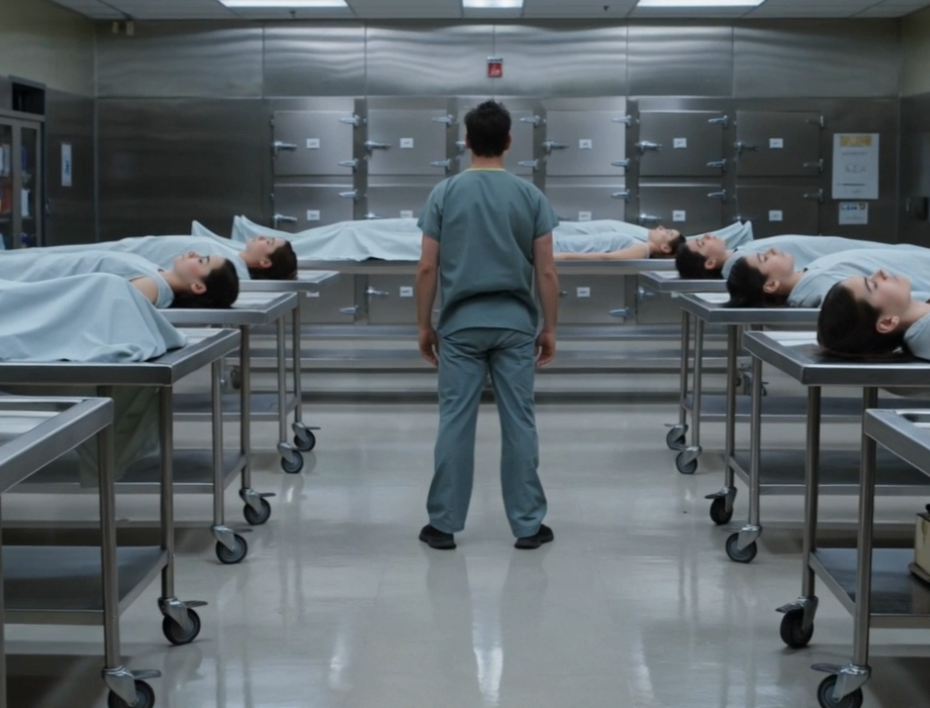
A morgue worker tagged bodies for fifteen years… until one night, the bracelet on a teenage girl’s wrist carried his own handwriting.
Daniel Mercer had a system.
Tag. Number. Drawer. Move on.
Fifteen years in the county morgue had taught him that emotion was a liability. You learned to look past the faces, past the hands, past whatever small personal effects the paramedics hadn’t removed. You looked at the paperwork instead. Age. Cause. Time of death. Clean, clinical, manageable.
He told his coworkers he preferred nights because the pay differential was better. That was a lie. He preferred nights because fewer people asked questions in the dark.
It was a Tuesday in February when they brought her in.
The call sheet said: Jane Doe, approximate age 14–16, found unresponsive beneath the Route 9 overpass. Hypothermia, probable. Toxicology pending. No ID. No phone. No next of kin located.
Daniel wheeled the gurney into Bay 3 with the same mechanical efficiency he applied to everything. Clipboard in hand. Pen uncapped. He pulled back the sheet to begin the intake process.
He wrote: Female. Adolescent. Approximate height—
Then he stopped.
Her left hand was curled loosely at her side, the fingers slightly open, the way a child’s hand looks in sleep. Around her wrist was a bracelet. Cheap plastic, the kind sold in drugstore bins for two dollars. The kind that came with a little stamp kit so you could press letters into the surface yourself.
The letters were faded. Worn down by what must have been years of wear.
Property of Dad.
Daniel’s pen didn’t move.
He recognized the handwriting because it wasn’t hers—it was his. He had pressed those letters into that plastic himself. He remembered the stamp kit. He remembered the kitchen table. He remembered his daughter Maya sitting across from him, seven years old, watching with enormous serious eyes as he made her the bracelet she’d asked for.
He remembered leaving three weeks later and not looking back.
He set the clipboard down. Very carefully. As though setting it down gently might prevent something from breaking.
It didn’t.
The supervisor on duty that night was a woman named Carol, fifty-something, with the particular brand of tired that comes from decades of the same job. She found Daniel standing over the gurney forty minutes later, completely still, still in his latex gloves, not having moved.
“Mercer.” She touched his arm. “Daniel.”
He looked up. His face was dry. That was the part that frightened her—no tears, no red eyes, just a kind of blankness, like a room with all the furniture removed.
“I need to make a call,” he said.
“Okay.” Carol’s voice was gentle. “Take your time.”
“I need—” He stopped. Started again. “I need to find out if this is my daughter.”
The silence that followed lasted four full seconds.
Carol picked up the desk phone and made the call herself.
It took the detective two hours to arrive, and another hour after that to confirm what Daniel already understood in his chest before any paperwork said so.
Maya Mercer, age fifteen. Aged out of her third foster placement eight months ago. Had been living intermittently in a shelter, intermittently on the street. No documented contact with the biological father in nine years. The caseworker’s notes used phrases like father’s whereabouts unknown and father expressed no interest in reunification.
That last line. Daniel read it three times.
Father expressed no interest.
He had said that. To an actual social worker, on an actual phone call, roughly nine years ago, when he had been thirty-four and selfish and convinced that some people were simply not built for fatherhood. He had used almost those exact words. He had thought it was honest. He had thought honesty made it acceptable.
He sat in the break room with a paper cup of coffee going cold in his hands and thought about the word honest.
His ex-wife, Sandra, arrived just before 4 a.m.
He hadn’t spoken to her in six years. She looked older in the way that hard years age a person—not badly, just accurately. She sat down across from him at the break room table and looked at his face for a long moment without speaking.
He waited for her to scream at him. He had been waiting for it since the detective made the call. He had prepared himself for it, even thought he deserved it, maybe needed it—some external punishment to match the internal one.
Sandra didn’t scream.
She said, quietly, “She kept the bracelet.”
Daniel closed his eyes.
“I want you to know,” Sandra continued, her voice flat and precise, “that she asked about you every year. Every single year on her birthday, she asked if you’d called. I told her no. She always said maybe next year.”
“Sandra—”
“I’m not here to fight with you.” She folded her hands on the table. “I’m here because she’s my daughter and someone had to identify her and you clearly can’t do it yourself. So I will. And then I’m going to walk out of here, and I don’t want you to contact me.”
She stood.
“She was kind,” Sandra said. “Kinder than either of us deserved, honestly. She was funny. She was smart when anyone bothered to pay attention. She had your eyes.” A pause. “She would have forgiven you, if you’d asked. That’s who she was.”
She walked out.
Daniel sat alone in the break room as the fluorescent light above him buzzed faintly, and for the first time in fifteen years, the tears came—ugly and silent and far, far too late.
He didn’t go back to work that night.
Carol sent him home around 5 a.m. with a card for the employee assistance program and the kind of careful silence that good people offer when they know words are useless.
Daniel sat in his car in the parking garage for a long time.
He thought about systems. About the comfort of numbers and tags and drawers. About how efficiently he had reduced everything human in his life to something manageable—his marriage, his daughter, his own capacity for feeling. How proud he had been, privately, of his emotional efficiency. How he had mistaken numbness for strength.
Maya had worn the bracelet for eight years. Through foster homes and shelters and hard winters and everything in between, she had kept a two-dollar piece of plastic with letters her father had stamped into it.
He had mistaken leaving for honesty.
He had mistaken silence for neutrality.
He had been wrong about all of it.
He called in a formal request to HR the next morning: temporary leave of absence, personal circumstances. He drove to the county family services office when it opened at eight and sat in a plastic chair for two hours until a caseworker could see him.
He told her everything. The bracelet. The morgue. The nine years. He didn’t try to frame it, didn’t reach for context or explanation. He said only: I failed my daughter, and I need to understand what her life was, and if there is anything left that I owe her, I want to know what it is.
The caseworker—young, maybe twenty-six, with the particular wary alertness of someone who had heard many such speeches before—looked at him for a moment.
“There’s no fixing this,” she said. Not unkindly.
“I know.”
“So what is it you actually want?”
Daniel thought about it. Really thought, for perhaps the first time in a very long time.
“She deserves to be buried with her name on it,” he said. “Her real name. And I want to pay for it. And I want there to be a record somewhere—official, permanent—that says someone claimed her. That she belonged to someone. Even if I didn’t act like it when it mattered.”
The caseworker wrote something down.
“That,” she said carefully, “I can help you with.”
Maya Mercer was buried on a Saturday in early March, in a small cemetery on the east side of the county. The grave marker was simple: her name, her dates, and a single line Daniel had chosen after three days of failing to find the right words.
She was kind. She was loved, too late, but truly.
Sandra didn’t come. He hadn’t expected her to.
Daniel stood at the grave alone in the cold for a long time. He didn’t speak. He didn’t try to explain himself to her—not to the earth, not to the air, not to whatever remained. Explanation was for the living, and it was always, in the end, for the person explaining.
He set something on the grave before he left.
A bracelet. New plastic, new letters, pressed carefully with a stamp kit he had bought the day before.
Property of Maya.
He had thought, when he bought it, that it was a gesture. Standing there in the cold with the clay ground hard beneath his feet, he understood it was something else entirely. It was the only honest thing he had left to offer: proof that he had finally learned her name.
He walked back to his car.
He didn’t return to the morgue. He took the leave, then extended it, then eventually didn’t return at all. He found work in a hospital records department—daytime hours, fluorescent lights, the same institutional hum. Different enough. He ate dinner at a table instead of over a sink. He kept the stamp kit in a drawer he opened sometimes and sometimes didn’t.
He was not redeemed. He understood that clearly. Redemption was a transaction, and there was no one left on the other side of this one to complete it.
But he was, for the first time, awake.
And some mornings, that felt like the beginning of a consequence he could actually survive.
