Nobody expected 2 AM on a Tuesday to change everything.
Sarah Callahan had been on her feet for eleven hours. Her scrubs were wrinkled, her ponytail half-collapsed, and the coffee she’d poured at midnight sat untouched and cold on the nurses’ station counter. The ER was loud tonight — it was always loud — but Sarah had learned years ago to filter out the noise. The shouting. The monitors. The grief.
She was good at filtering things out.
Too good, maybe.
She first heard the sound beneath Bay 4’s gurney around 1:58 AM. A low, trembling whimper. So quiet she almost missed it beneath the hiss of the ventilator in the next room.
She stopped walking.
There it is again.
Sarah crouched slowly, lifting the edge of the paper curtain, and peered beneath the gurney’s steel frame.
Two honey-brown eyes stared back at her.
The dog exploded from underneath with a violent metallic crash — equipment rattling, an IV pole swinging wildly, a steel tray of instruments launching off the counter and clattering across the linoleum like a gunshot.
Nurses screamed.
Someone grabbed a chair.
The fluorescent lights buzzed and flickered overhead, their cold blue-green glow turning everything into something that looked almost surgical, almost wrong.
“Get it out! Get it out of here!“
But Sarah was already on her knees.
She didn’t think. She never thought in moments like this. She just moved.
“Hey,” she breathed, reaching her hand forward, palm up, fingers loose. “Hey, buddy. Easy.”
The dog pressed himself against the far wall, his whole body trembling. He was golden — or had been, once. Now his fur was matted with weeks of dirt, streaked dark with something she didn’t want to identify. His ribs pushed visibly against his skin with every rapid breath. A thick scar crossed the bridge of his snout, pale and old, the kind that came from something deliberate.
Someone had hurt this dog. Badly. A long time ago.
But his eyes — God, his eyes.
Wide and hyper-alert and locked onto her with an intensity that made Sarah’s breath catch. Not the eyes of an animal. Something more. Something searching.
“It’s okay,” she whispered. “I’ve got you.”
She didn’t hear security arrive. She didn’t hear the heavy boots on the linoleum, the batons unclipped from belts, the aggressive commands being barked behind her.
She only heard the dog.
And then he launched.
The impact was total.
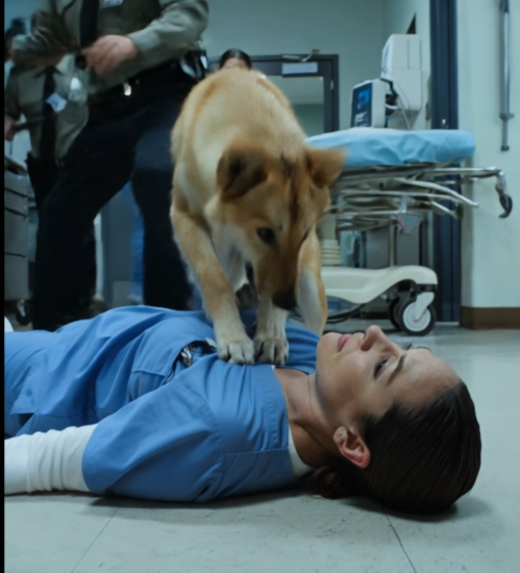
Sixty pounds of desperate, trembling animal slammed into Sarah’s chest and she went down hard — flat on her back, skull bouncing off the linoleum with a crack that silenced the room for one terrible half-second.
“GET IT OFF HER!“
Security swarmed forward. Two guards, then three, heavy footsteps pounding. Someone reached for the dog’s scruff.
But the dog didn’t run.
He didn’t flinch.
He pressed his paws onto Sarah’s sternum and he pushed.
Hard. Rhythmic. Urgent.
Like he’d seen it done before. Like he knew.
A rapid, desperate series of compressions — not frantic, not random — but timed. Deliberate. The dog barked directly into Sarah’s face, sharp and echoing, the sound ricocheting off every hard surface in the bay. He licked her cheek, her nose, her forehead — not gently, not sweetly, but desperately, the way you shake someone who won’t wake up.
“What is it doing—“
“Get it away from her—“
“Someone grab—“
But something stopped them.
All of them.
Because Sarah Callahan, eleven-year veteran, the woman who never flinched, the nurse who’d held strangers’ hands through the worst moments of their lives and walked back to the station dry-eyed and steady —
Sarah was not getting up.
Dr. Marcus Evans was twenty-nine years old and eight months into his residency, and he had already seen things that would follow him into old age. He thought he was past being shocked.
He slid into the bay on his knees, nearly wiping out on the polished floor, voice already breaking before he’d fully processed what he was seeing.
Sarah’s face.
The left side.
Drooping.
Not exhaustion. Not the floor impact. Something else — something underneath, something catastrophic and invisible, unraveling in real time.
Her lips parted. A sound came out that was barely a breath.
Her eyes were blurring. He could see it — that terrible going-away look he’d learned to recognize, the one that meant a person was starting the long drift toward a place you couldn’t follow.
“She’s crashing,” Marcus heard himself say, and his voice sounded far away, like it belonged to someone else. “Cardiogenic shock — possible dissection. Someone call a code, now, NOW—“
The room erupted.
The crash team hit the doorway like a wave — controlled chaos, overlapping voices, metal instruments clanging, the crash cart wheels screaming across linoleum. Someone was already cutting Sarah’s scrub top. Someone else pressed an oxygen mask toward her face.
And the dog—
The dog did not move.
He stayed on her chest. Pressing. Pushing. His eyes locked onto hers with something so focused, so present, that Marcus stopped for one full second in the middle of the chaos and just stared.
Because the dog’s eyes were not afraid anymore.
They were determined.
Stay, those eyes said. Stay with me. Stay.
Sarah felt her vision going soft at the edges, the fluorescent lights blurring into long white streaks above her. The noise of the room was tunneling — the shouting, the monitors, the crash cart — all of it compressing into a low, muffled ring, like the world was slowly being turned down.
She felt the weight on her chest.
The pressure. The rhythm.
And she focused on it. The only solid thing left.
She thought, strangely, of her first week as a nurse. The instructor who’d told her class: Pay attention to the ones who can’t speak. They’ll tell you everything you need to know, if you’re willing to listen.
She had always been good at listening.
She looked up into two honey-brown eyes, and she listened.
Don’t go, they said. Not yet.
They worked on her for forty-seven minutes.
Aortic dissection — Type A, the worst kind, the kind that kills in minutes. The kind that had been building inside Sarah’s chest for weeks, silent and invisible, while she took temperatures and started IVs and talked frightened strangers down from the edge.
The surgeon on call said later that they’d had maybe three minutes from the moment of collapse before irreversible damage. Maybe less.
The dog had given her those minutes.
Nobody fully understood how. A stray. No collar, no chip, no record. A dog who had wandered somehow through a propped service door at the back of the building and made his way — silently, invisibly — to Bay 4.
To her.
Whether he had smelled it — the biochemical cascade of a body in crisis — or whether something else entirely had drawn him there, no cardiologist, no veterinarian, no scientist could say with certainty.
What they could say was this:
Sarah Callahan lived.
She named him Steady.
He slept at the foot of her hospital bed for the eleven days of her recovery, curled tight, one ear always raised. The staff brought him water in a stainless steel bowl. Someone from radiology smuggled in a proper dog bed. An anonymous donor covered his vet bills — the malnutrition, the old injuries, the scar on his snout that had never properly healed.
On the morning of her discharge, Sarah sat on the edge of the bed and looked at him for a long time.
He looked back.
The same way he’d looked at her on the floor of Bay 4, with those ancient, searching, knowing eyes.
“Why me?” she whispered.
Steady stood up, crossed the three feet between them, and rested his chin on her knee.
And Sarah Callahan — who had held strangers’ hands through the worst moments of their lives and walked back to the station dry-eyed and steady —
Put her face in her hands and wept.
Because some things don’t need explaining.
Some things just need to be felt.
Three months later, Steady became the first certified therapy animal in the history of Mercy General Hospital. He works the night shift.
He always knows who needs him most.
