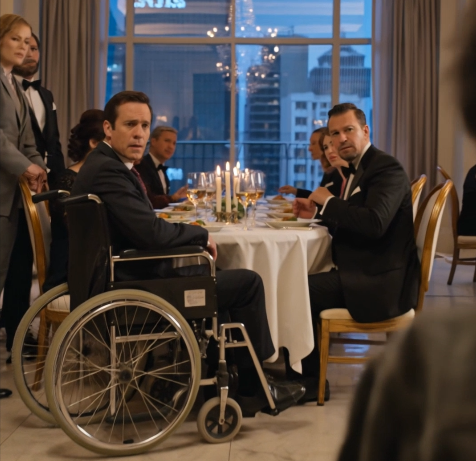
The restaurant hummed with the sound of privilege.
Crystal glasses clinked. Waiters in pressed white jackets glided between tables like ghosts. Outside, the city blazed cold and blue against the floor-to-ceiling windows — a world of steel and distance. Inside, everything was gold. Warm. Safe.
Nobody noticed the door open.
Nobody, until the silence fell.
He stood at the entrance like a mistake the night had made.
Eight years old, maybe nine — it was hard to tell beneath the layers of grime. His jacket was torn at the shoulder, held together by habit more than thread. His hair was a storm no comb had survived. His face was dirty in the way that takes days, not hours, to achieve. And his eyes — dark, wide, scanning the room with the careful caution of someone who had learned that safety was always temporary.
Every head turned.
A woman in pearls stopped mid-sentence. A man in a charcoal suit lowered his fork with a small, precise click. A waiter took half a step forward, then stopped, unsure of the protocol for this particular emergency.
The boy didn’t run.
He breathed. Short, nervous pulls of air. And then he walked.
At the center table — the best in the house, positioned like a throne before the city skyline — a man in a black suit sat in a wheelchair. His silver hair was combed back. His hands rested on the tablecloth with the stillness of someone who had learned to carry dignity like armor. Around him sat six guests, colleagues or admirers, it was difficult to say. They were mid-celebration. A birthday, perhaps. An anniversary. Something worth marking.
The boy walked toward him.
“Security—” a woman at a nearby table whispered sharply.
“Someone should call—” another voice started.
But no one moved. Because something about the boy’s face stopped them. He wasn’t threatening. He wasn’t begging. He was determined. As if he had somewhere important to be, and this was it.
The man in the wheelchair saw him first.
Their eyes met across the restaurant floor.
The boy stopped three feet away and held out his hand.
In his dirty palm: a small piece of bread. Slightly crushed. The kind sold outside convenience stores for almost nothing. The kind you eat standing up, in the cold, because there is nowhere else to go.
The room held its breath.
“I found this,” the boy said quietly. “For you.”
A guest laughed — just barely, just once — then immediately looked ashamed of the sound.
The man in the wheelchair stared at the bread. Then at the boy. His jaw worked silently for a moment.
“Son,” he said carefully, his voice low, “where did you get this?”
“Corner of Fifth. The baker throws them out at eight.”
“You waited for the baker to throw them out?”
“Every night.”
Another silence. Heavier this time.
“And you’re giving it to me?” the man asked.
“You looked lonely,” the boy said simply. “When I was outside. Looking in. You were the only one not laughing.”
The man blinked. Around him, his guests shifted in their chairs. One woman touched her necklace absently. A man picked up his wine glass and then put it down without drinking.
The man reached out and gently, carefully, took the bread from the boy’s hand.
Their hands touched — just for a second. Clean against dirty. Gold against grey.
“You need this more than me,” the man whispered.
The boy shook his head firmly. “I eat every night. I know where to look.”
“And me?” the man asked, something broken moving quietly behind his eyes. “What do I need?”
The boy thought about this with the seriousness of someone who takes questions seriously.
“I don’t know,” he admitted. “But you looked like someone who forgot.”
“Forgot what?”
“That people still see you.”
The man’s throat moved. His hand closed around the bread — this ridiculous, crushed, worthless piece of bread — as if it were made of something rare.
“What’s your name?” he asked.
“Mateo.”
“Mateo.” He said it slowly, like he was memorizing it. “I’m Richard.”
“I know. Your picture’s on the building across the street.”
A guest made a small sound — something between a laugh and a sob.
“Does anyone know you’re here, Mateo?”
The boy shrugged. “The city.”
Richard looked at him for a long moment. Then he turned to the waiter who had finally approached — hovering nervously at the edge of the scene, unsure of his role in this unrehearsed play.
“Bring him whatever he wants,” Richard said quietly. “And pull up a chair.”
“Sir, restaurant policy—”
“I know the owner,” Richard said. “Pull up a chair.”
The waiter hesitated. Then nodded. Then disappeared.
Mateo looked at the empty space being prepared beside the most important table in the room. He looked at Richard. He looked at his own hands.
“I’m dirty,” he said.
“So is the bread,” Richard answered. “I’m still going to keep it.”
And Mateo sat down.
Nobody spoke for a long moment. The restaurant slowly, carefully, returned to its sounds — the clink of cutlery, the murmur of conversation, the distant city pressing cold and blue against the glass.
But something had shifted. Something invisible and permanent.
A woman at the corner table quietly asked her husband for the bill. When she paid, she left three times the usual amount and said nothing about why.
A man in a charcoal suit caught his own reflection in the window, looked at it for a moment, then looked away.
And Richard — who had more money than he would ever spend, more buildings than he could name, more people around him than most would ever know — sat in his wheelchair holding a small crushed piece of bread as though someone had just handed him back something he had lost without knowing it.
Mateo ate his meal.
The city waited outside.
The bread sat on the table between them, untouched and perfect.
