The restaurant hummed with the quiet arrogance of wealth.
Crystal glasses caught the candlelight. Silverware clinked against porcelain. Men in tailored suits leaned toward women draped in silk, exchanging words that cost nothing and meant less. The air smelled of truffle oil and old money.
Nobody noticed the door open.
Nobody noticed him slip in.
Not at first.
He was maybe nine. Maybe younger — hunger has a way of aging a child from the outside while hollowing them from within. His jacket was torn at both shoulders, the zipper broken, the fabric so thin it was more memory than material. His face was streaked with the kind of dirt that comes from sleeping against concrete walls. His hair stood in uneven tufts, like something had tried to flatten it and given up.
He stood just inside the entrance, chest rising and falling fast, eyes scanning the room with the quiet terror of someone who knows they don’t belong.
The maître d’ spotted him first.
“Excuse me—” He stepped forward, one hand already raised in polished, practiced dismissal. “This is a private—”
“I just need one minute.” The boy’s voice was small but steady. “Please.”
The maître d’ froze. Something in the voice stopped him. He didn’t know what.
The room had gone quiet. Forks hovered above plates. Conversations dissolved mid-sentence. Forty pairs of eyes turned toward the door.
And the boy walked forward.
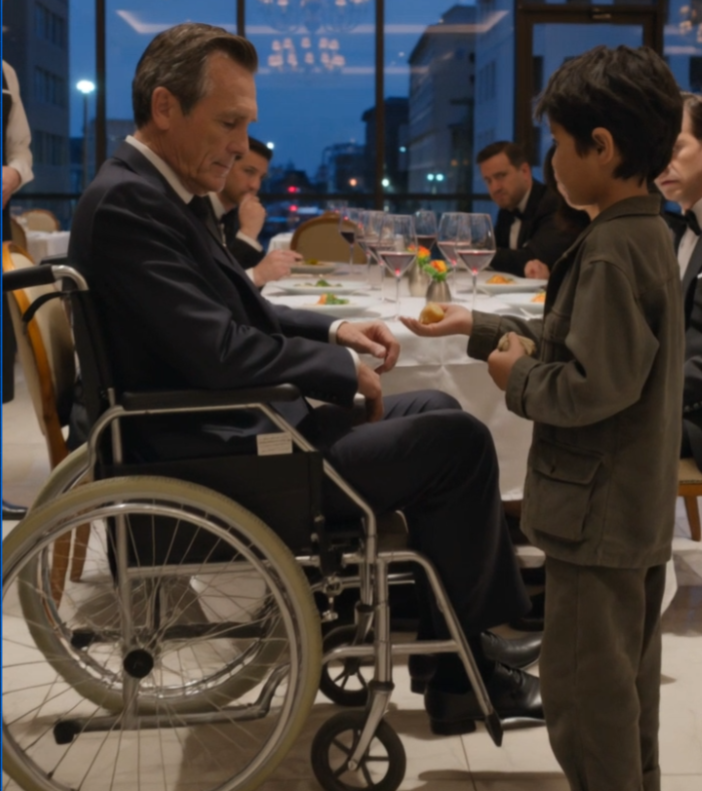
At the center table, near the floor-to-ceiling window with the city sprawling blue and electric behind the glass, sat a man in a wheelchair.
He was perhaps sixty, with silver hair swept neatly back and a black suit that had been pressed with military precision. His hands rested on the armrests — large, still, composed. Around him sat six guests: business partners, old friends, a woman who might have been his daughter. They’d been celebrating something. The remnants of a toast still hung in the air.
Now they all stared.
The man in the wheelchair watched the boy approach. He didn’t flinch. He didn’t call for anyone. He simply… watched.
The boy stopped three feet away from the table.
His fist was closed around something. His knuckles were white.
“I found this,” he said quietly, “for you.”
A woman at the table inhaled sharply. A man in a gray suit leaned back in his chair, visibly uncomfortable.
“Someone call the manager,” another man murmured.
“Don’t.” The man in the wheelchair said it calmly, without raising his voice. But it landed like a hand pressed flat against a drum. Everything stopped.
He looked at the boy. Really looked at him.
“What’s your name?”
The boy hesitated. “Mateo.”
“Mateo.” He repeated it gently, like he was making sure he had it right. “What do you have there?”
Slowly, the boy opened his hand.
It was bread. A small piece, slightly crushed from being held too tightly for too long. The edges were dry. It had probably come from a basket outside, or a trash bag near the kitchen, or the pocket of someone who hadn’t needed it.
Silence swallowed the room whole.
“I found it,” Mateo said. “On the street. Near the window.” He glanced toward the glass, toward the city outside, toward whatever version of the world existed beyond the warm light of this room. “I saw you sitting there. You were by yourself. Even with all these people.” He paused. “You looked lonely.”
Nobody breathed.
The man’s jaw tightened almost imperceptibly. His eyes, dark and steady until that moment, shifted. Something moved behind them — something old, and heavy, and real.
He reached out and gently took the piece of bread from the boy’s open hand.
Their skin touched. Clean and dirty. Soft and rough. The contrast was violent in its quietness.
“You need this more than I do,” the man said. His voice was barely above a whisper. “Mateo. Please. Take it back.”
The boy shook his head slowly.
“I had some already.” It was almost certainly a lie. The kind of lie a child tells when they want to give without making you feel like you owe them. “I wanted you to have it.”
At the table, the woman — the one who might have been his daughter — pressed two fingers to her lips. Her eyes were bright and wet.
The man in the gray suit looked down at his plate. He didn’t look back up.
A woman in pearls turned toward the window. Her reflection stared back, and she seemed surprised by what she saw in her own face.
The man in the wheelchair held the piece of bread in both hands now, the way someone holds something they’ve been told is fragile.
“Sit with me,” he said.
Mateo blinked. “I can’t. I’m not—”
“Sit. With. Me.” He looked at the maître d’. “Bring him whatever he wants. Everything. And if anyone at this table has a problem with that—” He let the silence finish the sentence for him.
Nobody spoke.
Mateo sat down in the empty chair beside him, stiff-backed and wide-eyed, still half-expecting someone to grab his arm and pull him toward the door.
Nobody did.
The man set the piece of bread carefully at the center of the table, between the candles and the crystal. Like an offering. Like a reminder.
And for the first time all evening, the conversation that mattered had no words left in it.
