Nobody stopped walking.
That was the thing that would haunt Marcus Chen for the rest of his life — not the sound of the kicks, not the cruel laughter, not even the old man’s broken sobbing. It was the feet. Dozens of them. Sneakers, heels, boots, all stepping around the scene on the sidewalk like it was a puddle. Like it was nothing.
The three boys were maybe sixteen, seventeen. Big enough to feel powerful. Young enough not to know what that word meant yet. The tallest one — a kid in a red hoodie with a shark-tooth grin — pulled his leg back and sent the old man’s backpack skidding six feet across the concrete. Its zipper split. Old rags spilled out like the guts of something that had already been dead for a long time.
Red Hoodie: “Look at this trash! This is all you have?!”
The laughter was the worst sound. Easy, casual laughter — the kind that meant this wasn’t even exciting to them. This was nothing. The old man, whose name was Henry, was on his knees in the cold. His beard was tangled with weeks of wind and rain. His hands shook as he reached out toward the scattered rags, trembling fingers inches from what may have been a photograph, or a letter — something small and precious that had no business existing in a world this brutal.
Henry: “Please… that’s all I own… please…”
His voice cracked on the second “please.” It wasn’t a word anymore. It was a frequency — the specific sound a human being makes when they’ve been reduced to nothing and they know it.
The second boy, shorter, in a grey jacket, crouched down and snatched the small object — it was a photograph, creased and worn soft as cloth. He held it up, squinting at it, then made a face of theatrical disgust.
Grey Jacket: “Ugh — who even are these people? Is this your family? They just left you here like this?”
Henry: “Give it back. Please — give it back, that’s my daughter—”
Grey Jacket: “Your daughter?” He looked at the photo again, then at the others. “Bet she’s embarrassed.”
More laughter. Henry’s hands dropped. The fight drained out of him like water through cracked stone. He pressed his forehead against the cold sidewalk and made a sound that had no word in any language — pure, formless grief.
That was when the girl appeared.
She came from the left — small red sneakers, a yellow coat two sizes too big, dark pigtails flying. No one saw where she came from. No one had been paying attention to anything except the spectacle of a man being destroyed. She was five years old and she moved like a person who had not yet learned that size determines authority.
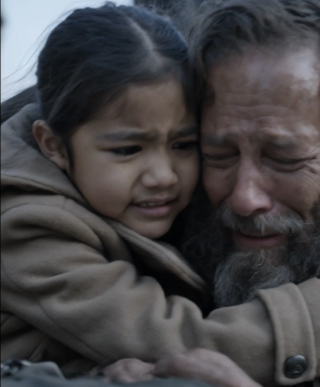
She threw herself over Henry’s back. Both arms wrapped around his hunched shoulders, her small face pressed against his dirty coat. She was shaking — full-body trembling — but she did not move.
Girl: “STOP IT! YOU’RE HURTING HIM!!”
The laugh died.
It didn’t fade — it died. Like something had reached into the air and switched it off. The three boys stared at the child draped across the old man like a human shield, and for three full seconds not one of them moved or spoke.
Red Hoodie recovered first. He shifted his weight, jaw tightening, and there was something in his eyes that wasn’t quite cruelty anymore but wasn’t kindness either. Something unsteady.
Red Hoodie: “Move, kid. This isn’t your business.”
The girl lifted her head. Her face was wet — tears streaming freely — but her eyes were steady in a way that made no sense for someone her age. She looked at him the way only children and very old people look at things: directly, without strategy.
Girl: “He’s not trash.”
Her voice dropped to a whisper on the last word. The street noise — buses, footsteps, a distant radio — seemed to go quiet around it.
Girl: “You are.”
No one breathed.
Grey Jacket took a small step backward. Not a retreat — just a shift, unconscious, like a body responding to gravity before the mind catches up. He was still holding the photograph. His grip on it loosened.
Henry hadn’t moved. His forehead was still near the ground, but one of his trembling hands had found the girl’s small arm, and his fingers had closed around her wrist — not to pull her away, but to hold on. The way a drowning man holds onto the one thing keeping him above water.
Red Hoodie’s jaw worked. He wanted to say something. Whatever it was, it didn’t come. He looked at his friends. His friends looked at the ground.
In the crowd that had gathered — the same crowd that had walked past for five minutes — a woman put her hand over her mouth. A man in a business suit stopped mid-stride and stood very still, as if suddenly aware of the weight of his own inaction. A teenager recording on his phone slowly lowered it.
None of them had stopped the cruelty.
A five-year-old girl had.
Grey Jacket looked down at the photograph in his hand. He stared at it for a long moment — the faded faces of a family, some old birthday, a backyard somewhere, a version of Henry that existed before the world took everything. He bent down and placed it carefully on the ground next to Henry’s hand.
He didn’t say anything. None of them did.
They left.
The girl stayed. She pressed her face into Henry’s shoulder and kept her arms around him while he wept — long, heaving sobs that seemed to come from somewhere deeper than sadness. The kind of crying that happens when someone has been alone in their pain for so long that a single moment of human warmth becomes unbearable.
The woman who had covered her mouth walked forward. Then the man in the suit. Then others — slowly, hesitantly, the way people move when they’re ashamed and trying to correct it.
Someone brought water. Someone else knelt down and began gathering the scattered belongings back into the torn bag. No one spoke. There was nothing to say.
A five-year-old girl had already said the only thing that mattered.
Later — when the little girl’s mother finally found her, breathless and frantic — she grabbed her daughter by the shoulders and demanded to know why she had run into the middle of strangers like that. Why she had put herself in the middle of something dangerous. Why.
The girl looked up at her, completely confused by the question.
Girl: “Because he was crying, Mama.”
As if that explained everything. As if it always had.
In the video — posted that evening by the man who had lowered his phone — the comment that got the most likes, shared over four hundred thousand times in 48 hours, simply read:
“A child reminded a city what it means to be human. I am ashamed it took her.”
