The rain had been falling since dawn, as though the sky itself had decided to mourn.
Père-Lachaise cemetery — Paris — wore its grief in stone and shadow. Black umbrellas crowded the hillside like a field of dark flowers. Two hundred people had come to bury Isabelle Moreau, thirty-four years old, dead of what the certificate called cardiac arrest and what nobody had yet dared call anything else.
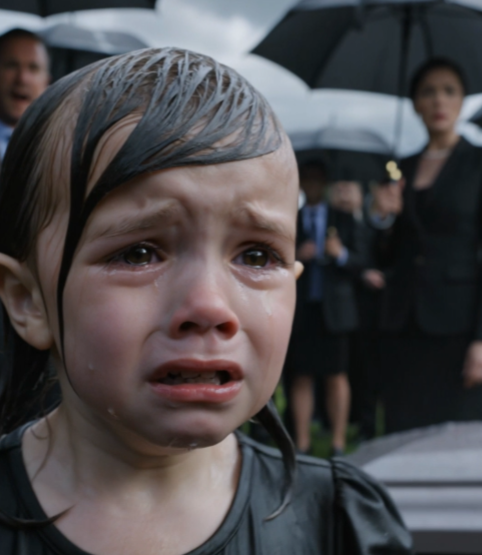
Her daughter stood at the edge of the grave in a dress that was already soaked through.
Five years old. No umbrella. Nobody had thought to give her one, or perhaps she had refused — the way children sometimes refuse comfort when comfort feels like a lie.
Her name was Léa. And she was staring at the coffin the way only a child can stare at something they don’t yet have the words to survive.
The priest was midway through his blessing when it happened.
The cry came from somewhere beneath language — raw, animal, the sound a small body makes when it finally breaks open under the weight of something too enormous for it to carry alone.
“WHO KILLED MY MOM?!”
Two hundred people stopped breathing simultaneously.
The priest’s hand froze mid-gesture. An elderly woman’s rosary slipped from her fingers into the mud. A man near the back of the crowd took one involuntary step backward, as though the question itself had physical force.
Léa’s face was entirely wet — rain and tears indistinguishable now, running together down her chin, dripping from her jaw onto her black dress. Her small chest heaved. Her hands were balled into fists at her sides.
She turned.
Slowly. With a deliberateness that no five-year-old should possess.
Her arm rose. Her finger — trembling, tiny, devastatingly certain — pointed through the rain.
At Dominique.
Isabelle’s former husband’s new wife. Forty-one. Dressed immaculately in structured black. Standing beneath a dry umbrella with the composed expression of a woman who had rehearsed this day.
Until now.
“IT WAS YOU!!” Léa screamed. “YOU KILLED HER!!”
Someone dropped an umbrella. It hit the wet ground with a sound like a gunshot.
The crowd didn’t move. Didn’t speak. Two hundred people held the same suspended breath, eyes moving between the tiny girl in the rain and the well-dressed woman going very, very still beneath her umbrella.
Dominique’s jaw tightened. Something shifted behind her eyes — fast, controlled, immediately suppressed.
“That’s not true,” she said, her voice clipped and precise. “I didn’t do anything.”
“I HEARD YOU.” Léa’s voice broke on the words but she didn’t stop. She stepped forward — one step, through the mud, toward the woman twice her height. “I heard you. That night.”
The whispers moved through the crowd like current through water.
“What night?” A woman near the front murmured to her husband.
“Which night is she talking about?” someone else said.
Dominique took one step forward. Her voice dropped — low enough to be intimate, sharp enough to cut. “Léa. You are a child. You don’t understand what you heard.”
“I’m not stupid,” Léa said. And the steadiness in it — the terrible, grief-soaked calm of a child who has been told too many times that she doesn’t understand — silenced the murmur completely. “You said if she didn’t stop, she would regret it. You said that. I was on the stairs.”
Dominique’s face flickered. “That was an argument. People argue. It doesn’t mean—”
“Three days later she died.”
The rain intensified. It hammered the umbrellas, turned the gravel path to rivers, plastered Léa’s dark hair flat against her small skull. She didn’t blink. She didn’t look away from Dominique’s face.
A man near the grave shifted his weight. An older woman covered her mouth.
Dominique stepped closer, her voice now barely above the sound of rain, controlled in the way of someone gripping something very tightly. “You need to stop this. Right now. Your mother had a heart condition. Everyone knew—”
“She didn’t have a heart condition.” The voice came from behind the crowd.
Heads turned.
A man in a dark coat stood at the cemetery gate — tall, unshaven, with the particular look of someone who had driven a very long way without stopping to sleep. In his hand, a manila envelope. Water was already bleeding through the paper.
He walked through the parting crowd without looking at anyone except Dominique.
“Philippe,” she said. Her composure cracked for the first time — just at the edges, just enough. “What are you doing here?”
“She called me,” Philippe said. “Two weeks before she died. She called me and she was terrified.” He held up the envelope. “And she sent me this. Medical records. Tox panel. Private lab.”
The murmur that moved through the crowd now was different — lower, darker, the sound of a collective understanding beginning to form.
“You have no right—” Dominique started.
“She had digitalis in her blood,” Philippe said. “Three times the therapeutic level. Isabelle didn’t have a heart condition. She had a husband who didn’t notice. And she had you.”
The silence that followed was the loudest thing anyone in that cemetery had ever heard.
Dominique’s umbrella tilted. Rain hit her shoulder. She didn’t fix it.
Léa stood in the downpour, staring at the woman who had come to bury her secret alongside her mother. The little girl’s finger was still raised.
“She knew,” Léa whispered. “Maman told me. She said — she said if anything happened to her, I should remember what I heard on the stairs.”
She turned to look at the coffin.
“I remembered, Maman,” she said softly. “I remembered everything.”
The rain fell harder. Nobody moved.
And Dominique, for the first time since she’d arrived, had absolutely nothing left to say.
