The city didn’t slow down for anybody.
That was the first thing you learned on these streets — the luxury cars kept moving, the suits kept walking, the world kept turning its expensive face away from anything that couldn’t afford to be seen. Midday heat pressed down on the boulevard like a hand on a shoulder, and the dust rose in small clouds from the pavement and settled on everything equally — on the black finish of the parked Mercedes, and on the bare feet of the boy standing next to it.
His name was Mateo. Eight years old. Barefoot on burning asphalt.
He hadn’t touched the car. He’d only been standing near it, in the thin strip of shade it cast, because the shade was free and the sun wasn’t kind.
That was his crime.
The car door slammed like a thunderclap.
The man who came out of it wore a suit that cost more than most people in this neighborhood made in a year — charcoal grey, perfectly pressed, the kind of fabric that didn’t understand sweat. His face was already arranged into disgust before he’d fully registered what he was looking at.
“GET AWAY FROM MY CAR!!”
Mateo flinched so hard he nearly fell. His whole body contracted — shoulders up, chin down, the practiced reflex of a child who has learned that loud voices come before pain.
He scrambled back two steps, three, his cracked heels scraping against the hot pavement.
The man — Édouard, though no one on this street knew his name and he had no interest in theirs — reached into his jacket pocket with the impatient energy of someone solving a problem. He pulled out a fold of bills, peeled one loose, and threw it.
Not handed. Threw.
The hundred-dollar bill fluttered through the dusty air and landed in the dirt near Mateo’s feet. It settled against a crack in the pavement, crisp and clean against everything around it.
“Take it and disappear,” Édouard said. The tone was the worst part — not even anger anymore. Dismissal. The sound of a man resolving an inconvenience.
Mateo stared at the bill.
His lips were cracked and dry. His face was layered in the particular grime of a child who has been sleeping outside, the kind that settles into the lines around your eyes and the creases of your knuckles. His shirt had a tear across the shoulder that had been there so long it had frayed into something softer.
He didn’t move.
“What are you waiting for?!” Édouard’s patience — what little there had been — evaporated. “Take it!”
Mateo’s eyes shifted.
Not to the man. Not to the money.
To the girl.
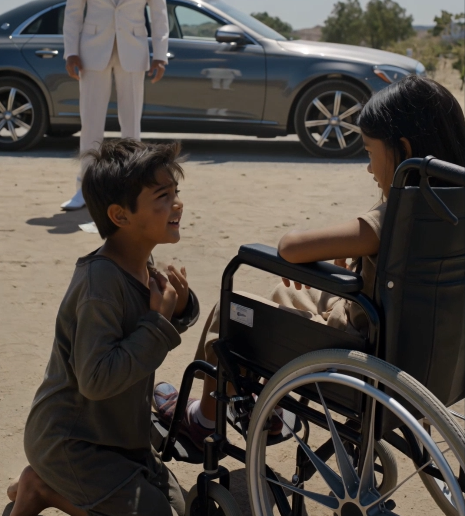
She was sitting twenty feet away, at the edge of the pavement where the shade from a closed shopfront reached the farthest. Her wheelchair was old — the kind that had been repaired more than once with mismatched parts — and she sat in it with the stillness of someone who had learned to occupy exactly the space she was given and no more.
Her name was Sofia. She was seven. She had been watching the whole thing with eyes that were too old for her face, filled with something that wasn’t quite pity and wasn’t quite fear — the particular sadness of someone who recognizes a situation because they have lived inside one like it.
Their eyes met.
In the middle of the boulevard noise, in the heat and dust and the impatient presence of a man in an expensive suit, Mateo and Sofia looked at each other.
He looked at the money.
He looked at her.
He looked at the money again.
“I’m not asking twice,” Édouard said. “Pick it up or I’m walking away and you get nothing.”
A long second passed.
Then Mateo stepped back.
Away from the bill. Away from the shade. Away from the hundred dollars lying in the dirt.
He walked toward Sofia instead.
The small gasp that moved through the half-dozen bystanders who had stopped to watch was involuntary — the sound people make when something surprises them into feeling something they hadn’t planned to feel today.
Édouard’s expression cracked. “What—” He actually turned to look at where the boy was going, as though the possibility hadn’t occurred to him. “Hey. Hey! The money is right there.”
Mateo didn’t look back.
He reached Sofia and crouched down in front of her wheelchair, bringing his face level with hers. Up close, she could see how his hands were shaking — he was still frightened, the fear hadn’t gone anywhere — but he looked at her and forced the corners of his mouth up into something small and real and deliberately ridiculous.
He crossed his eyes.
Sofia blinked.
He waggled his eyebrows. Made his hands into claws and did a silent monster impression, then immediately made himself look terrified of his own hands.
Something moved in Sofia’s face — a reluctant softening, the way frozen things thaw, slowly and then all at once.
She laughed. Barely — just a breath, just a small collapse of the careful stillness she’d been holding. But it was there.
“There it is,” Mateo said softly.
Behind him, Édouard hadn’t moved. He was staring — the hundred-dollar bill still on the ground, unclaimed, irrelevant — at a barefoot, filthy, frightened child making a little girl in a wheelchair laugh in the midday heat.
Something was happening in his face that he would not have been able to name. The architecture of his expression — the contempt, the impatience, the efficient cruelty of a man too busy to be human — was coming apart at a structural level.
“Why,” he said. The word came out strange — stripped of its usual authority, almost genuinely confused. “Why didn’t you take it?”
Mateo looked up at him over his shoulder.
His voice, when it came, was barely above a whisper. Quiet enough that the people nearby had to lean in. Quiet enough that the street noise seemed to dim around it.
“She needed it more than me.”
Édouard stood in his perfect suit on the dusty boulevard and could not think of a single word to say.
The hundred-dollar bill shifted slightly in the hot urban wind.
Nobody picked it up.
