The hand came down like a hammer.
It caught Roy Harris on the shoulder and shoved — hard, deliberate, the kind of force a man uses when he wants everyone in the room to know he isn’t afraid of anything. The coffee cup jumped. Dark liquid sloshed across the scratched Formica, pooling around Roy’s saucer, dripping off the edge of the table onto the floor.
The diner smelled like bacon grease and burnt toast and the particular tension that fills a room right before something goes very wrong.
Roy didn’t move. He set his fork down slowly. Parallel to his plate. The way his father had taught him.
Then he lifted his eyes.
The trucker’s name, Roy would later learn, was Dean Cutter. Six-four, two-eighty, with hands the size of dinner plates and the particular confidence of a man who had never once been told no by anyone who meant it.
He was leaning over Roy’s booth now, one hand still gripping the shoulder of an old man in a plain canvas jacket, smirking at the room like it was a performance.
“You think you own this place, old man?!”
Roy looked at the hand on his shoulder. Then up at the face attached to it. His expression didn’t change. His voice came out quiet and flat and absolute.
“Take your hand off me.”
Dean laughed — a short, ugly sound that filled the diner.
“Or what?” He leaned in closer. “Huh? Or what, old man?“
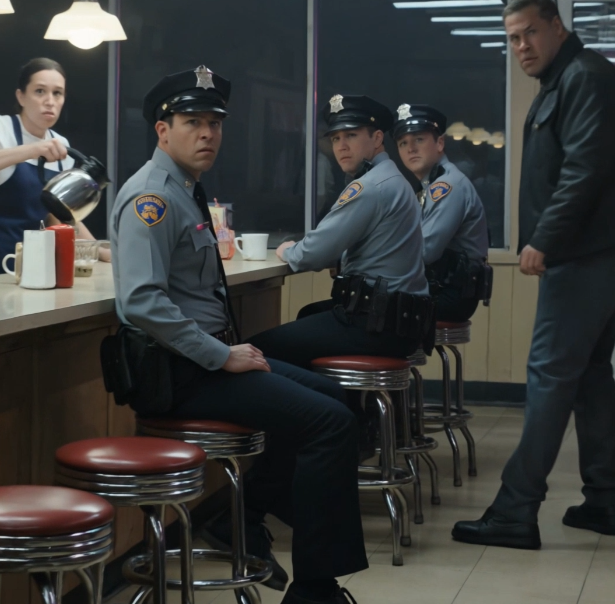
At the counter, four highway patrol officers had been halfway through their lunch. They turned in unison — not quickly, but completely. The way men turn when their training kicks in before their brain does.
One of them, youngest of the four, a kid named Torres who’d been on the job eleven months, leaned toward the officer beside him.
“You know that guy?” he murmured.
The older officer — Reyes, twenty-two years on the road — was already watching Roy’s hands.
“Not sure,” Reyes said slowly. “But I know that look.”
Dean Cutter had the room now, and he knew it. The waitress had stopped mid-pour. A family in the corner booth had gone perfectly still. The cook had appeared in the kitchen window.
Dean pulled Roy’s shoulder again — harder this time.
“I’m talking to you. I was sitting at that table yesterday and I left my jacket. Your waitress gave it away. You’re the manager, right? You’re going to compensate me or I swear to—”
“I’m not the manager,” Roy said.
“Then what are you?” Dean’s voice dripped contempt. “Some retired nobody taking up space?”
Roy looked at him for a long moment.
Then, without any hurry, he reached into the inside pocket of his canvas jacket.
Dean tensed — and then relaxed when he saw it wasn’t a weapon. Just a small leather wallet, worn smooth at the edges.
Roy set it on the table.
The badge caught the fluorescent light and held it.
Silver star. Center cut. Texas Ranger.
The diner went so quiet you could hear the coffee dripping off the table onto the linoleum.
Torres was already off his stool. Reyes was right behind him, one hand moving on instinct to his belt. The other two officers rose without a word, moving into position the way water finds its level — naturally, inevitably, with no wasted motion.
Dean Cutter stared at the badge.
Then at Roy.
Then at the four uniformed officers now standing in a loose line between him and the door.
“Wait.” His voice cracked on the word. “Wait — what—”
“Remove your hand,” Roy said, “or Torres there is going to do it for you.”
Dean’s hand came off Roy’s shoulder like it had burned him.
“I didn’t — I didn’t know—” He took a step back. His boots caught on a chair leg and he grabbed the edge of the counter to keep from going down. “I was just — it was about a jacket, I wasn’t trying to—”
“You put your hands on me twice,” Roy said. He picked up his coffee cup. What was left of the coffee. He took a slow sip. “In front of four peace officers and a diner full of witnesses.”
“I didn’t know who you were—”
“That,” Roy said, “is not a defense.”
Torres had his notepad out. The youngest officer in the room, and his hand wasn’t shaking even slightly.
“Sir,” Torres said to Dean, in the careful tone of someone choosing every word on purpose, “I’m going to need your name, your CDL, and your plates. And I’m going to need you to keep your hands where I can see them.”
Dean’s face had gone the color of old concrete.
“This is — this is insane. I was just — the jacket—”
“The jacket,” Reyes said from the left flank, arms crossed, “is not the issue anymore.”
Outside, through the diner’s wide front windows, red and blue light had begun strobing across the parking lot. Someone had called it in — the waitress, probably, or the family in the corner who had their phone out before Dean’s hand had even landed.
The light moved across Roy’s face in slow pulses. He didn’t look at it. He set his cup back down, folded his napkin, and looked at Dean Cutter with the particular patience of a man who has outlasted a hundred men who thought they were the most dangerous thing in the room.
“Son,” Roy said quietly, “I have been a Ranger for thirty-one years. I have put away men who would make you reconsider every bad decision you’ve ever made.” He paused. “You just assaulted a peace officer in front of four witnesses.”
Dean’s mouth opened.
Nothing came out.
“Sit down,” Torres said gently. “This is going to take a while.”
Roy picked up his fork.
His eggs had gone cold. He ate them anyway.
Some days that’s just how it goes.
