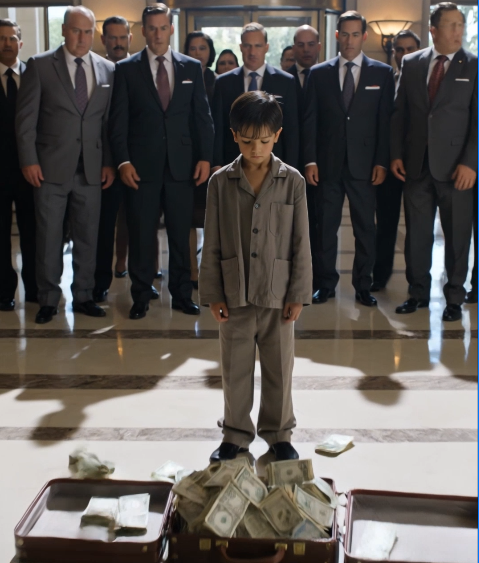
The lobby of the Hôtel Imperial was the kind of space designed to make you feel small in a way that felt like a compliment — forty-foot ceilings, marble floors the color of cream, light pouring through arched windows that faced the boulevard like eyes that had seen everything and been impressed by none of it. Men in tailored suits moved through it with the unhurried confidence of people who had never once been asked to wait.
The boy had been asked to wait his whole life.
He was maybe eleven. His jacket was clean but worn at the elbows, his shoes a half-size too small in the way you can tell from how a person shifts their weight. He was standing in the center of the lobby holding a wheeled suitcase that was too large for him, both hands gripping the handle, chin up, eyes moving across the space with the careful attention of someone memorizing an environment they’ve never been in before and might need to navigate fast.
Nobody looked at him.
Then the suitcase gave.
The clasp didn’t break so much as surrender — a sudden mechanical failure, the zipper splitting from one end to the other in under a second, and the sides of the suitcase falling open like something exhaling.
The sound of cash hitting marble is not what you expect. It’s not dramatic. It’s a soft, papery chaos — bills fanning out, sliding, catching the air from the lobby’s climate system and drifting in directions that don’t make sense, twenties and fifties and hundreds scattering across forty square feet of polished floor in the time it takes to blink.
For exactly one second, the lobby froze.
Then it didn’t.
“What the—” “Grab it—” “Is that real?” “Someone call—”
The crowd moved the way crowds move toward money — instinctively, not always honorably, the veneer of civilization thinning immediately at the edges. A man in a business suit actually crouched. A woman in heels took two quick steps forward before catching herself. A bellhop dropped a luggage cart.
The boy stood in the center of it, completely still.
Not frozen — still. The deliberate stillness of a person who has been told exactly what to do in this moment and is doing it.
He didn’t chase the money. Didn’t cry. Didn’t call for help.
He reached into his jacket pocket and held an envelope against his chest with one hand, and with the other he simply waited.
“Hey — kid.” A security guard pushed through the edge of the gathering crowd. “Is this yours? Where are your parents?”
“I’m waiting for someone,” the boy said.
“You can’t just — there’s cash everywhere, you need to—”
“I’m waiting for someone,” he said again. Calm. Absolute.
The guard looked at him, then at the money, then at him again, and made the calculation that this situation was above his specific authority level.
Then the crowd shifted — not randomly, but in the particular way crowds shift when someone with sufficient presence moves through them.
The man who came through was fifty, or looked it — the kind of fifty that comes from two decades of serious money and the specific stress that accompanies it. Dark suit, no tie, silver at the temples, the bearing of a man who had not been surprised by anything in a very long time. His name, if anyone in the lobby had known to ask, was Édouard Cassian — founder of Cassian Capital, owner of the top four floors of this hotel, a man whose name appeared in the financial press with the regularity of weather.
He had been crossing the lobby toward the elevator when the suitcase had burst. He had stopped. Watched. And now he was moving toward the boy with an expression that wasn’t concern or irritation but something more focused than either.
He stopped in front of him.
The crowd had pulled back slightly, the way crowds do around people they recognize as centers of gravity.
Édouard looked at the boy.
The boy looked back at him without flinching.
Then the boy reached into his jacket and held out the envelope.
“My mother said to give this to you.”
His voice was quiet but clear — the voice of a child who has rehearsed something important and is now performing it as perfectly as he can.
Édouard looked at the envelope. He didn’t take it yet. “Who is your mother?”
“She said you’d know. She said I shouldn’t say her name here.” He paused. “She said just give you this. And tell you one thing.”
“What thing?”
The boy held his gaze.
“She said,” he began, “that you’d remember the fire.”
The change in Édouard’s face was not subtle. It moved through him visibly — starting at his jaw, which tightened, then his eyes, which widened in a way that his money and his position and his thirty years of controlled presentation could not prevent. His breath audibly stopped. For three full seconds he was simply a man standing in a lobby who had just been handed something he thought he had buried.
“What did you say?” His voice had dropped to something barely above a whisper.
“The fire,” the boy repeated. “She said those three words and she said you’d understand.”
“How old are you?”
The question came out strangely — not parental concern, but something more desperate. Arithmetic behind the eyes.
“Eleven,” the boy said. “In March.”
Something crossed Édouard’s face that the crowd — still watching, still hovering at the edges — could not have named, because it was private in the way that only the heaviest things are private.
“What’s your name?” he asked.
“Lucas,” the boy said. Then, after a beat: “My mother says I have her eyes. But everyone tells me I don’t.”
Édouard’s hand came up and took the envelope.
It was shaking.
Not slightly — visibly, the tremor of a large man encountering something his body doesn’t know how to carry. He looked at it — cream-colored, sealed, his first name written on the front in handwriting he recognized the way you recognize something you’ve tried not to think about for over a decade.
“When did she give you this?”
“Three days ago,” Lucas said. “Before she went to the hospital.”
“Which hospital?”
“She said not to tell you that either. Not yet.” Lucas’s voice was steady but his hands, at his sides, had balled into fists — the only sign that he was not as composed as he appeared. “She said give you the envelope first. Let you read it. And then—” He stopped.
“And then what?”
“She said you’d either come,” Lucas said, “or you wouldn’t.”
The lobby had noise in it — the cash being quietly collected by staff, the murmur of bystanders, the distant sound of the revolving door — but around these two, the particular silence of consequence had settled.
Édouard looked at the envelope in his shaking hand.
His thumb moved to the seal. Pressed against it. Stopped.
He looked at the boy again — at his eyes, specifically, the way you look at something you’re trying to place, trying to match against a memory that has been living in a locked room for eleven years.
“She should have told me,” he said. Not to Lucas. To himself, or to the envelope, or to a version of a night twelve years ago that had apparently not stayed as buried as he’d believed.
“She said you’d say that,” Lucas replied quietly.
Édouard’s eyes snapped up.
“She said — and these are her words, I memorized them — she said: ‘He always thinks he should have been told. He never thinks about why I couldn’t tell him.'”
The silence that followed had weight.
Édouard Cassian — fifty years old, founder of Cassian Capital, a man who had not been surprised by anything in a very long time — stood in the lobby of his own hotel holding an unopened envelope with a trembling hand.
And Lucas stood in front of him, jacket worn at the elbows, shoes half a size too small, chin up, eyes steady.
Waiting to find out which kind of man was standing across from him.
