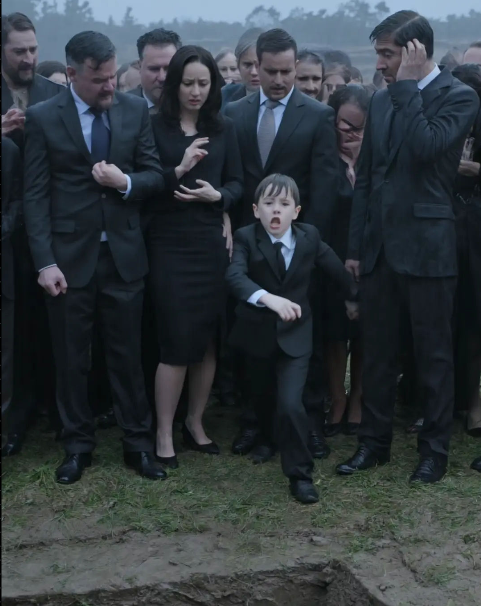
The rain had been falling since dawn.
By the time they carried Thomas Reeves to his place in the ground, the cemetery path had turned to a dark ribbon of mud, and the umbrellas of forty mourners formed a black canopy over the hillside that shuddered in the wind. The priest read from a laminated card because the paper would have dissolved. The flowers on the coffin had already lost their shape.
It was the kind of weather that felt intentional.
Like the sky had been informed.
His name was Callum. He was seven years old, and he had been standing beside his grandmother for eleven minutes with his hand in hers and something enormous locked behind his teeth.
He had been holding it since the hospital room three days ago. Since the moment Thomas Reeves — the man whose last name Callum carried, whose photograph hung in the hallway, whose voice he heard every morning saying good morning, son — had taken his small hand between both of his and told him the truth.
All of it.
The hand let go.
Callum ran.
He crossed the wet grass before anyone understood what was happening — before his grandmother could process the sudden absence of weight in her palm, before his mother could turn from the graveside, before the priest could lift his eyes from the laminated card.
He hit the coffin with both arms and held on.
“Don’t close it!” The scream tore out of him and into the rain. “He’s not my father!”
The gasps came from everywhere.
The priest stopped.
The wind kept moving.
Elena Reeves reached her son in seconds. She grabbed his shoulders with both hands — not gentle, because there was no time for gentle, because forty people were standing in a semicircle with their mouths open and the cameras were probably already out and this was the worst possible moment for the worst possible truth to choose to surface.
“Callum.” Her voice was shaking. “Stop this. Stop it right now.”
“You lied to me!” He twisted in her grip, fingers still white on the coffin edge. His face was a wreck of rain and tears, red and open and absolutely certain. “You lied to me my whole life!”
“Callum, please—”
“He’s not my father!” He said it again, louder, as if volume could make the crowd understand what he needed them to understand. “He told me! Three days ago he held my hand and he told me everything and you’ve been lying — you and — and—”
He stopped.
He turned.
Dominic Farrell had positioned himself at the back of the gathering. He had been doing that his entire adult life — positioning himself at the edges of rooms that belonged to other people, attending events he had no clean right to attend, maintaining the careful distance of a man who has made a particular choice and constructed an entire life around the maintenance of it.
He was forty-four years old. He had good shoes and a good suit and a face that people described as trustworthy, which had always struck him as the cruelest possible irony.
He saw the boy turn toward him.
He saw the arm rise.
He had approximately one second to prepare, and one second was not enough.
“Tell them!” Callum’s voice broke on the word and kept going. “Tell them who my real father is!”
The crowd turned in unison.
Dominic Farrell’s face did something he had no control over — it moved through shock and recognition and a drowning shame, and then it tried to go neutral and failed completely.
Forty people watched him fail.
“Callum.” His voice came out carefully. Too carefully. The voice of a man choosing every syllable. “This isn’t — this is not the place for—”
“Then where?” The boy’s arm was still pointing. Still shaking. “Where is the place? Tell me where the place is and I’ll go there. I’ll go anywhere. I just want you to say it. Just once. Just say it out loud.”
Dominic opened his mouth.
Nothing came out.
Elena’s knees hit the mud.
Not a collapse — a surrender. Something went out of her legs all at once, and she went down between the coffin and the open grave, her black coat soaking through instantly, her hands pressing flat against the wet ground.
She was crying in a way that had no performance in it. No management. The kind of crying that happens when the thing you have spent years preventing finally arrives and you understand, in the moment of its arrival, that preventing it was the only thing holding you together.
“Elena.” An older woman reached toward her. “Elena, what is he—”
“Don’t touch me.” Her voice came up from somewhere far below. “Please. I just — I need a minute. I just need—”
“Mom.” Callum’s voice changed when he looked at her. The anger didn’t leave, but something else moved in alongside it. “Mom, he told me everything. He said you knew. He said you always knew.”
“I know.” She pressed her hands harder against the ground. “I know what he told you.”
“Then why?” The word cracked in half. “Why didn’t you—”
“Because I was afraid.” She lifted her face. Her mascara was gone, her hair was flattened against her cheeks, and she looked, in this moment, exactly like what she was: a person who had made a decision in fear and spent seven years paying for it in a currency she hadn’t understood at the time. “I thought if the truth came out, everything would — I thought I would lose everything.”
“You should have told me.” Callum’s voice dropped to something quiet and devastating. “He was dying and he still told me the truth. You had seven years.”
The rain came down harder.
The sound of it on the coffin was the loudest thing in the cemetery.
And then the priest — who had been standing in stunned silence, still holding his laminated card — took one step forward and looked down.
The coffin lid had shifted when Callum threw himself against it. Just slightly. Just enough to show a narrow gap along one edge.
Through that gap, visible in the dead man’s folded hands — an envelope. Cream colored. Sealed with wax. Dark at the edges already from the rain seeping through.
For Callum was written on the front in Thomas Reeves’s careful, deliberate hand.
To be opened when the time comes. You’ll know when.
The crowd saw it.
Callum saw it.
He walked to the coffin slowly this time. He reached through the gap. His small fingers closed around the envelope, and he pulled it out carefully — reverently — and held it against his chest with both arms the way you hold something you’ve waited for without knowing you were waiting.
“He told me before he died,” Callum said. Not screaming now. Just stating. A child reporting a fact to a world that had been operating on a different set of facts. “He said I deserved to know who I was.”
Elena closed her eyes.
“I begged him not to tell you.” Her voice was barely a sound above the rain. “I begged him.”
Callum looked at the envelope in his hands.
Then at the man in the black suit, who still hadn’t moved, who was standing at the edge of the gathering with forty pairs of eyes on him and no version of this moment that led anywhere good.
“Did you know?” Callum asked him. Direct. Simple. “About me. Did you know I existed?”
The rain filled the silence where Dominic Farrell’s answer should have been.
And in that silence, everyone present got their answer.
