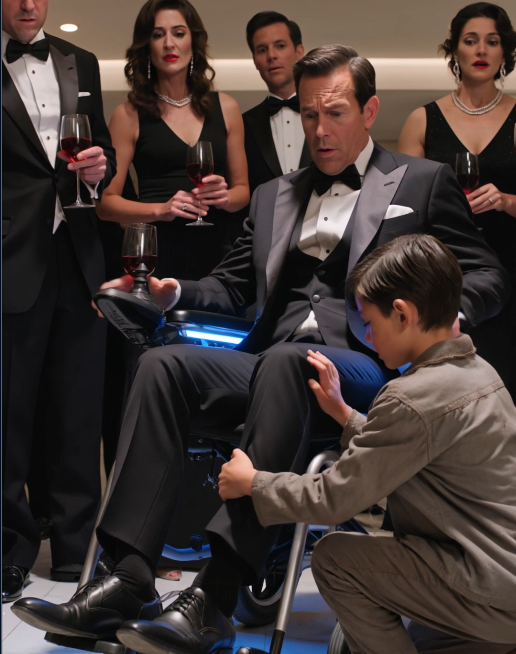
The party had cost forty thousand dollars.
That was the number Harrison Blake’s assistant had quoted him when he signed off on it — forty thousand for the penthouse rental, the catering, the bar that ran open all evening, the string quartet that nobody was really listening to. Forty thousand to celebrate the fifth anniversary of Meridian Technologies, which had made Harrison Blake very rich and had taken, three years ago on a rain-slicked highway outside Denver, the full use of his legs.
He did not enjoy parties.
He attended them because Harrison Blake in a wheelchair at a party was still more useful to Meridian than Harrison Blake in a wheelchair at home, and usefulness was the one currency he had never stopped counting.
He was midway through a glass of Château Margaux when the boy walked in.
Nobody stopped him.
That was the first strange thing. There were two security personnel at the elevator and a guest list with forty-three names on it and a door that was supposed to stay closed to everyone else. But the boy came in through the service entrance — the one the catering staff used, the one that was sometimes left propped open between deliveries — and by the time anyone registered his presence, he had already crossed half the room.
He was maybe ten years old. Barefoot, which was immediately wrong in a space with this kind of flooring. His clothes were the clothes of a child who had been outside for a long time in weather that didn’t care about him. His hair needed attention. His face was dirty in the specific way of children who wash when they can and not when they can’t.
He walked without hesitation.
The guests noticed him in sequence — a ripple of confused attention moving through the room as he passed, heads turning, conversations halting mid-sentence. The string quartet kept playing for four more bars and then trailed off, the violinist losing her place.
The boy stopped in front of Harrison Blake’s wheelchair.
He looked up at him with dark, steady eyes and said, with the complete calm of someone who has rehearsed this and has also moved beyond needing the rehearsal:
“Sir. I can fix your legs.”
Harrison Blake looked at him over the rim of his wine glass.
The silence lasted two seconds.
Then, from somewhere to his left, came a short, polished laugh — Devin Park, his CFO, who had a Harvard MBA and the social instincts of a man who had never once been uncomfortable in a room.
“Security,” Devin said, not urgently, the way you’d ask someone to remove a coat from a chair.
“Wait.” Harrison raised one finger.
Devin stopped.
Harrison looked at the boy.
“How old are you?” he asked.
“Ten.”
“And you can fix my legs.”
“Yes sir.”
“My spinal cord has been partially severed for three years.” Harrison’s voice was even. He had had this conversation — or versions of it — with three neurosurgeons, two experimental treatment teams, and one man in Zurich who had charged him sixty thousand dollars and done absolutely nothing. “Two hospitals, four specialists. My physiotherapist visits every Tuesday and Thursday. What makes you think—”
“I don’t think,” the boy said. “I know.”
Another laugh from the crowd. Quieter this time. People were less certain now about what register this was pitched in.
Harrison studied the boy’s face.
He had built a company worth four hundred million dollars on his ability to read people — to assess, in under a minute, whether someone was real or performing. It was the skill that had served him more than any other. More than the degrees, more than the connections, more than the money.
He looked at this child.
This barefoot, dirty, completely uninvited child who had walked through a catered party without permission and was standing in front of his wheelchair with steady hands and steady eyes and not a single tremor of uncertainty in his voice.
Harrison set his wine glass down on the arm of the wheelchair.
“Five seconds,” he said.
“That’s all I need,” the boy said.
Devin Park moved forward. “Harrison, you can’t possibly—”
“I said wait.” Harrison didn’t raise his voice. He never raised his voice. “Clear some space.”
The guests around them stepped back — some reluctantly, some with the barely concealed excitement of people watching something they can’t categorize.
The boy knelt.
The room went quiet the way rooms go quiet when something has shifted and nobody can yet identify what.
He placed both hands on Harrison Blake’s legs. Not on the knees — lower, along the calves, with a specific pressure and a specific positioning that was nothing like the practiced touch of the physiotherapist and everything like someone who knew exactly where to put their hands.
His eyes closed.
His lips moved slightly. No sound.
Harrison felt something.
He would spend a long time afterward trying to describe it to people who asked — trying to find the right language for a sensation that didn’t have language yet. The closest he could get was this: like a current. Like something that had been interrupted finding its path again. Like a wire reconnecting.
His right foot moved.
He looked down.
His right foot had moved.
He had not moved his right foot in three years.
“What—” His voice came out wrong. Stripped. “What are you—”
“Don’t talk,” the boy said quietly. “Just stand up.”
“I can’t—”
“Mr. Blake.” The boy looked up at him. His dark eyes were calm. “Stand up.”
Harrison’s hands went to the armrests.
His body remembered this. Somewhere below the injury, below the three years of accommodating and adapting and relearning what was possible, his body remembered the mechanics of standing up.
He pushed.
His legs took the weight.
They shook — badly, the way legs shake after long disuse, trembling under the unaccustomed demand — but they held. He was standing. Both feet on the floor, the penthouse party around him, forty guests and a string quartet and a view of the city at night behind the floor-to-ceiling windows.
He was standing.
The wine glass slipped from the arm of the chair.
It hit the marble floor and shattered, and the sound of it broke the silence open completely — gasps from everywhere at once, someone saying oh my God, the CFO making a sound that wasn’t a word.
Harrison stood and looked down at the boy, who was still kneeling, still calm, looking back up at him with an expression that was not surprise.
Not triumph.
Just — relief.
Like something that had needed to happen had finally happened.
“How?” Harrison’s voice was barely functional. “How did you do that? Who are you? Where did you—”
“My name is Owen,” the boy said. He stood up. He was small, standing next to Harrison, but he held himself like someone who had no reason to make himself smaller. “You knew my father. He worked for your company.”
Harrison stared at him.
“He was in the building,” Owen said. “The Denver office. The night of the accident. He was working late.” A pause. “He didn’t make it.”
The room had gone so quiet that the city noise through the windows was audible — the distant sound of a city that kept going regardless.
“Owen.” Harrison’s voice was fractured. “I didn’t — I never knew he had a son. I tried to reach everyone’s families and I thought—”
“We moved,” Owen said simply. “My mom moved us after.” He looked at Harrison’s legs — standing, shaking, real. “He used to talk about you. He said you were a good man.” Another pause. “I wanted to know if he was right.”
Harrison Blake stood in the ruins of his wine glass and looked at this barefoot child who had walked uninvited into his party and given him back something he had accepted losing — and understood, with the precision of a man who had built his life on accurate assessments, that he was looking at a debt he could never fully repay but was absolutely going to try.
“Stay here,” he said. His voice came out rough and certain. “You’re not going anywhere tonight. Neither is your mother, wherever she is. Do you understand me?”
Owen looked at him.
“My dad said you were a good man,” he said again.
This time it sounded like a verdict.
