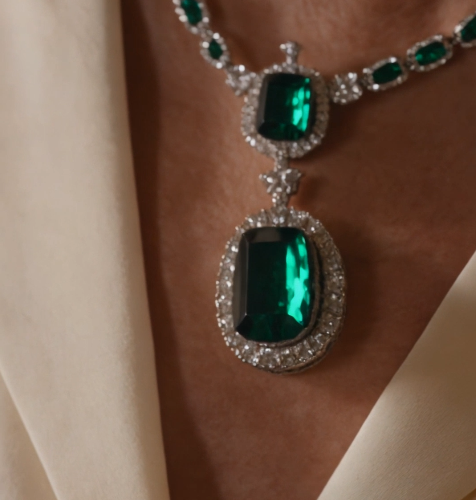
She had almost not worn it today.
That was the thing Margaret Ellison would think about afterward — standing in front of her mirror that morning, the emerald pendant cool against her fingers, telling herself it was too formal for a Tuesday, that the cream blouse didn’t need jewelry, that she should put it back in the velvet box where it had lived for thirty-one years.
She put it on anyway.
She never did understand why.
Clara had been working in the Ellison house for four months.
She had found the position through an agency that placed young women in domestic work — cooking, cleaning, the quiet maintenance of wealthy lives. The pay was fair. The hours were long. The house was beautiful in the way of things that have been expensive for so long they’ve forgotten they needed to try.
She was twenty-three years old. She had grown up in Saint Catherine’s Home for Children in rural Vermont, raised by a woman everyone called Sister Agnes who had fed thirty children on a budget that should have fed ten and had done it with a love so steady and particular that Clara still felt its warmth from a distance of seven years.
She had left the home with two things.
A reference letter from Sister Agnes.
And a necklace.
She’d never worn it. It was too valuable-looking, too fine for the life she actually lived — the bus rides and the shared apartments and the diner shifts between domestic placements. She kept it wrapped in a cloth in the bottom of her bag, and sometimes at night she took it out and held it and tried to understand what it meant that her parents had left her nothing else. Not a name. Not a note. Just this.
One emerald pendant. Diamonds around the edge. A gold chain so fine it looked like it might dissolve.
She had never seen another one like it.
Until now.
She was carrying a tray of coffee things through the sitting room when she saw it.
Mrs. Ellison was standing by the window with her back half-turned, talking on her phone, the afternoon light falling across the cream blouse — and there, against the fabric, catching the chandelier light in the specific way of something that knows its own value, was the pendant.
Clara’s tray tilted.
She caught it.
But the cups rattled, and Mrs. Ellison turned, and Clara was standing in the middle of the sitting room with a tray in her hands and her face completely rearranged by something she had no word for.
“Where did you get that necklace?”
The words came out before she could choose them. Too loud. Too urgent. All wrong for a maid speaking to her employer in the middle of an ordinary afternoon.
Margaret Ellison lowered her phone slowly.
She looked at the girl — this quiet, capable young woman who had been moving through her house for four months without incident — and registered the expression on her face with the particular attention of someone who has lived long enough to know that certain moments are hinges.
“I beg your pardon?” she said.
“The necklace.” Clara set the tray down on the nearest surface. Her hands were shaking. “I’m sorry. I’m so sorry, that was — where did you get it?”
Margaret touched the pendant reflexively. “It was my mother’s. She left it to me when she died.” Her voice cooled slightly. “Why?”
“There are only two like it,” Clara said. The words were coming out in the wrong order but she couldn’t stop them. “You said — I mean — are there? Are there only two?”
Margaret stared at her. “How would you know that?”
“Because—” Clara reached into the pocket of her uniform. She always carried it with her. She had carried it with her every day since she was old enough to keep track of a thing this small and this important. She unwrapped the cloth with hands that were no longer fully under her control.
She held up the pendant.
The chandelier light hit both necklaces at the same moment.
They were identical.
Not similar. Not close. Identical — the same emerald, the same cut, the same diamond setting, the same gold chain of the same impossible fineness. Like looking in a mirror. Like finding the other half of a sentence.
Margaret Ellison’s phone hit the carpet.
She didn’t notice.
“Where did you get that?” Her voice had changed entirely. The cool authority was gone. What replaced it was something raw and old and barely held together.
“A nun,” Clara said. “The woman who raised me. She said it was the only thing my parents left me when they—” She stopped. “When they left me at the home.”
“Which home?”
“Saint Catherine’s. In Vermont. I was left there when I was—”
“Three days old,” Margaret said.
Clara went very still.
“How do you know that?” she whispered.
Margaret crossed the room to the dresser. She moved like someone walking through water — each step deliberate, like the floor might not be trustworthy. She opened the top drawer. She pushed aside the papers and the small boxes and the accumulated geography of a life, and she pulled out a velvet jewelry box.
Her hands were shaking.
She opened it.
Inside, nestled in the velvet, was a pendant.
Emerald. Diamonds. Gold chain of the same impossible fineness.
Clara made a sound.
“That’s impossible,” Margaret said. But her voice said the opposite — her voice said I always knew this moment existed somewhere. I just didn’t know it looked like this.
“There were two,” she said, almost to herself. “My mother had them made. She said they were for—” She stopped. Her jaw worked. “She said they were for her granddaughters. Both of them. She gave me mine. The other one—” She pressed her hand flat against the dresser like she needed something solid. “The other one went with the baby.”
Clara’s body had gone the temperature of the room.
“What baby?” she asked. Though something in her — something below language, below thought, below the careful management of hope she’d practiced her entire life — already knew.
“My sister’s baby.” Margaret turned and looked at Clara — really looked, the way she hadn’t in four months of corridors and coffee trays and good morning Mrs. Ellisons. She looked at the jaw. The eyes. The way Clara held herself in moments of stress — chin up, spine straight — the exact posture of a woman who had stood in front of Margaret’s mirror for thirty years.
Tears were forming in Margaret’s eyes. Not falling yet. Held.
“My sister was seventeen,” she said. “Our parents sent her away. They said it was a mistake. They said the baby would have a better—” Her voice fractured. “She never recovered from it. She died six years later and I was never — I could never find where they—”
“Saint Catherine’s,” Clara said. “Vermont.”
“Then you are my—” Margaret’s voice broke completely on the last word. The sentence stopped. It didn’t need to finish. It had said everything that mattered in the space between the words.
Clara looked at this woman — this elegant, self-possessed woman who had walked through her house for four months as employer and stranger — and understood, in one vertiginous moment, that she had been cleaning the rooms of her aunt.
The necklace was warm in her palm.
The chandelier light fell across both of them.
Neither one moved.
