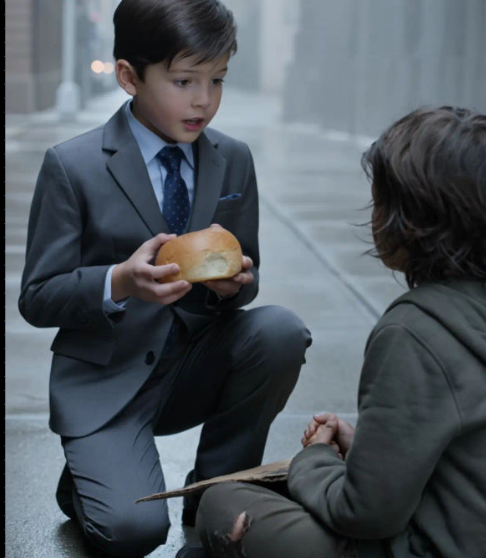
The bread was still warm.
That was the first thing — the detail that would stay with everyone who witnessed what happened on the corner of Clement and Fifth that Tuesday morning. The bread was warm because Aiden Cole had insisted on stopping at the bakery, had stood beside his mother at the counter and said can we get the big one with no explanation, and had carried it in both arms the three blocks to where he’d seen the boy yesterday after school.
He’d been thinking about the boy all night.
He was nine years old and he had not yet learned to stop thinking about things like this.
The boy was still there.
Same spot — the recessed doorway of a closed laundromat, just back from the sidewalk, with a square of flattened cardboard underneath him and another piece propped against the wall. The second piece had words on it written in marker, unsteady letters that had taken effort:
HOMELESS.
He was five, maybe six. It was hard to tell under the dirt and the exhaustion. His clothes were adult clothes cut down and badly — a shirt that had been shortened with scissors, pants rolled up at the ankle six times. His hair was a history of weeks without attention. His face, when Aiden crouched in front of him, was the face of a child who had learned to make himself small enough that people would stop seeing him.
He was looking at the bread.
“Here,” Aiden said. “Take this.”
He held the loaf out with both hands. The boy looked at it. Then at Aiden. Then at the bread again, the way you look at something when you’re doing the calculation — is this real, is there a cost, what happens when I reach for it.
His hands came out.
They were trembling.
He took the bread and held it against his chest with both arms immediately, like his body understood scarcity in a way that didn’t require thinking.
Aiden sat down beside him on the cardboard.
“I’m Aiden,” he said.
The boy looked at him sideways. “Tommy,” he said. Barely a sound.
“How long have you been here?”
A shrug. The shrug of a child who has lost track of time because time stopped meaning what it’s supposed to mean.
“Are you alone?” Aiden asked.
Tommy looked at his shoes — a pair of adult sneakers, also too large, wrapped with a strip of duct tape across the toe.
“My mom,” he said. “She was here. She went to get something.” A pause. “That was a while ago.”
Aiden didn’t say anything for a moment. He sat with that.
Then he put his arm around the smaller boy’s shoulders and pulled him in.
Tommy went rigid — the instinctive bracing of a child unaccustomed to being touched with kindness — and then, in stages, went soft. His head dropped against Aiden’s shoulder. His grip on the bread loosened slightly.
“Thank you,” he whispered.
They sat that way for maybe thirty seconds.
Which was when the footsteps started.
Claire Cole had been three steps behind her son, which was three steps too many.
She came around the corner fast, the good coat open despite the cold, the bag still on her shoulder from the bakery — and she saw Aiden on the ground, on cardboard, his good jacket pressed against a filthy child she did not know, and every carefully maintained instinct in her body fired at once.
“No!” She was moving before she’d finished the word. “Aiden — get away from him. Right now.”
Aiden looked up.
He did not move.
“Mom.” His voice was patient in the way children are patient when they have already decided something and are simply waiting for the adults to catch up. “He’s hungry.”
“I can see that. I’m sorry for him, I truly am, but you cannot just—you don’t know who he is, you don’t know if he’s—” She reached down and took Aiden’s arm. “Get up. Please.”
“He was alone all night, Mom.”
“Aiden—”
“He said his mom left to get something and didn’t come back.” Aiden looked at her steadily. “That means he was here all night. By himself. He’s six.”
Claire’s pulling slowed.
“Someone will help him,” she said. But her voice had changed register, dropping from alarm toward something more complicated.
“You’re someone,” Aiden said.
She opened her mouth.
And then the boy looked up at her.
It was the first time he’d lifted his eyes fully since she’d arrived — since the shouting and the pulling had disrupted whatever fragile safety the previous few minutes had offered. He looked up now with the bread still clutched to his chest and his hair hanging in his face and his eyes wide and dark and—
Claire Cole stopped breathing.
Those eyes.
She knew those eyes.
She had been trying not to know them for the past thirty seconds, had been running from that knowledge since the moment she came around the corner and saw the child’s face, had been filling the space of recognition with noise and urgency because knowing was more than she could manage on a Tuesday morning on a public sidewalk.
But there is a limit to how long you can not-know something that your entire body knows.
“Mom?” Tommy’s voice was the smallest sound in the city.
One word.
He said it the way you say something you’ve practiced in private a thousand times, with the desperate fragility of a person for whom that word has been theoretical for so long that using it out loud feels like standing on ice that might not hold.
“Mom?”
The bag slid off Claire’s shoulder.
She didn’t feel it hit the sidewalk.
She was staring at the boy — at the eyes she knew, at the jaw she knew, at the particular way he tilted his head when he was afraid, which she knew in the way of someone who had seen it every day for the first two years of his life before the world came apart at a seam she still didn’t fully understand.
“Tommy,” she said.
Not a question.
His name, in her mouth, in her voice — the voice that had said it ten thousand times over a crib and a bath and a car seat and a thousand ordinary moments that had turned out not to be ordinary at all because they were the last ones.
“Tommy.” She went to her knees on the sidewalk. The good coat hit the concrete. She didn’t register it. “How are you — where have you — who has been—”
“I was looking for you,” he said. His voice broke on the last word. “I was trying to find our street but the streets are different and I couldn’t—” Tears were streaming now, cutting lines through the dirt. “I couldn’t find our building.”
“How long?” Her hands were on his face. Cupping it. Memorizing it. “Tommy, how long have you been out here?”
He thought about it with the seriousness of a child doing real math.
“Eight sleeps,” he said.
Eight nights.
Her six-year-old son had been sleeping on a sidewalk in a city of three million people for eight nights, with a cardboard sign and adult sneakers held together with duct tape, and she had—
“I looked for you.” Her voice was a wreck of itself. “I called — I filed — they told me you were with your father, they said the paperwork showed—”
“Dad’s gone,” Tommy said simply. The simplicity of a child who states facts because he hasn’t yet learned to cushion them. “He left. He said he was going to get you and he didn’t come back either.”
Claire pulled him in.
All of him. Bread and dirt and duct tape shoes and eight nights of the city’s hardest education.
She held him the way you hold something you have spent every waking and sleeping hour trying to find — not carefully, not gently, but completely, with every part of yourself that still works.
Aiden Cole stood up from the cardboard.
He looked at his mother and the boy she was holding and the bread that had gotten slightly crushed in the middle of everything.
He picked up the bag from the sidewalk.
He waited.
Because he was nine years old and he had learned this morning that sometimes the most important thing you can do is hand someone a warm loaf of bread and sit down beside them and be present for whatever happens next.
Whatever happens next.
