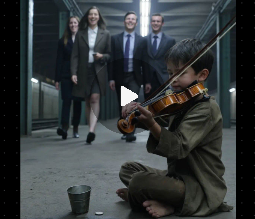
The violin was broken.
Not beyond use — its strings held, its body was intact — but the bow had lost half its hair and the crack along the neck had been repaired with something dark and improvised, and the sound it made was not the sound a violin is supposed to make. It was rougher than that. More human. The sound of an instrument that had survived things instruments aren’t built to survive.
The boy playing it had survived similar things.
He was six, maybe seven. Barefoot on the subway floor — the cold concrete that never fully dries, that carries the grime of a million daily passages. His clothes were the clothes of a child dressed by circumstance rather than choice. His eyes, when he played, were somewhere else entirely — not in the station, not in the fluorescent harshness of the underground, but somewhere the music took him that the rest of his life did not.
The tin cup at his feet held four coins.
He played anyway.
The teenagers came through in a group the way teenagers in groups sometimes come through — loudly, in the way of people who have decided, collectively, that the world is their audience. They were dressed well. They had somewhere to be and the confidence of people who always have somewhere to be.
One of them saw the cup.
The kick was casual. Almost lazy. The cup skittered across the concrete and the coins flew — spinning, scattering, landing in the dirty water that pooled near the drain, rolling into the gap near the wall, disappearing.
The group laughed.
The boy flinched.
He kept playing.
That was the thing — the thing that the laughing teenagers didn’t register as they moved through the station and on with their evening. He flinched and then he kept playing, jaw tight, eyes down, the bow moving across the strings with the practiced continuation of someone who has learned that stopping doesn’t make anything better.
One coin spun in a slow circle on the concrete. It caught the fluorescent light. It tipped sideways and landed in a small pool of water and went still.
The little girl’s name was Anna.
She was eight years old, in her school uniform — the plaid skirt and white shirt of a Catholic school two stops uptown — and she had been holding her mother’s hand while her mother stared at her phone and navigated the commute the way adults navigate commutes, which is to say with the practiced inattention of someone who has learned to process the subway without fully experiencing it.
Anna was paying attention.
She saw the cup get kicked. She saw the coins scatter. She saw the boy flinch and keep playing. She felt her mother’s hand in hers and made a decision.
She let go.
“Anna—”
But she was already across the platform, crouching down on the dirty floor in her school uniform, picking up coins one by one with careful fingers. She found the one in the water. She found the one near the wall. She moved with the methodical patience of a child who has decided this task matters and is going to complete it properly.
She placed each coin back in the dented cup.
One by one.
The boy had stopped playing.
He was staring at her — this uniformed girl on the grimy platform floor, putting his coins back like it was the most ordinary thing in the world and also like it was not ordinary at all — with an expression that had no practiced response for it. He had responses for being ignored. For being laughed at. For the studied non-seeing of commuters in a hurry. He did not have a response for this.
Anna looked up.
“Don’t stop,” she said. “It’s beautiful.”
He looked at her for a long moment.
Then, slowly, he raised the bow.
Rachel Mercer had been three steps behind her daughter for all of this.
She’d seen Anna break away. She’d called her name. She’d followed, because what else do you do when your eight-year-old releases your hand and walks toward a homeless child in a subway station.
She was preparing the words — Anna, you can’t just, we don’t know, we’re going to miss our train — when something stopped her.
Not a sound. Not a movement. Something visual, and the processing of it happened faster than her conscious mind could follow, registered by something deeper and older and more insistent.
The violin.
Specifically: the neck of the violin. Where the boy’s left hand held it. Where a pattern had been carved into the wood — small, precise, the work of someone who knew what they were doing and had a reason to make it permanent.
A family crest.
She knew that crest.
She had grown up with that crest on the stationery, on the ring her father-in-law wore, on the back of the violin that her husband had learned on as a child and had kept through every move, every upheaval, every iteration of their life together.
The violin that had disappeared five years ago.
Along with everything else.
Her hand came up over her mouth.
Her legs took her forward and then stopped functioning for a different reason and she went down — both knees on the platform floor, among the commuters and the grime and the fluorescent light and the sound of the boy’s violin starting again because her daughter had asked him to.
She was on her knees staring at the instrument and trying to breathe and trying to hold two realities at once — the one she had built over five years of learning to accept what was gone, and this one, in a subway station, where a barefoot boy was playing her husband’s violin.
“Ma’am?” A commuter paused near her. “Are you—”
She held up one hand. Not now. She could not manage now.
“Anna.” Her voice came out wrong. Stripped. “Anna, come here.”
Anna stood up from where she’d been crouching. She came to her mother. She looked at her mother’s face — which was doing something Anna had never seen it do — and her expression shifted from confusion to concern.
“Mom? What’s wrong?”
Rachel reached out and touched the violin.
Gently. One finger along the neck, finding the carved lines of the crest the way you find something in the dark when you know its exact shape.
The boy stopped playing again.
He looked at her hand on his instrument.
“Lady.” His voice was careful. Guarded. The voice of a child who has had things taken. “That’s mine.”
“I know.” Her voice broke on the second word. “I know it’s yours. I just need—” She looked at his face. Really looked. The way she had not allowed herself to look at children his age for five years because the looking was too expensive. “What’s your name?”
He hesitated. Trusting was a calculation he performed slowly now.
“Why?” he asked.
“Please.” The word came out undone. “Please, I just need to know your name.”
He looked at her. At her hand on the violin. At the tears she wasn’t trying to contain anymore.
“Noah,” he said.
Rachel Mercer stopped breathing.
Anna looked between her mother and the boy, holding the arithmetic of something she didn’t yet have the context to solve.
“Mom,” she said quietly. “You’re scaring me.”
“Noah.” Rachel said it again, like saying it twice would tell her whether it was real. “Noah what? What’s your last name?”
The boy’s jaw tightened.
He’d been asked questions like this before. By people who wanted to return him somewhere. By people who had agendas he couldn’t read. By a system that had, in his experience, not been notably good at helping him.
He pulled the violin slightly closer to his body.
But something in his face had shifted.
Something that recognized, in this woman’s expression, a quality he knew from the inside — the specific look of someone who has been missing something for so long that finding it has become unmanageable.
“I don’t remember my last name,” he said. “I was little when I forgot it.”
“How old were you?”
“Two, I think. Maybe two.”
“What do you remember?” Her voice was so careful now. Like handling glass. “From before. What’s the first thing you remember?”
Noah was quiet for a moment.
“Music,” he said. “Someone playing this. Someone teaching me where to put my fingers.” He looked at the violin. “I don’t remember the face. Just the hands. And a voice saying listen for the note inside the note.“
Rachel pressed both hands over her mouth.
Her husband had said that to her, on their second date, trying to explain why he played.
Listen for the note inside the note.
“Anna.” Her voice was barely functional. “Anna, go find the station officer. The one by the turnstile. Tell him I need help.”
“Why?” Anna’s voice was high with alarm. “Mom, what’s happening—”
“Go. Please. Go right now.” She looked at Noah. At the violin. At the crest she had traced ten thousand times in her memory. “I need you to go.”
Anna ran.
Rachel stayed on her knees.
Noah looked at her from two feet away, holding his violin, unsure.
“Why are you crying?” he asked.
She looked at him.
“Because,” she said, “I think I’ve been looking for you for five years.”
The subway station moved around them — trains and footsteps and the indifferent machinery of a city in motion — and in the middle of all of it, a boy with a broken violin and a woman on her knees on a platform floor sat with the possibility of something too enormous to speak directly.
“You don’t know me,” Noah said. But his voice was uncertain in a new way.
“I know that violin,” she said. “And I think—” She stopped. “I think you might know a song. One you didn’t learn from anyone. One that was just already in you.”
He stared at her.
His bow hand moved. Slowly. Without deciding to.
He began to play.
Not the piece he’d been playing for coins. Something different. Something private, the kind of music you don’t play for an audience because it belongs to the inside of you.
Rachel closed her eyes.
She knew every note.
