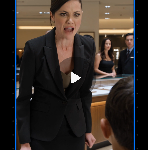
The Hartwell Mall jewelry district smelled like money and cold air conditioning. Glass cases gleamed under soft amber lighting, diamonds catching the light like trapped stars. It was the kind of place where people whispered, where heels clicked deliberately, where silence was a form of power.
Nobody noticed the boy come in.
He was maybe eight years old. His sneakers had holes at the toes. His jacket — too thin for January — was gray with the kind of dirt that doesn’t wash out in one cycle. He had the wide, cautious eyes of a child who had learned to make himself invisible, and he moved along the edge of the store the way water finds the lowest ground: quietly, without asking permission.
He stopped at a ring.
It sat on a velvet pedestal behind the low counter — a simple gold band, its diamond modest but brilliant. He pressed his small face close to the glass, breath fogging the surface, and stared at it the way children stare at birthday cakes they know aren’t theirs.
Then the woman screamed.
“Put that ring back right now!”
Margaret Whitfield’s voice split the ambient music like a blade. She was the kind of woman whose pearls were real and whose patience wasn’t. She had been reaching across the counter to speak with the jeweler — an older man named Gerald — when she saw the boy’s hand slip beneath the half-open display case.
Every head in the store turned.
“I said PUT IT BACK!”
The boy stumbled backward, the ring clutched in both hands. His knuckles were raw from cold. His eyes were enormous.
“I wasn’t stealing it,” he whispered. “I just wanted to see—”
“Security!” Margaret’s voice didn’t lower. It escalated. “Someone call security RIGHT NOW. There is a child stealing from this store!”
Two guards appeared almost instantly — large men in black uniforms who moved with the practiced efficiency of people who’d been called for far lesser things. Shoppers turned. A woman in a fur coat pulled her handbag closer. A teenage girl took out her phone.
The boy stood in the middle of all of it like a small stone in a river, everything moving around him and through him.
“Son.” The first guard crouched, extending his hand. “Give me the ring.”
The boy’s chin trembled. He looked down at it — really looked at it — and something in his face shifted. Something soft and devastated.
“I just wanted to see my mom’s name,” he whispered.
The guard paused.
Gerald — who had been standing behind his counter for thirty-one years, who had heard every kind of human story this side of a confession booth — went completely still.
“What did you say?” His voice came out strange. Stripped of its professional warmth.
The boy looked up. “The lady at the shelter said she saw a ring here. In the window. She said it had my mom’s name inside it.” His voice cracked on the last word. “She disappeared last year. The police said — they said she just left. But she didn’t. She wouldn’t.”
The store had gone quiet in a way that had nothing to do with luxury anymore.
Margaret Whitfield opened her mouth, then closed it.
Gerald’s hands were gripping the edge of the display case so hard his knuckles had gone white.
“Show me,” he said quietly. “Open it. Show me what’s written inside.”
The boy turned the ring with trembling fingers. Tilted it toward the light.
Forever Yours, Emily.
The sound Gerald made wasn’t a word. It was something older than words.
“That’s—” He reached forward, then stopped himself, hands hovering in the air. “That ring.” His voice broke completely. “I commissioned that ring myself. For my daughter. For her engagement.” He looked at the boy. Looked at him — really looked — for the first time. “It was stolen from her apartment.”
Margaret’s hand had come up to cover her mouth.
“The day she disappeared,” Gerald said. “Four hundred and seventeen days ago.”
The silence that followed was the kind that changes people.
The boy stood perfectly still, holding the ring that connected two losses together like a bridge built from grief.
“What’s your name?” Gerald asked. His voice was barely there.
“Lucas,” the boy said. “Lucas Monroe.”
Gerald closed his eyes. When he opened them, they were wet.
“Emily Monroe,” he said. “That was her married name. After—” He stopped. Started again. “After she got married at the courthouse. I never met him. We had a fight. I told her it wasn’t a real wedding without—” His voice collapsed entirely. “I never got to tell her I was sorry.”
Lucas stared at the old man behind the counter.
“You’re her dad?” he whispered.
Gerald could only nod.
The ring sat between them — tiny, brilliant, impossibly heavy.
“I didn’t know she had a son,” Gerald managed. “I didn’t know I had a grandson.”
Lucas looked down at the ring one more time. Then, carefully, with both hands, he set it on the glass counter between them.
“She used to say you’d find each other again,” he said quietly. “She said some people are like lost keys. They’re always somewhere. You just have to look in the right places.”
Gerald reached across the counter — past the glass, past the diamonds, past four hundred and seventeen days — and took the boy’s cold, dirty hands in his.
The security guards stepped back.
Even Margaret Whitfield didn’t say a word.
