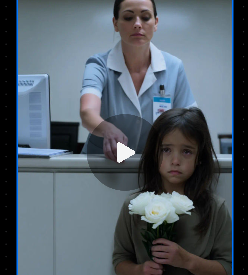
The waiting room at St. Clement’s Medical Center smelled like disinfectant and bad coffee and the specific kind of fear that settles into a place when too many people have sat in the same plastic chairs waiting for news that doesn’t come fast enough. Fluorescent lights hummed overhead, washing everything in a pale, honest light that was nobody’s friend.
She came through the automatic doors at 11:14 in the morning.
She was small — six, maybe seven — wearing a coat two sizes too large and boots that didn’t match. Her hair had been combed recently, carefully, the kind of careful that takes time and love and a broken piece of mirror. She was carrying flowers: white carnations wrapped in a damp paper towel, the kind sold outside gas stations for three dollars, held in both hands like something sacred.
She walked to the reception desk on her tiptoes.
“Excuse me,” she said. “I’m here to see my daddy.”
Donna Pryce had worked the St. Clement’s admissions desk for eleven years. She had seen everything. She had also, somewhere in those eleven years, quietly decided that certain things were not her problem.
She looked at the girl over the rim of her reading glasses. Took in the coat. The boots. The flowers that were already starting to wilt from being held too tightly.
“Name?” Donna said flatly.
“Lily,” the girl said. “Lily Cross.”
“Patient name.”
“Thomas Cross. He came in two days ago. They said—” Lily’s forehead wrinkled with the effort of remembering grown-up words. “They said cardiac something.”
Donna typed. Looked at the screen. Looked back at the girl.
Then she leaned forward across the counter and said, in a voice that carried farther than she intended:
“Patients don’t want to see beggars here. You need to leave.”
The flowers hit the floor in pieces.
Lily hadn’t dropped them on purpose — it was shock, just the pure shock of it — and she stood there looking down at the white petals scattered across the linoleum like something broken that couldn’t be unbroken.
“I’m not a beggar,” she said softly. “I brought them for my daddy.”
“I’m going to have to ask you to step outside—”
“She’s not going anywhere.”
The voice came from the far end of the waiting room. Low. Controlled. The kind of voice that has spent decades being listened to without needing to raise itself.
Every head turned.
The man in the wheelchair was perhaps sixty-five, with silver hair and the broad, once-powerful frame of someone who had been physically formidable before whatever had reduced him to this chair. An IV line ran from his left hand to a portable stand beside him. His clothes were expensive even now — pressed collar, good watch — but his eyes were the thing. His eyes were fixed on Lily with an expression that had moved past surprise into something raw and unnameable.
He wheeled himself forward slowly, into the center of the waiting room.
“Come here,” he said to Lily. Gently. “Don’t be frightened.”
Lily looked at him cautiously. Then she picked up what flowers she could and crossed the room toward him.
Up close, the man — his name was Richard Calloway, though no one in the room knew it yet — was looking at her wrist.
His breathing changed.
“That bracelet,” he said. His voice had dropped to almost nothing. “Can I see it?”
Lily held out her arm. The bracelet was simple silver, with small round charms — a star, a moon, a tiny letter E.
Richard’s hand came up. Stopped before touching it.
“Where did you get this?” he asked.
“My daddy gave it to me,” Lily said. “He said it was a gift. He said someone who loved me very much wanted me to have it.”
“When?” The word came out cracked at the edges. “When did he give it to you?”
“Before he got sick.” Lily’s eyes dropped to the flowers in her hands. “He said to keep it on always. He said it was important.”
Richard Calloway turned to look at the window. His jaw was working. His eyes were wet.
“Sir?” A passing nurse slowed. “Are you alright? Do you need—”
“I need a moment,” he said, and the nurse recognized something in his voice and gave him one.
He turned back to Lily.
“My daughter,” he said slowly, “had a bracelet exactly like that one. I had it made for her eighth birthday — silver, with those three charms. Star, moon, and her initial.” His voice fractured on the last word. “She disappeared four years ago. She was fifteen.”
Lily stared at him.
“She went for a run one morning and she didn’t come back.” He pressed his hand flat against his knee, steadying himself. “We searched. We never stopped searching. The police—” He stopped. Restarted. “They said she probably ran away. I never believed it. I never believed she would do that.”
“What was her name?” Lily whispered.
“Emma,” he said. “Emma Calloway.”
Something moved across Lily’s face — a tremor of recognition she was too young to fully process.
“My daddy talks about someone named Emma,” she said carefully. “Sometimes when he thinks I’m sleeping.”
The waiting room had gone completely quiet.
“He says he’s sorry,” Lily continued, her voice small and straight and devastating. “He says it over and over. He says, ‘I’m sorry, Emma. I’m sorry I didn’t find you in time.'”
Richard’s hand gripped the arm of his wheelchair.
“What is your father’s job, Lily?”
She scrunched her nose. “He used to drive a truck. Big ones, long distance. But he stopped. About four years ago he just — stopped. He said something happened that changed him.”
The fluorescent lights hummed on above them.
“I need to see him,” Richard said. “Right now. I need you to take me to his room.”
“They might not let you,” Lily said. “They said family only.”
“I may be family,” Richard said. The words came out strange — enormous and fragile at the same time. “I just don’t know it yet.”
He reached down and picked up one of the fallen carnations from the floor beside his wheel. He held it out to Lily.
She took it.
And then, without anyone at the desk saying a word, the girl with the mismatched boots led the man in the wheelchair down the corridor toward Room 14, carrying the remaining flowers between them like a peace offering to whatever truth was waiting at the end of the hall.
Donna Pryce watched them go.
She took off her reading glasses.
She didn’t put them back on for a very long time.
