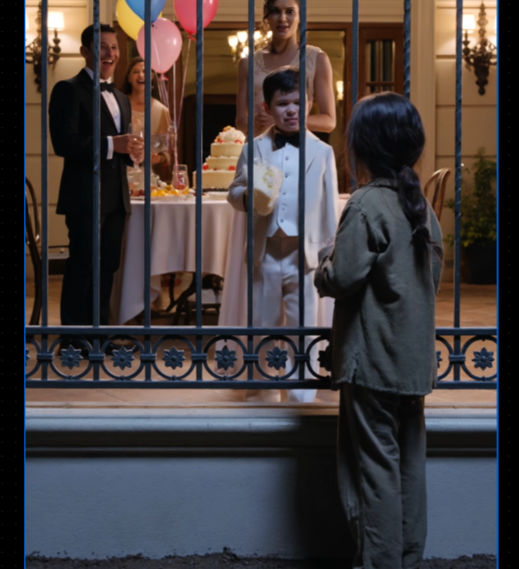
The party had cost eleven thousand dollars.
That was the number thrown out at the planning meeting three weeks earlier, and nobody had flinched because nobody in the Caldwell household was accustomed to flinching at numbers. The bouncy castle was the large kind. The catering was done by a company that usually did corporate events. The birthday cake was five layers with the child’s face reproduced in edible gold on the top tier.
Thirty-two children attended.
The girl at the fence was not one of them.
She had found the gap in the iron fence at the property’s east edge, where the decorative ironwork met the hedge and the sight line from the main lawn was partially obscured by the bouncy castle. She was eight years old and she had the particular stillness of a child who has learned to watch things from the outside and make that enough.
She was not making it enough today.
Today there was music and streamers and a table of food that extended further than any table of food she had ever seen in her life, and there were children in clean clothes laughing at things that were actually funny rather than laughing to fill the silence, and there was a birthday cake that was being carried out by two adults like something ceremonial and important.
She watched.
She held the fence with both hands.
She hadn’t meant to make a sound. The sound that came out was involuntary — barely a sound, just the intake of breath at the sight of the cake — but it was enough.
The birthday boy heard it.
His name was Cooper. He was turning nine. He had his father’s confidence and his mother’s eyes and ten years of being the most important person in most rooms he entered, which had produced in him a particular relationship to people who wanted things he had.
He saw the girl at the fence.
He picked up his plate.
He walked to the fence with the unhurried certainty of someone who has decided something and sees no reason to reconsider, and he held the plate over the iron railing and tipped it.
The cake slice fell.
It landed in the dirt outside the fence, face-down, the decorative frosting pressing into the ground.
Laughter from the cluster of children who had followed Cooper to see what he was doing. Not all of them — four or five of the thirty-two, the ones who had read the room and understood that this was a performance being given and an audience was being assembled.
The girl looked at the cake in the dirt.
She had been taught not to eat food from the ground.
She had also been very hungry since yesterday morning.
She bent down.
The locket swung forward when she bent.
It had been tucked inside her shirt — a habit she’d developed without being told to, the instinct of someone who carries something precious in a world that takes things. The movement of bending brought it out, and it hung in the space below her neck, catching the ambient light from the party.
Small. Silver. The shape of a heart, slightly worn at the edges.
It was the only thing she’d had when she was found.
That was what the woman at the shelter had told her, two years ago, when she’d asked where it came from. You had it when they found you. We don’t know anything else. It’s yours.
She’d kept it since.
She’d looked at what was inside it many more times than she could count.
Diane Caldwell had been standing near the dessert table when her son walked to the fence.
She had not been in time to stop the cake from falling.
She had been moving toward him — already reading his posture, already knowing from nine years of motherhood what that particular walk toward the fence meant — but she’d been in heels on grass and she was four steps too late.
She was about to call his name.
Then she saw the locket.
The light hit it at the angle of physics and timing and the particular arrangement of this specific afternoon, and something in Diane Caldwell’s brain — some recognition process that operates below thought, below language, in a place that is purely physical — fired.
She stopped walking.
The sound she made was not a word.
She crossed the lawn.
Not at the measured pace of a hostess managing a situation. At a pace that made Cooper step back and made the cluster of children scatter and made several adults look up from their conversations with the expression of people who have identified that something real is happening.
She reached the fence.
She was looking at the locket and she was looking at the girl and she was doing both at once and neither fully and her hands were on the fence railing and she was gripping it the way you grip something when you need something solid.
“Can I—” Her voice came out wrong. She tried again. “That locket. Can I see it?”
The girl looked at her.
She had been looked at, in her experience, in a fairly limited range of ways: with pity, with dismissal, with the specific not-seeing of people who had decided not to see her. This woman was looking at her in a way she had no category for.
“It’s mine,” the girl said.
“I know. I’m not—” Diane pressed her lips together. “I just need to see it. Please. I’ll give it right back.”
The girl looked at her for a long moment.
Then she unclasped it.
She handed it through the fence.
Diane’s hands were shaking when she took it. She already knew — some part of her already knew, had known since the light hit the silver and the recognition fired — but knowing and seeing are different things and she needed to see.
She opened the locket.
Inside: a photograph. Small, slightly faded, the colors slightly compressed by time. A woman holding a baby. The woman’s face was younger by eight years and her hair was different and she was in a hospital room, but the face was the face Diane saw in mirrors.
The baby was wrapped in the yellow blanket that Diane’s mother had knitted.
The baby was wearing a white hospital bracelet that said Baby Girl Caldwell.
“That baby,” Diane said. The words came out in pieces, the way things come out when the architecture that normally holds them has stopped functioning. “That baby was stolen from me.”
The girl went very still.
Thirty children continued their party in the background, the music playing, the bouncy castle bouncing, the five-layer cake still on the table with its edible gold face.
None of it existed.
There was only the fence between them, and the locket in Diane’s shaking hands, and the girl on the outside of it looking at the woman on the inside with an expression that was slowly, carefully, at great personal cost, beginning to understand something enormous.
“Where did you get this?” Diane asked. “Please. I need to know.”
“I’ve always had it,” the girl said. “The lady at the shelter said I had it when they found me.”
“When they found you where? Where did they—”
“A park,” the girl said. “Three years ago. I was five. I don’t remember before that.”
Diane Caldwell looked at the girl.
At the face.
She had spent eight years looking at faces — at every small girl in every grocery store and park and school pickup line, running the comparison that she’d been running for eight years with no result.
She ran it now.
Her eyes.
Her chin.
The way she held her head when she was frightened but had decided not to show it.
“What’s your name?” Diane said. “Do you know your name?”
“Maggie,” the girl said. “They call me Maggie.”
Diane Caldwell pressed her forehead against the iron fence.
Her eyes closed.
When she opened them, she looked at her son — at Cooper, standing five feet back, nine years old and beginning to understand from his mother’s posture that something had happened that was larger than he had the context for.
Then she looked at the girl.
“Maggie.” Her voice was barely functional. “My daughter’s name was Margaret. I called her Maggie from the beginning.” She held the locket out through the fence. “Before she was taken, I put this around her neck. The hospital photographer came in — the one who does the new baby portraits — and I put it on her for the photograph because I wanted her to have something of mine in the picture.”
The girl looked at the locket.
Then at the woman.
“Are you saying—”
“I’m saying I need you to come to the other side of this fence,” Diane said. “I’m saying I need you inside. Right now. And I’m saying I’m not going to be able to explain everything on this side of the fence because I can’t stand up straight right now and I need to sit down.”
The girl looked at the gate.
She had never been invited to the other side before.
“You’re sure?” she said.
Diane Caldwell looked at her daughter through an iron fence at a birthday party that had cost eleven thousand dollars and was now the least important thing in the yard.
“Come inside,” she said. “Please come inside.”
