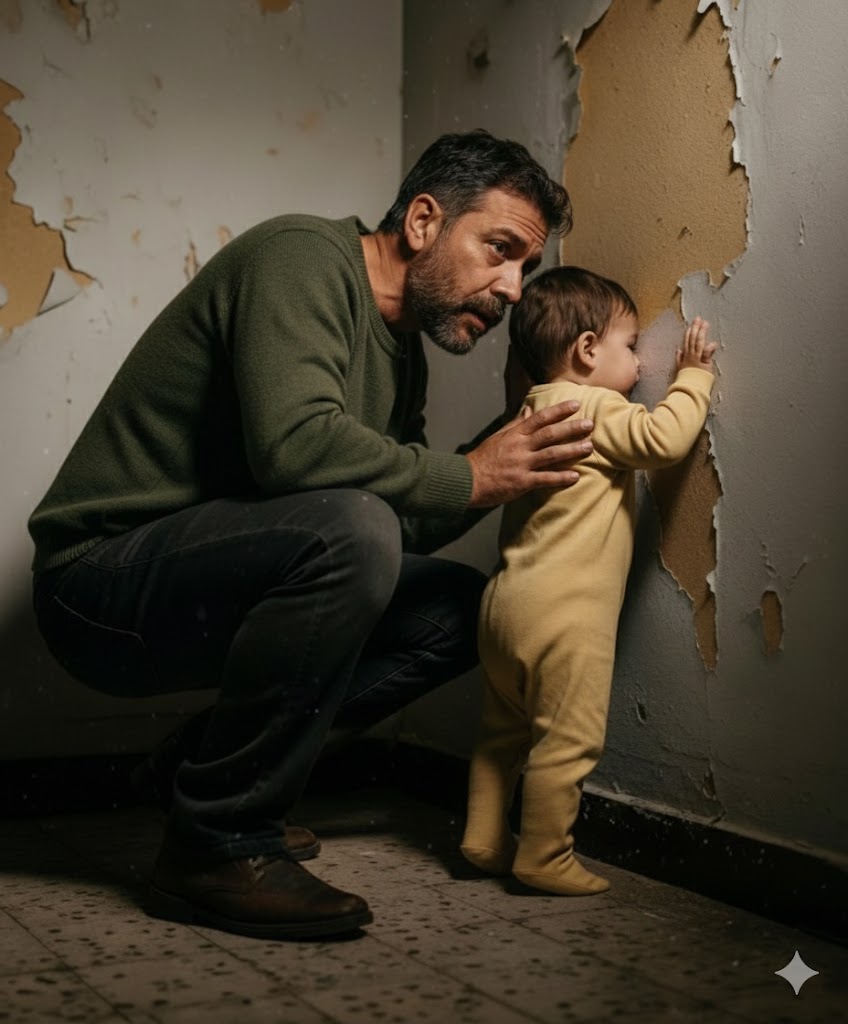
Just a year earlier, Daniel’s wife, Camila, had passed away due to complications during childbirth. The loss shattered him. The apartment, once full of laughter and future plans, had become a silent chamber of grief. Daniel worked from home, balancing engineering contracts with diapers, feedings, and quiet sobs he tried to hide from his infant son.
But over the past month, something unusual — something inexplicable — had begun happening inside their home.
A Strange Habit Begins
It started subtlely. One afternoon, Daniel noticed Mateo crawling to a particular corner of the living room. The baby stopped in front of a blank patch of wall, stood upright when he could barely stand, and remained completely still.
At first, Daniel thought the child was simply curious. Babies are unpredictable, after all. But then it happened again. And again. And again. Every day, sometimes two or three times, Mateo would crawl — or toddle unsteadily — to the same wall, place both tiny hands on it, and stare.
Not cry.
Not babble.
Not laugh.
Just stare.
Daniel began to worry—not because of the behavior itself, but because it felt eerily intentional. As if Mateo were waiting for something… or someone.
The Questions Grow
One night, after putting Mateo to sleep, Daniel called his sister.
“He does it for minutes at a time,” he explained. “He doesn’t move. He looks like he’s listening.”
“Listening to what?” she asked.
“I don’t know,” he admitted. “That’s what scares me.”
His sister gently suggested that children often behave strangely, especially when they grow and explore. But Daniel couldn’t shake the feeling. Every time Mateo stood before the wall, the atmosphere changed — the room felt heavier, colder, as though the air itself were holding its breath.
And then came the night everything changed.
The Night of the Three Words
It was just after midnight when Daniel woke to an unusual sound — a soft thud, followed by silence. He rushed toward the living room.
There, illuminated by the dim streetlight seeping in through the curtains, stood little Mateo. Barefoot. In pajamas. Facing the same wall.
“Mateo?” Daniel whispered. “Amor, what are you doing out of bed?”
No response.
Daniel took a step closer. The floor felt cold beneath his feet.
“Mateo?”
Still nothing.
He reached out to pick up his son — but before he could touch him, the baby spoke.

Three words.
Three soft, perfect words spoken with a clarity no one-year-old should have been capable of:
“Papá, she’s here.”
Daniel froze.
His breath caught in his chest.
His heart hammered painfully against his ribs.
“No… no, no, no…” he whispered, stumbling backward.
The apartment was silent except for the distant hum of traffic outside. Mateo turned slowly to look at him — not with fear, but with calm innocence, as if those words were the most natural thing in the world.
A Father Overcome by Shock
Daniel scooped up his son, trembling. Mateo rested his head against his father’s shoulder, already half-asleep as though nothing unusual had happened. But Daniel stood frozen in the middle of the room, staring at the wall where Mateo had been standing.
He waited. For what, he didn’t know. Something to move. A shadow. A sound. A sign.
But nothing happened.
The baby’s three simple words played again and again in Daniel’s mind:
“Papá, she’s here.”
She.
There was only one “she” Daniel could think of — the woman whose memory filled every silent corner of their apartment. The woman whose absence still felt like a missing limb. The woman who had left him too soon.
Camila.
Searching for Answers
The next day, Daniel called a pediatric specialist, fearing a neurological issue or delayed-reaction trauma. The doctor assured him that early speech anomalies were not uncommon, and young children sometimes repeated phrases they’d heard without understanding them.
But Daniel knew Mateo had never heard those words before. No visitor had said them. No television show. No recording.
Desperate, he turned to the building superintendent, asking whether previous residents had noticed anything unusual. The old man, rubbing his temples, sighed.
“That apartment… it’s old,” he muttered. “Families come and go. Some complain about drafts, noises, doors that won’t stay shut. Nothing more.”
Daniel left unconvinced.
He began observing Mateo carefully. Over the next week, the child continued going to the wall daily. But he didn’t speak again. Not a single word. Yet every time, he placed his hand in the same spot — about three feet from the floor.
Daniel finally pressed his own hand to that very spot on the wall.
It was colder than the rest of the surface.
Much colder.
A Hidden Discovery
One weekend, unable to take the uncertainty, Daniel called a contractor friend to inspect the wall. They removed a panel of old plaster, expecting to find rotten wood, bad insulation, maybe mold.
But what they found was unexpected.
Inside the wall was a small, hollow space — and within that space, wrapped in a yellowed cloth, lay a tiny wooden music box. Dusty. Forgotten.
The moment Daniel opened it, a familiar melody filled the room.
Camila’s lullaby.
The one she sang every night during her pregnancy.
Daniel sank to his knees, sobbing.
He had packed away all of Camila’s belongings after the funeral — but he remembered losing the music box during the move. He had searched everywhere but never found it.
It had been inside the wall the entire time.
Had Camila placed it there?
Had it fallen through a crack years earlier?
Had someone hidden it intentionally?
No one knew.
A Moment of Peace
That evening, Daniel held Mateo in his arms as the lullaby played softly.
“Papá, she’s here,” Daniel whispered, repeating his son’s haunting words.
Maybe Mateo had sensed the music box.
Maybe he had felt something his father could not.
Maybe grief leaves traces — echoes children can perceive before adults do.
For the first time in a year, Daniel didn’t feel afraid. He felt connected.

To his son.
To his memories.
To the love that remained, even after loss.
Life Moves Forward
The wall was repaired. The apartment warmed again. Mateo stopped standing in front of the wall. The strange behavior ended as suddenly as it had begun.
But the music box remained on a shelf in the living room — a reminder that love, like echoes in old walls, never disappears completely.
And sometimes…
just sometimes…
A child can hear what adults no longer can.
