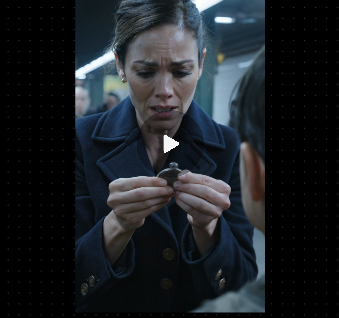
The Caldwell Street station smelled like every subway station smells — metal and concrete and the specific exhaustion of a city that never fully sleeps. Fluorescent tubes buzzed overhead, some flickering, casting everything in the kind of light that makes people look like earlier, tireder versions of themselves. The 6:47 southbound was three minutes out. The platform was packed the way platforms get in the dead of winter, when cold drives everyone underground.
Nobody was paying attention to the boy.
He was sitting at the far end of the platform, back against the tiled wall, knees against his chest. Small — eight, nine at most — with the particular stillness of children who have learned that stillness is safer than motion. His coat was a man’s coat, cut down or just worn large, hanging past his hips. He’d been there long enough for three trains to come and go, which meant he wasn’t waiting for a train.
His name was Sam. He was waiting for warmth.
Then he heard it.
It was small — almost nothing. A sound that existed just beneath the ambient noise of the platform, the kind of thing you feel before you hear it. Sam’s head came up. He turned toward the tracks.
And there it was. Wedged in the narrow darkness between the rail and the platform edge: a kitten. Gray, impossibly small, one paw extended upward as though it had been trying to climb and simply run out of strength. It couldn’t have been more than a few weeks old.
Next to it, catching the light from above, something silver.
Sam stood up.
He looked left. He looked right. He looked at the tunnel mouth where the signal light was still red.
“Hey—” A man in a suit nearby had his phone out. “Kid. Kid, don’t—”
Sam went over the edge.
The scream that went through the platform was collective and immediate — thirty people becoming one voice in a single second. People rushed to the edge, hands out, uselessly reaching for a boy who was already down and moving.
“Oh my God—” “Someone pull the alarm—” “THERE’S A CHILD ON THE TRACKS—”
Sam didn’t hear any of it. He was on his knees in the narrow space between rails, hands moving fast, fingers finding the kitten first — it fit in one palm, barely — then closing around the silver object beside it. A locket. He registered it without processing it and shoved it into his coat pocket.
The kitten made a sound like a question.
“I’ve got you,” Sam said.
The tunnel lit up.
Not the signal — the headlights. The real ones. The 6:47, running forty seconds early, came out of the dark the way trains do: all at once, sudden and absolute, the sound arriving with the light as one overwhelming thing.
Someone on the platform screamed his name even though they didn’t know his name.
Sam’s hands found the platform edge. His arms weren’t quite long enough and for one nauseating second he hung there, the kitten pressed against his chest with one arm, the other scrabbling for grip, and then three sets of hands grabbed him — his wrist, his collar, the back of his coat — and hauled him up and over with the particular violence of people operating on pure adrenaline.
He came up in a tangle of arms and strangers.
The train hit the station two seconds later, brakes shrieking, slowing to its normal stop as though nothing had happened below it.
Sam lay on the platform floor and looked at the ceiling and breathed.
The kitten poked its head out from inside his coat and blinked.
The crowd was chaos — voices everywhere, a station worker pushing through, someone already on the phone with emergency services. A woman was crying. The man in the suit was shaking his head and saying I couldn’t stop him to nobody in particular.
Sam sat up slowly.
He reached into his pocket and took out the locket.
It was silver, oval, the kind with a small clasp. The chain was broken — that’s how it had ended up on the tracks. Scratched from however long it had been down there, but intact. He turned it over in his fingers.
He didn’t open it. It wasn’t his.
He stood up, holding it loosely, looking around the platform with the faint, practical instinct of someone used to finding things and returning them to their rightful place.
That’s when he saw the woman.
She had come in on the last train — had stepped onto the platform right as the commotion peaked — and she’d been frozen at the edge of the crowd, trying to understand what she was seeing. She was sixty, maybe sixty-five, in a good coat, with the kind of face that was naturally composed but was currently doing something else. Her eyes were on Sam’s hand.
On the locket.
“Ma’am?” Sam took a step toward her. He held it out. “Is this yours? I found it on the tracks. I think the chain broke, it might’ve—”
She didn’t take it. Not right away.
Her hand came up and stopped in the air between them.
“Open it,” she whispered. “Please. I need to see if it’s—”
Sam worked the small clasp with his thumbnail and opened it.
Inside: two tiny photographs. On the left, a woman — young, dark-haired, smiling at someone outside the frame. On the right, a little girl, maybe four years old, with a gap between her front teeth and her eyes full of whatever was making her laugh.
The sound the woman made was not a word.
She took one step forward. Then her knees went, and the only reason she didn’t go down entirely was because the man in the suit caught her elbow without thinking.
“My daughter,” she said. The words came out fractured. “My daughter wore this. She — she was on the platform last month. They found her bag. They found her scarf.” Her voice collapsed and rebuilt itself in the space of one breath. “They never found her.”
Sam held the locket very still.
“It was right next to the rail,” he said quietly. “The chain was broken. Like it got caught on something.”
“She wouldn’t have—” The woman pressed her fingers to her mouth. “She wouldn’t have gone down there. She wouldn’t have.”
“Maybe it fell,” Sam said. “Maybe someone found it and didn’t know what to do with it. Maybe it’s been down there since—”
“A month,” the woman said. “Thirty-one days.”
The platform crowd had gone strangely quiet around them. People who had been ready to walk away were standing still instead, watching this without quite knowing why.
“What was her name?” Sam asked.
The woman looked at him — at this small, soaked, inexplicably brave boy holding the last physical trace of her daughter — and something in her face shifted into a kind of open, helpless gratitude that had nowhere to go.
“Grace,” she said. “Her name was Grace.”
Sam looked at the locket. At the little girl inside it with the laughing eyes.
“She looks like you,” he said.
The woman took it from his hands then, closing her fingers around it the way you hold something you thought was gone. She stood in the cold underground light and pressed it against her chest and didn’t say anything, because some moments have more in them than language can carry.
Sam tucked the kitten back into his coat. The kitten settled against his ribs like it had always been there.
“Will you be okay?” he asked.
The woman looked at him for a long moment. Then she shook her head slowly — not meaning no, but meaning that’s the wrong question, meaning I don’t know yet, meaning I’ve been carrying thirty-one days of not okay and this might be the beginning of something else.
“What’s your name?” she asked.
“Sam.”
“Sam.” She reached out and pressed her palm against his face for just a moment — the way you touch something you want to remember. “You went down there for a kitten.”
“And the locket.”
“You didn’t know about the locket.”
He thought about it. “No,” he admitted. “But I saw the light.”
She looked at him a long time.
“So did I,” she said finally. “Just now.”
The southbound train was announced. The crowd began to move. Somewhere above them, the city continued without knowing what had happened thirty feet below its streets.
Sam walked toward the exit with a kitten in his coat and nothing else, which was, somehow, more than he’d had that morning.
