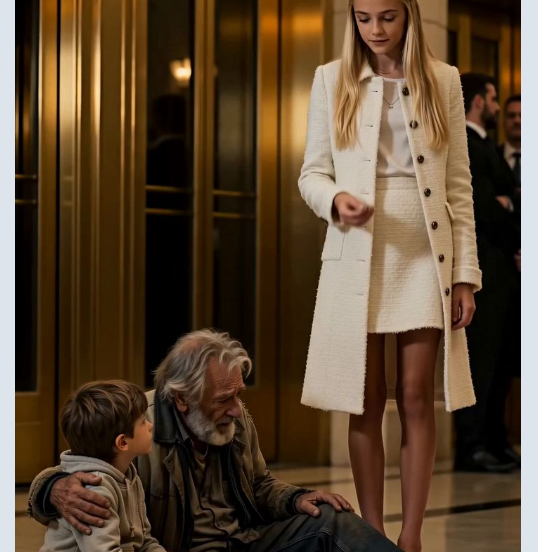
“Three Coins on Marble”
The Meridian Grand was the kind of hotel where the floors were so polished you could see your own reflection walking toward you. Bellmen moved like shadows. Elevators opened with a soft chime. Everything was designed to make wealthy guests feel that the world had been arranged specifically for their comfort.
Nobody had arranged anything for Walter Briggs.
He sat on the small bench near the entrance — the one hotels place near the door not as a kindness but as a legal buffer between the lobby and the street. His coat was clean but threadbare, and beside him sat his grandson Marcus, eight years old, with serious eyes and sneakers that had been resoled twice. They’d been waiting three hours for a social services callback that hadn’t come. Walter’s phone battery was at four percent. He was rationing it the way you ration the last of anything precious.
Marcus pressed close to his grandfather’s side and said nothing. He’d learned, the way children in difficult circumstances learn early, that saying certain things out loud makes them more real.
Then Brittany Holloway swept through the revolving door.
She was sixteen, expensively dressed, the daughter of whoever was staying in Suite 1204. Her phone was raised for a story, her laughter preceding her by three seconds, and her two friends moved in her orbit like small moons. She almost walked past the bench entirely.
Almost.
She stopped, looked down at Walter and Marcus with the particular expression of someone encountering an inconvenient painting, and reached into her coat pocket. She pulled out a handful of coins — loose change, the kind that accumulates at the bottom of designer bags — and let them fall. Not handed. Dropped. Onto the marble. They rang out in a small cascade that seemed, in the lobby’s acoustic quiet, much louder than it should have.
She smiled.
“Here. Take it.”
Her friends laughed. Someone nearby cleared their throat and looked at their phone.
Marcus stared at the coins on the floor. They were scattered in a small arc — a quarter, two dimes, a penny. He looked up at his grandfather.
“Grandpa,” he said softly, “I’m hungry.”
The words were not a performance. They were just true.
Walter closed his eyes for exactly one second. Then he put his arm around his grandson and drew him close.
“It’s okay,” he said quietly.
He didn’t touch the coins.
Brittany was already turning back to her friends, already composing the caption in her head, when a voice cut through the lobby.
“Brittany.”
The voice didn’t raise itself. It didn’t need to. It was the voice of a man used to being heard without effort.
James Holloway stepped out of the elevator and stopped walking the moment his eyes found the bench. He was in his early fifties, a charcoal suit, the kind of face that had once been boyish and now carried twenty years of boardrooms in its jaw. His briefcase hung forgotten at his side.
He was staring at Walter Briggs.
“Dad,” Brittany said, “we were just—”
“Stop.”
She stopped.
James crossed the lobby slowly. His footsteps were the only sound. He crouched down and picked up the scattered coins from the floor — all four of them — and held them in his closed fist for a moment. Then he straightened and looked at his daughter.
“Did you drop these?”
Brittany shrugged. “It’s just change. They looked like they needed—”
“They looked like they needed what?” His voice was quiet and controlled, which somehow made it worse. “What exactly did you decide they needed, Brittany?”
“Dad, I was just—”
“You were just humiliating someone.”
The lobby had gone very still. A bellman found somewhere else to be. One of Brittany’s friends took a small step backward.
“I didn’t—” Brittany started.
“That man,” James said, and his voice changed — something giving way beneath it, like ice over deep water — “sat behind me in sixth grade. His name is Walter Briggs, and he gave me his lunch three times that winter because my mother couldn’t afford to put food in my bag. Three times, Brittany. He never mentioned it. Not once.”
Brittany’s face went blank with something she didn’t have a word for yet.
James turned to Walter. The old man was watching him with the careful, contained expression of someone who has survived enough surprises to approach all of them slowly.
“Walter,” James said. “Is it really you?”
Walter looked at him for a long moment.
“Jimmy Holloway,” he said at last, and something in the tightness around his eyes released, just slightly. “You got tall.”
James laughed — a broken, unprepared sound — and sat down on the bench beside him. Just sat down, suit and briefcase and all, right there in the lobby of the Meridian Grand.
“Why are you here? What happened?”
“It’s been a complicated year,” Walter said simply. He glanced at Marcus. “This is my grandson. His name is Marcus.”
Marcus looked up at the businessman on the bench next to his grandfather.
“Are you his friend?” Marcus asked.
James looked at Walter, who gave the smallest, most dignified nod.
“Yeah,” James said. “I am.”
He reached into his jacket, but Walter shook his head once — sharp and clear.
“Don’t,” Walter said. “Not like that. Not here.”
James understood immediately. He put his hand back. He nodded.
“Okay. Then let me make a call. Just let me make one call, Walter. Please.”
Walter was quiet for a moment. He looked down at Marcus, who had rested his head against his grandfather’s arm, patient and exhausted and trusting in the way only children can still be.
“One call,” Walter said.
Behind them, Brittany Holloway stood very still in the center of the lobby with the coins her father had pressed back into her palm. They felt, for the first time, exactly as heavy as they were.
