“What Was Inside the Watch”
The Cathedral of Saint Marguerite had been dressed for a fairy tale.
White peonies banked every pew. Candlelight ran the length of the nave in two warm rivers, and through the tall lancet windows, the late afternoon sun came in amber and gold and fell across three hundred guests in their finest, all of them arranged to witness the marriage of Dominic Hargrove to Celeste Aumont — the wedding that four society pages had already described, before it had even happened, as the event of the season.
It had been going beautifully.
Right up until the moment Celeste saw the watch.
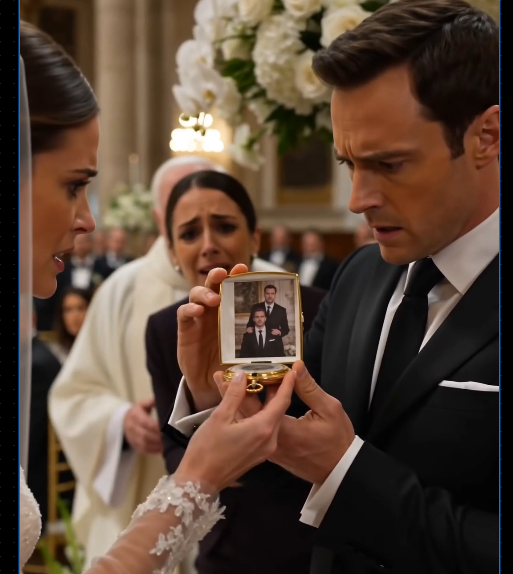
The ceremony had ended twelve minutes earlier. Guests were beginning the slow migration toward the reception hall, the string quartet was playing something tender and unhurried, and Dominic was near the altar accepting congratulations when Celeste had turned and seen her wedding coordinator — Elena Vasic, twenty-nine, efficient, meticulous, the woman who had spent seven months building this day into something perfect — standing off to the side with a gold pocket watch open in her trembling hands, staring at something inside it with an expression that had nothing to do with wedding coordination.
Celeste crossed the cathedral floor in eight steps.
“What are you doing?”
Elena looked up. Her face was the face of someone caught not in a wrong act but in a private moment they weren’t ready to explain — which, depending on the circumstances, can be worse.
“I — I can explain—”
“You ruined my wedding!” The words left Celeste at full volume, and the cathedral’s acoustics, designed for centuries to carry sacred sound to every corner, did their job perfectly. Three hundred heads turned. The string quartet trailed off. “Why were you touching my husband’s belongings?”
“Mrs. Hargrove, please—”
“Where did you get that? That is Dominic’s. That was his father’s.” Celeste reached toward the watch, and Elena pulled it back — instinctively, protectively — which was exactly the wrong thing to do.
“Please don’t take it. Not yet. Please.”
“Give it to me—”
“Just let me—”
“Give it to me right now!”
The guests had formed a loose, horrified circle. No one spoke. Two of Celeste’s bridesmaids had appeared at her shoulder, uncertain whether to intervene or simply witness. Dominic was pushing through from the altar, his face cycling through confusion and alarm.
Elena stood in the center of the cathedral with the watch in both hands and tears running freely down her face — not the tears of someone caught doing something shameful, but the tears of someone who has been carrying something for a very long time and has just reached the moment they can no longer carry it alone.
“Open it,” she said.
Her voice was barely above a whisper, but again the cathedral carried it.
“What?” Celeste said.
“Just open it. Please. Before you say anything else — just open it.”
Dominic reached them. He looked at Elena, then at his wife, then at the watch.
“What is happening?” he said.
“I don’t know,” Celeste said, her voice rigid. “She had your father’s watch and she won’t explain—”
“Open it, Dominic.” Elena’s eyes went to him. “Please. I’ve been trying to find the right moment for seven months. I know this isn’t it. But there isn’t going to be a right moment.”
Dominic took the watch from her hands. He looked at it — the gold case his mother had pressed into his hands the day before the wedding, telling him his father would have wanted him to carry it today. He’d clipped it to his vest that morning without opening it. He’d never opened it. His father had been gone since Dominic was four years old, and the watch had always felt less like an heirloom and more like a question he wasn’t ready to ask.
He opened it now.
Inside the case, tucked behind the clock face in the thin space where a watch should hold nothing, was a photograph. Small, folded once, the crease gone soft with decades. He unfolded it with careful fingers.
A man and a woman, young — twenty, perhaps twenty-two — standing in front of a building Dominic didn’t recognize, laughing at something outside the frame. The man’s arm around the woman’s shoulders. The woman visibly pregnant.
He knew the man’s face. He’d grown up with a single photograph of it on his mother’s nightstand.
He did not know the woman.
He looked up at Elena.
Something in his expression asked the question before his mouth could form it.
Father Aldric stepped forward from the edge of the gathered guests. He was seventy-eight, the cathedral’s senior priest, a man who had known the Hargrove family for forty years and baptized Dominic himself. He had been standing very still since the moment the watch opened, and now his face had gone the color of the cathedral’s white stone.
“That picture,” he said. His voice came out cracked and strange. “It vanished the day your father disappeared.”
The circle of guests contracted slightly, collectively, the way crowds do when something shifts from drama to revelation.
“Father Aldric,” Dominic said carefully. “What do you know about this?”
“Your father came to me the night before he left. He was — he was frightened. He said there were things he hadn’t told your mother. Things he needed to resolve before he could come home.” The old priest looked at Elena. “I never knew what they were. I never knew about—” He gestured toward the photograph. “I never knew about her.”
The entire cathedral was looking at Elena now.
She stood in her coordinator’s earpiece and her practical heels with her hands clasped in front of her, and she was crying, but she was also, somehow, very calm — the calm of someone who has rehearsed a moment so many times in their head that when it finally arrives, they’ve already lived it a hundred times over.
“My mother told me never to show it,” she said. “She said it would only cause pain. She said — she said he made his choice and we had to respect it.” She looked at Dominic. “But then I met you. At the venue walkthrough in February. And you were — you laughed the same way. You held your glass the same way. And I couldn’t—”
She stopped.
“I couldn’t plan your wedding and not tell you,” she said. “I couldn’t watch you build your life without knowing.”
“Knowing what?” Celeste said. Her voice had changed entirely. The anger had left it and something fragile had taken its place. “Elena. Knowing what?”
Elena looked at Dominic.
“That woman in the photograph,” she said. “The pregnant one.”
“Yes,” Dominic said.
“That’s my mother.”
The candlelight held. The peonies held. The three hundred guests in their finest stood in the Cathedral of Saint Marguerite and held their breath, and the string quartet did not play, and the only sound was the soft, shaking exhale of a groom on his wedding day, looking at a woman he had hired to plan the most important event of his life, and beginning to understand that she might be the most important person in it.
“You’re saying—” He couldn’t finish it.
“I’m saying I think we have the same father,” Elena said. “And I’ve known it since February. And I’m sorry. I’m so sorry for the timing. I didn’t know how—”
She didn’t finish either.
Some things don’t need finishing. Some things land completely in the silence between the last word and the next breath, in the space where a wedding becomes something else, and a stranger becomes family, and a gold pocket watch finally gives up the secret it has been keeping for twenty-five years.
