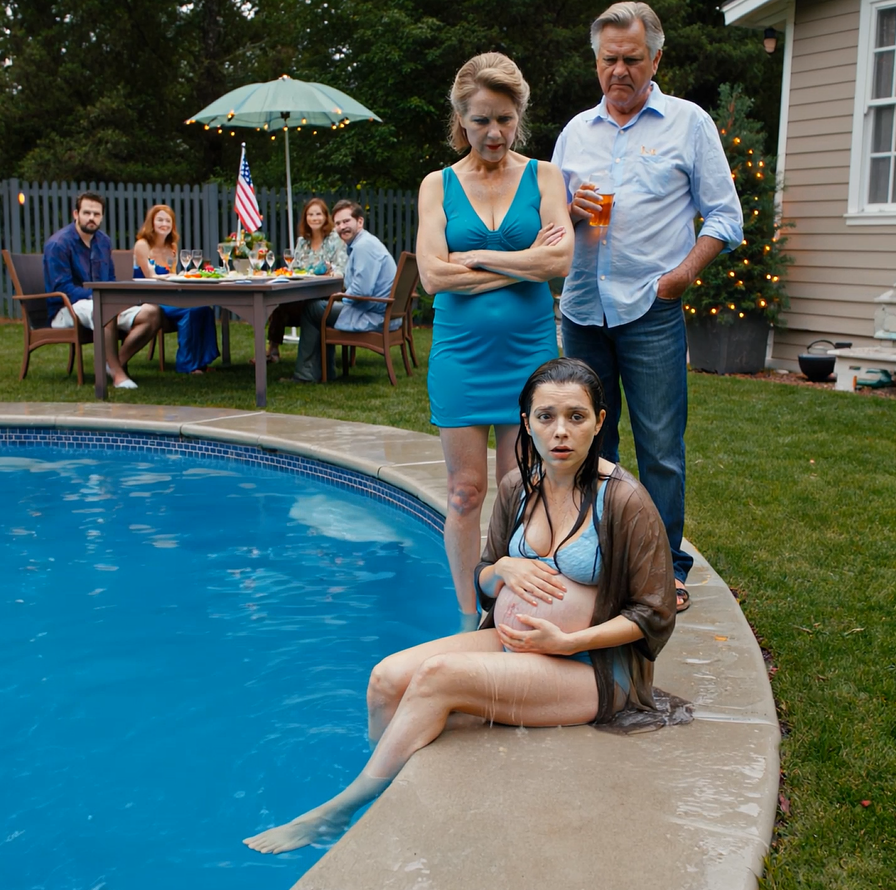
My own mother held my head underwater at the family pool party for just four minutes.
While everyone laughed, she said, “You need to endure this. It will make your unborn baby’s immune system strong.”
When I started thrashing and clawing at her arms, she tightened her grip and whispered into my ear, “Stop being such a crybaby. This is my new method of making your baby strong.”
Dad stood there watching and said, “She’s just toughening you up.”
The last thing I remember was letting my body go limp.
That was four years ago.
Yesterday, I woke up from my coma. She was sobbing over my hospital bed, begging, apologizing, shaking.
I looked her dead in the eyes and whispered back, “Now I’m coming for my revenge.”
The fluorescent lights burned my eyes when I first opened them. Everything felt wrong. My body was heavy, like someone had filled my bones with wet sand, and my throat was on fire. A tube snaked down into my chest, and machines beeped in rhythms I couldn’t understand. The ceiling tiles were yellowed and cracked in the corner, and I counted seventeen of them before I realized I was alive.
“Four years.” The doctor said those words three times before they finally penetrated the fog in my brain.
Dr. Montgomery, a woman with silver-streaked hair and kind eyes behind wire-rimmed glasses, held my hand while she explained what had happened to me. Severe hypoxic brain injury. Prolonged coma. Extensive brain swelling that had required emergency surgery.
A baby girl delivered via emergency cesarean section who had survived against impossible odds.
A baby girl. My daughter, Harper.
She was four years old now, and I had missed everything—her first breath, her first word, her first steps, the first time she called someone “Mama,” and that someone hadn’t been me.
The doctors told me she had been delivered within eight minutes of my cardiac arrest, that the emergency team had worked frantically to save us both. Harper had spent two weeks in the NICU, monitored for signs of oxygen deprivation, but she had emerged healthy and strong.
“A miracle twice over,” they said. Mother and daughter both defying the odds.
My hands shook as I tried to process the information. The last thing I remembered was the Fourth of July party at my parents’ house in Charlotte. The swimming pool glittering under the summer sun. My mother’s hands pressing down on my shoulders with a strength I never knew she possessed. The chlorinated water filling my nose, my mouth, my lungs. The muffled sound of laughter from above the surface. My husband Garrett’s voice saying something I couldn’t quite hear.
And then darkness.
When my mother walked into my hospital room two days after I woke up, I barely recognized her. Claudia Morrison had aged a decade in those four years. Her once vibrant auburn hair had turned mostly gray, and deep lines carved paths across her face like rivers on a map. She moved slowly, clutching her purse against her chest like a shield, and her eyes were red-rimmed and swollen.
“Vivien,” she whispered, and her voice cracked on my name. “Oh God, Vivien, baby, you’re awake. You’re really awake.”
She collapsed into the chair beside my bed and started sobbing—great, heaving sobs that shook her entire body. Her hands reached for mine, but I pulled away. The motion made my IV line tug painfully, but I didn’t care.
“I’m so sorry,” she wailed. “I’m so sorry. I never meant—I didn’t think. The doctors said you might never wake up. They said we should consider—”
She couldn’t finish the sentence.
“I’ve been praying every single day. Every single day for four years. Please, Vivien, please forgive me. It was supposed to help. I read about it online. Cold water immersion for pregnant women. I just wanted to help the baby. I just wanted to make her strong.”
I watched her cry. Something inside me had turned to stone during those years of darkness—something that used to feel sympathy for other people’s pain.
My mother was begging me for absolution, and all I could think about was how her fingers had felt wrapped around my skull, forcing me under the water while I struggled to protect the life growing inside me.
My father, Raymond, appeared in the doorway behind her, his face gray and drawn. He looked older too, diminished somehow, like someone had let the air out of him. He didn’t come any closer.
“She’s been a mess,” he said quietly. “We both have. This has destroyed her, Viv. She hasn’t been the same since that day.”
Something shifted in my chest—a cold, dark thing uncurling from where it had been sleeping.
I looked at my mother, watching the mascara run down her cheeks in black rivers, and I leaned forward as far as my weakened body would allow. My voice came out as a ragged whisper, my vocal cords still damaged from years of intubation.
“Now I’m coming for my revenge.”
She stopped crying. The color drained from her face so quickly I thought she might faint. My father made a strangled sound in the doorway.
“Vivien, you don’t mean that,” my mother said, her voice trembling. “You’re confused. The doctor said there might be some cognitive effects—”
“Get out,” I said.
They left. My mother kept looking back over her shoulder, her expression a mixture of horror and disbelief. When the door finally closed behind them, I closed my eyes and let myself remember everything.
I spent the next three months in rehabilitation, learning how to use my body again. My muscles had atrophied during my years in the coma, and even simple tasks like lifting a cup of water to my lips required enormous effort. My physical therapist, a patient man named Jerome, never let me give up, even on the days when I wanted to scream from frustration.
My sister, Miranda, visited twice during those months. She brought flowers the first time—yellow roses, my favorite—and sat awkwardly in the chair beside my bed, unable to meet my eyes.
“I should have stopped her,” Miranda said finally, staring at her hands. “I was there, Viv. I was standing right there. I thought…I don’t know what I thought. Mom said it was some kind of holistic treatment. She’d been reading those wellness blogs obsessively, talking about ice baths and cold exposure therapy. When she first pushed you under, I thought you were playing along. And then you started struggling, and Dad said you were just being dramatic. And Mom said you needed to endure it for the baby’s sake. And I just…I froze. I stood there and watched.”
“You all did,” I said.
“Garrett tried to pull you out,” Miranda whispered. “After about two minutes, he tried to intervene. But Dad held him back. Said Mom knew what she was doing. Said you were being hysterical.”
My husband.
I hadn’t seen Garrett since I woke up, and the absence was a wound I hadn’t let myself examine too closely. When I asked the nurses about him, they exchanged glances and changed the subject. When I asked Dr. Montgomery, she suggested I focus on my recovery first.
It was my aunt Sylvia who finally told me the truth.
She showed up on a Tuesday afternoon, her silver hair pulled back in a severe bun, carrying a folder thick with documents.
“Your mother is my sister,” Aunt Sylvia said, settling into the visitor’s chair with a crisp efficiency I remembered from my childhood. She had always been the practical one in the family, the one who dealt in facts while everyone else swam in emotions. “But what she did to you was attempted murder. Vivien, I’ve felt sick about it for four years, and I refused to stay silent any longer.”
She opened the folder and began laying out papers on my hospital bed—police reports, medical records, witness statements. A civil lawsuit that had been filed on my behalf by a court-appointed guardian while I was incapacitated.
“Garrett filed for divorce eighteen months after the incident,” Sylvia said matter-of-factly. “He cited your incapacitation and the trauma of witnessing the assault. The months following the incident broke something in him. I watched it happen. He visited you every day at first, then every week, then barely at all. The guilt of not stopping your mother sooner. The grief of losing the life you had planned together. The pressure from your parents insisting it had been an accident and that he needed to move on. It all became too much for him.”
She tapped another document.
“He was awarded full custody of Harper along with all marital assets. Your mother testified on his behalf at the custody hearing.”
The stone thing inside me grew heavier, colder.
“She testified that you had a history of mental health issues,” my aunt continued, her voice tight with barely suppressed fury. “That you had been showing signs of instability during your pregnancy. That she had only been trying to help you with an alternative therapy technique, and that your reaction was evidence of your underlying psychological problems. Your father corroborated her testimony.”
I couldn’t speak. My hands had curled into fists, fingernails digging into my palms until I felt the sharp bite of pain.
“The criminal case was dropped,” Aunt Sylvia said. “Lack of evidence of intent to harm. Everyone at that party—your parents, your sister, your husband, even the neighbors who were there—they all told the same story. Wellness treatment gone wrong. Tragic accident. No one pressing charges.”
“Garrett gave up custody of our daughter,” I managed finally, the words scraping against my damaged throat.
Aunt Sylvia’s expression softened slightly.
“He remarried six months ago. A woman named Bianca. They have a son together, and they’re living in Austin now. Harper is being raised by your parents.”
The laugh that escaped me was hollow and strange. My mother had nearly killed me, lied about it, helped my husband steal everything from me, and been rewarded with a chance to raise my child.
“I want to see her,” I said. “Harper. I want to see my daughter.”
“Your parents have legal guardianship,” Sylvia said gently. “They obtained it through family court while you were incapacitated, with Garrett’s support. When Garrett remarried and moved to Austin, he signed over his custody rights to your parents rather than uproot Harper from the only home she knew. If you want to change that arrangement, you’re going to need a lawyer.”
I spent that night staring at the ceiling tiles, counting them over and over, planning what came next.
Recovery was measured in inches. The physical therapists celebrated each small victory: the first time I stood unassisted for thirty seconds, the first time I walked the length of the rehabilitation hallway without my wheelchair waiting behind me, the first time I climbed a single stair. My body had forgotten how to be a body, and I had to teach it everything again, like a child learning for the first time.
The cognitive assessments were almost worse than the physical ones. Dr. Montgomery brought in specialists who tested my memory, my reasoning, my ability to process information and make decisions. They showed me pictures and asked me to identify patterns. They read me lists of words and asked me to repeat them back. They asked me questions about my life before the incident—where I had gone to college, what my job had been, the names of my childhood pets—and I answered them all correctly while something inside me screamed that none of this mattered, that my daughter was out there being raised by the woman who had tried to kill me.
The neuropsychologist, a serious man named Dr. Franklin Shaw, delivered his assessment with clinical detachment. My cognitive functions had recovered remarkably well, he explained. Some patients with my level of brain injury never regained consciousness at all. The fact that I could speak coherently, remember my past, and reason through complex problems was nothing short of extraordinary.
“You’re a medical miracle, Ms. Morrison,” he said, flipping through his notes. “The brain has remarkable plasticity, but what you’ve experienced goes beyond typical recovery patterns. You should consider yourself exceptionally fortunate.”
Fortunate.
The word tasted bitter on my tongue. I was fortunate that my mother had only held me underwater for four minutes instead of five. Fortunate that the paramedics had arrived quickly enough to restart my heart. Fortunate that my brain had managed to heal itself while the rest of my life crumbled into ruins.
I discharged myself from the rehabilitation facility against medical advice three weeks earlier than recommended. The doctors warned me about the risks—falls, setbacks, complications from pushing too hard too fast. I signed the papers anyway. Every day I spent in that facility was another day my daughter grew up without me. Another day my parents solidified their control over her life. Another day the lies they had told became more deeply entrenched in the official record.
Aunt Sylvia picked me up in her sensible sedan and drove me to the extended-stay hotel she had booked on my behalf. My old apartment was gone, of course. Garrett had terminated the lease during the divorce proceedings, selling or donating everything I owned. I had nothing but the clothes Sylvia had purchased for me and a prepaid phone she had set up in my name.
“Your parents have been calling me,” Aunt Sylvia said as she helped me settle into the hotel room. The space was small but clean, with a kitchenette and a window overlooking a parking lot. “They want to know where you’re staying. They want to arrange a meeting to discuss Harper’s care.”
“What did you tell them?” I asked.
“That you would contact them when—and if—you were ready.” Aunt Sylvia’s expression hardened. “Claudia cried on the phone for twenty minutes. Said you were being unreasonable. That she only ever wanted to help you. That this whole situation has been blown out of proportion. Raymond threatened to have his lawyer contact me about ‘interfering with family matters.’”
“And what did you say to that?” I asked.
My aunt smiled, thin and cold.
“I told him that his lawyer was welcome to try, and that I had witnesses prepared to testify about exactly what happened at that pool party.” She shrugged. “He hung up after that.”
The first night alone in that hotel room was the hardest. I lay in the unfamiliar bed, listening to the sounds of traffic outside my window, and tried to remember what my life had been like before. Garrett and I had been married for three years when I got pregnant. We had been happy—or at least I thought we had been happy. We talked about baby names and nursery colors and whether we wanted to find out the sex before the birth. I had felt nauseous every morning for the first trimester and craved pickles and peanut butter in combinations that made Garrett laugh. We had picked out a crib together, assembled it in the spare bedroom that would become the nursery, argued playfully about whether to paint the walls yellow or green.
All of that was gone now. Garrett had moved on, remarried, fathered another child. The nursery we had decorated together had been dismantled. The crib sold or given away. Every trace of the life we were building erased as completely as if it had never existed.
I cried that night for the first time since waking up—great, heaving sobs that shook my still weakened body and left me gasping for air. I cried for the pregnancy I barely remembered, for the birth I had missed entirely, for the infant daughter I had never held. I cried for the husband who had abandoned me, for the sister who had watched in silence, for the parents who had valued their reputations more than my life.
When the tears finally stopped, something else remained. Something harder and sharper than grief.
Determination.
The next morning, I began making phone calls. Aunt Sylvia had given me a list of attorneys who specialized in family law, and I worked my way through them one by one. Most were sympathetic but cautious. My case was complicated, they said. The existing custody arrangement had been established through proper legal channels. Overturning it would require substantial evidence of wrongdoing, and even then, the courts prioritized stability for the child.
“Your daughter has been living with your parents for four years,” one attorney explained gently. “In the eyes of the court, that’s the only home she’s ever known. Removing her from that environment—even to place her with her biological mother—could be seen as traumatic and disruptive.”
“Her grandmother tried to kill me,” I said flatly. “Her grandmother held me underwater until I stopped breathing. How is that a safe environment?”
The attorney shifted uncomfortably.
“I understand your perspective, Ms. Morrison, but the incident was investigated at the time, and no charges were filed. Without new evidence—”
I hung up before he could finish.
The breakthrough came from an unexpected source.
Jennifer Okafor had been my closest friend at work before the incident. We had started at the marketing firm on the same day, bonded over shared complaints about our micromanaging boss, celebrated each other’s promotions, and commiserated over each other’s setbacks. When I woke from my coma, she was one of the first people Aunt Sylvia contacted on my behalf.
Jennifer came to visit me at the hotel on a rainy Thursday afternoon, carrying takeout containers of Thai food and a folder bulging with papers.
“I’ve been doing some research,” Jennifer said, spreading documents across the small table in my kitchenette. “After Sylvia told me what really happened, I couldn’t stop thinking about it. Your mother’s story about the wellness treatment—I knew I’d heard something similar before, and it took me weeks to track it down.”
She pulled out a printout of a website. Garish colors. Pseudoscientific jargon. Testimonials from satisfied customers.
COLD WATER IMMERSION THERAPY FOR EXPECTANT MOTHERS, the header proclaimed. BOOST YOUR BABY’S IMMUNE SYSTEM NATURALLY.
“This is what your mother was reading,” Jennifer said. “The site was taken down about six months after your incident, but I found archived versions. Look at the recommended protocol.”
I read through the instructions with growing horror. The website advocated for pregnant women to be submerged in cold water for extended periods—up to five minutes at a time—claiming that the stress response would somehow strengthen the developing baby’s immune system. There were no medical citations, no scientific backing, just anecdotes and promises and dangerous misinformation dressed up in the language of “natural wellness.”
“It gets worse,” Jennifer continued. “I found three other incidents linked to this website. A woman in Florida who went into premature labor after attempting the treatment. A baby in Oregon born with complications that the parents believe were caused by oxygen deprivation during an immersion session. And a wrongful death lawsuit in Nevada that was settled out of court.”
“My mother found this website and decided to try it on me,” I said slowly. “Without my consent. Without telling me what she was planning.”
“The comment section on the archived pages is…illuminating.” Jennifer pulled out another sheet of paper. “Your mother posted there under a username I was able to trace back to her email address. She asked questions about the proper technique, about how long to hold the immersion, about what to do if the subject resisted.”
My hands were shaking as I read through my mother’s posts. She had been planning this for weeks before the Fourth of July party. She had researched the technique, asked for advice from other believers in this dangerous pseudoscience, convinced herself that she was doing something beneficial for her granddaughter. The replies to her posts were encouraging, supportive, utterly divorced from medical reality.
“This is evidence,” I said. “This proves it wasn’t an accident. This proves she planned it.”
Jennifer nodded.
“I’ve already made copies for your attorney. Whoever you end up hiring is going to want to see this.”
I hugged Jennifer so tightly that she laughed and complained she couldn’t breathe. For the first time since waking up, I felt something other than despair and rage.
I felt like I might actually have a chance.
The weeks that followed were consumed by preparation. Aunt Sylvia helped me find a small apartment—nothing fancy, just a one-bedroom unit in a quiet complex with good schools nearby. She co-signed the lease since I had no credit history, no recent employment record, nothing to prove I was capable of functioning as an adult in the world I had woken up to.
I started physical therapy as an outpatient, pushing myself harder than the therapists recommended. My body ached constantly, muscles screaming from the effort of rebuilding themselves, but I welcomed the pain. It reminded me that I was alive, that I had survived something that should have killed me, that I was strong enough to keep fighting.
The nightmares began around this time. I would wake up gasping, convinced I was still underwater, still feeling my mother’s hands pressing down on my head. Sometimes I dreamed I could hear Harper crying somewhere far away, her voice getting fainter and fainter until it disappeared entirely. The therapist, Dr. Winters, prescribed medication to help me sleep, but I refused it.
I needed to be sharp, clear-headed, ready for whatever came next.
Miranda tried to visit once during this period. She showed up at my apartment unannounced, standing in the hallway with tears streaming down her face, begging me to talk to her. I watched her through the peephole for a long moment before walking away and turning up the volume on my television.
My phone buzzed with her text messages for hours afterward.
I know you hate me.
I hate myself too.
Please just let me explain.
Please just give me a chance to make this right.
I deleted every message without responding.
There was nothing Miranda could say that would change what had happened. She had stood by the pool and watched our mother try to kill me. She had testified in court that I was mentally unstable. She had helped Garrett take my daughter away.
Some betrayals are too deep to forgive with words.
I found a job at a small marketing consultancy downtown—not as prestigious as my old position, but the owner was willing to take a chance on someone with a four-year gap in her résumé when I explained the circumstances. The work was tedious, mostly data entry and basic analytics, but it gave me a paycheck and a reason to get out of bed every morning.
My coworkers treated me with a mixture of curiosity and pity that I learned to ignore. They whispered about me in the break room—the woman who had been in a coma for four years, the woman whose own mother had nearly drowned her, the woman who was fighting to get her daughter back.
I let them whisper. Their opinions meant nothing compared to what I was working toward.
The attorney’s name was Maxwell Cooper, and he came recommended by Aunt Sylvia’s network of practical-minded friends. He was a lean man in his fifties with shrewd eyes and a reputation for handling complicated family cases. When I first met him, I was still using a wheelchair, my legs not yet strong enough for extended walking, but my mind was sharper than it had ever been. Four years of darkness had stripped away everything unnecessary, leaving only clarity and purpose.
“Your case has several avenues,” Maxwell said, spreading documents across the conference table in his downtown office after I finished explaining the assault, the coma, the stolen years, the daughter I had never held. His expression remained neutral, but something flickered in his gaze.
“Criminal prosecution is unlikely at this point,” he said, “given the statute of limitations and the existing testimony. But civil remedies are very much on the table.”
“I don’t care about money,” I said.
“This isn’t about money, Ms. Morrison.” Maxwell leaned back in his chair. “It’s about establishing a legal record of what actually happened. Your mother’s testimony in your husband’s divorce and custody proceedings was defamatory and damaging to your parental rights. If we can prove that she deliberately misrepresented the facts—that this wasn’t a wellness treatment but an assault—we can potentially overturn the guardianship arrangement.”
“How do we prove that?” I asked.
Maxwell smiled, thin and sharp.
“Your aunt has been busy these past four years. She collected contact information for everyone at that party. Several of them have expressed private discomfort about what they witnessed. One neighbor in particular, a woman named Veronica Sanchez, has apparently been struggling with guilt about her silence.”
Three weeks later, I sat across from Veronica Sanchez in a quiet coffee shop downtown. She was a small woman in her forties, nervous and fidgety, unable to stop adjusting her coffee cup.
“I can’t stop thinking about it,” Veronica said, her voice barely above a whisper. “The way you looked when they pulled you out of the pool. You were so pale. Your lips were blue. And your mother…she was standing there saying it was fine, that you just needed to catch your breath, that you were being dramatic. But you weren’t breathing at all. Your husband was screaming for someone to call 911. And your father kept saying to wait, to give you a minute.”
“Tell me everything you remember,” I said.
Veronica talked for two hours. She described how my mother had announced her plan earlier that afternoon, a special “immunity-boosting treatment” for pregnant women that involved cold water immersion. How she had led me to the pool and told me to take a deep breath. How the initial dunking had seemed playful, almost, and several guests had laughed and clapped.
How the laughter had died when I started thrashing.
How my father had blocked Garrett from reaching me.
How my sister Miranda had covered her mouth with her hands but never moved to help.
How four minutes had stretched into an eternity before my body went limp and my mother finally released me.
“When the paramedics came,” Veronica said, her eyes wet with tears, “your mother told them you had slipped and hit your head on the pool ladder. She said you must have been disoriented and inhaled water. She said she tried to pull you out, but you kept struggling. Everyone backed her up. I don’t know why I did it. I was scared, I think. Your parents are respected in the community. Your father sits on the city council. I didn’t want to cause trouble.”
“Will you tell the truth now?” I asked.
Veronica nodded slowly.
“I should have told it four years ago. Maybe you wouldn’t have lost everything.”
With Veronica’s testimony and similar statements from two other witnesses Maxwell’s investigators had located, we filed a motion to modify the guardianship arrangement. My parents hired their own attorney, an expensive criminal defense lawyer named Sebastian Drake, who specialized in protecting wealthy clients from consequences.
The legal battle that followed was brutal and exhausting. But I had something my parents hadn’t counted on.
Time.
Four years of lying in darkness had taught me patience. Four years of missing my daughter’s life had taught me what truly mattered. And four years of my mother’s hands pressing down on my head had taught me that the people you trust most can hurt you worst.
Months into the case, Maxwell called me into his office on a Friday afternoon in late September, his expression grave.
“We have a problem,” he said, sliding a document across his desk. “Your parents’ attorney has filed a motion to dismiss our petition. They’re arguing that you lack the mental capacity to serve as Harper’s primary caregiver.”
I stared at the legal language, trying to make sense of the dense paragraphs.
“On what grounds?” I asked.
“They’ve obtained statements from two psychiatrists who claim that your prolonged coma may have resulted in personality changes, impaired judgment, and potential instability. Neither psychiatrist has actually examined you, mind,” Maxwell added. “They’re basing their opinions on medical records and statements provided by your parents.”
“That’s not how psychiatric evaluation works,” I said, my voice rising. “They can’t just make claims without examining me.”
“They can file motions based on ‘expert opinions,’” Maxwell replied, “and the court will have to address those motions before proceeding with our case.” His jaw tightened. “This is a delay tactic, pure and simple. Your parents are trying to drag this out, hoping you’ll run out of money or energy or will before we can get to a hearing.”
“How long?” I asked.
“Months, potentially. We’ll have to arrange for our own psychiatric evaluation, submit counterevidence, argue the motion before a judge. Your parents have deep pockets. Your father’s political connections give them access to resources most families couldn’t afford.”
I thought about my small apartment, my entry-level job, the modest savings account Aunt Sylvia had helped me establish with the settlement from my meager assets. I thought about Harper growing older every day, being told stories about her unstable mother, being shaped by my parents’ version of events.
“We keep fighting,” I said. “Whatever it takes, however long it takes, we keep fighting.”
Maxwell nodded slowly, something like respect flickering in his eyes.
“Then let’s get to work.”
The psychiatric evaluation Maxwell arranged was conducted by Dr. Elizabeth Winters, a forensic psychiatrist with decades of experience in custody cases. She met with me over several sessions, asking probing questions about my mental state, my memories of the incident, my plans for Harper’s care.
At the end of our final session, she set down her notepad and looked at me with something approaching admiration.
“I’ve evaluated hundreds of patients over my career,” she said. “People who have experienced trauma often struggle with anger, with obsessive thoughts about revenge, with an inability to move forward. You have every right to those feelings, Ms. Morrison. What your mother did to you was monstrous.”
“But?” I prompted.
“But you’re not consumed by those feelings,” she said. “You’ve channeled your energy into practical goals—recovery, employment, building a stable life for your daughter. Your priorities are clear, your thinking is organized, and your emotional responses are appropriate to your circumstances.” She paused. “In my professional opinion, you are not only mentally competent to care for your daughter, you are remarkably resilient. Whatever personality changes your parents’ experts claim to see, I find a woman who has survived an unimaginable trauma and emerged with her fundamental self intact.”
Her report was submitted to the court three weeks before the hearing. Sebastian Drake filed objections, claiming that Dr. Winters was biased, that her methodology was flawed, that the evaluation had been conducted improperly.
The judge dismissed every objection.
Meanwhile, Aunt Sylvia had been working her own contacts. She helped coordinate with Maxwell’s investigators to prepare witness testimony from Veronica Sanchez, ensuring her statement would hold up under cross-examination. She also located a former friend of my mother’s who had become alarmed by Claudia’s obsessive interest in alternative medicine and had tried to warn her away from dangerous practices. And she found a nurse from the hospital who remembered inconsistencies in the story my parents had told the emergency room doctors.
“The mother kept changing details,” the nurse, a woman named Denise, told us in a recorded statement. “First she said the patient had slipped on the pool ladder. Then she said the patient had jumped in and hit her head on the bottom. Then she said the patient had been practicing holding her breath and gone too long. The father kept correcting her, trying to keep the story straight, but it was obvious they were lying about something.”
Our case was building piece by piece, testimony by testimony. My parents’ carefully constructed narrative was beginning to crack under the weight of accumulated evidence.
The night before the hearing, I couldn’t sleep. I sat by my apartment window, watching the lights of the city flicker in the darkness, and thought about Harper. She would be in the courtroom tomorrow, not physically, but her entire future would be decided by what happened in that room. Whatever the judge decided would shape the rest of her life.
I thought about what it would mean if I lost. If the court decided that my parents should retain guardianship, if my mother’s lies prevailed over the truth, if I was forced to watch my daughter grow up calling someone else “Mama.” The thought was unbearable, a weight pressing down on my chest until I could barely breathe.
But I also thought about what it would mean if I won. If Harper was returned to me, she would be taken from the only home she had ever known. She would lose her grandmother, her grandfather, the bedroom and toys and routines that made up her entire world. She would have to learn to love a mother she didn’t remember, to trust a stranger with her own face.
Was I fighting for Harper’s best interests, or was I fighting for my own need for justice?
The answer, I realized, was both.
And that was okay.
My daughter deserved to know the truth about what had happened. She deserved to be raised by someone who loved her genuinely, not by people who had proven themselves capable of terrible harm. She deserved a mother who would fight through anything—coma, divorce, legal battles, the total destruction of her previous life—to be there for her.
I was that mother.
Whatever happened tomorrow, I would prove it.
The guardianship hearing took place on a gray November morning, eight months after I woke from my coma. I walked into the courtroom on my own two feet, supported by a cane but standing straight and tall. My parents sat at the opposite table with their expensive lawyer, and for the first time since the hospital, I looked directly at my mother.
She had tried to reach out multiple times over the past months—phone calls, letters, messages through Miranda. Each one was full of apologies and explanations, of pleas for understanding. She had been desperate to help me, she wrote. She had been misled by bad information online. She never intended to hurt me. She loved me. She had always loved me.
I never responded.
In the courtroom, I listened as Veronica Sanchez took the stand and described what she witnessed. I listened as my mother’s attorney tried to discredit her as a disgruntled neighbor with an axe to grind. I listened as Maxwell Cooper methodically dismantled the false narrative my parents had constructed, presenting medical records showing that the severity of my injuries was inconsistent with a simple drowning accident.
When my mother took the stand, something extraordinary happened. Perhaps it was the weight of the truth finally being spoken aloud. Perhaps it was four years of guilt that had been eating away at her conscience. Or perhaps it was simply the look in my eyes when she glanced over at me—calm, patient, utterly devoid of the forgiveness she craved.
She broke.
“I knew it was wrong,” my mother sobbed, her composure crumbling on the stand. “I knew it after the first minute, when she kept struggling. But I couldn’t stop. I kept thinking if I just held on a little longer, the treatment would work. The website said the baby would be stronger, healthier. I wanted my granddaughter to have every advantage. And then Vivien stopped moving, and I thought…I thought she was just relaxing. I thought the treatment was working. By the time I realized something was actually wrong, it was too late.”
Sebastian Drake tried to intervene, to get her to stop talking, but my mother couldn’t be silenced. Four years of suppressed guilt came pouring out in a flood of tears and confession.
“Raymond told me to lie to the paramedics,” she continued, ignoring her lawyer’s frantic signals. “He said if I told the truth, I would go to prison. He said I would never see Harper grow up. So I made up the story about the pool ladder, and everyone went along with it because they were scared. And then Vivien didn’t wake up, and it was easier to keep lying than to admit what I had done. Even when Garrett started the divorce proceedings, even when we got guardianship, it was all built on lies. Everything.”
The judge called a recess. Sebastian Drake conferred frantically with my father while my mother sat alone, weeping into her hands.
Maxwell leaned over to me with a satisfied expression.
“That confession changes everything,” he said. “Not just for the guardianship case. She just admitted to filing false statements in multiple legal proceedings. Your father’s potential liability as a co-conspirator is substantial.”
I watched my parents across the courtroom—my father red-faced and furious, my mother hollow and broken. Four years ago, they had held me underwater and watched me drown. They had lied to protect themselves. They had stolen my daughter and my husband and my life.
This was my revenge.
And it tasted like ashes in my mouth.
The guardianship was transferred to me three weeks later. My parents’ attorney negotiated a settlement to avoid criminal charges for perjury and filing false statements. My mother agreed to enter treatment for her obsessive behaviors and anxiety disorders, while my father resigned from the city council and agreed to community service. The financial settlement provided enough for me to establish a stable home for Harper and myself.
Meeting my daughter for the first time was the hardest thing I have ever done.
She didn’t know me. Why would she? She had been raised by my parents for four years on bedtime stories about how her birth mother was sick and sleeping and might never wake up.
When I walked into the supervised visitation room at the family services office, Harper looked at me with curious blue eyes—Garrett’s eyes—and no recognition at all.
“Hello, Harper,” I said, lowering myself carefully into a child-sized chair. My legs still ached from the effort of walking, but I wanted to be at her level. “My name is Vivien. I’m your mommy.”
“Grandma said my mommy was sleeping,” Harper said. “Are you awake now?”
“I am,” I managed, my voice thick with emotion I couldn’t control. “I’ve been sleeping for a very long time, but I’m awake now, and I’m not going to sleep anymore.”
Harper tilted her head, considering this information.
“Grandma says you might sleep again,” she said. “She says I should be careful not to love you too much in case you go back to sleep.”
The stone thing inside me—the cold, dark thing that had kept me going through all those months of recovery and legal battles—cracked just a little.
“I’m not going back to sleep,” I said firmly. “I promise you, Harper, I’m going to be here from now on. It might take some time for us to get to know each other, but I’m your mommy, and I love you very much.”
Harper nodded solemnly.
“Okay,” she said. “Do you want to see my drawings? I like to draw horses.”
We spent the next hour looking at her artwork—dozens of colorful horses in various poses, some with wings, some with unicorn horns, all of them vibrant and alive. My daughter had spent four years growing up without me, and she had become a person I didn’t know at all.
But she was here, and I was awake, and we had time.
That night, alone in the small apartment I had rented near the family services office, I sat by the window and watched the city lights flicker in the darkness. My phone buzzed with a message from Miranda—another apology, another plea for reconciliation.
I deleted it without reading.
The revenge I had promised my mother in the hospital had come true, but not in the way either of us expected. I hadn’t destroyed her. She had destroyed herself, unable to carry the weight of her lies any longer. My father’s reputation was ruined. His political career was over. His marriage to my mother was showing signs of strain. Miranda had moved across the country, unable to face me with the guilt of her inaction.
I had won, but winning felt hollow compared to what I had lost. Four years of my daughter’s life. Four years of my own life. A marriage that might have survived if my husband hadn’t been broken by witnessing my near-death. Trust in my own family that could never be restored.
The therapist I started seeing, Dr. Caroline Meadows, a kind woman who specialized in trauma recovery, helped me understand that revenge and healing weren’t the same thing. One could give you satisfaction. Only the other could give you peace.
A year after I woke from my coma, I was granted full custody of Harper. Garrett relinquished his remaining parental rights voluntarily, too consumed by his new family in Austin to maintain a connection with the daughter he had abandoned.
Harper and I moved into a small house with a backyard big enough for the garden I wanted to plant and the dog she had been begging for. We named the dog Winston, after the character in her favorite book about a brave little mouse. She had been asking for a puppy ever since she moved in with me, leaving drawings of dogs on the refrigerator and pointing out every golden retriever we passed on our walks. Winston was a golden retriever mix with more energy than sense, and watching Harper chase him around the yard became my favorite part of every day.
My mother wrote to me on Harper’s fifth birthday, a long letter full of explanations about the websites that had convinced her cold water immersion was beneficial, the desperation she had felt to give her grandchild advantages, the horror she experienced when she realized what she had done. She was in therapy now, she wrote. She had been diagnosed with anxiety and obsessive-compulsive tendencies that had spiraled out of control during my pregnancy. She took responsibility for her actions. She would understand if I never forgave her.
I kept the letter in a drawer for six months before I wrote back.
I don’t forgive you, I wrote. I don’t know if I ever will. What you did stole four years of my life and nearly killed me and my daughter. You lied about it. You helped my husband take everything from me. You raised my child on stories about how I might never wake up.
I paused, my pen hovering over the paper.
But I’m not interested in revenge anymore, I continued. I spent so long in the darkness, dreaming of making you pay for what you did. Now I have my daughter back. I have a life. I have a future. And I’m not going to waste any more of my time and energy on hating you.
I mailed the letter and never received a response.
Perhaps there was nothing left to say.
Two years after I woke from my coma, Harper started first grade. I stood on the sidewalk outside her school, watching her disappear through the front doors with her horse-patterned backpack, and I felt something unfamiliar blooming in my chest.
Hope.
The years I had lost would never come back. The family I had trusted had betrayed me in the worst possible way. But I was alive, and my daughter knew my name, and the future stretched out before us like an unwritten book.
I had whispered a promise of revenge to my mother in that hospital room.
And in a way, I had kept it.
But the real victory wasn’t in her suffering or my father’s disgrace or my sister’s exile. The real victory was standing on this sidewalk on a crisp September morning, watching my daughter start first grade, knowing that I would be here to pick her up when the final bell rang.
I went home, made coffee, opened my laptop, and started writing. Not this story, not yet. A different story about a woman who survived something terrible and learned to live again. Fiction helped me process what reality had given me, and the words flowed easier than they had since before my pregnancy.
Winston curled up at my feet, snoring softly. Outside my window, the autumn leaves were beginning to turn. Somewhere across the country, my parents were learning to live with the consequences of their choices, and my ex-husband was raising a son who would never know about the half sister he had abandoned.
I didn’t waste time thinking about them.
I had a daughter to raise, a life to rebuild, and no more room in my heart for hatred.
The revenge was complete.
The healing had finally begun.
And when Harper came home that afternoon, chattering about her new teacher and the friend she had made at recess, I held her close and breathed in the scent of her strawberry shampoo and felt something I hadn’t experienced in over four years.
Peace.
Not forgiveness—never that.
But peace, which turned out to be enough.
