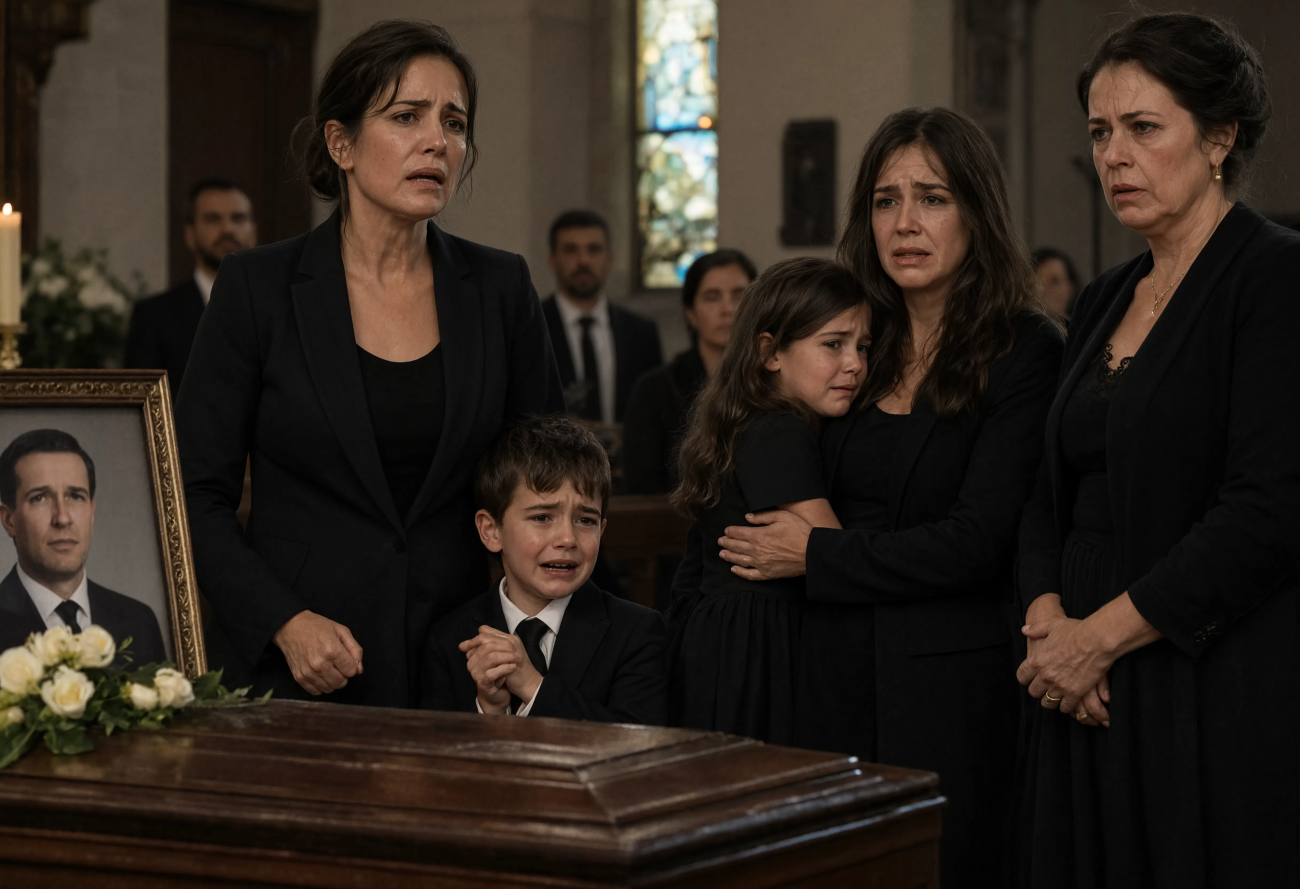
— Did you really not know about us?
I lifted my black veil and looked down.
A girl of about eight stood in front of me wearing a dark coat. Her enormous gray eyes were identical to my late husband’s.
Beside her stood a pale woman with a frozen expression.
“What did you say, sweetheart?” I asked.
The girl pointed toward the portrait beside the coffin.
“Mommy told me that man was my daddy.”
A loud ringing filled my ears.
“Laura, don’t,” someone whispered behind me.
I turned around.
It was my mother-in-law.
But her voice held no surprise.
Only panic.
“You know them?” I asked.
The woman beside the girl straightened.
“Of course she knows us. She’s the one who asked us not to come before today.”
“What?” I whispered.
My six-year-old son, Michael, gripped my hand tightly.
“Mommy, who are they? I want to go home.”
I knelt in front of him.
“Everything is okay, sweetheart.”
It was a lie.
Nothing was okay.
Three days earlier, my husband, Oliver, had died in a car accident. For three days, I had lived inside a fog, calling relatives, choosing his burial clothes, and holding our son as he repeatedly asked when his father would come home.
Now, when I thought my pain had reached its limit, life had found another way to destroy me.
“Explain this,” I said, struggling to remain standing.
My mother-in-law moved closer.
“Laura, this is not the time.”
“No. This is exactly the time.”
The woman placed both hands on the girl’s shoulders.
“This is Anna. She’s eight years old. Your husband supported us for six years.”
Cold spread through my entire body.
“That’s a lie.”
“I wish it were,” she replied. “Oliver rented an apartment for us, paid for Anna’s school, and visited on weekends. He promised he would tell you everything after his mother died.”
I slowly turned toward my mother-in-law.
She lowered her eyes.
“You knew.”
“I was protecting the family!” she snapped. “Your family! Had you found out, you would have divorced him!”
“How many years did this continue?”
The little girl approached the coffin.
“Daddy promised to take us to the beach this summer,” she whispered before bursting into tears.
Michael began crying too.
“Mommy, why does that girl call Daddy her daddy?”
His question tore through me.
The woman opened her bag and handed me an envelope.
“I didn’t want to bring these here, but now that Oliver is gone, I have no one else to turn to.”
Inside were photographs, receipts, and Anna’s birth certificate.
Oliver’s name appeared under Father.
Then I noticed the girl’s date of birth.
My heart stopped.
On the exact day Anna had been born, I had also been in the hospital.
I had delivered a baby girl who doctors claimed was stillborn.
They had never allowed me to see her.
“How old did you say your daughter is?” I whispered.
“Eight.”
“And her birthday?”
She repeated the date.
It was identical.
My mother-in-law took a nervous step backward.
I looked at the little girl’s gray eyes again.
Then I turned toward my mother-in-law.
“Who is this child really?”
PART 2
My mother-in-law’s face had gone the color of ash. She opened her mouth, then closed it again, as if she could somehow swallow the question back down.
“Who is she?” I repeated, louder now, my hand trembling around the envelope. “You were in that hospital room with me. You held my hand when they told me she hadn’t survived. Look at me and tell me why this child has the same birthday.”
“Laura, please, not here, not in front of—”
“Tell me.”
The woman with the frozen expression — the one I now understood had spent years living some version of a life that overlapped with mine — looked between us, confusion creeping into her features for the first time.
“Margaret,” she said slowly, using my mother-in-law’s name like a question. “You told me Anna’s mother gave her up. That she couldn’t care for a child. You said Oliver was doing a kind thing, taking her in.”
The color drained further from Margaret’s face.
“What is she talking about?” I asked. “Margaret. What did you do?”
She sank onto the front pew, her legs seeming to give out beneath her.
“You were unconscious for almost two days after the delivery,” she said finally, her voice barely audible over Michael’s quiet sobbing. “The bleeding wouldn’t stop. The doctors were fighting to save you, and no one had time to explain anything properly. When you woke up, you were told the baby hadn’t made it. It was easier than telling you the truth.”
“What truth?” My voice cracked on the word.
“She was born early. Small. Struggling to breathe. The specialists said she needed care we couldn’t have given her at home, care that would have meant months in the city, away from you, away from Michael who was barely two at the time.” Margaret’s hands twisted in her lap. “I made a decision. I told the hospital we couldn’t take her, that she should go to a family who could give her what she needed. Oliver agreed, God forgive him. We told you she died because we thought—” her voice broke, “—we thought it would be a mercy. A clean grief instead of watching her fight for months and maybe still lose her.”
I stared at the little girl standing beside the coffin, at eyes that were not just Oliver’s — they were mine too, I realized now, my own mother’s eyes staring back at me from a face I had never been allowed to memorize.
“You gave away my daughter,” I said, “and let me bury a grief that wasn’t even real.”
“Oliver found her again three years later,” the other woman said quietly, seeming to understand at last what she herself had been swept into. “Through the adoption agency. He told me she was a family friend’s child, that he was helping out of guilt over her circumstances. He visited every weekend. He paid for everything.” She looked down at Anna, horror dawning slowly on her face. “He never told me she was his. He never told me she was yours.”
“He knew,” I whispered. “This whole time, he knew she was alive, and he let me believe I buried her.”
Anna turned from the coffin, her small face streaked with tears, and looked directly at me — really looked, the way children do when they’re trying to solve something too large for them.
“Are you my mommy?” she asked. “The real one?”
Michael’s hand tightened in mine, and for a moment I couldn’t speak at all, caught between the son beside me and the daughter I had mourned for eight years without ever knowing there had been nothing to mourn.
I knelt down, slowly, until I was at her eye level, the black fabric of my dress pooling on the church floor between us.
“Yes,” I said. “I am.”
Behind me, Margaret began to weep — for the first time since I’d known her, sounding genuinely broken. But I didn’t turn around. I reached out and, gently, took my daughter’s hand for the very first time.
