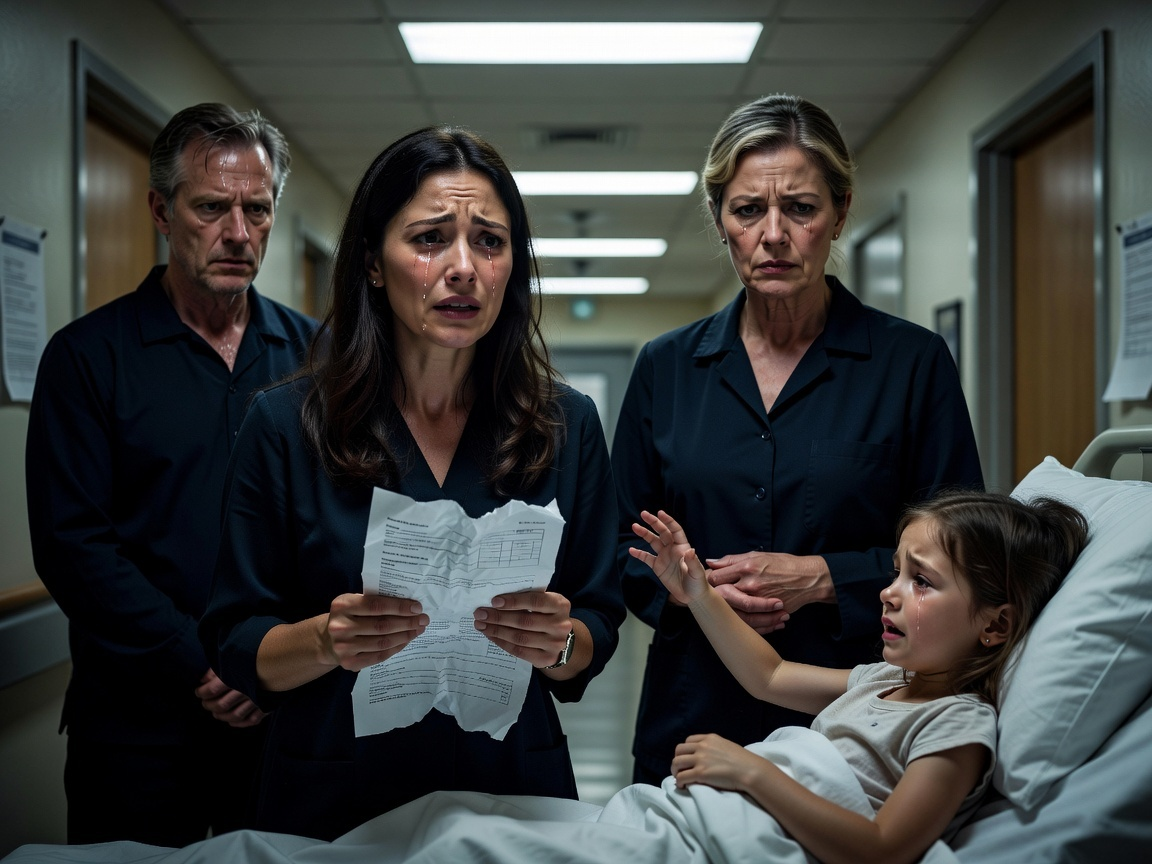
— Are you certain you are her biological mother?
I stared at the doctor, unable to understand why he would ask such a question.
The children’s hospital corridor smelled of disinfectant and fear.
My six-year-old daughter, Grace, was scheduled for emergency surgery in less than an hour. She was lying in her hospital bed, terrified, clutching her stuffed bear.
“What kind of question is that?” I whispered.
The doctor adjusted his glasses.
“There are unusual inconsistencies in the test results. They are extremely rare. I wondered whether there had been an adoption, an egg donor, or another medical circumstance. I need accurate information for her treatment.”
My knees nearly gave way.
“No. I gave birth to her.”
“I understand,” he said gently. “But I had to confirm.”
At that moment, my mother-in-law stepped into the corridor. She had come to “support” us.
When she heard the doctor’s final words, she froze.
The look on her face told me everything.
She knew something.
“Why are you looking at me like that?” I asked.
She quickly turned away.
“How should I know what is wrong with your tests?”
My husband, Robert, approached us.
“What happened?”
I turned toward him.
“The doctor wants to know whether I am Grace’s biological mother.”
His face lost all color.
“Robert?”
From inside the room, Grace began crying.
“Mommy! Don’t leave me!”
I rushed back to her bedside.
“I’m here, sweetheart.”
“I’m scared.”
I kissed her forehead, fighting back tears.
“Everything is going to be okay.”
But when I returned to the corridor, anger was burning inside me.
“Tell me now,” I said to my husband and his mother. “What are you hiding?”
My mother-in-law folded her arms.
“This is not the time.”
“This is exactly the time! My child is about to undergo surgery, and the doctor is asking whether I’m her mother!”
Robert rubbed his face nervously.
“It happened a long time ago.”
“What happened?”
His mother spoke before he could answer.
“You were unconscious after the delivery.”
My heart began pounding painfully.
“And?”
“There was confusion at the hospital that night,” Robert said.
“What kind of confusion?”
He remained silent.
My mother-in-law sighed.
“Another woman gave birth to a baby girl that night. The woman died several hours later. And your baby…”
I grabbed the wall.
“What happened to my baby?”
Robert closed his eyes.
“The doctors said she probably wouldn’t survive.”
“You knew?”
“I didn’t want to lose you,” he whispered. “You wouldn’t have survived the grief.”
Grace cried from the room again.
“Mommy!”
Tears streamed down my face.
“If Grace is not my daughter, then where is mine?”
My mother-in-law slowly removed an old photograph from her handbag.
It showed a woman I had never seen standing beside a little girl of about six.
Written on the back were the words:
“If you ever decide to tell her the truth, the child lives in Richmond.”
I raised my head.
“Who are they?”
Robert’s entire body began trembling.
His mother answered coldly:
“That is the woman who has been raising your real daughter all these years.”
PART 2
The corridor seemed to close in around me. I stared at the photograph — a stranger’s face, a little girl with my own dark eyes and my mother’s smile, six years old, standing in a yard I had never seen.
“Explain,” I said. “All of it. Now.”
Robert’s hands were shaking as he took the photograph from me, then set it down as if it burned him. “You had a hemorrhage during delivery. They rushed you into emergency surgery to save your life. In that same maternity ward, another woman had just given birth — a stranger, no family with her, and she died from complications within hours.”
“And the babies,” I said. “Tell me about the babies.”
“Yours was born early. Small. The doctors said her lungs weren’t developed enough, that she likely wouldn’t make it through the night.” His voice cracked. “The other baby was healthy. Full-term. No one to claim her.”
“So you switched them,” I said, the words tasting like acid.
“My mother did,” Robert whispered. “While I was in the hallway, out of my mind with fear that I was about to lose both my wife and my daughter in the same night.”
I turned to my mother-in-law. “You just — decided. You decided which child would live in this family and which one would be left behind, and you never told either mother the truth.”
“I told myself I was sparing you unbearable grief,” she said, though for the first time her voice wavered. “You were barely alive yourself. I thought, let her wake up to a healthy baby instead of a funeral. The other mother had already died — there was no one left to object.”
“There was a baby,” I said. “My baby. Alive, apparently, since you’re telling me she’s been raised in Richmond for six years. You didn’t spare me grief. You stole a decade of my daughter’s life from me and replaced her with someone else’s.”
“I know,” Robert said. “I’ve known for six years, and every single day I told myself I would find the courage to tell you, and every single day I was too afraid of what it would do to us — to Grace.”
“Grace.” I said her name like it might dissolve in my mouth. “The little girl in that room right now, about to go into surgery, terrified and calling for her mother — she’s not even mine, and I have loved her every single day since I first held her.”
“She is yours,” Robert said fiercely. “In every way that has ever mattered, she is yours.”
A nurse appeared in the doorway. “We need to take Grace back now. Are you coming?”
I looked at the photograph one more time — at a stranger’s daughter, my daughter, growing up hundreds of miles away without ever knowing my face — and then at the door where Grace was waiting, frightened, needing me.
“Yes,” I said, my voice finally steady. “I’m her mother. I am absolutely her mother, and nothing in that photograph changes what happens in that operating room today.”
I walked past both of them without another word, because right now, love outweighed biology, and there would be time — later, after Grace was safe — to reckon with everything else this family had buried.
