At My Daughter’s Graduation, the School Janitor Called Her “My Little Girl”
— I always knew you would make me proud, my little girl.
The elderly school janitor said those words as he hugged my daughter after her graduation ceremony.
I smiled politely at first.
Then I noticed the way my seventeen-year-old daughter, Emma, froze in his arms.
“Please don’t call me that,” she whispered.
The man stepped back.
His eyes were filled with tears.
“I’m sorry. I forgot myself.”
My husband, Richard, rushed toward us.
“What are you doing here?” he demanded.
The janitor’s expression changed.
“I work here.”
“You know what I mean.”
I looked between them.
“You two know each other?”
Richard grabbed my arm.
“Let’s go. The restaurant is waiting.”
Emma began crying.
“I’m not going anywhere.”
Hundreds of families were taking photographs around us, but suddenly it felt as if we were standing alone.
“What is happening?” I asked.
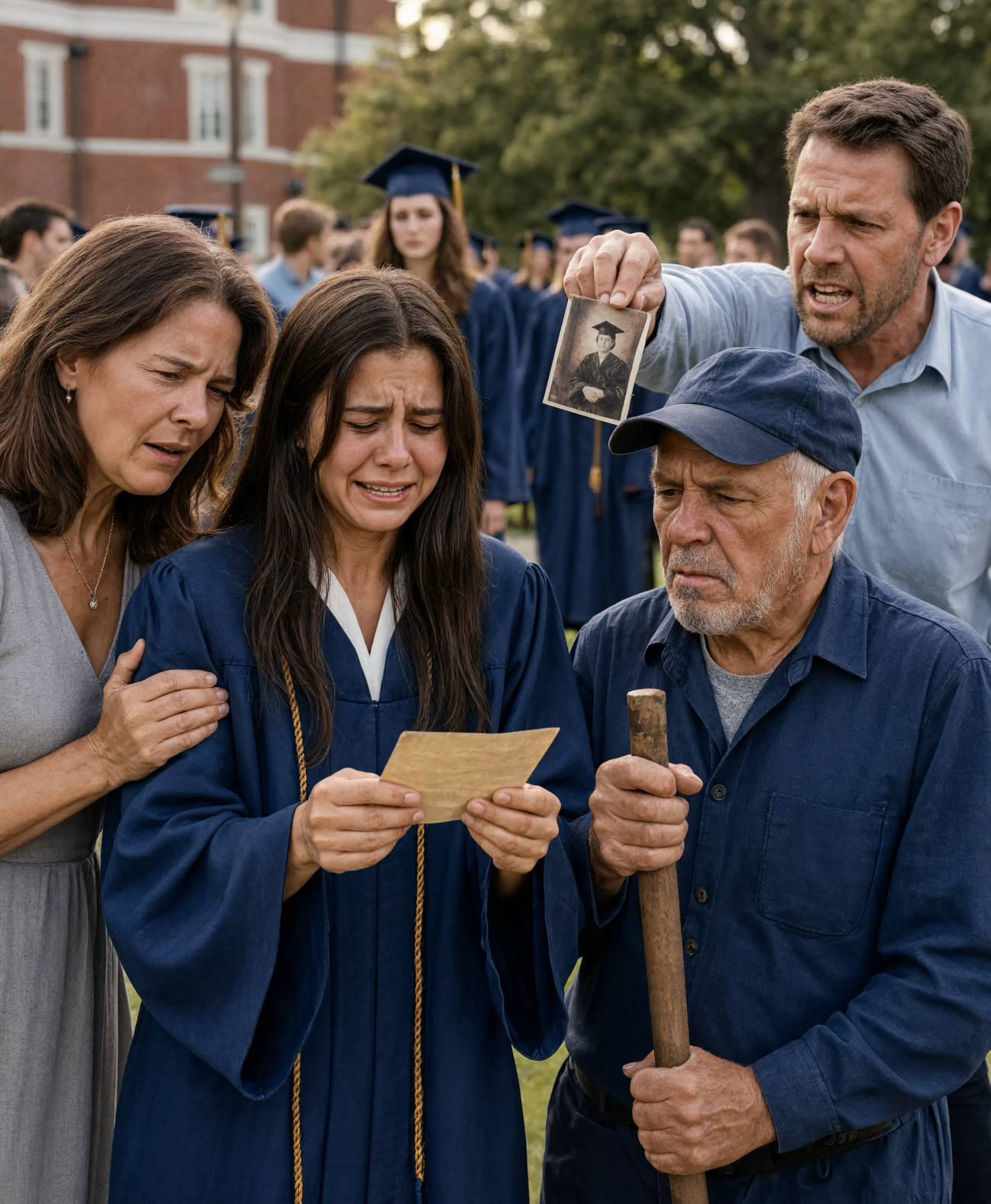
The janitor reached into his work jacket and removed an old photograph.
Richard tried to snatch it from him.
“Give me that!”
The man pulled it away.
“She deserves to know.”
Emma’s graduation cap fell from her hands.
“Know what?”
The janitor handed the picture to me.
It showed my husband as a young man standing beside a smiling teenage girl.
The girl was holding a newborn baby.
On the back someone had written:
“Our Emma. The best day of my life.”
My hands began to shake.
“Richard?”
“It isn’t what it looks like.”
The janitor laughed bitterly.
“It is exactly what it looks like.”
Emma covered her mouth.
“Dad, who is that woman?”
Richard said nothing.
The janitor answered.
“Her name was Catherine.”
“Was?” Emma asked.
“She died three days after you were born.”
My daughter staggered backward.
I reached for her, but she pulled away.
“You told me Mom gave birth to me.”
“I did give birth to you,” I said desperately.
And I believed it.
I remembered the hospital. The pain. The doctor placing a baby in my arms.
But there were things I did not remember.
The emergency surgery. The hours I had spent unconscious. Richard refusing to discuss why there were no photographs from the first day.
“Richard,” I whispered, “tell me he is lying.”
My husband looked at the ground.
The janitor’s voice softened.
“Catherine was my daughter.”
Emma stared at him.
“That makes you…”
“Your grandfather.”
She began sobbing.
Richard stepped toward her.
“Emma, listen to me. Your mother raised you. She loves you.”
“That isn’t an answer!” she screamed.
Students and parents started turning toward us.
I no longer cared.
“Why was another woman holding my daughter?”
Richard wiped sweat from his forehead.
“You lost your baby during delivery.”
My breath vanished.
“No.”
“The doctors said you might not survive the grief. Catherine had just died. Her baby had no mother.”
The janitor shook his head.
“That is not the full story.”
Richard’s face hardened.
“Be quiet.”
“You took Emma before my family reached the hospital,” the man continued. “Then your mother paid someone to change the records.”
Emma looked at me.
“Did you know?”
“No. I swear to you.”
She collapsed against my chest, crying.
The janitor removed another envelope.
“There is one more reason I came today.”
He handed it to Emma.
“This was written by your biological mother before she died.”
Emma opened the letter.
Her eyes moved across the first few lines.
Then she looked at Richard in horror.
“What does it say?” I asked.
She turned the page toward me.
The final sentence was underlined:
“Richard is not the baby’s father. He knows who is—and that man is still inside our family.”
PART 2
The final line of Catherine’s letter seemed to burn against my palm: Richard is not the baby’s father. He knows who is — and that man is still inside our family.
“Who?” I demanded. “Richard, tell me.”
He wouldn’t meet my eyes. “My brother. Thomas.”
Emma made a small, wounded sound. “Uncle Thomas?”
“He and Catherine were together before I ever met her,” Richard said, his voice cracking. “When she died so suddenly after the birth, he panicked. He was twenty years old, unmarried, terrified of what it would mean for the family business. I offered to raise the baby as my own. I told myself I was helping.”
The janitor’s hands curled into fists at his sides. “You didn’t help anyone. You erased my daughter’s memory completely, and let my granddaughter grow up two miles from my house while your mother threatened me with a restraining order every time I so much as waved at her outside a grocery store.”
Emma turned to her father, tears streaming freely now. “Does Uncle Thomas know? That I’m actually his?”
“He’s always known,” Richard admitted.
I thought of every holiday dinner, every birthday, Thomas sitting across the table from his own daughter for seventeen years without ever once saying a word.
“I want to see him,” Emma said. “Today. Not as an uncle. As whatever he actually is to me.”
The janitor reached for her hand, gently, and this time she didn’t pull away.
“And you,” she said, turning to him, “you’re really my grandfather. That part is true, at least.”
“That part was always true,” he said, his voice breaking. “I just never got to say it out loud.”
Richard sank onto a nearby bench, his graduation-day suit suddenly looking too small for the weight of everything he’d been carrying. “I was going to tell you eventually. I swear I was.”
“Eventually isn’t good enough,” I said. “Not after seventeen years.”
Emma wiped her eyes and looked between the two men — the father who had raised her under a lie, and the grandfather who had spent nearly two decades on the outside of a family that had once belonged, in every real sense, to him.
“I think,” she said quietly, “today needs to be about meeting Thomas. Everything else can wait until tomorrow.”
