I had barely finished giving birth when my eight-year-old daughter rushed into the hospital room, her eyes large and frightened. She darted to the window, pulled the curtains shut, then leaned close to my ear and whispered, “Mom… get under the bed. Right now.”
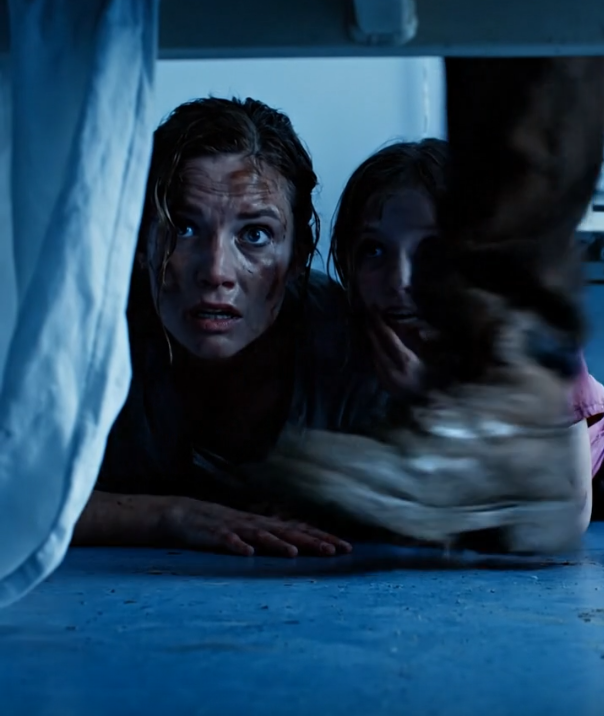
My body went cold. I didn’t argue. We slid beneath the bed, pressing ourselves into the tight space. Suddenly heavy footsteps entered. I tried to peek, but she gently covered my mouth, her expression filled with a fear I had never seen in her. And then…
When Raina slipped inside, her light sneakers barely tapped the tile before she shut the door behind her. Something about her face made my heart jolt. She was eight, but her eyes carried a fear too old for her years. Without speaking, she rushed to the curtains and pulled them shut with a swift tug. The baby slept soundly nearby in the plexiglass bassinet, unaware of the danger settling into the air.
“Mom,” she whispered, voice cracking slightly, “under the bed. Now.”
I was still weak from labor, my legs shaky, my stomach sore, but the urgency in her voice tore through every ache. I didn’t hesitate. Her fear was real. Her instinct was sharp.
We crawled beneath the hospital bed together. It was cold under there, the smell of metal and disinfectant thick in the air. Dust bunnies clung to the wheels of the mechanical frame. Raina clutched the edge of her denim jacket so tightly her knuckles turned white. I opened my mouth to ask what was happening, but she shook her head, eyes wide, pleading for silence.
Then we heard them. Footsteps. Heavy. Measured. Calm.
The pattern didn’t belong to staff. Nurses moved quickly, their rubber soles squeaking. Doctors moved with purpose, clicking against the linoleum. This rhythm was different. It was the heavy, thudding sound of work boots.
Raina grabbed both my hands and held them tight against her chest. Her heartbeat thudded rapidly, almost painfully against my palm.
I shifted slightly to look out, but she placed her hand over my mouth, her stare intense. She was terrified. Truly terrified.
The footsteps stopped right at the bedside. No one spoke. No one breathed. Then the mattress above us dipped, just enough to make the metal frame creak. I could hear breathing now, slow and deliberate, like the person was examining the room calmly, confidently.
A shadow slid closer to where we hid. And then, the boots came into view.
My blood turned to ice. They were brown leather work boots, scuffed on the left toe, with a distinct splash of dried yellow paint on the heel.
I knew those boots.
They belonged to David. My husband. The man who had just kissed my forehead thirty minutes ago and told me he was going to the cafeteria to get me a ginger ale.
Confusion warred with terror. Why was Raina hiding from her father? Why was he walking so strangely—so predatory?
Above us, David’s voice cut through the silence. But it wasn’t the warm, soft tone he used with me. It was cold. Detached.
“Room is clear,” he said. He was on the phone.
I felt Raina flinch. She squeezed my eyes shut, tears leaking out.
“Yeah, she’s not in the bed. Bathroom door is open, it’s empty,” David said. “She must have taken a walk. But the package is here.”
The package.
My eyes shot to the bassinet where my newborn son, Leo, was sleeping.
“I’m taking it now,” David continued. “Have the car running at the loading dock. I don’t want to deal with the mother if I don’t have to, but if she comes back before I’m out… yeah. I have the syringe ready. It’ll look like an embolism. Just get the money ready.”
The world spun. My husband. The man I had been with for five years. The man who rubbed my back during contractions. He wasn’t getting a soda. He was selling our son.
And he was willing to kill me to do it.
Raina must have heard him on the phone in the hallway. That’s why she ran. She knew.
I watched the boots turn toward the bassinet. I heard the wheels of the crib unlock.
A primal rage, hot and blinding, surged through my exhausted body. The pain in my uterus vanished, replaced by the adrenaline of a mother whose young were being hunted.
I looked at Raina. I pointed to the red emergency call button dangling from the bed frame, just inches from the floor where it had fallen.
She nodded.
As David’s boots shifted, moving the bassinet toward the door, I grabbed Raina’s ankle and squeezed. Now.
I rolled out from under the bed, screaming a sound I didn’t know I could make. I didn’t try to stand—I lunged for his legs.
David shouted, startled, stumbling back as I wrapped my arms around his heavy boot and yanked with every ounce of strength I possessed. He crashed to the floor, the phone skittering across the tiles. The bassinet wobbled but didn’t tip.
“Raina, run!” I screamed.
David kicked out, his heavy boot catching me in the shoulder, sending a shockwave of pain down my arm. “You stupid b*tch!” he snarled, his face twisted into a mask of hatred I didn’t recognize. He reached into his jacket pocket.
The syringe.
He scrambled to his knees, raising the needle. I was on the floor, defenseless, unable to get up fast enough.
Click.
The door handle turned. But it wasn’t the door opening.
Raina hadn’t run to the hallway. She had grabbed the heavy, metal oxygen tank standing in the corner. She was small, but the adrenaline of survival is a powerful thing. With a grunt of effort, she shoved the tank over.
It fell like a monolith, crashing directly onto David’s outstretched arm.
The crunch of bone was audible. David howled, dropping the syringe as he clutched his shattered forearm.
The door burst open. Two nurses and a security guard rushed in, alerted by the chaos.
David tried to scramble up, trying to put on his mask of the concerned husband. “She went crazy! She attacked me! Help me!” he yelled, pointing at me with his good arm.
For a second, the security guard looked at me—disheveled, bleeding from my IV site, lying on the floor.
“He has a needle!” Raina screamed, pointing under the bed where it had rolled. “He tried to kill Mom! Check his phone! He called the bad men!”
The security guard kicked the syringe away and pinned David to the ground.
Hours later, after the police had taken my statement and the hospital was swarming with detectives, I sat in a different room, holding Leo tight against my chest. Raina was asleep in the chair next to me, clutching my hand.
The police found the text messages. They found the wire transfer. David had gambling debts—huge ones. He had been planning this for months. A black-market adoption ring had offered him $50,000 for a healthy white male infant.
I looked down at the scuffed boots the police had bagged as evidence. I thought about how many times I’d seen those boots at the front door and felt safe.
I kissed Raina’s forehead. She shifted in her sleep, murmuring something.
I didn’t need a hero. I had raised one.
