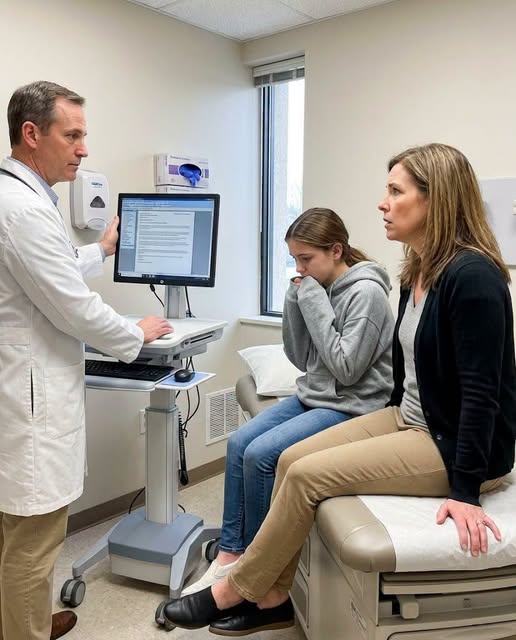
I got to my feet with my phone pressed into my palm.
For one hard second, every part of me wanted to call my husband right there in that exam room and demand an explanation.
I wanted to ask why he had taken our fifteen-year-old daughter to a medical appointment five weeks earlier and never told me.
I wanted to ask why the chart showed that additional imaging had been recommended while the version our daughter remembered hearing at home was that nothing important had been found.
Most of all, I wanted to ask why our daughter believed I had agreed that her pain was nothing more than a bid for attention.
But my daughter was still sitting on the paper-covered exam bed with her hoodie sleeves pulled over her hands.
She had spent weeks believing both of her parents had dismissed her.
Calling him first would have made the next few minutes about him.
So I lowered the phone.
The doctor was still beside the computer, the older note open on the screen.
Five weeks.
That number had changed the shape of the entire afternoon.
I had signed my daughter out of school the day before because she had finally said something I could not ignore.
“I stopped telling Dad when it hurts,” she had whispered. “He says I’m just doing it for attention.”
I can still remember the way she said it.
There was no teenage anger in her voice.
No dramatic accusation.
She sounded tired.
That frightened me more.
The next afternoon, I took her to the hospital without telling my husband because I did not want another discussion about whether she was exaggerating before someone actually examined her.
At that point, I thought I was taking my daughter in for a problem my husband had failed to take seriously.
I had no idea he had already brought her in once.
Halfway through her scan, the technician became noticeably quiet.
Then the doctor entered, shut the door, and asked the question that made everything inside me go still.
“How long has her father known about this?”
At first, I thought he was confused.
“He doesn’t know,” I told him. “I didn’t tell him we were coming.”
The doctor looked toward my daughter before returning his attention to me.
“I’m not asking about today.”
Then he showed me the older entry.
My husband was listed as the parent who had brought her in five weeks earlier for the same pain.
The note documented that follow-up and additional imaging had been recommended.
I had known none of it.
The doctor did not accuse my husband of anything.
He did not speculate about motives.
He simply needed to know why a recommended follow-up apparently had not happened, because what they were seeing now required prompt attention and further testing.
That distinction mattered.
The medical issue belonged to my daughter.
The unanswered questions belonged to the adults.
I turned toward her.
“Did Dad take you to that appointment?”
She nodded.
“What did he tell you afterward?”
She hesitated before answering.
“He said they didn’t find anything important.”
I looked back at the doctor.
He did not argue with what she remembered being told.
Instead, he rotated the screen enough for me to read the earlier discharge plan myself.
The follow-up was there.
Clearly.
It was not a vague possibility or an optional suggestion hidden in a paragraph nobody would reasonably notice.
There was supposed to be another step.
I felt something cold settle in my stomach because suddenly I was remembering months of ordinary moments that no longer felt ordinary.
My daughter moving carefully in the morning.
My daughter leaving food on her plate.
The heating pad disappearing into her bedroom.
Her saying she was fine.
Me believing her because teenagers sometimes want privacy and because the explanations available to me had all seemed normal enough.
Cramps.
Stress.
School.
Nothing that immediately announced itself as a crisis.
I had asked questions.
She had given short answers.
And because she kept saying she was okay, I had let those answers stand.
Now I understood that there had been another force inside those conversations.
She had already learned that talking about the pain could create conflict.
Worse, she believed telling me would only bring the same judgment from another direction.
I moved my chair beside the exam bed.
“You are not in trouble,” I told her. “I need the truth, even if you think it’s going to make me angry.”
Her eyes filled.
She looked at me anyway.
“He got mad after the appointment,” she said.
Then she told me he had talked about my stress over work and money.
According to her, he said she was making everything worse.
That part landed with an uncomfortable familiarity.
My husband had always disliked problems he considered unnecessary drama.
An unexpected bill could irritate him.
A work problem could irritate him.
Anything that did not have an immediate solution could become, in his mind, something people were making bigger than necessary.
Until that afternoon, I had often interpreted that trait as impatience.
Maybe even his way of trying to keep problems manageable.
Sitting in that hospital room, I was forced to consider what it felt like from the other side when the person being told to calm down was a fifteen-year-old girl in pain.
Still, I searched for another explanation.
Maybe he had misunderstood the discharge instructions.
Maybe he thought the symptoms were resolving.
Maybe our daughter had misunderstood something he said while everyone was worried.
I wanted one of those possibilities to work.
Not because they made sense yet.
Because they were easier to live with.
The doctor asked the question that removed most of that comfort.
“Did your father ever tell you not to tell your mother about the follow-up?”
My daughter pulled one sleeve even farther over her hand.
Then she nodded.
That nod changed what I was trying to understand.
A misunderstanding could explain missing a detail.
A misunderstanding could explain confusion about timing.
But telling a child not to tell the other parent about recommended medical follow-up was different.
And even then, there was another layer I did not know about yet.
I kept my voice quiet.
“What exactly did he say?”
This time she looked directly at me.
“He said you already knew.”
I waited.
“He said you agreed with him that I was doing it for attention.”
I think that was the moment the past five weeks became more painful to imagine than the confrontation waiting outside that room.
My daughter had not merely believed her father doubted her.
She believed I doubted her too.
Every morning she moved slowly, she thought I knew why.
Every dinner she could not finish, she thought I knew there had been a medical visit.
Every time the heating pad disappeared into her room, she thought I had already heard the recommendation and had chosen not to act.
She had been living beside me while carrying a version of me I did not recognize.
And my name had helped make that version believable.
I looked again at the older note on the monitor.
Five weeks earlier.
Her father present.
Follow-up recommended.
Those facts did not explain his motive.
They did not tell me what he remembered, what he believed, or what he would eventually say when asked.
But they established something I could no longer talk myself around.
There had been information about our daughter’s care that I did not receive.
And our daughter said she had been told to keep it that way.
My phone was still in my hand.
That was where the immediate story could have turned into a fight between two adults.
I could have called him.
I could have demanded answers while the doctor listened.
I could have listed every sentence our daughter had repeated and waited for him to defend himself.
Instead, I looked at her.
She had already spent too much time carrying adult tension while hurting.
The next decision needed to be about her.
I put the phone down beside my chair.
“What happens next medically?” I asked the doctor.
He kept the answer focused on what he had been saying from the beginning: she needed prompt attention, further evaluation, and the follow-up that had not happened before.
There were still questions to answer.
There was still testing to do.
I did not need a diagnosis that minute to understand my responsibility.
I needed to stop treating uncertainty as permission to delay.
My daughter was watching me closely.
Children notice what adults prioritize, especially after they have been told their problems are inconvenient.
So I did something I wish I had understood sooner.
I separated the two emergencies in my head.
There was the medical problem.
And there was the marriage problem.
They were connected, but they were not the same thing.
The first belonged to my daughter and required attention now.
The second could wait until she was not sitting on an exam table wondering whether the adults around her believed her.
“I need you to hear me,” I told her.
She looked over.
“I did not know about that appointment.”
Her face tightened.
“I did not know about the follow-up.”
I paused because I wanted the next sentence to be simple enough that she would not have to interpret it.
“I believe you.”
She looked down at her covered hands.
I did not ask her to reassure me.
I did not ask whether she was angry with me.
I did not explain all the reasons I had failed to recognize how much she had been hurting.
Those explanations might matter later.
At that moment, they would only have given her one more adult emotion to manage.
So I stayed beside her while the doctor continued.
And while he talked, I kept thinking about the word attention.
My husband had apparently used it as an accusation.
Doing it for attention.
Wanting attention.
Making everything worse.
But sitting there, the phrase seemed almost absurd.
Of course she needed attention.
She was fifteen years old and hurting.
Attention was not the problem.
The absence of it was.
That realization did not make me feel noble.
It made me feel late.
There is a particular kind of guilt in discovering that someone you love stopped asking for help because they believed you had already refused.
I could not erase those five weeks in one conversation.
I could not immediately repair whatever had happened between my daughter and her father.
I could not make her forget that she had looked at both of us and concluded it was safer to stay quiet.
What I could do was make the next hour different from the previous five weeks.
So I listened.
I asked questions when the doctor needed information.
I let my daughter answer for herself when the question belonged to her.
And when she hesitated, I did not fill the silence for her.
Little by little, I started noticing how much effort it took for her to say things plainly.
Not because she did not know what had happened.
Because she was waiting to find out whether honesty would cost her something.
That hurt to realize.
It also clarified what came next.
Whatever conversation I eventually had with my husband, it could not begin with whether our daughter had been dramatic.
It could not begin with whether work had been stressful.
It could not begin with money.
It could not begin with what he thought she meant.
It had to begin with the facts already sitting in front of us.
He had taken her to the earlier appointment.
The chart contained a recommendation for follow-up.
I had not been told about it.
Our daughter said he told her not to tell me.
And she said he used my name to make her believe I agreed that she was seeking attention.
Those facts were enough to change what I trusted.
For years, I had believed that when my husband sounded certain about something, certainty meant he had the situation under control.
That afternoon taught me the difference between confidence and completeness.
Someone can sound calm and still leave out the one fact that would change your decision.
Someone can call a problem unnecessary and still be wrong about who pays the price for ignoring it.
I thought again about all those evenings when the heating pad disappeared down the hallway.
Before the hospital, that object had meant ordinary teenage discomfort to me.
Afterward, I could not see it the same way.
It became a reminder of how easily pain can disappear inside routine when everyone around it has a reason not to look too closely.
My daughter had not needed me to become suspicious of every complaint.
She had needed me to remain reachable.
That was the part I could change without waiting for anyone else’s explanation.
When the doctor finished going over what needed to happen next, I picked up my phone again.
My husband’s name was still there among the people I could call.
I stared at it for a moment.
Then I locked the screen and slipped the phone into my bag.
Not because the conversation no longer mattered.
Because for the first time that afternoon, I understood the order in which things mattered.
My daughter came first.
The questions for her father would still exist later.
The medical record would still exist later.
The contradiction between what I knew and what she had been told would still exist later.
None of it required me to turn her exam room into the stage for our marriage argument.
I moved my chair closer instead.
Her hand was still hidden inside the cuff of her hoodie.
I rested mine beside it, close enough for her to choose whether she wanted contact.
After a moment, her fingers came out of the sleeve and settled into my palm.
It was a small movement.
But after everything I had learned, I understood exactly what she was giving me.
Trust was not restored because I said the right sentence once.
It was being offered back in inches.
I closed my hand gently around hers and turned toward the doctor.
“Tell us what she needs next,” I said.
This time, nobody in that room was going to teach her that asking for care was the same thing as asking for attention.
