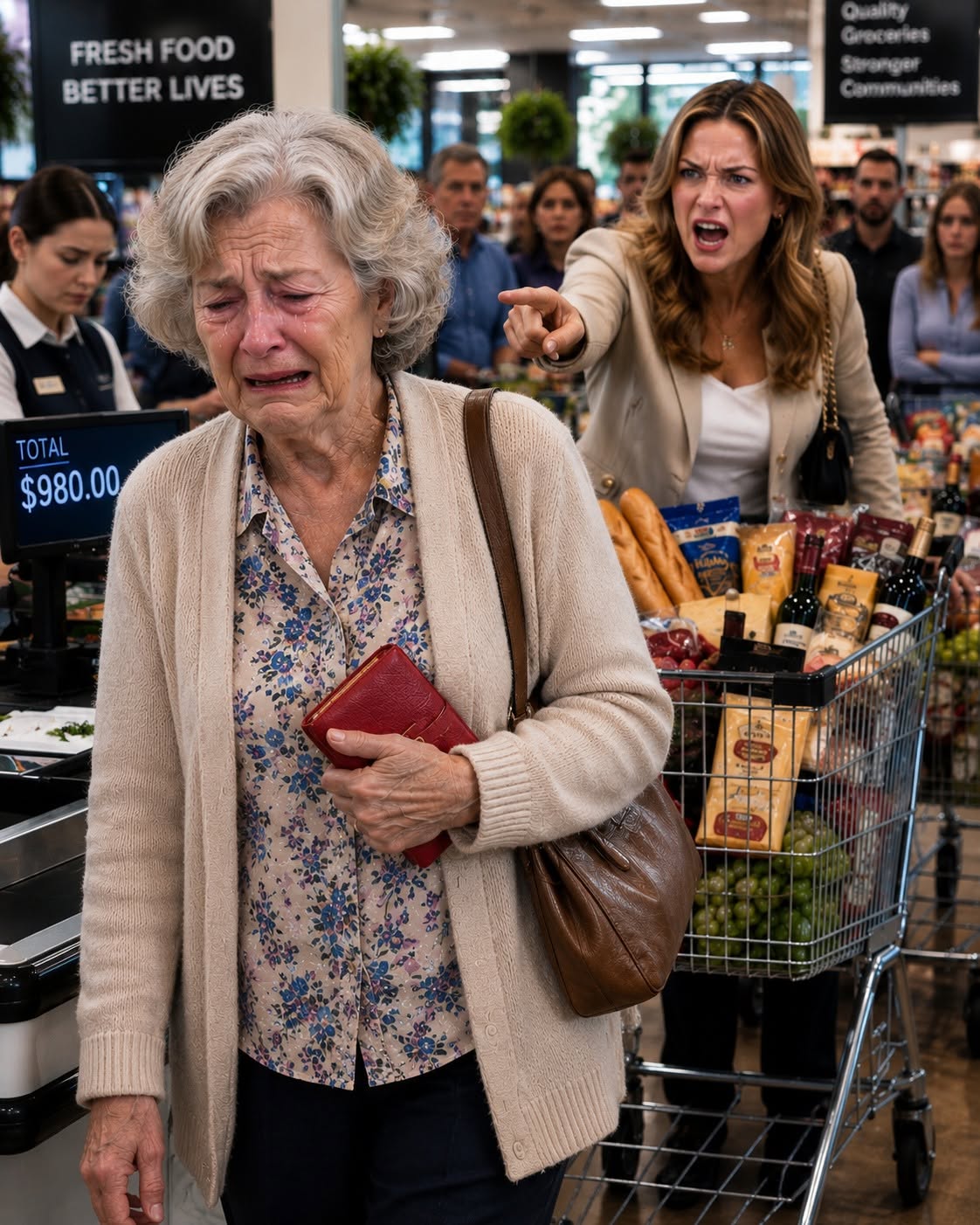
PART 3
Stephanie lunged across the dining table so fast her chair crashed backward.
“Give me that!”
Daniel pulled the document out of reach.
For three full seconds, nobody moved.
I stared at my daughter.
Her face had gone completely white.
Not angry.
Not embarrassed.
**Terrified.**
Daniel slowly placed the paper beside his leather folder.
“That reaction,” he said, “answers one of my questions.”
Clinton slammed his palm against the table.
“What exactly are you accusing us of?”
“I haven’t accused anyone of anything.”
Daniel turned the document toward me.
“Margaret, according to county records, the title to this property was modified eleven months after you moved in.”
I frowned.
“Modified how?”
Daniel pointed to a line near the bottom.
I saw Stephanie’s name.
Clinton’s name.
And then—
Mine.
My stomach tightened.
“I never signed this.”
Stephanie folded her arms.
“Mom, you signed tons of papers back then. You were grieving. You probably forgot.”
“No.”
The word came from me instantly.
I recognized my own signature.
And **that was not it**.
Daniel nodded.
“The signature transferring Margaret’s financial interest in the property was notarized on March seventeenth.”
He looked at me.
“Were you in Savannah on March seventeenth?”
Before I could answer, something clicked in my memory.
March seventeenth.
My sister Ruth’s birthday.
I had spent that entire week with her in Charleston.
I even had photographs from the trip.
“No,” I whispered.
Daniel’s eyes hardened.
“That’s what I thought.”
Clinton stood.
“This is ridiculous.”
Daniel didn’t even look at him.
“The notary stamp belongs to a man named Leonard Graves.”
Stephanie suddenly spoke.
“You can’t prove anything.”
The room froze.
Daniel slowly turned toward her.
“I didn’t say I intended to.”
For the first time, Stephanie seemed to realize what she had just revealed.
She looked at Clinton.
He looked back at her with pure fury.
And suddenly I understood.
**They weren’t merely taking advantage of me.**
They had prepared for the possibility that one day I might stop allowing it.
The little bedroom.
The bills.
The errands.
The humiliation.
None of it had happened by accident.
I looked at my daughter and felt something inside me become strangely calm.
“You forged my signature?”
Stephanie’s expression twisted.
“Don’t be dramatic.”
“Answer me.”
She stood.
“I did what I had to do to protect my family.”
“From whom?”
She looked directly at me.
“From you.”
Those two words hurt more than everything she had said in the supermarket.
I had changed her diapers.
Sat beside her hospital bed when she had pneumonia at eight.
Paid for college.
Paid for her wedding.
Held her hand through fourteen hours of labor when Mason was born.
And somewhere along the way, my daughter had begun seeing me not as her mother—
but as a financial threat.
Clinton walked toward Daniel.
“I think you should leave.”
Daniel calmly buttoned his jacket.
“We will.”
He gathered the papers.
“But before we do, Mr. Hayes, you should understand that a potentially fraudulent deed isn’t a family disagreement.”
Stephanie’s mouth opened.
Daniel continued.
“It’s a legal problem.”
Clinton’s confidence disappeared.
I stood too.
Stephanie followed me toward the front door.
“Mom.”
I stopped.
Her voice changed instantly.
Soft.
Almost frightened.
“We can fix this.”
For four years, those words would have made me turn around.
That day, they didn’t.
“I know,” I said.
Hope flickered across her face.
Then I finished.
**“That’s exactly what I’m doing.”**
Outside, Daniel opened the passenger door for me.
But before I got into his car, I looked back at the house.
The shutters were the pale blue I had chosen.
The porch swing had been purchased with Donald’s money.
The roses beside the steps came from cuttings I had brought from my old garden.
And for the first time, I wondered whether the house I had been told I was lucky to live in—
**might legally still belong partly to me.**
Daniel started the engine.
“We have one more stop.”
“Where?”
“The bank.”
I looked at him.
“Why?”
His expression became serious.
“Because the deed isn’t the only thing I found.”
And once again, my daughter’s secret turned out to be bigger than I imagined.
# **PART 4 — THE ACCOUNT WITH MY DEAD HUSBAND’S NAME**
The bank manager led Daniel and me into a private office.
Her name was Elaine Porter, a silver-haired woman with careful eyes and the kind of voice people use when they know they are about to change someone’s life.
She closed the door.
“Mrs. Bennett, Mr. Reeves asked us to review several historical transactions connected to your home sale.”
My palms became damp.
“Is my money gone?”
Elaine hesitated.
“Some of it was used exactly as you intended.”
“Some?”
She slid a stack of statements toward me.
Four years earlier, I had transferred $310,000 after selling my home.
I believed $280,000 had gone toward Stephanie and Clinton’s mortgage and renovations.
It had.
But there had been another thirty thousand dollars.
I had assumed it disappeared into construction expenses.
It hadn’t.
Elaine pointed toward a transfer.
“Twenty-seven thousand five hundred dollars was moved into an investment account.”
I stared at the name.
**Donald and Margaret Bennett Family Trust.**
My breath caught.
“Donald’s been dead for four years.”
Daniel leaned forward.
“Donald created the trust six years before his death.”
I looked from him to Elaine.
“I never knew.”
“You were a beneficiary,” Daniel said. “But Donald was the trustee. After his death, the successor trustee was supposed to contact you.”
“Who was the successor?”
Daniel turned a page.
I already knew the answer before he said it.
“Stephanie.”
The room seemed to tilt.
Elaine continued carefully.
“The account wasn’t empty.”
“How much is there?”
She glanced at Daniel.
Then at me.
“Approximately **four hundred and twelve thousand dollars**.”
I couldn’t speak.
I actually laughed once, because the number sounded absurd.
“That’s impossible.”
“It was invested conservatively for years,” Elaine explained. “Your husband purchased shares and municipal bonds over time. There were also life insurance proceeds deposited after his death.”
I pressed both hands against my mouth.
Donald.
My quiet, careful Donald.
The man who saved rubber bands in kitchen drawers and refused to replace a toaster until smoke came out of it.
He had left me almost half a million dollars.
And I had spent four years worrying about whether I could afford medication.
“Why didn’t Stephanie tell me?”
Elaine looked uncomfortable.
Daniel answered.
“Because distributions from the trust required the trustee to acknowledge them.”
I slowly understood.
“She controlled access.”
“Yes.”
“Could she take it?”
“Not legally.”
That word again.
Legally.
It was astonishing how many things my daughter had apparently done that required that qualification.
Daniel continued.
“There are withdrawals.”
My heart dropped.
“How much?”
“About sixty-three thousand dollars over four years.”
I closed my eyes.
The SUV.
The vacations Stephanie claimed Clinton’s bonuses paid for.
The kitchen remodel.
Christmas in Cancun.
Maybe even the handbag she had bought herself while telling me I couldn’t afford better hearing aids.
My grief turned into anger so clean and sharp that it almost felt medicinal.
I opened my eyes.
“Can we stop her?”
Daniel nodded.
“We already have.”
He pushed a form toward me.
“The bank froze discretionary withdrawals this morning pending review.”
For the first time since the supermarket, I felt something deeper than relief.
**I felt Donald beside me.**
Not literally.
But in the careful planning.
In his stubborn habit of protecting me.
In the man who had apparently looked into the future and worried that someday I might need money no one else could touch.
My eyes filled.
“That old fool,” I whispered.
Daniel smiled.
“He was a very thorough old fool.”
Then Elaine cleared her throat.
“There is one other matter.”
Of course there was.
I almost laughed.
She placed a small envelope in front of me.
“This was stored with the original trust documents. Your husband instructed that it be given to you if there was ever a dispute involving Stephanie’s trusteeship.”
My hands began trembling.
My name was written across the front.
Not typed.
Written.
**Donald’s handwriting.**
I hadn’t seen it since the sympathy cards after his funeral.
I opened the envelope.
Inside was a single sheet of paper.
My darling Maggie,
If you’re reading this, then something has gone wrong between you and our girl.
My vision blurred instantly.
I kept reading.
Don’t blame yourself for loving her. Love isn’t foolish because someone misuses it.
At the bottom, Donald had written one final sentence.
**There is something about Stephanie that I never had the courage to tell you. Ruth knows the truth.**
I stared at the page.
My sister Ruth.
The woman I had visited on the exact day my signature was forged.
I grabbed my phone.
And for the first time in nearly four years, I was afraid of a truth that had nothing to do with money.
# **PART 5 — MY SISTER’S FORTY-YEAR SECRET**
Ruth answered on the second ring.
“Maggie?”
“Donald left me a letter.”
Silence.
A long, terrible silence.
Then I heard my sister exhale.
“Oh.”
One syllable.
That was enough.
“You know what he meant.”
Another silence.
“Ruth.”
“Yes.”
I closed my eyes.
“Tell me.”
She asked me to come to Charleston.
I refused.
“I have spent four years being told what I can handle. **Tell me now.**”
Ruth began crying.
And then she took me back forty-seven years.
Stephanie had been born during one of the worst winters Georgia had seen in decades.
I remembered the hospital.
The fluorescent lights.
The smell of antiseptic.
The exhaustion.
What I didn’t remember was nearly dying.
“I was there,” Ruth said. “You hemorrhaged after delivery. They sedated you. Donald thought he was going to lose you.”
“I know that.”
“No, Maggie. You don’t know all of it.”
My fingers tightened around the phone.
“There were two babies born that night.”
I stopped breathing.
Ruth continued.
“Another woman on the ward was seventeen. Her baby was premature. She panicked and disappeared before morning.”
I whispered, “What does that have to do with Stephanie?”
Ruth sobbed.
“Your baby didn’t survive.”
The room vanished around me.
For a moment I heard nothing.
Not Daniel.
Not traffic outside the bank.
Not even Ruth.
Then my own voice came from very far away.
“No.”
“Maggie—”
“No.”
“Donald was destroyed. The hospital was chaotic. There were discussions about temporary placement for the abandoned baby. Donald… he made a decision.”
My chest ached.
“He brought her to me?”
“Yes.”
I stood so suddenly the chair scraped backward.
“Stephanie isn’t my daughter?”
Ruth answered immediately.
“She is your daughter. You raised her. You loved her. But no, Maggie. You didn’t give birth to her.”
I pressed one hand against the wall.
For seventy-two years, I had believed I understood the basic architecture of my own life.
In less than ten minutes, someone had moved every wall.
“Why didn’t you tell me?”
“Donald begged me not to. At first he was terrified the adoption wasn’t properly handled. Later, lawyers corrected everything. By then you loved her. He thought telling you would only create pain.”
I looked at Donald’s letter.
“He knew she might hurt me.”
“No,” Ruth said softly. “He knew something else.”
“What?”
“Stephanie found out.”
My blood went cold.
“When?”
“Five years ago.”
Before Donald died.
Before she asked me to sell my house.
Before she invited me to move in.
Ruth continued.
“She found old records in Donald’s desk. She confronted him. He told her everything.”
I understood then why Donald had created protections around the trust.
Why he had insisted on legal documents.
Why he had told Daniel to document my money.
He had seen something changing in Stephanie before I ever noticed.
My daughter had learned the truth—
and instead of fearing she would lose me,
**she had apparently decided to make sure she got everything she could from me first.**
But Ruth wasn’t finished.
“Maggie, there’s one more thing.”
I almost begged her not to say it.
“What?”
“The seventeen-year-old mother who left the hospital…”
Ruth’s voice broke.
“She never stopped looking for Stephanie.”
I gripped the phone.
“What are you saying?”
“She found Donald twelve years ago.”
My knees weakened.
“Who is she?”
Ruth whispered a name.
And suddenly the entire story changed again.
Because I knew exactly who that woman was.
**Elaine Porter.**
The bank manager sitting six feet away from me.
# **PART 6 — THE WOMAN ACROSS THE DESK**
I lowered the phone.
Elaine was staring at me.
Not like a banker.
Like a woman who had been waiting half her life for this moment.
“You knew,” I whispered.
Tears immediately filled her eyes.
“Yes.”
Daniel quietly stood.
“I’ll give you privacy.”
“No.”
I looked at Elaine.
“No more private conversations. No more hidden truths. Everyone stays.”
Daniel sat down.
Elaine folded her hands.
“When I was seventeen, I was terrified. My parents were deeply religious, very strict. I hid my pregnancy as long as I could. When I delivered early, I panicked.”
Her voice shook.
“I left.”
I felt anger rise in me.
Then I saw her hands trembling.
“I came back the next day,” she continued. “My baby was gone into emergency foster placement. Records were sealed. My parents moved us to Virginia immediately.”
“You searched for her.”
“For thirty-five years.”
“And when you found Donald?”
“He wouldn’t let me meet her.”
A hard edge entered my voice.
“He had no right.”
“I know.”
“Neither did you.”
Elaine accepted that without flinching.
“I know that too.”
The room became painfully quiet.
“Why didn’t you contact me?”
“Donald told me you didn’t know. He said revealing everything could destroy your family.”
I laughed bitterly.
“Well. We handled that beautifully.”
Elaine’s mouth trembled.
Then she said something I wasn’t expecting.
“I didn’t come here to take Stephanie from you.”
I stared at her.
“She doesn’t know who you are?”
“She knows I exist. Donald eventually told her. But she refused contact.”
That surprised me.
“Why?”
Elaine looked down.
“She sent me a letter.”
“What did it say?”
Elaine hesitated.
Then opened her desk drawer.
She removed a folded piece of paper.
I recognized Stephanie’s handwriting.
Elaine handed it to me.
The letter was only six sentences long.
She had written it five years earlier.
I read the last paragraph twice.
*I already have a mother. She may be annoying and controlling sometimes, but she raised me. I don’t need another one. Please don’t contact me again.*
My throat closed.
Somewhere inside the woman who had humiliated me at the supermarket—
somewhere inside the daughter who had taken my money—
there had once still been a child saying:
**I already have a mother.**
And painfully, unexpectedly, that mattered.
It didn’t erase anything.
But it complicated everything.
For the first time, Stephanie stopped being a simple villain in my mind.
She became what human beings usually are.
A mixture of fear, greed, resentment, love, selfishness and old wounds.
Then Daniel’s phone rang.
He glanced at the screen.
“It’s Clinton.”
I almost told him to ignore it.
Instead I said, “Answer.”
Daniel put it on speaker.
Clinton didn’t say hello.
“Stephanie’s gone.”
I sat upright.
“What?”
“We had a fight after you left yesterday. This morning, she packed a bag.”
“Where’s Mason?”
“With me.”
Then Clinton said something strange.
“She emptied the safe.”
Daniel’s eyes narrowed.
“What was in it?”
“Documents. Cash. Passports.”
A pause.
“And a copy of Margaret’s deed.”
Daniel stood.
“Do you know where she went?”
“No.”
I did.
I don’t know how.
Maybe it was instinct.
Maybe motherhood isn’t blood at all but forty-seven years of memorizing the places someone runs when frightened.
There was one place Stephanie always went when life overwhelmed her.
Tybee Island.
Donald had taken her there every summer when she was a child.
I was already reaching for my purse.
Daniel tried to stop me.
“Margaret, if she has taken legal documents—”
“She is still my daughter.”
Elaine looked at me.
Then she picked up her keys.
“She is mine too.”
The words hung between us.
Neither of us smiled.
Neither of us argued.
Twenty minutes later, two mothers drove toward the ocean to find the same daughter.
# **PART 7 — THE THREE WOMEN ON THE BEACH**
We found Stephanie near the old pier.
She was sitting alone on the sand with her shoes beside her.
The August sky was heavy and gray, and the Atlantic looked almost black beneath it.
When she saw me approaching, she stood.
Then she saw Elaine.
Everything changed.
“You.”
Elaine stopped several feet away.
“Hello, Stephanie.”
“Did she bring you?”
“No,” I said. “You did.”
Stephanie laughed, but there was no humor in it.
“So now everybody knows.”
“Yes.”
Her face crumpled for half a second.
Then the anger returned.
“Great. Perfect. Dad’s dead, and now everyone gets to dig through his secrets.”
I walked closer.
“Why did you forge my signature?”
She looked away.
“Answer me.”
“Because Clinton said we needed security!”
“So you stole mine?”
“You don’t understand.”
“Then explain it.”
And she did.
Not gracefully.
Not all at once.
But like a dam cracking.
Clinton’s business had been failing for nearly three years.
Credit cards were maxed out.
The SUV was months from repossession.
He had borrowed against the house.
Then borrowed again.
Stephanie had been terrified they would lose everything.
“He kept saying your money was going to come to me eventually anyway,” she cried.
I felt sick.
“So you decided eventually wasn’t fast enough?”
“I thought I could fix it!”
“With my pension?”
“With the trust.”
Elaine stiffened.
Stephanie looked at her.
“I knew who you were the first day you transferred into that branch.”
Elaine blinked.
“You knew?”
“I recognized your name from Dad’s records.”
“Why didn’t you say anything?”
Stephanie’s eyes filled.
“Because I hated you.”
The words were brutal.
Elaine absorbed them silently.
“I hated you for leaving me. I hated Dad for lying. And I hated Mom because every time she loved me, I wondered whether she’d still love me if she knew I wasn’t really hers.”
I took one step forward.
“Stephanie.”
“No! You don’t understand what it was like!”
Her voice broke.
“I spent my whole life thinking I belonged somewhere. Then overnight I found out I was a replacement baby.”
That phrase shattered something in me.
“A replacement?”
“That’s what it felt like!”
I moved closer.
“You were never a replacement.”
She began crying.
“My baby died,” I said. “And I didn’t know it. That truth was stolen from me. But **you were not stolen love, Stephanie. Every day after that hospital was real. Every birthday. Every scraped knee. Every school play. Every fight. Every Christmas morning. I chose you thousands of times without even knowing there was a choice.**”
She covered her face.
I wanted to hold her.
But I didn’t.
Love did not require pretending nothing had happened.
“You still forged my name,” I said.
She nodded.
“You still took money.”
Another nod.
“You still treated me cruelly.”
“Yes.”
“And I will not go back to living the way I lived.”
She looked at me.
I saw a child there.
And a grown woman who had done terrible things out of fear and entitlement.
Both were true.
Then she reached into her bag.
“I brought these because I was going to destroy them.”
She handed Daniel’s copied documents to me.
“But I couldn’t.”
“Why?”
She wiped her face.
“Because Dad wrote something on the back of one.”
I turned the deed over.
There, in Donald’s handwriting, were twelve words:
**If fear turns this family against itself, tell the truth before money finishes the job.**
I laughed through my tears.
“Donald always did like giving instructions.”
Stephanie laughed too.
It was tiny.
Broken.
But real.
Then tires screeched behind the dunes.
Clinton’s truck appeared beside the beach access.
He got out furious.
“There you are!”
Stephanie went pale.
Clinton marched toward us.
“Give me the documents.”
“No,” Stephanie said.
He stopped.
“What?”
Her voice shook.
Then strengthened.
“No.”
His face changed.
“Don’t be stupid.”
For years, I had seen him use that tone with her.
Maybe I had ignored too much.
He reached for her bag.
Stephanie stepped back.
“Don’t touch me.”
Clinton looked at me.
“This is your fault.”
I surprised myself by smiling.
“No, Clinton.”
Sirens sounded in the distance.
Daniel lifted his phone.
“Actually,” he said, “this part is mine.”
He had contacted the sheriff after Clinton reported missing financial documents that were potentially evidence in a fraud investigation.
Clinton stared at him.
Then at Stephanie.
“You told them?”
Stephanie looked at me.
Then Elaine.
Then finally her husband.
“Yes.”
The sirens grew louder.
And for the first time since I had known him, Clinton had absolutely nothing to say.
# **PART 8 — THE BILL I NEVER EXPECTED TO PAY**
Six months later, I stood inside a house I never expected to see again.
My old house.
The one Donald and I had lived in for forty years.
After I sold it, a retired teacher named Mr. Wallace bought it.
When Daniel helped recover my trust funds and unwind the fraudulent property transfer, I began searching for a small apartment.
Then, one morning, my phone rang.
“Mrs. Bennett?” a man said. “My name is Thomas Wallace. I believe I’m living in your house.”
I laughed.
“Not anymore.”
“Well,” he replied, “funny thing about that.”
His daughter had convinced him to move closer to her in North Carolina.
He was planning to sell.
When he learned through mutual acquaintances what had happened to me, he offered me the first chance to buy it back.
I walked through the front door three weeks later.
The kitchen wallpaper was gone.
The oak tree was taller.
But Donald’s pencil marks were still inside the pantry door where we measured Stephanie as she grew.
Age six.
Age nine.
Age thirteen.
At seventeen, she had written above the final mark herself:
**TALLER THAN MOM!!!**
I touched those words and cried until I couldn’t breathe.
I bought the house.
Not because I wanted the past back.
You can’t buy that.
I bought it because **I finally understood the difference between returning somewhere and going backward.**
Clinton eventually admitted to pressuring Stephanie to access the trust and refinance the house. Investigators discovered he had hidden substantial business debts from everyone.
The forged deed became part of a larger fraud case.
Stephanie wasn’t innocent.
She admitted what she’d done.
Her cooperation, restitution agreement, and evidence against Clinton mattered in how the case was resolved, but consequences still followed.
For the first time in her life, I didn’t rescue her from them.
That was one of the hardest things I ever did.
Mason lived with me for several months while everything settled.
He was sixteen.
Old enough to understand that adults could love each other and still fail each other terribly.
One evening, he found me making chamomile tea.
“Grandma?”
“Yes?”
“Mom says you’re never going to forgive her.”
I stirred my tea.
“I didn’t say that.”
“So you will?”
I thought carefully.
“Forgiveness and trust aren’t the same thing.”
He nodded as though storing that sentence for later.
Then came the strangest development of all.
Elaine started visiting on Sundays.
At first, she sat stiffly at one end of my kitchen table.
Stephanie sat at the other.
I sat between them.
It was possibly the most uncomfortable tea party in Georgia.
Nobody knew what to call anybody.
Elaine never asked Stephanie to call her Mom.
I never asked Stephanie to pretend Elaine didn’t matter.
We simply began with names.
Margaret.
Elaine.
Stephanie.
Three women tied together by one frightened decision made in a hospital nearly half a century earlier.
Some Sundays ended in tears.
One ended with Stephanie storming out.
Another ended with Elaine laughing so hard she spilled coffee.
Healing wasn’t beautiful.
**Healing was awkward, repetitive, embarrassing work.**
Then, almost seven months after the supermarket incident, Stephanie came to my house carrying three grocery bags.
Not carts.
Bags.
She set them on the kitchen counter.
“I bought dinner.”
I looked inside.
Chicken.
Potatoes.
Green beans.
And one box of chamomile tea.
I raised an eyebrow.
“You remembered.”
She looked embarrassed.
“I remember more than I acted like I did.”
We cooked together.
Later, as we sat on the porch, she handed me an envelope.
Inside was a check.
The first installment of what she owed the trust.
I tried to hand it back.
She refused.
“No.”
I looked at her.
She smiled sadly.
“I’m learning that word from you.”
I laughed.
Then she became serious.
“Mom, there’s something I’ve wanted to ask you.”
“What?”
“At the supermarket… when you walked away… did you know about the trust? The agreement? Elaine? Any of it?”
“Not a thing.”
“Then how did you know everything would work out?”
I looked toward the oak tree moving gently in the evening wind.
“I didn’t.”
She seemed confused.
I reached across the porch table and placed my hand over hers.
“That’s what took me seventy-two years to understand.”
“What?”
**“You don’t have to know what happens next before you’re allowed to say no to what is hurting you now.”**
Her eyes filled.
So did mine.
Then a car pulled into the driveway.
Elaine climbed out carrying a pie.
Behind her came Ruth.
Mason ran from the backyard.
For a moment, everyone spoke at once.
There was laughter.
Confusion.
Someone nearly dropped the pie.
And I thought that was the happy ending.
I was wrong.
Because when Elaine entered the house, she handed me a small package.
“This came from the bank archives,” she said. “It belongs to you.”
Inside was an old cassette tape.
A label had been written in Donald’s handwriting.
**FOR MAGGIE — WHEN THE WHOLE TRUTH IS FINALLY OUT.**
My heart nearly stopped.
Mason found an old cassette player in the attic.
We gathered in the living room.
I pressed play.
Static filled the room.
Then Donald’s voice came through the speaker.
Older.
Warm.
Alive.
“Maggie, if you’re listening to this, then somehow all my secrets have finally caught up with me.”
I covered my mouth.
Stephanie began crying immediately.
Donald continued.
“I made choices because I was afraid of losing people. Some were right. Some were terribly wrong. But there is one thing I hope nobody ever doubts.”
A pause.
Then his voice softened.
“Stephanie, if you’re there, you were never the child we settled for. You were the child who taught us that family can arrive through a door you didn’t know existed.”
Stephanie collapsed against me.
I wrapped my arms around her.
The tape crackled again.
“And Maggie…”
I closed my eyes.
“You always complained that I never let you win an argument, so here’s one final chance.”
Everyone laughed through their tears.
Then came his final words.
“Take your money. Buy yourself something ridiculous. Stop worrying about everyone else. And for heaven’s sake, make them pay for their own groceries.”
The room exploded with laughter.
Even me.
Especially me.
Months earlier, I had walked out of a supermarket believing I had finally lost my daughter.
Instead, I lost something else.
**Fear.**
I lost the belief that motherhood meant endless sacrifice.
I lost the idea that keeping a family together required one person to be slowly emptied.
And strangely, once I stopped paying for everyone else’s comfort, we finally began paying attention to one another.
That night, our family sat around the same old dining table Donald and I had bought when Stephanie was seven.
Elaine cut the pie.
Ruth complained that the slices were uneven.
Mason stole whipped cream directly from the bowl.
Stephanie washed the dishes without being asked.
And I sat there listening to them bicker and laugh inside the house I once thought I had lost forever.
Before bed, I opened my red wallet.
Inside was the same card I had refused to use that afternoon.
I remembered the cashier.
The three overflowing carts.
The humiliation.
The automatic doors opening.
At the time, walking through them had felt like the end of my family.
Now I understood.
**Some doors don’t close behind you.**
**They open in front of you.**
And sometimes the most important thing you will ever buy—
is your own life back.
THE END
