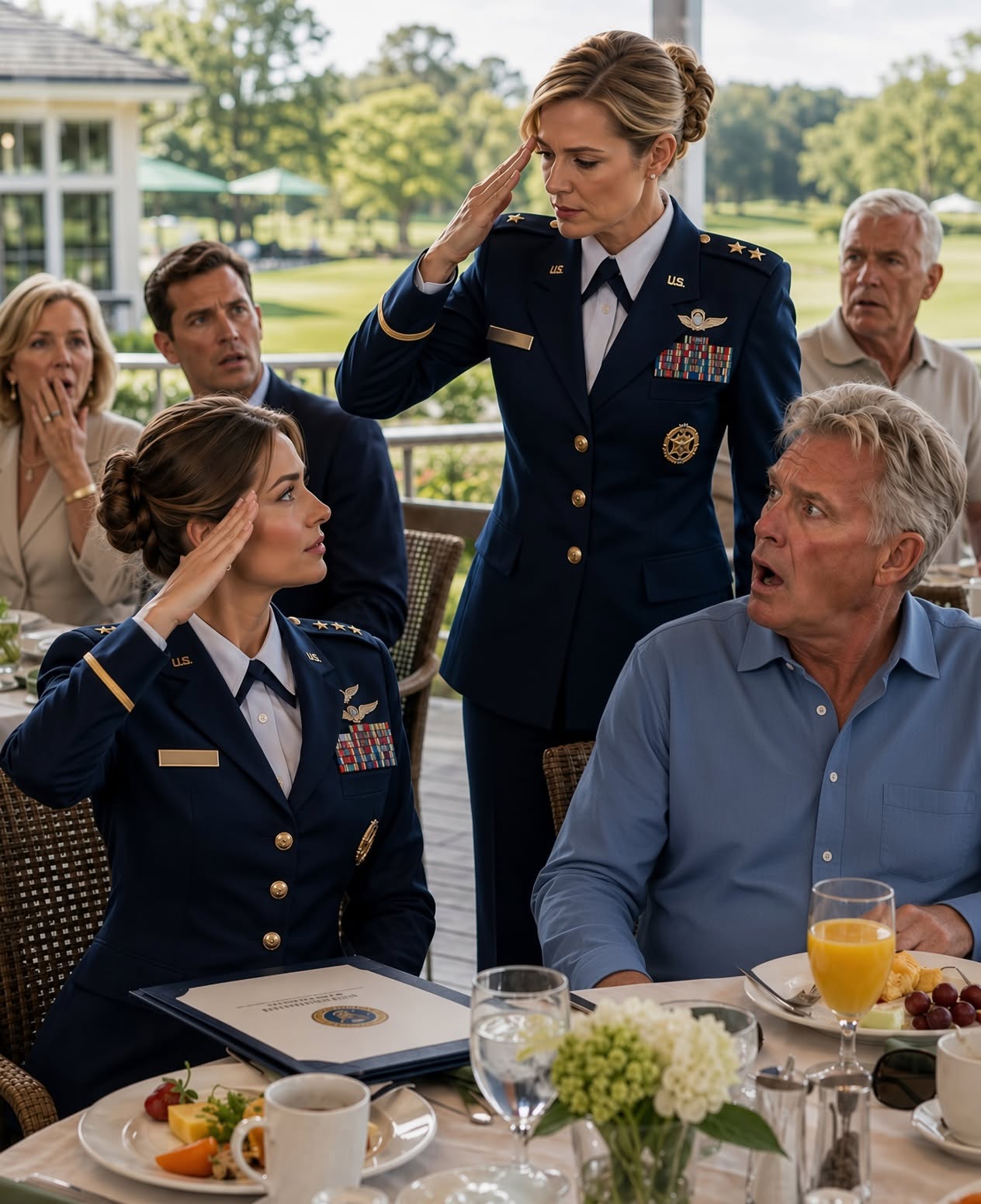
My father laughed over brunch at his country club while telling his golf buddies I was “just a nurse” handing out flu shots on some Air Force base. He thought I was too ordinary to matter, too quiet to impress anyone at his table. Then, twelve feet behind him, a two-star general slowly stood up, stared directly at the insignia pinned to my blazer, and addressed me by the title my father never imagined I carried.
By the time I pulled into the circular driveway of Briarwood Country Club outside Columbus, Ohio, the summer heat had already soaked through the back of my blouse.
My father’s silver Cadillac sat crooked across two parking spaces near the entrance.
Of course it did.
Gordon Whitmore had spent his entire life believing rules were suggestions for other people.
I stayed inside my car for a moment longer than necessary, staring at myself in the rearview mirror.
Navy blazer.
Cream silk blouse.
Hair twisted neatly at the nape of my neck.
And pinned carefully to my lapel was the small silver insignia that had followed me through deserts, hurricane evacuations, crash sites, and places whose names I was still forbidden to say aloud.
Flight surgeon wings.
Most civilians saw something decorative.
Pilots knew better.
I touched the edge of them with one finger, then stopped myself.
I had spent years learning not to need my family to understand who I was.
That morning, I thought I had finally succeeded.
The clubhouse smelled exactly as it had when I was seventeen and waiting tables there during summer break: polished oak, bacon grease, expensive cologne, cut grass, and the faint stale sweetness of entitlement.
Oil paintings of dead businessmen lined the hallway.
Golf trophies glittered beneath chandeliers.
Near the entrance stood a wall of photographs labeled BRIARWOOD FAMILIES THROUGH THE YEARS.
My father appeared in three.
My brother Nathan appeared in another, smiling beside an Ohio senator at a charity tournament.
My mother stood in one wearing pearls.
I wasn’t in any.
Families do not always erase people by throwing them out.
Sometimes they simply stop hanging your picture.
“Claire.”
My mother, Evelyn, lifted two fingers when I stepped onto the patio.
She did not stand.
She never did.
“You made it.”
“I said I would.”
My father occupied the center chair with the unconscious confidence of a man who considered every table his boardroom.
To his right sat Dennis Walker, a retired investment broker with a sunburned forehead and a laugh that always arrived half a second after Dad’s.
To his left was Frank Ellis, a former commercial pilot who still wore a tiny gold Boeing pin on his golf shirts.
Nathan sat opposite them, thirty-four years old, handsome, manicured, and glowing from the promotion everyone had apparently gathered to celebrate.
My empty chair had been placed closest to the service station.
Naturally.
Dad gestured toward it.
“Sit down. We ordered for you.”
I looked at the plate already waiting.
Egg-white omelet.
Dry wheat toast.
Fruit.
I hated egg whites.
My father knew that.
But ordering for people had never been about preference. It was about deciding what they ought to want.
“Perfect timing,” he said as I sat. “Nathan was just telling Dennis about the promotion.”
Nathan adjusted his cuff.
“Regional vice president.”
“Thirty-four,” Dad added. “Youngest executive in company history.”
“Congratulations,” I said.
Nathan gave me the same little smile he had used since childhood whenever he believed he had won something I had not realized we were competing for.
“Thanks. Big responsibility.”
“I’m sure.”
Dad leaned back.
“He’ll be supervising nearly nine hundred people.”
Dennis whistled.
“That’s leadership.”
My mother lifted her mimosa.
“To Nathan.”
Glasses rose.
I lifted my coffee.
For a few minutes, the conversation stayed on Nathan’s career, executive compensation, a new house he wanted in Upper Arlington, and whether a membership at another private club would help him “network upward.”
Then Frank looked at me.
“And what are you doing these days, Claire?”
I opened my mouth.
My father answered first.
“This is my daughter Claire. She’s a nurse on one of the Air Force bases somewhere out west.”
He chuckled.
“Not exactly brain surgery, but somebody’s got to give pilots their flu shots.”
Dennis laughed.
Nathan smirked into his coffee.
Even my mother smiled faintly, not because the joke was funny, but because smoothing my father’s ego had become instinct.
Frank looked uncomfortable.
“Well, military nursing is still admirable work.”
“I’m not actually…”
Dad waved his fork.
“Oh, she’s always dramatic about it. You’d think she was running the Pentagon.”
More laughter.
Something old stirred under my ribs.
Not anger.
Not anymore.
Memory.
I remembered being twelve years old at the kitchen table with a dissected frog diagram spread in front of me, telling Dad I wanted to become a doctor.
He had not looked up from the newspaper.
“Doctors need a certain temperament, Claire.”
“What temperament?”
“Confidence.”
At sixteen, I told him I wanted to apply to the Air Force Academy.
He laughed.
At twenty-two, when I entered medical school on an Air Force scholarship, he told his friends I was “doing some government nursing program.”
When I graduated, he skipped the ceremony for one of Nathan’s amateur golf tournaments.
When I completed aerospace medicine training, my mother mailed me a card that read:
Hope you enjoy your new nursing position.
I had corrected them at first.
Then corrected them less.
Then stopped.
There is a point where repeatedly explaining yourself becomes another form of begging.
I had long since passed it.
I reached for my coffee.
Then a chair scraped sharply behind us.
The sound sliced across the patio.
I turned.
A woman had risen from a nearby table.
Air Force dress blues.
Short silver hair.
Command posture.
Two silver stars on each shoulder.
Every muscle in my body recognized her before my mind finished processing the sight.
Major General Victoria Hale.
Commander, Wright-Patterson Air Force Base.
She had been speaking with two civilian officials when her gaze fixed on my lapel.
Then my face.
Recognition transformed her expression.
She crossed the patio.
Dad frowned as she approached, probably trying to remember whether they had met at some fundraiser.
General Hale stopped beside me.
I stood immediately.
Then she saluted.
“Colonel Claire Whitmore.”
The table went dead silent.
“I didn’t realize you’d be in Ohio today.”
I returned the salute.
“Good morning, General.”
Frank’s fork stopped halfway to his mouth.
Nathan stared.
My mother slowly lowered her glass.
Dad blinked twice.
“Colonel?”
General Hale glanced at him, then back at me.
“I was hoping Washington would confirm your transfer before Monday.”
She smiled.
“Most people don’t realize the Air Force currently has only three trauma flight surgeons qualified for orbital recovery medicine at your level.”
Dad’s face changed.
Not completely.
Not yet.
Just enough.
“Orbital… what?”
I looked at him.
For the first time all morning, I smiled.
“I don’t give flu shots, Dad.”
Frank actually whispered, “Jesus.”
But General Hale was no longer smiling.
She reached for the black leather case in her hand, opened it, and removed a sealed folder.
Across the top were the words:
DEPARTMENT OF DEFENSE
EMERGENCY APPOINTMENT AUTHORIZATION
SCI ACCESS REQUIRED
She placed it before me.
My pulse shifted.
Military training does strange things to fear.
It does not eliminate it.
It teaches you to recognize the exact second ordinary life has ended.
“Ma’am?”
“Read the first page.”
I broke the seal.
My father began, “Now, hold on. Is this really appropriate at breakfast?”
General Hale did not look at him.
I read.
Then read the first paragraph again.
My appetite vanished.
At 0837 Eastern time, a multinational experimental orbital vehicle designated Asteria Seven had declared a medical and systems emergency during reentry preparation.
Four people were aboard.
Two American military officers.
One German aerospace physician.
One Japanese systems engineer.
The spacecraft was carrying biomedical research samples from an eighteen-month classified orbital study.
Telemetry indicated a cascading environmental-control failure.
Oxygen instability.
Possible carbon monoxide contamination.
One crew member unconscious.
Another with cardiac irregularities.
The vehicle could still land.
Maybe.
But its planned recovery corridor crossed Central Europe, and a guidance malfunction had created the possibility of an uncontrolled reentry over populated territory.
My eyes reached the final paragraph.
By authority of the Secretary of Defense, Colonel Claire Whitmore was designated Joint Medical Recovery Commander, Asteria Seven Emergency Response, effective immediately.
I looked up.
“When?”
“First transport is waiting at Wright-Patterson.”
“How long do we have?”
“Best estimate? Six hours before deorbit commitment.”
I stood.
My father gave a disbelieving laugh.
“You’re leaving?”
General Hale looked at him.
“Mr. Whitmore, your daughter has just been placed in charge of the medical recovery component of an emergency involving four nations.”
The words seemed too large for him.
Nathan finally spoke.
“Wait. Asteria?”
I glanced toward him.
His complexion had gone pale.
“You know the program?”
“Everyone in aerospace contracting knows the name.”
Dad frowned.
“I thought it was a satellite project.”
Nathan’s eyes flicked toward him.
For one strange second, neither man looked at me.
They looked at each other.
Something passed between them.
Quick.
Silent.
Wrong.
I noticed because pilots survive by noticing things other people dismiss.
General Hale noticed too.
“Colonel,” she said quietly, “we need to move.”
I closed the folder.
My mother suddenly reached for my wrist.
“Claire.”
I looked down.
Her fingers were trembling.
Not with pride.
Not confusion.
Fear.
“Mom?”
She released me instantly.
“Nothing.”
But when I turned to leave, she whispered something so softly only I heard it.
“Don’t trust the telemetry.”
I froze.
“What?”
Her face had already emptied.
“Go.”
I stared at her.
My mother had never served in the military.
Never worked in aerospace.
She taught piano lessons for twenty-seven years.
At least, that was what I had always believed.
“Claire,” General Hale called.
I followed her.
Behind us, my father said something sharp to my mother.
I did not hear the words.
But as the patio doors closed, I looked back once.
Nathan was no longer celebrating.
He was making a phone call.
And my mother was staring straight at me with the expression of someone watching a secret she had buried decades earlier come back from the dead.
The drive to Wright-Patterson took twenty-three minutes.
General Hale spent seventeen of them briefing me.
Asteria Seven had begun reporting abnormal cabin-pressure fluctuations shortly after leaving a high orbital research platform.
The onboard scrubbers were showing contradictory readings.
Automatic systems insisted air quality was within survivable limits.
Crew biometrics said otherwise.
“That’s impossible,” I said.
“Exactly.”
“The biomedical telemetry and environmental telemetry are separate systems.”
“Yes.”
“So either both have failed independently…”
“Or someone made one of them lie.”
I looked through the window at highway traffic sliding past.
Don’t trust the telemetry.
My mother’s voice would not leave me.
“What company built the environmental system?”
General Hale hesitated.
That was answer enough.
“Tell me.”
“Calderon Advanced Systems.”
My stomach tightened.
Nathan’s company.
I turned slowly.
“He works for Calderon.”
“I know.”
“He was promoted to regional vice president this week.”
“I know that too.”
“Why didn’t you mention it at the club?”
“Because I wanted to see whether your family would.”
A cold sensation moved down my spine.
“This isn’t just a medical appointment.”
“No.”
“You were already investigating them.”
General Hale watched me carefully.
“Colonel, from this moment forward, I need to know whether your family connection compromises your judgment.”
I thought of Nathan’s pale face.
My father saying Asteria like the name meant more to him than it should.
My mother whispering words she had no business understanding.
Then I thought of four people falling around Earth at seventeen thousand miles per hour.
“No, ma’am.”
“Good.”
We reached the base.
Everything accelerated.
Security gates opened before us.
A black SUV carried me directly to a command building I had visited only twice before.
Inside, a wall-sized display showed the curve of Earth and a pulsing white line marking Asteria Seven’s orbit.
Men and women in uniforms from four countries worked at terminals.
English overlapped with German and Japanese.
Digital clocks counted down.
05:31:44 UNTIL DEORBIT WINDOW.
I removed my blazer and rolled up my sleeves.
The country club disappeared.
This was where I understood myself.
Not because anyone here admired me.
Because nobody cared who my father was.
Competence was the only language that mattered.
A physician handed me the crew data.
“Commander is Lieutenant Colonel Marcus Reed, forty-two. Pilot Major Selena Brooks, thirty-nine. Dr. Lukas Weber, German Aerospace Medical Service, fifty-one. Engineer Kenji Sato, forty-five.”
“Status?”
“Reed unconscious. Weber confused. Sato vomiting. Brooks still functional.”
“Cardiac?”
“Brooks has intermittent ventricular ectopy.”
“CO levels?”
“Nominal according to environmental sensors.”
“Blood oxygen?”
“Falling.”
“Carboxyhemoglobin?”
“We don’t have direct readout.”
“Then stop calling it nominal.”
I moved to the communication station.
“Asteria Seven, this is Joint Recovery Medical. Major Brooks, do you copy?”
Static.
Then breathing.
Heavy.
Female.
“Recovery… this is Brooks.”
“Major, Colonel Claire Whitmore. I’m taking medical control.”
There was a pause.
“Whitmore?”
“Yes.”
Her breathing changed.
Then she said something that made my entire body go cold.
“Thank God they found you.”
I stared at the console.
“Major, have we met?”
“No.”
“Then why do you know my name?”
Static swallowed several seconds.
Finally:
“Dr. Weber said… if ground readings stopped making sense… ask for Whitmore.”
I looked at General Hale.
She had heard it.
“Why?”
Another burst of interference.
Brooks coughed.
Then came her answer.
“Because your mother designed the system.”
The command center seemed to tilt.
I said nothing.
Could not.
General Hale removed her headset slowly.
Across the room, an intelligence officer turned toward us.
“My mother is a piano teacher.”
Brooks laughed weakly through the radio.
“No, Colonel.”
A pause.
“Your mother is Dr. Evelyn Mercer.”
I forgot how to breathe.
Mercer.
My mother’s maiden name.
A name I had seen maybe twenty times on Christmas cards from relatives we rarely visited.
General Hale motioned toward a side room.
“Claire.”
“No.”
“Colonel.”
“Not yet.”
I forced myself back toward the screen.
Four lives first.
Questions later.
“Major Brooks, listen carefully. Tell me what you smell.”
“Nothing.”
“Headache?”
“Yes.”
“Cherry-red skin on Reed?”
“Hard to tell.”
“Any heat near the scrubber assembly?”
“Port unit’s running hot.”
There.
“Shut down automatic environmental management.”
Ground engineers erupted.
One called, “Colonel, that could destabilize pressure.”
I turned.
“If the software is lying, keeping it active is poisoning them.”
“We don’t know that.”
“We have four symptomatic crew and ‘perfect’ cabin air.”
I looked at Brooks’s biomedical trace.
“Major, manual bypass. Port scrubber offline. Emergency oxygen masks on everyone.”
“Copy.”
A warning alarm screamed through the audio.
An engineer swore.
Cabin-pressure numbers plunged.
Then stabilized.
Thirty seconds later, Brooks’s oxygen saturation began climbing.
So did Sato’s.
The command center went silent.
General Hale spoke softly.
“You were right.”
“No.”
I stared at the display.
“My mother was.”
Three hours later, Asteria Seven was alive but crippled.
The sabotaged scrubber had nearly killed its crew.
Manual oxygen had bought us time.
Guidance remained unstable.
And someone had altered the software so thoroughly that engineers could not tell which commands were authentic anymore.
Intelligence personnel arrived.
Then FBI agents.
Then representatives from Calderon Advanced Systems.
One of them was Nathan.
When he entered the command center, his eyes found mine immediately.
“Claire.”
I stared at his visitor badge.
“You shouldn’t be here.”
“I lead regional systems integration.”
“You sell contracts.”
His jaw tightened.
“I manage more than you think.”
“So do I, apparently.”
General Hale stepped between us.
“Mr. Whitmore, you’re here to answer technical questions.”
Nathan looked toward the orbital display.
His arrogance had vanished.
“I didn’t know they would launch with that software.”
“Who is they?”
He said nothing.
An intelligence officer placed a tablet on the table.
“We found a legacy authentication string embedded in the corrupted code.”
Nathan closed his eyes.
That frightened me more than surprise would have.
“What string?” I asked.
The officer turned the screen.
MERCER-9.

My mother’s maiden name.
Nathan whispered, “Oh, God.”
I grabbed his arm.
“What do you know?”
“Claire, not here.”
“Four people almost died.”
“I know.”
“Then talk.”
He looked around the room.
Then at me.
“Dad owns the original patent.”
I laughed once because the alternative was screaming.
“Dad owns car dealerships.”
“No. Dad owns Whitmore Aviation Holdings.”
“I’ve never heard of it.”
“You weren’t supposed to.”
The room around me became distant.
Nathan continued.
“Calderon licensed old environmental-control architecture from a company Dad acquired in the nineties.”
“What company?”
He looked at me.
“Mercer Aeromedical Systems.”
My mother.
I walked out before my knees betrayed me.
General Hale followed.
I stood in the corridor, palms against the cold wall.
“My entire life is a lie.”
“Parts of it.”
“You knew?”
“Some.”
“How long?”
“Forty-eight hours.”
“And you said nothing?”
“You were about to take command of a rescue mission. I needed the physician, not the daughter.”
I turned on her.
“She told me she taught piano.”
“She did.”
“Why?”
“I think you need to ask her.”
My phone vibrated.
MOM.
I stared at the screen.
Then answered.
“Claire?”
Her voice was shaking.
“You designed Asteria’s environmental system.”
Silence.
“I designed its ancestor.”
“You lied to me.”
“I protected you.”
“From what?”
“Your father.”
I closed my eyes.
“Mom, I’m standing inside an Air Force command center with federal agents investigating software carrying your maiden name. Do not give me half an answer.”
She inhaled.
“Before I married Gordon, I was an Air Force physician.”
My hand tightened around the phone.
“No.”
“Yes.”
“Aerospace medicine?”
“Yes.”
“How long?”
“Eleven years.”
Everything rearranged itself.
Her strange calm during thunderstorms.
The way she could identify aircraft by sound.
The medical journals hidden beneath old sheet music.
The insistence that I learn CPR at nine.
A childhood filled with clues I had never known were clues.
“Why did you leave?”
Her voice dropped.
“Because I discovered a defect in an orbital environmental-control design being rushed toward certification. I refused to sign it.”
“Mercer Nine?”
“Yes.”
“Dad owned the company?”
“Not then. He was the attorney representing the investors.”
A darkness began forming inside me.
“What happened?”
“He convinced everyone the risk was theoretical.”
“Was it?”
“No.”
Her next breath broke.
“A test pilot died.”
I stopped moving.
“Who?”
“Captain Andrew Whitmore.”
My father’s older brother.
The uncle whose photograph hung in Dad’s study.
The war hero I had been told died during a classified training accident.
My mother continued.
“Andrew believed my analysis. He volunteered for one final test because he wanted proof.”
“And he died.”
“Yes.”
“What did Dad do?”
“He blamed me.”
I leaned against the wall.
“He married you after that?”
“Three years later.”
“Why?”
“Because people are complicated, Claire. Grief makes terrible things resemble love.”
She began crying.
I had heard my mother cry only once before, at her father’s funeral.
“Gordon promised the program was dead. He promised the patents had been destroyed. When you were born, I left medicine completely because I wanted one life untouched by all of it.”
“And then I became a flight surgeon.”
A broken laugh escaped her.
“You were eight years old when you pointed at an F-16 and told me you wanted to know how the pilot’s body survived turns like that. I knew then.”
“Why didn’t you tell me?”
“Because your father could tolerate a daughter he considered ordinary.”
The words hit harder than I expected.
“What does that mean?”
“He was afraid you would discover Andrew.”
A warning sounded behind me.
General Hale opened the command-room door.
“Colonel. Guidance is failing.”
I spoke into the phone.
“Mom, I have to go.”
“Claire.”
“What?”
“Mercer Nine has a mechanical override.”
I froze.
“That isn’t in our schematics.”
“Because Gordon removed it from the commercial patent.”
“Where?”
“Behind the port scrubber pressure manifold. A red lever recessed beneath the oxygen line.”
“What does it do?”
“It disconnects the environmental computer physically.”
I stared through the glass at the falling spacecraft.
“And guidance?”
Her voice became very quiet.
“Mercer Nine wasn’t only an environmental system.”
I understood.
“You designed the emergency flight controller.”
“Yes.”
The secret my mother had buried for thirty years was about to save four astronauts.
I ran.
For the next eleven minutes, the command center became controlled violence.
We guided Brooks through panels never described in her manuals.
She removed two fasteners.
Found the red lever.
Pulled.
Asteria Seven’s automated environmental system went dark.
So did half the guidance display.
Then a secondary analog controller appeared.
Engineers stared.
One whispered, “What the hell is that?”
I almost smiled.
“My mother.”
Brooks took manual control.
The landing corridor narrowed.
Weather teams recalculated.
Japan cleared an alternate recovery site.
Germany opened emergency airspace.
American rescue aircraft moved into position.
Asteria Seven began descending.
Reed regained consciousness at eighty thousand feet.
We lost communications at sixty-three thousand.
At fifty thousand, radar acquired them.
At thirty-two thousand, one parachute failed to deploy.
The room stopped breathing.
Then the backup chute opened.
Asteria Seven hit the Atlantic hard enough to injure everyone aboard but softly enough to keep them alive.
When the recovery helicopter transmitted the words FOUR SURVIVORS, the command center erupted.
People cheered.
Someone hugged me.
I did not know who.
General Hale squeezed my shoulder.
“You brought them home.”
I shook my head.
“My mother did.”
“No.”
She looked at the medical team, the pilots, the international officers, the exhausted engineers.
“She gave you a door. You walked everyone through it.”
By sunset, the rescue was international news.
The sabotage was not.
That investigation stayed behind locked doors.
Nathan was questioned for six hours.
My father for nine.
My mother arrived at the base just before midnight.
I almost did not recognize her.
Not because she looked different.
Because for the first time in my life, she walked like the woman she had once been.
Back straight.
Eyes forward.
No apologetic smile.
General Hale met her in the corridor.
“Dr. Mercer.”
My mother stopped.
For several seconds, neither woman spoke.
Then General Hale saluted.
My mother’s eyes filled.
She returned it.
Watching her, I suddenly understood how much of herself she had buried to survive inside our family.
Dad arrived under escort twenty minutes later.
The transformation in him was astonishing.
The country-club king was gone.
His tie hung loose.
His expensive shirt was wrinkled.
He looked old.
When he saw Mom, anger flared instantly.
“You talked.”
She faced him.
“For thirty years, Gordon, I stayed silent.”
“You promised.”
“I promised to protect our children. Not your lies.”
He looked at me.
“Claire, you don’t understand.”
“I understand my uncle died because you ignored a safety warning.”
“That’s not what happened.”
“You buried Mom’s design.”
“I saved her from prosecution.”
Mom laughed softly.
It was the saddest sound I had ever heard.
“No. You threatened me with prosecution.”
Dad’s face hardened.
“I had investors. Contracts. Hundreds of employees.”
“And Andrew?”
His eyes flickered.
“My brother knew the risks.”
Mom stepped closer.
“Your brother trusted you.”
The words landed.
Dad looked away.
Nathan sat in a chair against the wall, silent.
For once, nobody rescued my father from discomfort.
Then the intelligence officer entered carrying a sealed evidence bag.
Inside was an old black flight recorder.
Dad went white.
I noticed.
So did everyone else.
“What is that?” Nathan asked.
Mom stared at it.
“I thought it was destroyed.”
The officer placed it on the table.
“It was recovered from Captain Andrew Whitmore’s accident and classified with the investigation. We pulled it from archives after Dr. Mercer’s statement.”
Dad backed toward the wall.
“Those recordings were ruled corrupted.”
“Most of them were.”
The officer looked at me.
“One segment wasn’t.”
My father whispered, “Don’t.”
Nobody moved.
The recording began.
Static filled the room.
Then a man’s voice.
Andrew Whitmore.
Thirty years dead.
Breathing hard.
“Control, Mercer was right. Scrubber controller is forcing closed-loop failure. I’m going manual.”
More static.
Then another voice.
Ground control.
My father.
Younger.
Terrified.
“Andrew, maintain automatic mode. We need the test data.”
Mom covered her mouth.
Andrew answered.
“Gordon, I’ve got carbon monoxide climbing.”
Dad’s recorded voice came back.
“Telemetry says nominal.”
“My blood says otherwise.”
“Stay automatic.”
There was a long silence.
Then Andrew said the sentence that destroyed my father.
“You know the telemetry is false.”
No one in the room breathed.
Dad whispered, “Turn it off.”
The recording continued.
Andrew’s voice weakened.
“Gordon… you changed it.”
Static.
“You changed the ground display.”
Mom closed her eyes.
Nathan stood abruptly.
“No.”
Dad lunged toward the recorder.
Two agents stopped him.
“It wasn’t supposed to hurt him!”
His shout cracked through the room.
Everyone froze.
Dad stopped struggling.
Too late.
Nathan stared at him.
“You altered the telemetry?”
“I needed the test completed.”
“Your brother died.”
“I thought he would abort!”
Mom’s face had become utterly still.
“You disabled the abort warning.”
Dad looked at her.
“I was trying to save the company.”
“And then,” I said slowly, “you spent thirty years telling everyone I wasn’t smart enough to be a doctor.”
His eyes came to mine.
I saw it then.
The truth beneath every joke.
Every dismissal.
Every missing photograph.
It had never been that he thought I was ordinary.
He had been terrified I wasn’t.
Terrified that I would enter aerospace medicine.
Terrified I would learn the language of the systems he had corrupted.
Terrified that someday I would stand exactly where I stood now and understand what killed his brother.
“You knew,” I whispered.
He did not answer.
“You knew I became a physician.”
Silence.
“You knew I became a flight surgeon.”
His jaw tightened.
Nathan looked between us.
“Dad?”
My father sat down.
Suddenly, he seemed much smaller than the man who had occupied the center of every table in my childhood.
“Yes.”
The word barely existed.
My chest tightened.
“All those years?”
“Yes.”
“You knew my rank?”
“No. Not exactly.”
“But you knew enough.”
“Yes.”
“Then why tell everyone I was a nurse?”
He looked at the floor.
“Because every time someone asked what you did, I heard Andrew.”
The room seemed to disappear.
His voice broke.
“I thought if I made it sound unimportant, maybe you would eventually believe it too.”
Mom stared at him in horror.
“You were ashamed of her because she reminded you of what you did.”
“No.”
He looked at me.
“I was afraid of her.”
For thirty-seven years, I had believed my father saw me as weak.
Ordinary.
Forgettable.
The truth was almost worse.
He had spent my entire life trying to make me smaller because he knew exactly how dangerous I would become to his lie if I ever understood my own strength.
Federal agents arrested him before dawn.
Nathan was not charged with sabotage.
The corrupted Asteria software had been inserted using archived code inherited through Calderon’s acquisition chain. Nathan had discovered irregularities only days earlier, and instead of reporting them, he had tried to investigate quietly because he feared losing his promotion.
That choice nearly destroyed him.
He resigned.
For the first time in our lives, he called me not to compete, boast, or explain.
He called to apologize.
“I knew Dad lied about your job,” he admitted. “Not the details. But I knew you were a doctor.”
I stood outside the base hospital, watching sunrise turn the runway gold.
“Why did you go along with him?”
Nathan was silent.
Then he said, “Because being the favorite felt good.”
The answer was ugly.
And because it was ugly, I believed it.
“I’m sorry.”
I closed my eyes.
“I know.”
That was not forgiveness.
Not yet.
But it was a beginning.
My mother’s story became harder.
The Air Force reopened the investigation into Andrew’s death.
Her original safety warnings were recovered.
Her name was formally cleared of every accusation that had been whispered through the program after the accident.
Three months later, she stood beside me in the National Museum of the United States Air Force while General Hale presented her with a civilian aerospace service medal.
My mother wore blue.
Not piano-teacher blue.
Air Force blue.
She cried through the entire ceremony.
Afterward, she touched my flight surgeon wings.
“I used to have a pair.”
“I know.”
“I threw them away.”
“No, you didn’t.”
She looked confused.
I opened my handbag.
Inside was a small velvet case.
Her old wings lay within it, tarnished but intact.
Her hand flew to her mouth.
“Where did you find those?”
“Dad’s study.”
She stared at me.
“He kept them?”
“Yes.”
That mystery bothered me.
Even after everything else.
Why would the man who had spent decades burying my mother’s career keep her wings locked inside his desk?
The answer came six months later.
By then, Gordon Whitmore had pleaded guilty to obstruction, falsification of federal test data, and conspiracy related to the original program.
He was awaiting sentencing.
I had not visited him.
Then I received a letter.
Just one page.
Claire,
There is something about Andrew you still do not know.
Ask your mother why she married me.
I almost burned it.
Instead, I drove to her house.
Mom was in the garden trimming lavender.
I handed her the letter.
She read it.
Her face changed.
“No.”
“What?”
“He promised he would never do this.”
“Do what?”
She sat slowly on the porch step.
Suddenly, the strongest woman I knew looked frightened again.
“Claire, your father was responsible for Andrew’s death.”
“I know.”
“But that is not why I married him.”
My pulse began to race.
“Then why?”
Her eyes filled with tears.
“Because of you.”
I stared at her.
“I wasn’t born until three years later.”
“No.”
She shook her head.
“You were born eight months after Andrew died.”
The world stopped.
“That’s impossible.”
“The birth certificate you’ve seen was amended.”
My mouth went dry.
“What are you saying?”
She looked at me with unbearable tenderness.
“Gordon Whitmore raised you.”
I could barely hear my own voice.
“But he isn’t my father.”
Tears slid down her face.
“No.”
One possibility emerged.
I rejected it before she spoke.
“No.”
“Claire.”
“No.”
She reached for my hand.
I pulled away.
“Say it.”
Her lips trembled.
“Andrew is your father.”
For several seconds, I heard nothing.
Not birds.
Not traffic.
Nothing.
The uncle whose photograph had hung in Gordon’s study my entire childhood.
The pilot who died exposing the system.
The man whose final recorded words had destroyed Gordon.
He was my father.
I stood so quickly the porch spun.
“Gordon knew?”
“Yes.”
“His brother got you pregnant?”
“We loved each other.”
“And after he died, you married Gordon?”
“I had nowhere to go. Gordon controlled the company, the investigation, the lawyers. He told me if I challenged the accident report, he would make sure I lost you.”
My knees weakened.
“He threatened to take me?”
“He said an unstable, disgraced military physician would never win against a respected businessman.”
“So you married him.”
“I survived him.”
The distinction shattered something inside me.
I walked into the yard because I needed air.
All those years Gordon had stared at me across dinner tables.
All those times he mocked aviation medicine.
All those moments he looked uncomfortable when people said I resembled nobody else in the family.
I had thought he hated what I became.
The truth went deeper.
Every time Gordon Whitmore looked at me, he saw the brother whose death he caused.
And every achievement I earned carried Andrew back into the world.
Flight training.
Medicine.
Aerospace.
My wings.
My rank.
Maybe that was why he kept my mother’s insignia.
Not love.
Not nostalgia.
Evidence of the life he had stolen.
I drove to the federal detention center the next morning.
Gordon entered the visitation room wearing gray.
For the first time, I called him by his first name.
“Gordon.”
He flinched.
I sat opposite him.
“Andrew was my father.”
“Yes.”
“You raised me knowing that.”
“Yes.”
“Did you hate me?”
He looked at me for a long time.
Then something extraordinary happened.
The man who had treated vulnerability like a contagious disease began to cry.
“No.”
I felt no satisfaction.
“Then what?”
“I loved you.”
I laughed bitterly.
“You have an interesting way of showing it.”
“I know.”
“You spent my life belittling me.”
“I know.”
“You erased my mother.”
“I know.”
“You let me believe I disappointed you.”
His face crumpled.
“Because you didn’t.”
I stared.
“You terrified me.”
He swallowed.
“You walked like Andrew. You argued like him. The first time you climbed a tree and refused to come down because Nathan said girls were scared of heights, I nearly threw up.”
I said nothing.
“When you said you wanted the Academy, I heard him again.”
“So you tried to stop me.”
“Yes.”
“Because you thought I’d die?”
“Because I thought you would learn.”
There it was.
Even his love had been selfish.
“You could have told the truth.”
“I know.”
“You could have confessed thirty years ago.”
“I know.”
“Andrew would be alive.”
His eyes closed.
“Yes.”
We sat in silence.
Finally, he pushed something beneath the divider.
A small sealed envelope.
“I’ve had this since the accident.”
I did not touch it.
“What is it?”
“Andrew wrote it before the test flight.”
“To Mom?”
“To you.”
My throat tightened.
“I wasn’t born.”
“He knew she was pregnant.”
My hands began to shake.
I opened it.
The paper had yellowed.
The handwriting was strong.
Claire,
Your mother says that if you are a girl, this will be your name.
I hope someday you see the sky the way I do. Not as something above you, but as a place you are allowed to enter.
If anyone ever tells you courage means not being afraid, do not believe them. Courage is knowing exactly what can happen and moving forward because something matters more than fear.
Your mother is the smartest person I have ever known. Listen to her.
And if you ever choose medicine, aviation, or anything difficult simply because someone says you cannot do it, then I suppose you really are mine.
Love,
Dad
The letters blurred.
I pressed my fist against my mouth.
Gordon looked away.
“Why did you keep it from me?”
“I told myself you didn’t need a dead father.”
“No.”
My voice hardened.
“Why?”
He looked back.
“Because every sentence sounded like him.”
I folded the letter carefully.
Then stood.
“Claire.”
I stopped.
“I’m sorry.”
Thirty-seven years earlier, those words might have changed something.
Ten years earlier, perhaps.
Even one year earlier.
Now they were simply true and insufficient.
“I hope someday,” I said, “you become someone who understands what those words cost.”
Then I left.
A year after Asteria Seven, I stood on a runway at Edwards Air Force Base beneath a white California sunrise.
My transfer had become permanent.
Then came promotion.
Then a new assignment.
Asteria’s rescue had accelerated a program already quietly forming inside the Department of Defense, NASA, and allied space agencies.
Human spaceflight was changing.
So was military aerospace medicine.
General Hale stood beside me as technicians moved around a sleek black-and-white recovery aircraft behind us.
She handed me a small velvet box.
I opened it.
Inside were new insignia.
One silver star.
I stared at her.
“No.”
She smiled.
“Brigadier General Claire Mercer Whitmore.”
My eyes lifted.
“Mercer?”
“Your request was approved.”
For the first time, I had chosen the name myself.
Not to erase Gordon.
Not to pretend he had not raised me.
But because truth did not require simplifying complicated things.
Whitmore carried Andrew.
Mercer carried my mother.
And Claire belonged to me.
General Hale pinned the star to my shoulder.
Beyond us, my mother stood with Nathan.
Nathan had rebuilt his career at a small aerospace-safety nonprofit and looked happier earning half as much money.
Mom wore her old wings again.
A young captain approached.
“General Whitmore, orbital recovery team is ready.”
General.
The word still felt strange.
I looked toward the aircraft.
Then my phone vibrated.
A news notification appeared.
Gordon Whitmore had been released early from federal custody after cooperating with several aerospace investigations.
For a second, old emotions rose.
Then faded.
I locked the phone.
My mother walked toward me.
“Everything okay?”
“Yes.”
She studied my new star and smiled.
“Andrew would have been unbearable today.”
I laughed.
“Why?”
“He would have told everyone within fifty miles that his daughter was a general.”
The sentence struck me harder than I expected.
For years, I had imagined recognition as revenge.
I thought one day I would become important enough that Gordon would regret every time he called me ordinary.
But standing there, I finally understood something simpler.
The people who love you should not require a rank before they respect you.
I did not need the country club anymore.
I did not need Dad’s golf friends to know my title.
I did not need my photograph on Briarwood’s wall.
I had spent too much of my life confusing being underestimated with being unseen.
They were not the same.
The people who mattered had always seen me.
Pilots who trusted me with their lives.
Patients who woke after impossible rescues.
Young physicians who watched me enter rooms they had been told women rarely entered.
My mother.
Andrew, before I had even been born.
I walked toward the aircraft.
Then stopped.
A black SUV had pulled onto the edge of the flight line.
The rear door opened.
Gordon stepped out.
He looked thinner.
Older.
No expensive suit.
No country-club smile.
Security kept him twenty yards away.
He did not approach.
He simply stood there.
For a moment, I considered leaving.
Then he raised his hand.
Not a wave.
A salute.
Sloppy.
Civilian.
Almost embarrassing.
But sincere.
My breath caught.
He held it.
Waiting.
I could have ignored him.
Part of me wanted to.
Instead, I returned the salute.
Not because he deserved absolution.
Not because the past had disappeared.
But because forgiveness, I had learned, was not declaring that something had been acceptable.
Sometimes it was simply refusing to let another person’s worst choice control the rest of your life.
Gordon lowered his hand.
He was crying.
I turned toward the aircraft.
That should have been the end.
For years, I believed it was.
But two months later, while preparing an academic lecture about the Asteria accident, I reviewed Andrew’s restored flight recording one final time.
I had heard it dozens of times.
This time, something changed.
A digital technician had cleaned the final four seconds.
After Andrew said, “You changed the ground display,” there was static.
Then another voice.
A woman.
Barely audible.
I replayed it.
Again.
Again.
My blood went cold.
The voice said:
“Andrew, abort now. Gordon found out Claire is yours.”
I stopped breathing.
The timestamp was eight minutes before the crash.
There had been another person in ground control.
I called General Hale.
“Victoria.”
Something in my voice made her stop speaking.
“I need the complete personnel roster from Andrew’s test.”
“Why?”
“Because somebody warned him.”
Silence.
Keyboard sounds.
Then Hale inhaled sharply.
“What?”
“Claire…”
“Tell me.”
“There were seven people in the control room.”
She began reading names.
I recognized none.
Until the last.
My hand went numb.
“No.”
“I’m looking at the original clearance sheet.”
“That’s impossible.”
“It’s her signature.”
The woman who had warned Andrew was not my mother.
It was not an engineer.
It was not a technician.
It was a twenty-six-year-old Defense Department legal observer assigned to monitor the test after concerns had been raised about falsified safety certifications.
Her name was Victoria Hale.
I drove to her house that night.
She opened the door before I knocked.
She had clearly been expecting me.
“You were there.”
“Yes.”
“You knew Andrew.”
“Yes.”
“You knew he was my father.”
Her silence answered.
Every conversation we had ever shared rearranged itself.
The country club.
Her immediate recognition.
The appointment.
The way she had trusted me before we had formally worked together.
The medal ceremony.
My promotion.
“You knew all along.”
“I knew who you were.”
“Why didn’t you tell me?”
“Because it wasn’t my secret to give you.”
I stepped closer.
“You warned him about Gordon.”
“Yes.”
“How did you know Gordon knew about me?”
She looked toward a framed photograph on the wall.
Young officers stood beside an experimental aircraft.
Andrew was among them.
So was my mother.
And Victoria Hale.
Then she said the sentence I never saw coming.
“Because Gordon didn’t alter the telemetry to protect the company.”
My stomach dropped.
“What?”
“He altered it because Andrew was planning to testify the next morning.”
“About the safety fraud?”
“No.”
She looked at me.
“About Gordon.”
The room suddenly felt too small.
“What about him?”
Victoria’s face tightened.
“Your father discovered Gordon had been secretly selling classified aerospace research through an overseas intermediary.”
I stared at her.
“Espionage?”
“Yes.”
“Then why wasn’t that in the investigation?”
“Because Andrew died before he could testify, your mother disappeared from the program, and the evidence vanished.”
I thought of Asteria.
The same legacy software.
The same false telemetry.
Four nations.
The words from the country-club folder returned to me.
International incident.
“Gordon didn’t sabotage Asteria,” I whispered.
“No.”
“Then who did?”
Victoria looked at me for a long moment.
“We spent a year assuming the old code resurfaced by accident.”
My skin prickled.
“It didn’t?”
“No.”
She stepped toward her desk and removed a file.
“Someone deliberately recreated the same failure that killed Andrew.”
“Why?”
“To force the old investigation open.”
I stared.
“Who?”
She slid a photograph across the table.
My mother.
Standing beside an Asteria systems engineer six months before launch.
I felt the floor disappear beneath me.
“No.”
Victoria said nothing.
“My mother nearly killed four people?”
“No.”
“Then what am I looking at?”
“She never intended the crew to be harmed.”
I laughed in disbelief.
“That is not an answer.”
“She designed the hidden manual override into the system thirty years ago. She knew you were one of only three physicians capable of recognizing the physiological pattern fast enough. She knew you would shut down automation.”
My mouth went dry.
“She knew I would be appointed.”
“She recommended you anonymously months before.”
The country club flashed through my mind.
My mother trembling.
Don’t trust the telemetry.
“Then Asteria…”
“Was bait.”
“For Gordon?”
“For the network he built.”
Victoria opened the file.
Inside were bank records, encrypted transmissions, corporate acquisition documents, and photographs spanning decades.
“Your mother spent thirty years pretending to be afraid of Gordon.”
“She was afraid of him.”
“Yes.”
“But she was also watching him.”
I could barely process it.
“She stayed married to him because…”
“Because Gordon believed he had silenced the only person who knew enough to destroy him.”
Victoria’s expression shifted.
“He never realized Evelyn had become a confidential counterintelligence asset.”
My mother.
The quiet piano teacher.
The woman who apologized when waiters brought the wrong order.
The woman who had spent three decades standing two steps behind Gordon Whitmore at every photograph.
She had not disappeared.
She had gone undercover.
In her own marriage.
I whispered, “Did Nathan know?”
“No.”
“Did Gordon?”
“Not until the day Asteria landed.”
“And the sabotage?”
“Controlled intrusion. The crew had been briefed that certain anomalies were possible, but not the exact nature. Reed’s loss of consciousness was real and not expected. Your mother almost terminated the operation.”
Rage surged through me.
“She risked lives.”
“Yes.”
“To catch him?”
“To expose a network that had already caused more deaths than Andrew’s.”
“That doesn’t make it right.”
“No.”
Victoria held my gaze.
“It makes it complicated.”
I drove to Mom’s house at midnight.
She was waiting at the kitchen table.
No piano music.
No lavender tea.
Just two cups of black coffee.
I put the file down.
“Tell me everything.”
She looked at it.
Then at me.
“How much?”
“All of it.”
For three hours, my mother told me the life she had actually lived.
Andrew had discovered Gordon’s betrayal accidentally.
Gordon’s investors were not merely cutting safety corners.
They were laundering classified research through foreign shell companies.
Andrew planned to expose them.
Gordon discovered Andrew’s plan.
He manipulated the test.
He expected a medical emergency severe enough to discredit Andrew, not a fatal crash.
Afterward, Mom found fragments of the financial network.
Victoria recruited her.
But Gordon controlled too much of the evidence.
So Evelyn Mercer became Evelyn Whitmore.
She married the man responsible for the death of the man she loved.
She raised his children.
She played piano.
She smiled at country clubs.
And every few months, for nearly three decades, she quietly passed information to military counterintelligence.
I stared at her.
“Why have Nathan?”
Pain crossed her face.
“Because by then Gordon believed the marriage was real.”
I understood.
Nathan was her son.
My brother.
Innocent.
Loved.
And also part of the cover.
“Did you love Gordon?”
She took a long time to answer.
“Sometimes.”
That answer hurt more because life refused to become clean even at the end.
“And Asteria?”
“I approved the operation.”
“You used me.”
“Yes.”
The word struck like a slap.
“You knew what I would do.”
“I believed in what you would do.”
“That’s not better.”
“No.”
She reached across the table.
I moved my hand away.
Tears filled her eyes.
“I’m sorry.”
“You could have told me.”
“If Gordon suspected you knew, you became a target.”
“I was already a target.”
“I know.”
Her composure finally broke.
“I hated every second of it.”
I stood.
“So did Andrew.”
She covered her face.
I left.
For six months, I did not speak to her.
Then came the final prosecution.
Gordon’s cooperation had been a lie.
He had used his plea agreement to identify what investigators knew and warn surviving members of the espionage network.
But Mom had anticipated that too.
The Asteria operation had not merely reopened Andrew’s case.
It had triggered dormant communication channels Gordon thought were safe.
Thirty-two arrests followed in four countries.
Millions in hidden accounts were seized.
Two defense contractors collapsed.
A foreign intelligence operation that had survived since the late Cold War was dismantled.
And the final witness at Gordon Whitmore’s sentencing was not me.
It was my mother.
She walked into court wearing her old Air Force wings.
Gordon looked at her.
For the first time in thirty years, he understood who his wife had actually been.
She took the oath.
Then said:
“My name is Dr. Evelyn Mercer. For twenty-nine years, eleven months, and twelve days, Gordon Whitmore believed he had silenced me.”
She turned toward him.
“He was wrong.”
Gordon received thirty-one years.
At seventy-two, it was effectively life.
Outside the courthouse, reporters shouted questions.
My mother ignored them.
She found me behind the barricades.
For a moment, neither of us moved.
Then she said, “Claire.”
I stepped forward.
She started crying before I hugged her.
“I’m still angry,” I whispered.
“I know.”
“I may always be angry about Asteria.”
“I know.”
“But I understand.”
Her arms tightened.
Sometimes forgiveness is not a door.
Sometimes it is a hallway.
You walk it slowly.
Years later, a framed photograph appeared inside the entrance of Briarwood Country Club.
I know because Frank Ellis mailed me a picture.
The old board had been replaced.
So had most of Gordon’s photographs.
The new one showed two women standing beside an Air Force recovery aircraft.
One wore a general’s star.
The other wore faded flight surgeon wings.
Beneath it, a brass plaque read:
DR. EVELYN MERCER AND BRIGADIER GENERAL CLAIRE MERCER WHITMORE
SERVICE BEFORE SELF
I smiled when I saw it.
Then I put the photograph in a drawer.
I did not need it on a wall.
Three months later, I stood beneath a clear desert sky watching the next orbital recovery team prepare for launch.
A young medical officer beside me looked nervous.
“General?”
“Yes?”
“My father thinks this job is ridiculous.”
I looked at her.
She smiled awkwardly.
“He tells everyone I’m basically an ambulance doctor with a pilot’s license.”
For a moment, I saw myself sitting at a country-club table while people laughed.
Then Andrew’s letter came back to me.
The sky is not something above you.
It is a place you are allowed to enter.
I touched the silver star on my shoulder.
“Do you know what you are?”
She straightened.
“Yes, ma’am.”
“Good.”
I looked toward the rising aircraft.
“Then someday he might understand.”
I paused.
“And if he never does, fly anyway.”
