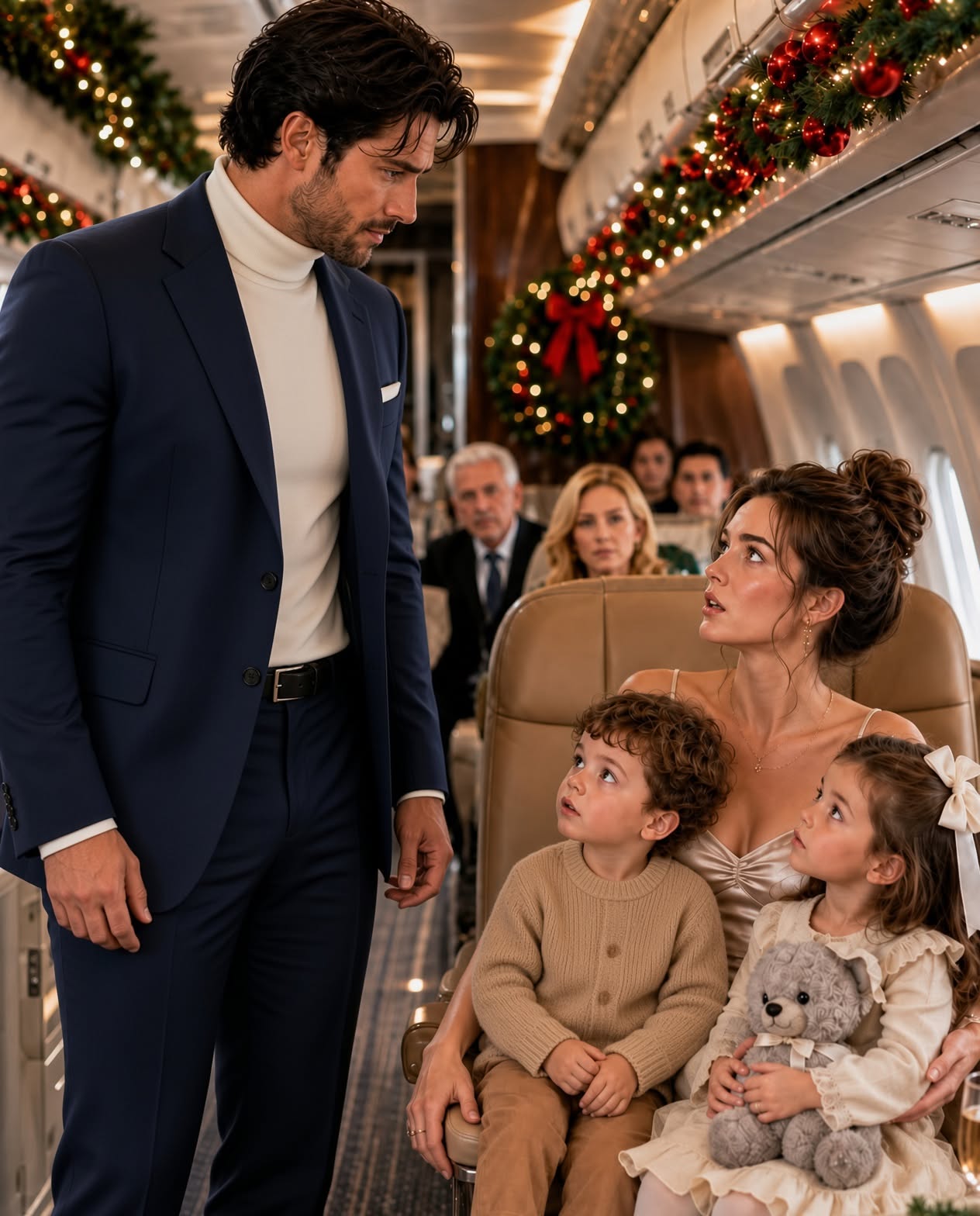
My name is Damon Prescott, and until that moment, I thought I understood the cost of ambition.
“Sorry,” the little boy said, reaching toward the crayon. “It escaped.”
He couldn’t have been more than two or three. Sandy brown hair curled above his forehead, and when he smiled, a small dimple appeared in his left cheek.
I had the same dimple.
I picked up the crayon.
“What’s your name?”
“Luke.”
Then I heard a woman’s voice behind him.
“Luke, sweetheart, come back here.”
My chest tightened before I even turned around.
I knew that voice.
Cassandra Hayes stood in row twenty eight with a little girl balanced against her hip. Her hair was shorter now, her face more tired, but I would have recognized her anywhere.
The little girl had my eyes too.
“Damon,” Cassandra whispered.
I stared from Luke to the child in her arms and started calculating dates automatically.
Three years since Cassandra and I had broken up.
The twins looked about two and a half.
Our last night together had been almost exactly nine months before they would have been born.
The truth hit me so hard I gripped the seat beside me.
“Who are these children?”
Cassandra went pale.
Before she could answer, a flight attendant touched my arm and ordered me back to first class because the plane was preparing to depart.
“We’re going to talk,” I told Cassandra.
“Not in front of them.”
Luke looked between us.
“Mama, do you know the angry man?”
Her answer cut deeper than I expected.
“I used to.”
I returned to first class only because aviation regulations managed to accomplish what executives, investors, and employees rarely could.
They made me sit down.
My phone vibrated before airplane mode.
THE ACQUISITION TEAM IS WAITING IN DENVER. WE NEED YOUR SIGNATURE BEFORE MIDNIGHT OR MERRITT SYSTEMS MAY ACCEPT CALDER’S OFFER.
Three hours earlier, that message would have consumed me.
Prescott Technologies had spent nine months preparing the $780 million acquisition. Merritt had created a revolutionary neonatal monitoring platform capable of identifying dangerous complications in premature infants hours earlier than conventional systems.
It was business.
But it was also personal.
My younger sister, Emily, had died at seventeen days old. I had been five, too young to understand medicine but old enough to remember my mother sitting beside an empty crib afterward.
That loss had shaped everything.
The company.
The money.
The obsession.
I had always told myself I worked sixteen hour days because I wanted to build things that mattered.
Now I wondered whether that was merely the respectable version of the truth.
As the plane climbed into the dark Oregon sky, I looked through the gap between the seats.
Luke had both palms against the window.
The little girl, whom I heard Cassandra call Violet, held a gray stuffed elephant against her chest.
Then turbulence struck.
The plane dropped suddenly.
Violet began crying.
“It’s okay, baby,” Cassandra soothed. “The clouds are just dancing with us.”
My throat tightened.
She had always done that.
When thunder scared us, she called it clouds moving furniture.
When the electricity was shut off in our first apartment because we couldn’t pay the bill, she lit candles and called it indoor camping.
Back then, I had nothing.
No private aircraft.
No Manhattan penthouse.
No company valued in the billions.
Just Cassandra.
And somehow I had been happier.
I unbuckled my seat belt.
The flight attendant appeared immediately.
“Sir, sit down.”
“There are children back there.”
“There are many children on this flight.”
I heard myself say the words before I understood how terrifying they were.
“My children may be back there.”
For the first time, her expression softened.
“Then stay seated until the captain turns off the sign.”
Those twelve minutes felt longer than any board meeting of my life.
The moment the light disappeared, I stood.
I walked to row twenty eight while Cassandra watched me approach with one arm protectively around the twins.
An elderly woman across the aisle stopped pretending not to listen.
I stopped beside Cassandra.
“May I sit?”
Her jaw tightened.
Then she shifted just enough to let me into the empty seat.
Luke stared at me curiously.
Violet hid behind her stuffed elephant.
I lowered my voice.
“Cassandra, I need the truth.”
She looked down at the children.
Then back at me.
“They’re yours.”
For several seconds, the entire plane seemed to vanish around me.
I had missed their births.
Their first steps.
Their first words.
Christmas mornings I never knew existed.
I had missed fevers and scraped knees and bedtime stories.
I had spent thirty months negotiating contracts while two human beings carrying half my DNA learned how to say Mama.
My voice barely worked.
“Why didn’t you tell me?”
Cassandra’s eyes filled with tears.
“I tried.”
Then she reached into her bag and pulled out something that made my blood run cold.
It was a bundle of envelopes.
Dozens of them.
Every envelope had my name on it.
Every envelope had been returned.
I picked up the first.
DAMON PRESCOTT.
My old Seattle address.
Stamped across the front in red were the words:
RETURN TO SENDER. RECIPIENT REFUSED.
I grabbed another.
Same stamp.
Another.
Same.
My hands started shaking.
“What is this?”
“I wrote after I found out I was pregnant.”
“I never received these.”
“I know.”
“How?”
Cassandra swallowed.
“Because somebody made sure you didn’t.”
I stared at her.
“Who?”
She looked toward the twins.
“Not here.”
“Cassandra.”
“Damon, please.”
For once, I listened.
I sat there while Luke colored a dinosaur red because, according to him, green was “too boring.”
Violet eventually lowered her elephant.
She studied my face with solemn green eyes.
Then she reached out and touched my cheek.
“Dimple,” she whispered.
I almost broke.
“Yes.”
She touched her own cheek.
“Luke has one.”
“I noticed.”
“Mama says dimples are where angels poke you.”
Cassandra looked away quickly.
I remembered saying that to her once.
Years ago.
She had remembered.
She had passed it on.
My phone vibrated again in my pocket.
Denver.
The deal.
I ignored it.
Luke leaned against Cassandra.
“Are you Mama’s friend?”
The question silenced both of us.
Cassandra answered first.
“He was.”
“Why not now?”
“Sometimes grown ups get lost.”
Luke considered that.
“Then use a map.”
The elderly woman across the aisle laughed softly.
I didn’t.
Because somehow a two year old had just summarized the previous three years of my life.
I had built a company worth billions.
And I had gotten lost.
When the twins eventually fell asleep, Cassandra finally spoke.
“You really didn’t know?”
“No.”
She searched my face.
“You swear?”
“On Emily.”
That did it.
Cassandra knew I had never used my sister’s name lightly.
Her shoulders dropped.
“I believed you hated me.”
“I thought you left me.”
“I did leave.”
“Without telling me you were pregnant.”
“I didn’t know yet.”
That much I remembered.
Three years earlier, I had been trying to close the financing round that transformed Prescott Technologies from a struggling startup into an industry powerhouse.
Cassandra had begged me to slow down.
I called her unsupportive.
She asked me to attend her father’s retirement dinner.
I skipped it for an investor meeting.
She asked me to spend one weekend without my laptop.
I laughed.
Then came the night everything ended.
“You told me there was no room for me in your life,” Cassandra said quietly.
“I was angry.”
“You said your company was the only thing that would never ask you to become smaller.”
I closed my eyes.
I remembered every word.
“You packed the next morning.”
“I thought you’d stop me.”
“I thought you wanted me to chase you.”
“I did.”
“Why didn’t you say that?”
“Because I was twenty eight and proud and terrified.”
“So was I.”
She looked at me.
“We were idiots.”
“Apparently.”
For the first time, something almost like our old smile passed between us.
Then it disappeared.
“I found out six weeks later,” she said.
“About the pregnancy?”
She nodded.
“I called your office.”
“What happened?”
“Your assistant said you refused to speak to me.”
“Which assistant?”
“Margaret.”
My stomach tightened.
Margaret Prescott.
My mother.
After my company secured its major financing, my mother had temporarily taken over executive communications while I rebuilt the leadership team.
“You spoke to my mother?”
“Many times.”
The cabin suddenly felt cold.
“What did she say?”
Cassandra stared at the sleeping children.
“She said you knew.”
I stopped breathing.
“She said you didn’t want children distracting you while the company was expanding. She told me you would provide financial support if a paternity test proved they were yours, but you wanted no personal involvement.”
“That’s a lie.”
“I know that now.”
“Why now?”
Cassandra reached into the bag again.
This time she removed her phone.
“There’s more.”
Before she could show me, the captain announced our descent into Denver.
My phone reconnected twenty minutes later.
Thirty seven messages appeared.
My chief operating officer, Nathan Cole, had sent nineteen.
My board chairman had sent eight.
My mother had sent six.
The latest message was from Nathan.
CALDER’S CEO IS IN THE BUILDING. IF YOU AREN’T HERE BY 11:30, WE MAY LOSE MERRITT.
It was 10:42.
Cassandra buckled Violet into her seat.
“You should go.”
I stared at her.
“You think I’m leaving?”
“You came here for a $780 million acquisition.”
“I came here thinking that mattered most.”
Her expression changed slightly.
“And now?”
I looked at Luke.
Then Violet.
“Now I know better.”
The aircraft landed at 11:03.
My driver was waiting outside the terminal.
So was a second vehicle.
Cassandra stopped.
“You arranged that?”
“I arranged everything while we were taxiing.”
“Damon, we have somewhere to go.”
“Where?”
“My sister’s house.”
“Then my driver will take you.”
“We don’t need your money.”
“I didn’t offer money.”
She stiffened.
“I offered transportation.”
That sounded ridiculous even to me.
Luke solved the argument by grabbing my finger.
“Angry man coming?”
Cassandra closed her eyes.
“His name is Damon.”
Luke looked at me.
“Damon coming?”
I crouched.
“If your mother says yes.”
Luke immediately turned to Cassandra.
“Say yes.”
She almost smiled.
“Fine.”
I rode with them.
For twenty minutes, I watched my children exist.
Luke counted red cars incorrectly.
Violet sang half of “Jingle Bells” repeatedly.
Cassandra corrected neither of them.
Then my phone rang.
Mother.
I answered.
“Where are you?” Margaret demanded.
“In Denver.”
“Thank God. Nathan says Merritt’s lawyers are preparing Calder’s agreement.”
“I’m not going to the meeting yet.”
Silence.
“Excuse me?”
“I found Cassandra.”
The silence changed.
It became something else.
Something alive.
Something afraid.
My mother finally said, “Where?”
“On the flight.”
Another pause.
Then:
“Damon, whatever she told you, do not believe her.”
Cassandra heard.
I saw it in her face.
My heartbeat slowed.
Dangerously.
“What exactly do you think she told me?”
My mother hesitated.
That hesitation answered more than words could.
“Come to the office,” she said. “We’ll discuss this privately.”
“Did you know she was pregnant?”
“Damon.”
“Did you know?”
“Yes.”
The word landed like a bullet.
Cassandra turned toward the window.
“Did you tell her I wanted nothing to do with my children?”
“I protected you.”
“From what?”
“From throwing away everything you had worked for.”
I looked at Luke sleeping against Cassandra’s arm.
“You stole three years from me.”
“I gave you Prescott Technologies.”
“No. I built Prescott Technologies.”
“Because I made sure you stayed focused.”
My hand tightened around the phone.
“You returned her letters.”
“I handled a distraction you were too emotional to handle yourself.”
Cassandra flinched.
I had never hated anyone in that instant as much as I hated the calmness in my mother’s voice.
“You called my children a distraction.”
“They were embryos, Damon.”
I hung up.
Cassandra whispered, “I’m sorry.”
I looked at her sharply.
“For what?”
“For being right about her.”
“No.”
I stared through the windshield at Christmas lights blurring across snowy Denver streets.
“You don’t apologize for somebody else’s cruelty.”
My phone rang again.
Nathan.
I almost ignored it.
Then I answered.
“Damon, where are you?”
“Occupied.”
“Calder just increased their offer.”
“How much?”
“Eight hundred and twenty million.”
I glanced at Cassandra.
“Then let them.”
Nathan went silent.
“What?”
“Let Calder buy Merritt.”
“You spent nine months on this.”
“I know.”
“The platform is the reason you built the medical division.”
“I know.”
“Then get here.”
“No.”
His voice lowered.
“You don’t understand what you’re doing.”
And something about the way he said it made me pause.
“What does that mean?”
Nothing.
Then Nathan said, “Just get here before midnight.”
He hung up.
At Cassandra’s sister’s house, Christmas decorations covered every window.
Luke woke immediately.
“Santa house!”
He ran toward the door.
Violet followed more slowly, carrying her elephant.
Before Cassandra went inside, I touched her arm.
“What were you going to show me on the plane?”
She froze.
Her hand went to her bag.
“The thing on your phone.”
For several seconds she didn’t move.
Then she unlocked it.
“I received this yesterday.”
She handed me the screen.
It was an email.
No sender name.
Only an encrypted address.
Attached was an audio file.
Cassandra pressed play.
My mother’s voice filled the car.
“Once Damon signs the Merritt acquisition, the final transfer becomes irreversible.”
Then Nathan spoke.
“What about Cassandra?”
My blood stopped.
My mother answered.
“She has no idea what she has.”
Nathan laughed.
“And the children?”
A pause.
Then my mother said something I could barely process.
“They’re the reason we need Damon’s signature tonight.”
The recording ended.
I stared at Cassandra.
“What does that mean?”
“I don’t know.”
“Where did you get this?”
“I told you. Someone sent it anonymously.”
“Why?”
“I don’t know.”
I looked at the timestamp.
Yesterday, 4:16 a.m.
Suddenly the $780 million acquisition was no longer merely a deal.
Something connected Merritt Systems to Cassandra.
To my mother.
To Nathan.
And somehow to my children.
I called my personal attorney, Evelyn Shaw.
“Evelyn, pull every document connected to Merritt. Ownership, patents, trusts, side letters, everything.”
“It’s Christmas Eve.”
“Now.”
She heard something in my voice.
“I’ll call you back.”
Twenty three minutes later, she did.
I was standing alone in Cassandra’s sister’s kitchen while the twins decorated cookies in the next room.
“Damon,” Evelyn said, “do not sign anything.”
My skin prickled.
“Why?”
“The neonatal platform isn’t owned directly by Merritt.”
“What?”
“It’s licensed through a holding trust.”
“Who controls the trust?”
“That’s complicated.”
“Uncomplicate it.”
Papers rustled.
“The trust was established thirty one years ago by Dr. Samuel Merritt and your father.”
I gripped the counter.
“My father?”
Richard Prescott had died when I was twenty one.
He had been a biomedical engineer before abandoning research to build the small electronics company I later transformed into Prescott Technologies.
“What did my father have to do with Merritt?”
“Apparently, everything.”
Evelyn continued.
“The original neonatal detection algorithm was partially based on research your father conducted after Emily died.”
My knees nearly gave out.
My infant sister.
The loss that had supposedly inspired my career.
My father had already been trying to solve it.
“There’s more,” Evelyn said.
“Of course there is.”
“Your father placed his intellectual property rights into a family trust.”
“Mine?”
“No.”
I stopped.
“What do you mean, no?”
“The trust beneficiary isn’t you.”
I heard Luke laughing in the next room.
“Who is it?”
Evelyn exhaled.
“Any biological child of yours.”
I said nothing.
“The trust activates upon verified birth of your first biological child. Until then, your mother served as contingent administrator.”
The room tilted.
“When Luke and Violet were born…”
“Control should have transferred to them.”
“But it didn’t.”
“No.”
“Because nobody declared their existence.”
“That appears to be the case.”
My mother had not hidden my children merely to protect my career.
She had hidden them because their existence stripped her of control over an asset now worth hundreds of millions of dollars.
I felt sick.
“What happens if I acquire Merritt?”
Evelyn’s answer came slowly.
“The acquisition agreement contains a consolidation clause. Once Prescott Technologies buys Merritt, all licensing rights held by related family trusts can be converted into corporate equity.”
“Meaning?”
“Your children’s trust disappears into the company.”
“And who controls the company?”
“You do.”
“Not entirely.”
I understood before she answered.
My mother controlled eleven percent.
Nathan controlled four.
Together with two allied board members, they could force a restructuring if the acquisition triggered certain debt provisions.
“Jesus.”
“They weren’t trying to help me buy Merritt.”
“No.”
“They were trying to steal it from Luke and Violet.”
“Yes.”
I closed my eyes.
Then another thought struck me.
“Why would Nathan send Cassandra that recording?”
“We don’t know that he did.”
But I knew.
Or thought I knew.
At 11:41, I walked into Prescott Technologies’ Denver office.
My mother stood at the conference table.
Nathan stood beside her.
Merritt’s attorneys sat opposite them.
Everyone looked relieved when I entered.
My mother smiled.
“There he is.”
I placed my coat over a chair.
“Where’s the agreement?”
Nathan pushed a folder toward me.
“Signature tabs marked.”
I opened it.
Page after page.
Numbers.
Representations.
Warranties.
Then I reached the consolidation clause.
My mother watched me.
“Problem?”
“No.”
I picked up the pen.
Nathan relaxed.
My mother almost did.
Then I placed the pen down.
“I know about the trust.”
Nobody moved.
Nathan’s face remained perfectly still.
My mother’s did not.
“What trust?”
“Emily’s.”
Her eyes flickered.
That was enough.
“The trust belongs to my children.”
“Damon, listen to me.”
“You knew Luke and Violet existed.”
“I explained that.”
“You hid them because the moment their births were documented, you lost control of my father’s research.”
Nathan stepped forward.
“This isn’t the place.”
I turned toward him.
“You knew too.”
His jaw tightened.
My mother said, “Everything I did was for this family.”
“No.”
I pulled the returned letters from my coat and dropped them onto the table.
“You destroyed my family for money.”
Her composure finally cracked.
“You think Cassandra loved you?”
I stared at her.
“She left the moment things became difficult.”

“She tried to contact me.”
“She wanted your money.”
“She asked for nothing.”
“Because she already had something better.”
“What?”
My mother smiled.
And that smile frightened me.
“Ask her who sent the recording.”
The conference room went silent.
I looked at Nathan.
His eyes dropped.
My stomach turned.
“You sent it.”
Nathan said nothing.
“Why?”
My mother laughed once.
“Because he’s been working with Cassandra.”
I grabbed my phone.
I called Cassandra.
She answered on the second ring.
“Damon?”
“Did Nathan send you that recording?”
Silence.
Too long.
“Cassandra.”
“I didn’t know it was him.”
“Did you communicate with him?”
“Yes.”
My chest tightened.
“How long?”
“Two months.”
I closed my eyes.
My mother whispered, “There.”
Cassandra continued quickly.
“He contacted me. He said someone inside Prescott Technologies had been intercepting information about the twins. He said he could prove it.”
“Why didn’t you tell me?”
“Because I didn’t trust you yet.”
The words hurt.
But they made sense.
Nathan suddenly spoke.
“She’s telling the truth.”
My mother spun toward him.
He stepped away from her.
“I contacted Cassandra because I discovered Margaret had altered the trust disclosures.”
My mother’s face hardened.
“You idiot.”
Nathan reached into his jacket.
He placed a flash drive on the table.
“I’ve been collecting evidence for eleven months.”
I stared at him.
“Why?”
His expression changed.
And suddenly I saw grief there.
Old grief.
Deep grief.
“Because your father asked me to.”
My breath caught.
“My father has been dead for eighteen years.”
Nathan shook his head.
“No, Damon.”
The room stopped.
My mother went white.
Nathan looked directly at me.
“Richard Prescott is alive.”
I laughed.
I actually laughed because the alternative was accepting an impossible sentence.
“That’s not funny.”
“I’m not joking.”
“My father died in a boating accident.”
“There was an accident.”
“I identified his watch.”
“You identified a watch.”
My mother backed toward the table.
“Stop.”
I turned toward her.
For the first time in my entire life, Margaret Prescott looked afraid.
Not angry.
Not defensive.
Afraid.
“Mother?”
She said nothing.
Nathan continued.
“Richard discovered that the prototype monitoring system used on Emily had produced a warning six hours before she died.”
I stared at him.
“What?”
“The warning was suppressed.”
“By whom?”
Nathan looked at my mother.
The world inside me cracked open.
“No.”
Margaret whispered, “It wasn’t like that.”
I could barely hear her.
“What did you do?”
“Emily was already sick.”
“What did you do?”
She began crying.
I had seen my mother cry exactly twice in my life.
At Emily’s funeral.
And at my father’s.
Both suddenly felt like performances.
“The prototype generated too many false alarms,” she said. “Your father wanted to halt the clinical trial. The investors would have withdrawn.”
My stomach twisted.
“So you ignored it?”
“I thought it was another false positive.”
“Emily died.”
“I KNOW!”
Her scream filled the conference room.
Everyone froze.
Margaret covered her mouth.
Then the truth poured out.
“Your father blamed me. He said he would go to regulators. He said he would destroy the company and expose everything.”
“So you killed him?”
“No!”
“Then where is he?”
“I don’t know.”
Nathan interrupted.
“Yes, you do.”
He tapped the flash drive.
“You paid someone to sabotage Richard’s boat.”
My mother stared at him.
“You have no proof.”
“I have the payment trail.”
Her face collapsed.
Nathan looked at me.
“Richard survived. The man hired to sabotage the boat warned him beforehand and helped stage his death.”
“Why wouldn’t he come back?”
“Because he believed Margaret would come after you next.”
My mouth went dry.
“He abandoned me to protect me?”
“He disappeared to build a case. Then he learned Margaret had people inside law enforcement and the company. By the time he had enough evidence, you were an adult and had rebuilt Prescott Technologies around her.”
“Why wait eighteen years?”
“He didn’t.”
Nathan’s eyes moved toward the conference room doors.
“He’s been trying to reach you.”
The doors opened.
An elderly man walked in.
Silver hair.
Thin shoulders.
A scar running from his temple toward his ear.
But I knew his eyes.
Because I saw them every morning in the mirror.
My knees weakened.
“Dad?”
Richard Prescott stopped ten feet away.
For eighteen years, I had imagined what I would say if I could speak to my father one more time.
Nothing came.
He looked at me.
Then his face crumpled.
“Hello, son.”
I crossed the room.
I hit him.
The sound echoed.
Nobody moved.
Richard touched his mouth.
“I deserved that.”
“You let me bury you.”
“Yes.”
“You let me think you were dead.”
“Yes.”
“You left me with her.”
His eyes filled.
“That is the part I will never forgive myself for.”
I wanted to hit him again.
Instead, I grabbed him.
I don’t know whether I was trying to hurt him or hold him.
Maybe both.
Then I was crying into the shoulder of a man I had mourned for almost two decades.
My mother tried to leave.
Two federal agents entered before she reached the door.
She stopped.
Richard looked at her.
“Hello, Margaret.”
Her face became stone.
“You ruined everything.”
“No,” he said quietly. “We did that years ago.”
The agents arrested her on charges connected to fraud, obstruction, attempted theft of trust assets, and conspiracy relating to my father’s disappearance.
The investigation would take months.
Maybe years.
But none of that was the strangest part.
At 12:07 Christmas morning, I returned to Cassandra’s sister’s house.
The $780 million deal had expired seven minutes earlier.
Calder had withdrawn too.
Because without clear ownership of the intellectual property, Merritt couldn’t legally sell.
I stood outside beneath falling snow.
Cassandra opened the door.
“Well?”
“I lost the deal.”
Her face fell.
“I’m sorry.”
I smiled.
“I’m not.”
Then Richard stepped out of the car behind me.
Cassandra stared.
“Damon…”
“I know.”
Luke appeared behind her wearing dinosaur pajamas.
He looked at Richard.
Then at me.
“Another angry man?”
For the first time that night, I laughed.
“No.”
Richard crouched.
“I’m his grandpa.”
Luke frowned.
“What’s a grandpa?”
Richard’s eyes filled with tears.
“A person who has a lot of time to make up for.”
That nearly destroyed me.
Christmas morning arrived quietly.
No boardroom.
No champagne.
No billion dollar announcement.
I sat on the floor watching Luke tear wrapping paper into microscopic pieces while Violet placed bows on everyone’s heads.
Cassandra sat beside me.
Our shoulders touched.
Neither of us moved away.
“I’m not asking you to forgive me,” I said.
“For what?”
“For not being there.”
“You didn’t know.”
“I should have found you.”
“And I should have tried harder.”
“No.”
I looked at her.
“We’re not doing that anymore.”
“Doing what?”
“Turning other people’s crimes into our guilt.”
Her eyes softened.
I continued.
“I don’t know what happens with us.”
“Neither do I.”
“But I know what happens with them.”
I looked at our children.
“I’m here.”
Cassandra’s eyes filled.
“Tomorrow too?”
“Yes.”
“Next week?”
“Yes.”
“Even when Luke draws dinosaurs on your furniture?”
“Especially then.”
She smiled.
It was the smile I remembered.
The smile I had spent three years pretending I didn’t miss.
Six months later, the federal case against Margaret expanded dramatically.
Nathan testified.
Richard testified.
So did Cassandra.
Prescott Technologies’ board removed Margaret permanently and restructured the company.
I stepped down as chief executive.
Business magazines called it shocking.
Investors called it irrational.
One television commentator said I had suffered “an emotional collapse.”
He was right.
The man I had been needed to collapse.
I remained chairman, but I hired someone else to run daily operations.
Then I did something no analyst predicted.
I transferred my controlling shares into the same trust established for Luke and Violet.
Cassandra nearly threw the documents at me.
“They don’t need billions.”
“No.”
“Then why?”
“Because it was never mine.”
She stared at me.
“My father built the original research for Emily. The trust was meant to protect whatever came from it for the next generation.”
“You’re still their father without giving them a company.”
“I know.”
That was precisely why I could give it away.
A year after that Christmas Eve flight, Merritt’s neonatal technology received regulatory approval under a nonprofit licensing model Richard had originally envisioned.
Hospitals serving low income communities could use it for almost nothing.
Prescott Technologies funded implementation.
We named the initiative the Emily Project.
The first infant officially credited with being saved by an early warning from the system was born in Portland.
A premature baby girl.
Seventeen days old when the system detected the complication.
The same age Emily had been when she died.
I cried when I received the report.
Richard did too.
But the final truth came three days later.
And it changed everything again.
Cassandra and I were at home.
Our home.
Not the penthouse.
I sold that.
We had bought a four bedroom house outside Portland with a backyard, a crooked apple tree, and a kitchen perpetually covered in crayons.
Luke was drawing at the table.
Violet was making her elephant attend an imaginary tea party.
The doorbell rang.
Richard stood outside holding a small metal box.
His expression told me immediately that something was wrong.
“What happened?”
“Nothing.”
“Then why do you look like that?”
He glanced toward Cassandra.
“Because there is one thing I never told you.”
My stomach tightened.
Cassandra took the twins upstairs.
Richard placed the box on our dining table.
Inside were documents.
Medical records.
Birth certificates.
Old photographs.
And one sealed envelope.
My name was written across it.
Not Damon.
Damien.
The name on my original birth certificate.
A spelling my parents had supposedly changed when I was an infant.
“What is this?”
Richard sat down.
“Your mother wasn’t the only person who lied to you.”
I stared at him.
“What did you lie about?”
“Emily.”
I froze.
“What about her?”
He pushed a photograph toward me.
My mother was younger.
Richard stood beside her.
And in Margaret’s arms was a newborn baby.
On the back:
EMILY PRESCOTT.
I frowned.
“So?”
Richard’s hands trembled.
“Look at the date.”
I did.
The photograph had been taken eleven months before I was born.
“That makes sense.”
“No.”
Richard looked at me.
“Read Emily’s full medical record.”
I opened it.
My eyes moved over clinical terms until I reached the identification section.
Sex: Female.
Date of birth.
Parents.
Then blood type.
I looked at Richard.
“What am I supposed to see?”
“Your blood type is AB negative.”
“Yes.”
“Mine is O positive.”
I waited.
“Margaret’s was O negative.”
I stared at him.
Understanding came slowly.
Then violently.
Two type O parents could not have an AB child.
My mouth went dry.
“You’re not my biological father.”
Richard’s face broke.
“No.”
I stood so quickly the chair fell backward.
“Who is?”
He didn’t answer.
“WHO?”
Luke cried upstairs.
I lowered my voice immediately.
Richard covered his face.
“The physician supervising Emily’s trial.”
I felt nauseated.
“My mother had an affair?”
“No.”
The answer confused me.
Richard reached for the last document.
“Margaret couldn’t conceive again after Emily.”
“But I was born eleven months after her.”
“Yes.”
“How?”
Richard looked toward the staircase.
Then back at me.
“You weren’t born to Margaret.”
The room became completely still.
I laughed weakly.
“That’s impossible.”
“No.”
“Her name is on my birth certificate.”
“It was falsified.”
“Then who gave birth to me?”
Richard slid the final document across the table.
I looked down.
A name.
Dr. Eleanor Merritt.
I knew that surname.
Everyone did.
Samuel Merritt had founded Merritt Systems.
But Eleanor Merritt had been his younger sister.
The neonatal physician who developed the first clinical research program.
The woman who had supposedly died in a car accident thirty six years earlier.
Five years before I was born.
I looked at Richard.
“She was dead.”
“That’s what Samuel told everyone.”
“Why?”
“Because she discovered the trial records had been manipulated.”
My skin went cold.
“Where is she?”
Richard stared at me.
“She died giving birth to you.”
I sank into the chair.
Nothing made sense.
“Why would Margaret raise another woman’s baby?”
Richard’s answer was barely audible.
“Because Eleanor was my wife.”
I stared at him.
“What?”
“Before Margaret.”
He wiped his eyes.
“Eleanor and I were married secretly. Her family opposed it. Samuel believed I wanted access to their research.”
My head spun.
“Then Margaret…”
“Worked with us.”
He looked ashamed.
“After Emily died, Eleanor discovered Margaret had suppressed the warning. She threatened to expose her. Margaret discovered Eleanor was pregnant with you.”
I could barely breathe.
“She arranged the accident.”
Richard nodded.
“Eleanor survived long enough to give birth prematurely.”
“And Margaret took me.”
“She convinced me that if the Merritts learned you existed, they would take you away while I was being investigated over the trial. I was grieving. Terrified. Stupid.”
“Why call Emily my sister?”
Richard looked at me.
And that was when I saw the final horror in his eyes.
“Because she was.”
I stopped breathing.
“But you said Eleanor was my mother.”
“She was.”
“Then how was Emily my sister if Margaret was her mother?”
Richard said nothing.
I understood.
“No.”
His eyes closed.
“No.”
“Damon…”
“No.”
“Emily wasn’t Margaret’s biological daughter either.”
My heart pounded.
Richard pushed one final laboratory report toward me.
“Eleanor gave birth to twins.”
I stared at him.
The room vanished.
“Emily…”
“Was your twin sister.”
I couldn’t speak.
“She was born first,” Richard whispered. “You were born eleven minutes later.”
“But she died seventeen days before I was born.”
“That date was fabricated.”
Everything inside me fractured.
My childhood.
My family.
The empty crib.
The funeral photographs.
The story I had built my entire life around.
Emily had not been my older sister.
She had been my twin.
And Margaret had changed my birth date so nobody would connect me to the infant who died during the Merritt clinical trial.
I looked at the ceiling.
At the sound of Luke and Violet laughing upstairs.
Twins.
My twins.
Suddenly I understood why my father had written the trust the way he had.
“Any biological child of Damon Prescott.”
Not because he wanted to make my descendants rich.
Because he had lost one twin.
And he wanted to protect the next ones.
I started crying.
Not politely.
Not quietly.
I folded over the table and wept for a sister I had mourned my entire life without ever knowing that we had entered the world together.
Richard came around the table.
This time, when he touched my shoulder, I didn’t hit him.
I held his hand.
“Why tell me now?”
“Because you broke the cycle.”
I looked at him.
“You chose your children over the company before you knew the company belonged to them. You chose Cassandra before you knew what it would cost.”
His voice cracked.
“I needed to know you were nothing like us.”
I thought about that for a long time.
Then Luke came downstairs.
He stopped when he saw me crying.
“Daddy?”
That word still had the power to rearrange my heart.
He climbed onto my lap.
“Why sad?”
I looked into those green eyes.
My eyes.
Emily’s eyes.
Maybe Eleanor’s.
“Because I learned something about my sister.”
“Was she nice?”
I laughed through my tears.
“I think she was.”
“Where is she?”
I kissed his forehead.
“Gone.”
Luke thought carefully.
Then he took the red crayon from his pajama pocket.
The same color that had rolled against my shoe on the plane a year earlier.
He placed it in my hand.
“You can have this.”
“Why?”
“For when you miss her.”
I stared at that ridiculous broken crayon and understood something no acquisition, fortune, or boardroom had ever taught me.
The most valuable things in life rarely announce themselves as valuable.
Sometimes they look like missed flights.
Returned letters.
Children coloring dinosaurs the wrong color.
A woman giving you another chance.
A father returning eighteen years late.
A sister whose true story waited decades to be heard.
And sometimes they look like a red crayon rolling across the floor of an airplane while you are staring at your phone, furious because you think $780 million is the most important thing you might lose that night.
Cassandra came downstairs carrying Violet.
She saw the papers.
Then she saw my face.
She didn’t ask questions.
She simply sat beside me.
Violet climbed into my other arm.
Richard sat across from us.
For a while, nobody spoke.
Snow fell outside the windows.
Christmas lights reflected softly against the glass.
My phone buzzed on the counter.
Once.
Twice.
Three times.
I didn’t look.
Eventually it stopped.
Luke leaned against my chest.
Violet fell asleep against my shoulder.
Cassandra rested her head beside mine.
And I finally understood the lesson ambition had spent half my life preventing me from learning.
Success is not measured by how much the world notices when you arrive.
It is measured by who notices when you come home.
I had once believed my greatest tragedy was losing my infant sister.
Then I believed it was losing Cassandra.
Then three years later, aboard a crowded Christmas Eve flight, I discovered I had also lost the first years of my children’s lives.
I could never recover those years.
I could never hold Luke the night he was born.
I could never hear Violet’s first word for the first time.
I could never become the young father I should have been.
But regret is a strange thing.
If you stare backward long enough, it becomes another form of absence.
So I stopped.
I stopped trying to recover yesterday.
And I started showing up for today.
I attended preschool performances where Luke forgot every word.
I let Violet paint my fingernails before investor calls.
I learned that pancakes shaped like dinosaurs tasted exactly like ordinary pancakes but were apparently worth screaming about.
I learned how to braid hair badly.
I learned bedtime stories required voices.
I learned children do not care what your company is worth.
They care whether you promised to come home before they fall asleep.
And Cassandra?
We didn’t magically become the people we had been.
That would have been another mistake.
We became different people.
Better ones.
We went slowly.
Coffee.
Walks.
Counseling.
Arguments where neither person disappeared afterward.
Months later, I proposed again.
Not in Paris.
Not beneath fireworks.
Not inside some restaurant rented for the evening.
I proposed in our kitchen while Luke was covered in flour and Violet was wearing one of Cassandra’s shoes.
Cassandra stared at the ring.
Then at me.
“You’re serious?”
“Terrifyingly.”
“What if we get lost again?”
I looked toward our children.
“Then we use a map.”
She laughed because she remembered.
Then she cried.
Then she said yes.
On our wedding day, Richard walked Cassandra halfway down the aisle before stopping beside Luke and Violet.
The twins took her hands.
Together, they brought her the rest of the way to me.
There were no reporters.
No investors.
No billionaires.
Just family.
Real family.
Messy family.
Family built not from perfect histories but from people deciding that inherited damage would stop with them.
At the reception, Richard handed me a small velvet box.
Inside was a hospital bracelet.
EMILY E. MERRITT.
Beside it was another.
DAMIEN R. MERRITT.
Mine.
The original.
I held both bracelets together.
Two tiny pieces of plastic.
Two children born eleven minutes apart.
One given seventeen days.
One given decades.
For years, I had wondered why I survived when Emily didn’t.
Now I knew that was the wrong question.
Survival does not make you deserving.
It makes you responsible.
So the following morning, Cassandra and I signed the final papers transferring another portion of my personal fortune into the Emily Project.
Not because money could repair the past.
It couldn’t.
But perhaps it could buy someone else a future.
Years later, when Luke and Violet were old enough to understand, I told them everything.
About Emily.
About Eleanor.
About Richard.
About Margaret.
About the letters.
And about Christmas Eve.
Luke stared at me.
“So you met us because I dropped a crayon?”
“Yes.”
“What if I hadn’t dropped it?”
I smiled.
“I’ve wondered that.”
Violet rolled her eyes.
“Obviously we still would’ve met him.”
“How do you know?”
“Because Mom was three rows behind him.”
Luke considered this.
“Oh.”
Then he frowned.
“Still, my crayon helped.”
“It did.”
He grinned.
That dimple appeared.
My dimple.
Emily’s, according to Richard.
And suddenly I was back on that airplane again.
A man in a tailored suit.
A $780 million acquisition waiting.
A phone filled with urgent messages.
A red crayon against my shoe.
And a little boy saying:
“It escaped.”
I had thought he meant the crayon.
Maybe, in a strange way, he didn’t.
Maybe I was the thing that had escaped.
From love.
From family.
From grief.
From the man I might have become if I had understood sooner what mattered.
And on Christmas Eve, somewhere between Oregon and Denver, two children I never knew existed brought me home.
