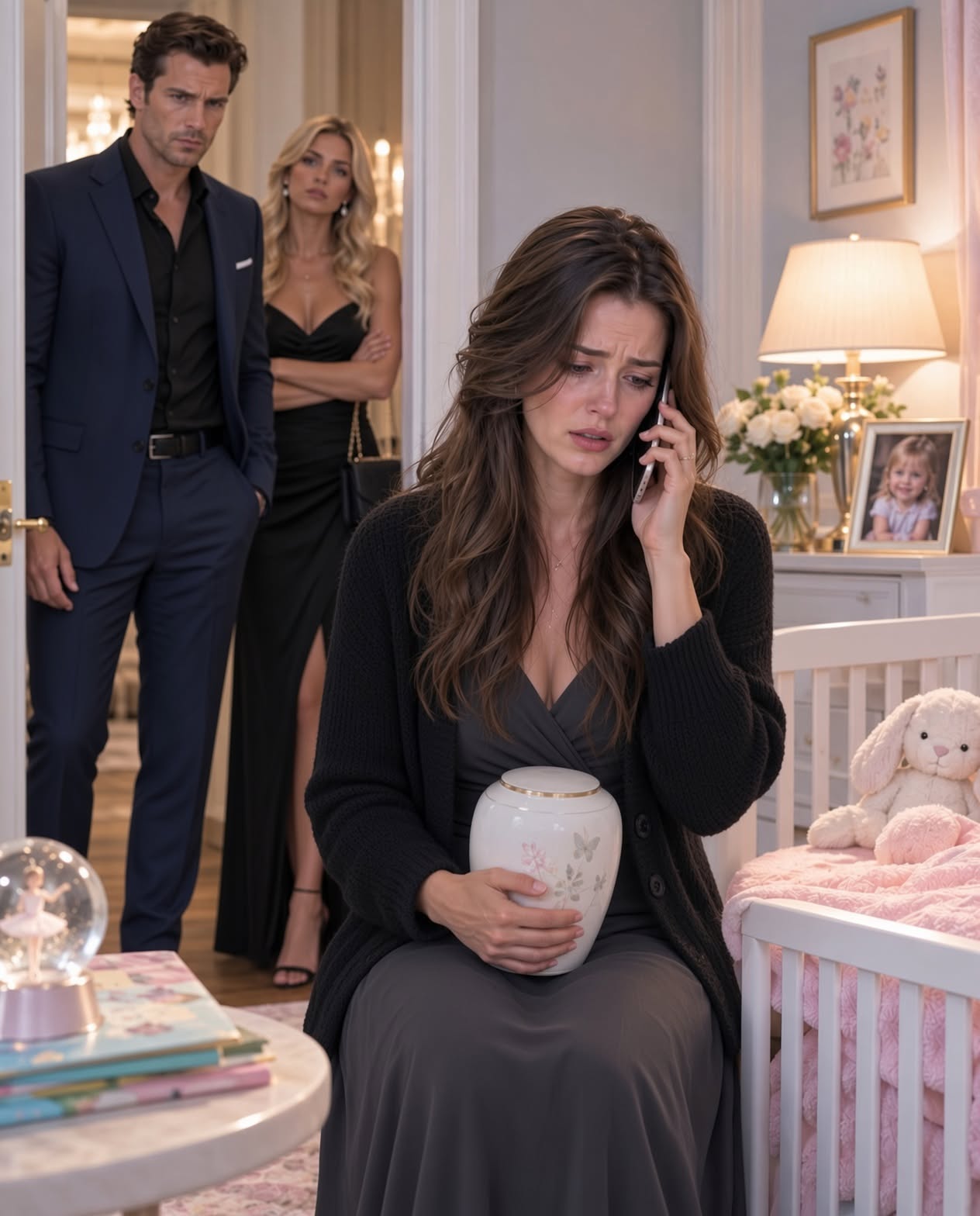
I left the hospital carrying my daughter’s ashes when my husband finally called from wherever he was with his mistress and coldly said, “The bill has been taken care of.
Stop bothering me.”
I didn’t argue.
I didn’t let him hear my voice break.
Instead, I stood beneath the gray November sky with a small white urn pressed against my chest and listened to the man I had loved for seven years complain that I was making his afternoon difficult.
“The medication was approved,” Brendan Fairchild continued impatiently.
“Ximena handled it.
Bring Chloe home and stop calling my office.”
Behind him, music played softly.
A woman laughed.
Samantha Hayes.
I knew her laugh because she had spent the previous Christmas sitting across from me at Brendan’s family table, smiling while Chloe slept against my shoulder.
Brendan had introduced her as a consultant.
I had been pretending to believe him ever since.
My fingers tightened around the urn.
Our three-year-old daughter had been dead for seventy-two hours.
Her father didn’t know.
“Fine,” I whispered.
He hung up.
No goodbye.
No question about Chloe.
Nothing.
I stood outside St.
Catherine’s Children’s Hospital while families moved around me.
Somewhere behind those glass doors, another mother was probably bargaining with God.
I had already finished bargaining.
The nurses had removed Chloe’s little yellow blanket from her bed three days earlier.
Her cardiologist, Dr.
Miriam Cole, had held me while I screamed into her shoulder.
Yesterday, I had signed cremation papers.
Today, they gave me what remained of my daughter in a container light enough to carry with one hand.
Three years of lullabies, surgeries, tiny socks, frightened smiles, and whispered promises had become an urn weighing less than my handbag.
I drove home alone.
The Fairchild estate stood behind iron gates in Lake Forest, enormous and immaculate, with pale limestone walls and windows reflecting Lake Michigan.
When I married Brendan, people called it a palace.
By the time Chloe died, I understood it was a cage.
Brendan’s sister, Vanessa, was standing in the foyer when I entered.
She looked irritated.
“Nora, where have you been?
Mother canceled dinner because everyone assumed there was another hospital emergency.”
I stared at her.
There was something almost fascinating about cruelty when grief had burned everything else out of you.
“What are you carrying?”
I looked down.
“Your niece.”
Vanessa blinked.
“Don’t be ridiculous.”
“It’s Chloe’s ashes.”
The color disappeared from her face.
For perhaps three seconds, she looked human.
Then her eyes flicked toward the urn as if it were something embarrassing.
“Oh.”
That was all she said.
Oh.
I walked past her.
Chloe’s bedroom was at the far end of the second floor because Brendan had complained that the oxygen concentrator disturbed his sleep.
Her crib remained beside the window.
A stuffed rabbit lay beneath the blanket.
I placed the urn inside.
Then I sat on the floor.
I don’t know how long I stayed there.
Eventually voices drifted upstairs.
Brendan had returned.
Vanessa must have told him.
I expected footsteps.
Instead, I heard him downstairs talking to her.
“What exactly happened?”
“Apparently Chloe died.”
Apparently.
I closed my eyes.
“When?”
“Three days ago.”
Silence.
Then Brendan said something that killed whatever remained of my marriage.
“Why the hell didn’t Nora tell me?”
Vanessa lowered her voice.
“She probably tried.”
Brendan exhaled sharply.
“Well, Ximena was right to slow her down.
Nora thinks she can use family money whenever she wants.
Every crisis becomes an excuse to spend.”
My eyes opened.
For weeks I had wondered whether Brendan understood what had happened with Chloe’s medication.
Now I knew.
He understood perfectly.
During Chloe’s final cardiac crisis, Dr.
Cole had prescribed an emergency medication not covered by our normal insurance authorization.
The hospital needed immediate financial approval.
I submitted everything through the Fairchild family portal.
Ximena rejected it.
Reason:
DEPENDENT QUARTERLY MEDICAL ALLOCATION EXCEEDED.
I called Brendan seventeen times.
He ignored every call.
I waited five hours inside the lobby of Fairchild Capital until he finally came downstairs with Samantha.
“Don’t embarrass me at work again,” he had said.
“Chloe needs the medication.”
“Then deal with Ximena.”
“She rejected it.”
“That means there’s probably a reason.”
“She could die.”
He had looked at his watch.
“Nora, everything is life or death with you.”
Dr.
Cole eventually paid for one dose herself.
One.
It bought us time.
My second authorization request remained marked UNDER REVIEW for seven days.
On the seventh day, Chloe’s heart stopped.
Now Brendan was downstairs defending the delay.
Something inside me became very quiet.
I stood.
At the back of my closet was an old leather suitcase I had not touched since my wedding.
Inside, beneath photographs and university certificates, was a black phone.
My father had given it to me three days before he died.
His name was Arthur Bennett.
And unlike the Fairchilds, my father had never confused wealth with power.
He understood the difference.
He had placed that phone in my hand and said, “Nora, love makes intelligent people volunteer for cages.
If you ever discover yours has a lock, turn this on.”
I had been furious.
I accused him of hating Brendan.
Dad merely smiled sadly.
“I hope you spend your entire life proving me wrong.”
I never turned the phone on.
Until that night.
The battery still held a charge.
There was only one contact.
RAYMOND VALE.
I pressed call.
An elderly voice answered.
“Hello?”
“Raymond?”
Silence.
Then his breathing changed.
“Nora?”
My throat tightened.
“Yes.”
“Oh, child.”
That nearly broke me.
I looked at Chloe’s urn.
“I need you to execute everything my father prepared.”
Another silence.
“Are you certain?”
“Yes.”
“There will be consequences.”
“I’m counting on them.”
“Nora, once I activate the trust provisions, certain people will know immediately.”
“Good.”
Raymond lowered his voice.
“Then I need you to listen carefully.
Your father left you considerably more than Brendan knows.”
“How much?”
“It isn’t primarily money.”
Footsteps sounded in the hallway.
Brendan.
Raymond continued.
“Your father left you control.”
The bedroom door opened.
I ended the call.
Brendan stood there.
For the first time since our wedding, I looked at my husband and felt absolutely nothing.
He stared at the urn.
His face changed.
“Nora…”
“Chloe died Tuesday.”
He swallowed.
“Why didn’t you tell me?”
I almost laughed.
“I called seventeen times.”
“I was working.”
“With Samantha?”
His jaw tightened.
“This isn’t the time.”
“No,” I said.
“It isn’t.”
He approached the crib.
For one strange second, I wondered if grief might finally reach him.
He touched the white urn.
Then he asked, “What did the hospital charge for cremation?”
I stared at him.
That was the moment my marriage ended.
Not legally.
Not publicly.
But completely.
I picked up Chloe’s urn.
“Don’t touch her.”
“Nora.”
“Don’t.”
He stepped back.
“You’re emotional.”
“Our daughter is dead.”
“And screaming at me won’t change that.”
I looked into his eyes.
“You’re right.”
My calm frightened him more than anger would have.
“What does that mean?”
“It means I’m done screaming.”
I walked around him.
That night, I slept beside Chloe’s empty crib.
At 6:14 the next morning, Raymond called.
“The first transfer has been completed.”
“What transfer?”
“Your father’s voting trust.”
I sat upright.
Raymond explained what Dad had never told me.
Twenty-eight years earlier, Arthur Bennett had quietly rescued Fairchild Capital from bankruptcy.
Brendan’s grandfather had been brilliant at appearances and disastrous with debt.
Dad provided the capital through a network of private investment vehicles.
In exchange, he received convertible preferred shares.
Over the years, those shares had been diluted, reorganized, hidden behind holding companies and assumed forgotten.
They weren’t.
My father had consolidated them into the Bennett Legacy Trust.
And I was its sole beneficiary.
“How much of Fairchild Capital do I own?”
“Directly and indirectly?”
“Yes.”
“Thirty-seven percent.”
I stopped breathing.
“That’s impossible.”
“It gets better.”
I almost smiled at Raymond’s tone.
“The Fairchild family controls thirty-four.”
My hand went cold.
“So I’m the largest shareholder.”
“Yes.”
“But Brendan is CEO.”
“For now.”
I walked toward the window.
Below me, Brendan was getting into his Bentley.
He looked powerful.
Untouchable.
He had no idea his wife could remove him from the company his surname was carved across.
“Why didn’t Dad tell me?”
“Because he wanted your marriage to have a chance.”
That hurt.
Raymond continued.
“Arthur believed that if you knew, you would never know whether Brendan loved you or your leverage.”
“So Dad hid it.”
“Yes.”
“And now?”
“Now we investigate.”
The next ten days changed everything.
I left the Fairchild estate with one suitcase and Chloe’s urn.
Brendan didn’t stop me.
He assumed I would return when my credit cards stopped working.
He froze them that afternoon.
Raymond had expected it.
By sunset, I had access to accounts Brendan had never known existed.
I rented a modest house near the lake.
Then I began working again.
Not for money.
For Chloe.
Before marriage, numbers had been my language.
Risk.
Probability.
Patterns.
For three years, grief and exhaustion had made me forget who I was.
Raymond gave me access to Fairchild Capital’s internal financial records through my shareholder rights.
I started reading.
Within forty-eight hours, I found the first anomaly.
Medical reimbursements allocated to executive families had been repeatedly denied while the same reserve accounts funded luxury travel labeled “client retention.”
I found Samantha’s name.
Hotels.
Private flights.
Jewelry.
A villa in Cabo.
All billed through Fairchild subsidiaries.
But that wasn’t the worst part.
I found Chloe.
Every rejected authorization.
Every delayed approval.
Every note.
Then I found a message attached to her final request.
HOLD UNTIL B.F.
CONFIRMS.
B.F.
Brendan Fairchild.
My hands shook.
I called Raymond.
“He ordered them to delay it.”
“We need proof.”
“There’s a note.”
“A note establishes involvement.
We need intent.”
So we kept digging.
Brendan meanwhile began sending messages.
First angry.
Then threatening.
Then strangely affectionate.
Nora, come home.
We’re both grieving.
You’re making decisions while unstable.
Finally:
My attorneys will seek guardianship over your finances if necessary.
I forwarded everything to Raymond.
His reply contained four words.
Please let him try.
Three days later, Brendan filed.
He claimed I was psychologically impaired by Chloe’s death and incapable of managing substantial assets.
The irony would have been funny if my daughter weren’t dead.
The filing forced disclosure.
Brendan had to submit financial records.
Including communications with Ximena.
That was his mistake.
Raymond’s forensic team recovered a deleted email.
The subject line was Chloe’s patient number.
Brendan had written:
Do not approve anything above the quarterly limit without speaking to me first.
Nora needs to understand boundaries.
Ximena replied:
Doctor says delay may be medically dangerous.
Brendan answered:
Then Nora will learn not to create emergencies every time she wants something.
Hold it.
I read those words twice.
Then I vomited.
For months, I had blamed bureaucracy.
A system.
A cold assistant.
A complicated insurance process.
But there had been no accident.
My husband had intentionally delayed our daughter’s medication to teach me a lesson about money.
Raymond wanted to file immediately.
I said no.
“Why?”
“Because there’s something else.”
My actuarial instincts were screaming.
Chloe’s medical spending was tiny compared with the irregularities elsewhere.
I followed the numbers.
Eventually they led to something called Project Lark.
Millions had moved through shell companies controlled by Fairchild executives.
Raymond initially suspected embezzlement.
I didn’t.
The transactions were too carefully structured.
They weren’t stealing money.
They were hiding ownership.
Then I found a payment from Project Lark to Samantha Hayes.
$2.8 million.
I stared at it.
“What does Samantha do?”
Raymond investigated.
His answer arrived the following morning.
“She isn’t a consultant.”
“I know that.”
“No, Nora.
I mean she has never been a consultant.”
“Then what is she?”
“An attorney.”
I frowned.
“For whom?”
“Originally?”
“Yes.”
“Your father.”
The room seemed to tilt.
“What?”
“Samantha Hayes worked as a junior associate on Arthur’s estate restructuring four years ago.”
I couldn’t speak.
“She knew about the Bennett Legacy Trust?”
“She may have.”
“Then Brendan didn’t meet her through work.”
“No.”
“He met her through my father.”
“Possibly.”
The affair suddenly looked different.
Samantha hadn’t simply entered my marriage.
She had entered my inheritance.
Raymond obtained security records.
Samantha had met Brendan privately six months before our wedding.
Then repeatedly afterward.
The timing was devastating.
Brendan had known there was something hidden.
Maybe not everything.
But enough.
My marriage had begun to feel less like love and more like reconnaissance.
Raymond scheduled an emergency shareholder meeting.

Brendan learned about my ownership forty-eight hours before it.
He came to my rental house that night.
I opened the door but left the chain attached.
He looked exhausted.
“Nora, we need to talk.”
“No.”
“Please.”
I almost closed the door.
Then he said, “Your father lied to both of us.”
I stopped.
“What?”
“He knew what he was doing.”
“Explain.”
“He used you.”
I laughed softly.
“You delayed Chloe’s medication.”
His face tightened.
“That isn’t what happened.”
“I have your emails.”
He went pale.
“Nora…”
“You wrote, ‘Hold it.’”
“I thought the hospital was exaggerating.”
“You thought our daughter’s cardiologist was exaggerating?”
“I made a mistake.”
“A mistake is forgetting an anniversary.”
My voice cracked for the first time.
“You gambled with our child’s heartbeat because you wanted to teach me obedience.”
He lowered his head.
“I loved Chloe.”
“Then God help anyone you hate.”
I started closing the door.
“Nora, Samantha isn’t my mistress.”
I froze.
He looked directly at me.
“That’s what your father wanted you to think.”
I opened the door slightly.
“What did you say?”
“Samantha and I never slept together.”
I remembered hotel charges.
Trips.
Her laughter behind his phone call.
“Liar.”
“Ask Raymond.”
That stopped me.
“Why Raymond?”
Brendan’s expression changed.
Fear.
“Because Raymond knows who Samantha really works for.”
I closed the door and immediately called Raymond.
He didn’t answer.
For the first time since contacting him, Raymond Vale did not answer my call.
I called again.
Nothing.
Then Samantha called me.
I stared at her name.
Answered.
“Nora, don’t trust Brendan.”
“Who do you work for?”
Silence.
“Answer me.”
“Your father.”
“He’s dead.”
“Yes.”
“Then who do you work for now?”
Another silence.
Finally she whispered:
“You.”
I laughed bitterly.
“I never hired you.”
“No.
Arthur did.”
She explained.
Years before his death, Dad had suspected that members of the Fairchild family were trying to discover who controlled the old convertible shares.
Samantha had been assigned to monitor them.
Brendan discovered her role.
Instead of exposing her, he began feeding her information.
“You’re telling me Brendan was helping my father?”
“At first.”
“What changed?”
“You married him.”
My stomach tightened.
Samantha continued.
“He became obsessed with finding the trust.”
“Why?”
“Because his family business was collapsing.”
I looked at Project Lark documents.
“How badly?”
“Worse than you know.”
The Fairchild empire was carrying nearly nine hundred million dollars in concealed liabilities.
Project Lark was an attempt to restructure ownership before creditors discovered the truth.
Brendan needed my shares.
But because the trust was designed to remain dormant unless I activated it, he couldn’t reach them.
“So he controlled me instead.”
“Yes.”
“And you?”
“I stayed close to him because I was gathering evidence.”
“The hotels?”
“Meetings.”
“The villa?”
“Project Lark.”
“The jewelry?”
“Asset transfers disguised as gifts.”
I closed my eyes.
“Why didn’t you tell me?”
“Your father’s instructions prohibited contact unless the trust activated.”
Then I remembered something.
“You were laughing when Brendan called me the day I left the hospital.”
Samantha went silent.
“I heard you.”
“Nora…”
“You were there.”
“Yes.”
“Did you know Chloe was dead?”
“No.”
Her voice broke.
“I swear.”
I wanted to believe her.
I didn’t.
The shareholder meeting took place Friday morning.
The Fairchild boardroom occupied the forty-second floor overlooking Chicago.
Brendan sat at one end.
His father, Charles Fairchild, sat beside him.
Vanessa was there.
So was Ximena.
Samantha entered separately.
Raymond arrived last.
I walked in carrying a leather folder.
No urn.
Chloe stayed home.
This wasn’t a place for her.
Charles looked at me with open contempt.
“You’ve caused enough damage.”
I sat.
“No.
I’ve finally started measuring it.”
Raymond presented the trust documents.
The room went silent when he announced my voting position.
Thirty-seven percent.
Charles exploded.
Brendan didn’t.
He simply watched me.
Then came the evidence of hidden liabilities.
Project Lark.
Fraudulent disclosures.
Misuse of corporate assets.
The directors began turning against Brendan.
I moved for his immediate removal as CEO.
Charles shouted.
Vanessa cried.
Brendan remained motionless.
The vote passed.
Seven to four.
Brendan Fairchild was removed from the company his family had controlled for four generations.
I thought I would feel satisfaction.
I felt nothing.
Then Raymond placed Chloe’s authorization emails on the table.
Brendan finally looked away.
I stood.
“This isn’t about revenge.”
My voice trembled.
“My daughter needed medicine.
People sitting inside this company treated her life like a budget category.”
Nobody moved.
“She was three.”
Ximena started crying.
I looked at her.
“You rejected the request.”
She shook her head violently.
“I was ordered to.”
“By Brendan?”
“Yes.”
Brendan closed his eyes.
Then Ximena said something unexpected.
“But he reversed the order.”
I stared at her.
“What?”
“The next morning.”
She opened her laptop.
“He told me to approve everything.”
My heart pounded.
“That’s impossible.
It remained under review.”
“I approved it.”
“No.”
“I did.”
She turned the screen toward us.
There it was.
Authorization approved.
Timestamped six days before Chloe died.
I felt dizzy.
“Then why didn’t the hospital receive it?”
Raymond suddenly stood.
“We should stop.”
Everyone looked at him.
I stared at Raymond.
“Sit down.”
“Nora.”
“Sit.”
He didn’t.
And in that instant, something clicked.
Raymond had been eager to investigate Brendan.
Eager to activate the trust.
Eager to obtain corporate records.
But every time I got close to understanding Project Lark, he redirected me.
I looked at Samantha.
She looked terrified.
Not of Brendan.
Of Raymond.
“Who blocked the authorization after Ximena approved it?”
I asked.
Nobody answered.
I turned to our forensic accountant.
“Trace it.”
Raymond moved toward the door.
Brendan stood and blocked him.
“Sit down, Raymond.”
The elderly attorney’s face hardened.
For the first time, the gentle man who had answered my father’s phone disappeared.
The forensic accountant typed rapidly.
Thirty seconds.
A minute.
Then she stopped.
“I found the override.”
“Who?”
She swallowed.
“The Bennett Legacy Trust administrator.”
My blood went cold.
There had been only one administrator before activation.
Raymond Vale.
The room vanished around me.
I looked at him.
“You stopped Chloe’s medication?”
Raymond said nothing.
“Why?”
His expression contained no shame.
Only exhaustion.
“Because Arthur made a mistake.”
My hands began shaking.
“What mistake?”
“He loved you too much.”
I stared at him.
Raymond slowly sat.
“Your father built the trust to protect you.
But he also created a succession clause.”
“What succession clause?”
“If you remained married to a Fairchild and produced a biological heir, control of the trust would eventually pass through that child.”
I stopped breathing.
Chloe.
Raymond continued.
“Arthur intended to unite the Bennett assets and Fairchild Capital through his granddaughter.”
Samantha whispered, “Raymond, stop.”
But he didn’t.
“The Fairchilds discovered part of the clause.
Project Lark was designed to exploit it.
Once Chloe reached a certain age, they intended to challenge the trust structure and regain control through her.”
I could barely hear him.
“So you killed my daughter?”
Raymond’s face twisted.
“No.
I delayed one authorization.
I believed the hospital had alternatives.”
The same excuse.
Different man.
Same arrogance.
“You decided whether she deserved medicine.”
“I was protecting what Arthur built.”
“She was what Arthur built!”
My scream shook the room.
Raymond flinched.
For the first time, his composure cracked.
Brendan whispered, “Nora…”
I turned on him.
“You knew?”
“No.”
But Samantha was staring at Brendan.
Something in her expression made my stomach drop.
“What?”
She opened her bag.
“I found this yesterday.”
She placed an envelope before me.
My father’s handwriting was on it.
FOR NORA ONLY.
Raymond lunged.
Brendan grabbed him.
Security rushed inside.
I tore open the envelope.
There was a letter.
And a DNA report.
I read the first line.
Then again.
My knees weakened.
Dad had written:
My dearest Nora, if you are reading this, Raymond has violated my instructions.
I kept reading.
There is one truth I withheld because revealing it while I lived would have destroyed two families.
My eyes moved to the DNA report.
Names.
Percentages.
Relationships.
Then I saw it.
Brendan Fairchild was not Charles Fairchild’s biological son.
I looked at Brendan.
He looked equally stunned.
The report identified his biological father.
Arthur Bennett.
My father.
For one horrible second, I thought the impossible.
Then I saw the second page.
My hands stopped shaking.
Because Arthur Bennett was not my biological father.
My mother had been pregnant when she met him.
He had adopted me privately and raised me as his own.
Brendan and I were not related.
But Dad had been Brendan’s biological father.
Which meant the Fairchild heir was secretly a Bennett.
The entire trust structure suddenly made sense.
Arthur hadn’t been planning to give Fairchild Capital to Chloe merely because she was his granddaughter through me.
Chloe had been his biological granddaughter through Brendan.
And Raymond had known.
Raymond had spent decades protecting what he thought was Arthur Bennett’s legacy without understanding that Arthur had never cared which surname survived.
He cared about the children.
About us.
About Chloe.
Samantha began crying.
“There’s more.”
I looked at her.
She handed me a second document.
It was an amendment signed by Dad two weeks before his death.
Raymond had never filed it.
The amendment dissolved Raymond’s administrative authority and transferred all trust control to me upon Chloe’s birth.
Raymond had concealed it.
Every action he had taken afterward was unauthorized.
Every blocked payment.
Every corporate maneuver.
Every attempt to manipulate my marriage.
Illegal.
Brendan sank into his chair.
Raymond looked suddenly ancient.
“You don’t understand what Arthur was throwing away,” he whispered.
I stared at him.
“No, Raymond.”
I folded Dad’s letter carefully.
“You’re the one who never understood what he was trying to save.”
Police arrived twenty minutes later.
Raymond was arrested pending investigation into fraud, breach of fiduciary duty, obstruction, and his interference with Chloe’s medical authorization.
Ximena agreed to cooperate.
So did Samantha.
Charles Fairchild resigned from the board when the concealed debt structure became public.
But Brendan remained seated long after everyone else left.
I was gathering my papers when he spoke.
“I did tell Ximena to hold the first request.”
I stopped.
“I know.”
“I wanted to scare you.”
“I know.”
“I thought you would come to me.”
I looked at him.
“You wanted our daughter’s illness to make me obedient.”
His eyes filled.
“Yes.”
There are confessions that heal.
That one didn’t.
“I reversed it the next morning.”
“You still did it.”
“I know.”
He cried then.
Not elegantly.
Not quietly.
He bent forward with both hands over his face and sobbed.
“I didn’t know she would die.”
Neither did I.
That was the tragedy.
Nobody who failed Chloe believed they were killing her.
Brendan thought he was teaching his wife a lesson.
Raymond thought he was protecting a legacy.
Ximena thought she was following procedure.
Everyone had a reason.
And Chloe had paid for all of them.
I left Brendan in the boardroom.
Six months later, Fairchild Capital no longer existed under that name.
I used my controlling position to break apart the most dangerous holdings, settle legitimate creditor claims, and establish independent oversight.
The profitable healthcare investment division became the Chloe Bennett Foundation.
Its first program covered emergency pediatric medications when insurance or administrative authorization was delayed.
Dr.
Miriam Cole became one of its medical advisers.
She cried when I showed her the name.
Brendan pleaded guilty to corporate misconduct connected to Project Lark and accepted responsibility for his role in manipulating family medical approvals.
We divorced quietly.
I didn’t take his house.
I didn’t want it.
I kept only Chloe’s things.
Her rabbit.
Her yellow blanket.
Her tiny hospital bracelet.
And her ashes.
Samantha visited me once after Raymond’s trial began.
She placed a photograph on my kitchen table.
Arthur Bennett stood beside a much younger woman.
Brendan’s mother.
Dad was smiling.
On the back, he had written:
Some mistakes become responsibilities.
Some responsibilities become love.
“Your father monitored Brendan from a distance his entire life,” Samantha said.
I looked at the photograph.
“Did Brendan know?”
“No.”
“Why didn’t Dad tell him?”
“Fear, probably.”
That answer felt painfully human.
Dad had built trusts and corporations and legal safeguards because numbers were easier than confession.
He had prepared a phone for me because he feared my marriage might become a cage.
But he had never found the courage to tell his own biological son who he was.
Powerful men could move millions.
They could still be cowards.
On what would have been Chloe’s fourth birthday, I drove to the lake before sunrise.
I carried her urn down to the shore.
For months, I had been unable to decide what to do with her ashes.
Then I remembered one of her happiest days.
She had been two.
Brendan and I had taken her to the lake after a hospital appointment.
She had kicked off her shoes and squealed every time the cold water touched her toes.
For ten minutes, she hadn’t been a patient.
She had simply been a little girl.
I opened the urn.
The wind lifted my hair.
“I’m sorry,” I whispered.
There were a thousand things I could have meant.
Sorry I couldn’t save you.
Sorry I stayed too long.
Sorry adults made your life into paperwork.
Sorry love wasn’t enough.
Then I heard footsteps.
Brendan stopped several yards behind me.
He looked thinner.
Older.
He carried Chloe’s stuffed rabbit.
“I thought she should have this.”
I almost told him to leave.
Instead, I held out my hand.
He gave it to me.
We stood without speaking.
Finally he said, “I dream about that last phone call.”
“So do I.”
“I keep thinking if I’d answered the first time…”
“Don’t.”
He looked at me.
“You don’t want me to apologize?”
“You’ve apologized.”
“It isn’t enough.”
“No.”
His eyes lowered.
“It never will be.”
For once, he didn’t defend himself.
I looked toward the water.
“Your father loved you.”
He gave a broken laugh.
“Which one?”
“Arthur.”
Brendan stared across the lake.
“I spent my whole life trying to become Charles Fairchild.”
“And you nearly did.”
He understood what I meant.
That hurt him.
It was supposed to.
But I didn’t say it cruelly.
Truth no longer needed cruelty to make itself sharp.
I scattered Chloe’s ashes slowly.
The wind carried them over the water.
Brendan began crying beside me.
I let him.
I cried too.
Not as husband and wife.
Not even as friends.
Just two people standing at the edge of something we could never undo.
When the urn was empty, I placed the stuffed rabbit against my chest.
The sun rose.
For the first time in years, I didn’t know what would happen next.
And strangely, that felt like freedom.
I turned to leave.
“Nora.”
I stopped.
Brendan was holding something.
A small folded piece of paper had fallen from the rabbit when he picked it up.
“I found this inside the stitching.”
My heart stumbled.
He handed it to me.
The paper was from St.
Catherine’s Children’s Hospital.
At first I thought it was another bill.
Then I saw Dr.
Cole’s handwriting.
Nora, if anything happens before I can speak with you, please contact me immediately regarding Chloe’s genetic panel.
There is a finding that affects another living family member.
I stared at the words.
“What does that mean?”
Brendan asked.
I didn’t answer.
That afternoon, Dr.
Cole met us in her office.
She looked surprised to see Brendan.
Then she closed the door.
“Chloe’s condition wasn’t random,” she said.
My pulse quickened.
“We know it was congenital.”
“Yes, but the final genetic analysis identified the specific mutation.”
She slid a report across the desk.
“It is inherited through the paternal line.”
Brendan went still.
Dr.
Cole continued.
“We tested Chloe because understanding the mutation could have changed her long-term treatment.
Unfortunately, the final result came too late.”
I swallowed.
“What living family member were you referring to?”
She looked at Brendan.
“Him.”
Brendan frowned.
“I’m healthy.”
“You may be asymptomatic.”
She recommended immediate testing.
Brendan agreed.
Two weeks later, his result came back positive.
So did something else.
The specialist reviewing his medical history discovered early signs of the same cardiac disorder.
Without Chloe’s genetic panel, it might have remained unnoticed until it became catastrophic.
Brendan sat beside me in the consultation room staring at the results.
His daughter, whom he had failed when she needed him most, had unknowingly given him the warning that could save his life.
He cried harder than I had ever seen him cry.
But that still wasn’t the final revelation.
Because when Dr.
Cole compared Brendan’s genetic profile with Arthur Bennett’s archived medical records, something didn’t match.
Arthur could not have been Brendan’s biological father.
The DNA report Raymond had hidden was fraudulent.
Samantha investigated.
Three weeks later, she came to my house carrying a sealed evidence file recovered from Raymond’s private safe.
Inside was the authentic report.
Arthur had ordered it years earlier because he suspected Brendan might be his son.
The result had been negative.
Raymond altered it after Arthur’s death.
Why?
Because he needed a legal narrative that could justify keeping the Bennett assets tied to Fairchild Capital.
Arthur’s real final amendment had intended the opposite.
He wanted the investments sold.
The Fairchild connection ended.
The money transferred entirely to me and Chloe.
Raymond had spent years manufacturing a legacy Arthur never wanted.
But there was one last page.
One name.
I read it standing in my kitchen.
Then I sat down.
Brendan’s biological father was listed there.
Charles Fairchild was not his father.
Arthur Bennett was not his father either.
The probability column showed a different relationship.
I recognized the surname.
Vale.
Raymond Vale had a younger brother named Thomas.
Thomas had died thirty-eight years earlier.
Brendan was Thomas Vale’s son.
Raymond had known Brendan was his nephew all along.
Suddenly everything became horribly clear.
Raymond hadn’t protected Arthur’s legacy.
He had been trying to steal it for his own bloodline.
By keeping Brendan in control of Fairchild Capital, then manipulating Chloe’s inheritance structure, Raymond believed he could eventually place the Bennett fortune into the hands of his brother’s descendants.
Chloe wasn’t an obstacle because she was a Fairchild.
She was an obstacle because she was the one person who would eventually receive everything independently.
Raymond had delayed her medication because he believed her death would cause the trust to revert into a structure he could control through Brendan.
But he had misread Arthur’s final amendment.
Chloe’s death did not transfer the trust to Brendan.
It transferred everything permanently to me.
The woman Raymond had spent years dismissing as a grieving, financially dependent wife.
Me.
At his trial, Raymond finally looked directly at me.
“I never meant for the child to die.”
Those words again.
Always those words.
I stood before sentencing and held Chloe’s photograph against my chest.
“I have heard every version of that sentence,” I told the court.
“From executives.
From administrators.
From people who delayed, ignored, justified, and assumed someone else would fix what they had done.”
Raymond stared at me.
“My daughter died surrounded by people who believed their intentions mattered more than their actions.”
My voice shook.
“But love without action is only a story people tell themselves afterward.”
The courtroom was silent.
Raymond received a lengthy prison sentence.
The civil cases dismantled what remained of his financial interests.
But I never celebrated.
There was no victory large enough to equal Chloe.
There never would be.
Two years later, the Chloe Bennett Foundation had paid for more than twelve thousand emergency pediatric prescriptions.
Its approval system had one unusual rule.
When a physician marked medication as urgently necessary to preserve a child’s life, no executive could delay it for financial review.
Treatment happened first.
Money was discussed afterward.
People told me it was financially reckless.
I smiled whenever they did.
I had spent my career studying risk.
There are some risks worth taking.
Brendan survived corrective heart surgery.
We never reconciled.
But every year on Chloe’s birthday, he donated anonymously to the foundation.
I knew it was him.
I never acknowledged it.
Some guilt belongs to the person carrying it.
One spring morning, I visited the lake alone.
Children were playing near the shore.
A little girl in yellow boots ran through the shallow water while her mother shouted for her to slow down.
The girl laughed.
For one second, the sound pierced me.
Then something unexpected happened.
I smiled.
I finally understood that surviving grief did not mean leaving Chloe behind.
It meant carrying her differently.
I sat on the same stone where I had once opened her urn.
My phone vibrated.
It was a notification from the foundation.
Emergency medication approved.
Patient age: 3.
Three.
I stared at the number.
Somewhere, another mother was sitting beside another hospital bed.
Somewhere, a frightened child was waiting for medicine.
And this time, nobody was waiting for a husband.
Nobody was waiting for an executive assistant.
Nobody was waiting for a quarterly allowance or a billionaire’s signature.
The medicine was already moving.
I looked across Lake Michigan as sunlight scattered across the water.
“Happy birthday, sweetheart,” I whispered.
My phone vibrated again.
The hospital confirmed delivery.
I closed my eyes.
For years, I had believed my father’s greatest gift was the secret fortune he had protected for me.
Then I thought it was the trust.
Later, I thought it was the evidence that destroyed Raymond.
I had been wrong every time.
My father’s greatest gift had been that old phone.
Not because of the man waiting on the other end.
Raymond had betrayed everything Dad trusted him to protect.
The phone mattered because Dad had given me permission to make one call when I finally understood I was trapped.
He could never have known where that call would lead.
He could never have known it would expose Brendan, Raymond, the Fairchilds, or decades of lies.
But he had understood something I hadn’t.
A cage survives only while the person inside believes there is no door.
I had found mine too late to save Chloe.
That truth would hurt until the day I died.
But because of her, thousands of other mothers would never have to make seventeen unanswered calls while their children waited for medicine.
I stood and walked back toward my car.
Behind me, the little girl in yellow boots laughed again.
This time I didn’t turn around.
I carried Chloe’s stuffed rabbit beneath my arm.
The lake stretched endlessly behind me.
And for the first time since the day I had walked out of the hospital carrying a white urn instead of my daughter, I understood that the story had never truly been about bringing the Fairchild family crashing down.
It had been about what happened afterward.
Brendan lost his company.
Raymond lost his freedom.
The Fairchilds lost the empire they had spent generations protecting.
But none of those losses gave Chloe back to me.
Revenge could punish people.
Truth could expose them.
Money could repair systems.
Only love could decide what came next.
I had entered the Fairchild estate believing love meant enduring whatever was necessary to keep a family together.
Chloe taught me differently.
Love was Dr.
Cole buying medicine with her own money.
Love was fighting when someone told you to be quiet.
Love was opening the locked door.
Love was refusing to let another child become a line on somebody’s spreadsheet.
And sometimes love was walking away from the people who had taught you to confuse obedience with devotion.
I reached my car and looked once more at the water.
There was nothing dramatic left to say.
No enemy waiting.
No hidden document.
No final fortune.
Just morning sunlight.
Children laughing.
And twelve thousand families who would never know Chloe Fairchild personally, yet whose children had been helped because she had lived.
Three years old.
A tiny heart.
A life that the most powerful people around her had treated as financially inconvenient.
Yet in the end, the little girl they had reduced to a quarterly allowance became more powerful than every one of them.
Her name was on hospital grants.
On emergency pharmacies.
On research programs.
On medication delivered in the middle of the night without waiting for some wealthy man to approve it.
The Fairchild name had disappeared from the building.
Chloe’s remained.
I touched the rabbit’s worn ear.
Then I whispered the words I had been unable to say when I carried her ashes through those hospital doors.
“You came home, sweetheart.”
My tears came quietly.
But this time, they were not the tears of a woman trapped inside someone else’s life.
They belonged to a mother who had finally understood what her daughter left behind.
And somewhere across the city, another three-year-old child received the medicine Chloe had once been forced to wait for.
That was the inheritance Raymond never understood.
That was the empire Brendan could never own.
And that was how my daughter finally won.
