My family pushed me and my son off a cliff… But as we lay broken in the dirt, my sister looked down and said six words that froze my blood.
My family took us hiking that day like it was supposed to be normal.
It was early fall outside Asheville—clean air, damp leaves, a trail my dad claimed was “easy.” My six-year-old son, Owen, bounced ahead with a tiny backpack and the kind of trust kids give to people they’re told are safe. I tried to match his energy even though my stomach had felt tight since breakfast.
My parents had been unusually cheerful. My sister, Kendra, kept offering to “help” with Owen, to hold his hand, to take photos of us together like we were some healed version of a family. They had been distant for years, ever since I refused to loan my father money for his failing dealership, but suddenly, they wanted a “reunion.”
Halfway up the trail, my phone lost service. My mom smiled and said, “Good. No distractions.” It should’ve sounded sweet. Instead, it sounded like an instruction.
We reached a viewpoint where the trees opened and the valley dropped away. There was a waist-high stone ledge meant for pictures. My dad stepped behind me as if to frame a selfie, and my mom called, “Stand right there, Ava, the light is perfect.”
I moved closer with Owen beside me. Kendra slid in on Owen’s other side, her hand resting lightly on his shoulder.
And then—without warning—everything changed.
My father’s hands slammed into my back. My mother grabbed my arm and yanked forward. Kendra shoved Owen with both hands like she was pushing a door closed.
The world tilted.
I didn’t have time to scream. I only had time to twist, to snatch at Owen’s jacket, to feel air rip past my ears as the ledge vanished above us.
We didn’t fall forever. We hit a steep slope below the viewpoint—scrub, loose dirt, sharp rocks. I tumbled, pain exploding through my ribs and shoulder. The sound of tearing fabric and snapping branches filled my ears. I slammed into a thicket of rhododendrons, the breath knocked out of me violently. Owen slid past me, his small body rolling until a fallen log caught him ten feet further down.
Silence crashed back into the woods.
I gasped, trying to inhale, but my side felt like it was on fire. I clawed at the dirt, dragging myself toward my son. “Owen,” I wheezed.
He was already moving. He crawled toward me, face streaked with dirt, blood trickling from a cut on his forehead. His eyes were huge, filled with terror, but terrifyingly focused.
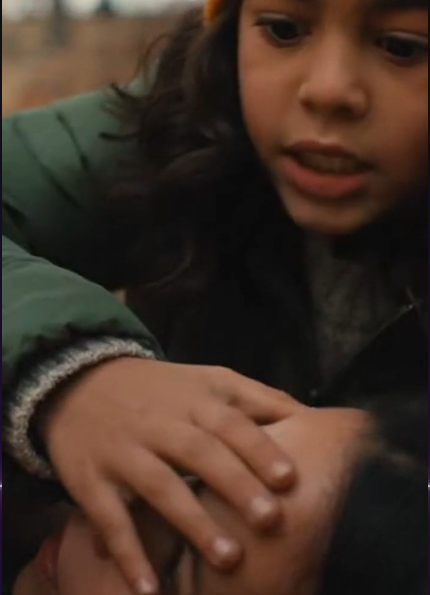
He pressed his cheek close to mine and whispered, “Mom… don’t move yet.”
I blinked, barely able to think through the pain. “Owen…” I breathed.
He put a small, shaking hand over my mouth—gentle, careful—and whispered again, “Please. Play dead. Like the possum.”
Above us, footsteps crunched on gravel. Shadows shifted as my family leaned over the stone wall, staring down into the brush.
My mom’s voice floated down, breathy and bright like she was acting in a play. “Oh my God,” she called, fake panic ringing in the air. “They slipped! Ava! Can you hear us?!”
My dad added, loud enough for any distant hiker to hear, “Help! Someone help! My daughter fell!”
I started to cry out, to beg for help, but Owen dug his fingernails into my arm. He shook his head violently, his eyes pleading.
Then, the tone above changed. The shouting stopped. My father’s voice dropped, suddenly cold, no longer pretending. “I can’t see them well through the brush. Are they moving?”
And then Kendra spoke. Her voice was clear as glass in the open air, devoid of any emotion.
“Wait. If she’s still breathing, I’ll go down and finish it. We can’t have her waking up and talking.”
I froze. My heart hammered against my ribs so hard I thought they would hear it.
“Don’t be stupid, Kendra,” my mother hissed. “You’ll leave tracks. It’s a sixty-foot drop to the rocks. Nobody survives that without a broken neck. Besides, the ranger station is three miles back. By the time we hike down and ‘find help,’ nature will have done the rest.”
“Are you sure?” Kendra asked. “Because if she survives, the life insurance policy is void. I need my share, Dad. The loan sharks aren’t waiting.”
“She’s dead,” my father grunted. “Look at the angle. Just… throw the water bottle down. Make it look like they were reaching for it.”
A blue plastic bottle tumbled through the air, bouncing off a rock and landing near my foot.
“Let’s go,” my mom said. “Remember, we were taking a family photo. She got dizzy. She slipped. Tragic accident.”
They waited one more minute. A minute that felt like an hour. Owen didn’t twitch. I held my breath until my lungs burned, staring fixedly at a dead leaf near my nose. Finally, the crunch of footsteps retreated.
They were gone.
I let out a ragged sob, trying to sit up. A scream of agony ripped through my shoulder—my collarbone was definitely broken. My leg was twisted at a sickening angle.
“Mom,” Owen whispered, his voice finally breaking into a child’s scared whimper. “Are we going to die?”
I looked at my six-year-old, the boy who had just saved my life with a wisdom no child should possess. I gritted my teeth, forcing myself to sit up despite the black spots dancing in my vision.
“No, baby,” I said, grabbing his hand. “We are not going to die. And they are not going to get a single dime.”
It took us four hours to crawl out of that ravine.
I couldn’t walk. I had to scoot on my good hip, dragging my shattered leg behind me. Owen cleared the path, moving branches and finding handholds for me. Every inch was torture. Every shadow looked like Kendra coming back to “finish it.”
We didn’t go back to the trail. I knew they might be waiting at the trailhead with “rescuers,” playing the grieving family. We went sideways, through the dense woods, heading toward the sound of a distant highway.
When we finally broke through the tree line onto the asphalt of a service road, the sun was setting. A trucker found us. I passed out the moment he opened his cab door.
I woke up in the hospital two days later. Two police officers were standing at the foot of my bed.
“Ma’am?” one of them asked gently. “Your family… they’ve been worried sick. They reported you missing. They said you fell.”
I tried to speak, but my throat was dry. I looked around wildly. “Owen?”
“He’s fine. He’s with Child Protective Services right now, pending your recovery. He… he told us quite a story, Ma’am. But we need to hear it from you.”
I took a deep breath. “It wasn’t an accident,” I rasped. “My sister has gambling debts. My father is bankrupt. They pushed us.”
The officer looked skeptical. “It’s a serious accusation, Ma’am. Without proof, it’s your word against three respectable people.”
“Respectable?” I laughed, a broken, wheezing sound. “Check my father’s bank records. Check Kendra’s texts. And check the photos on my phone.”
“Your phone?”
“I had it in my hand,” I lied. “I was taking a video of the view right before they pushed me. It might have recorded the fall.”
It was a bluff. I had lost my phone in the fall. But I knew my family. They were greedy, but they were paranoid cowards.
The police brought them in for questioning separately. They told them I was alive. They told them I had a video.
They turned on each other in less than twenty minutes.
Kendra cracked first. She thought Dad had made a deal to pin it on her, so she spilled everything about the insurance scheme. She told them how Mom planned the “photo op.” She told them about the debts.
I watched their arraignment on the news from my hospital bed. My father, hiding his face. My mother, sobbing fake tears. Kendra, looking at the camera with cold, dead eyes.
My leg will never be quite right again. I have a scar running down my arm. But Owen? He’s thriving. We moved to the coast, far away from the mountains.
Sometimes, when I tuck him in, he asks if the “bad people” are still in jail.
“Yes,” I tell him. “For a very, very long time.”
I realized something that day on the cliff. Family isn’t blood. Family is the person who holds your hand in the dark and tells you to stay quiet so you can survive. My family is just Owen. And that’s enough.
