I’ve been through things most people would never want to experience.
I’ve had bullets flying past me. I’ve jumped from an aircraft thousands of feet above the ground, surrounded by nothing but darkness. I’ve held a dying friend in my arms while helplessly watching the life leave him.
But none of those moments ever made me feel the kind of anger I felt that ordinary Tuesday afternoon inside a small roadside diner.
It wasn’t the heat.
It wasn’t exhaustion after days on the road.
It was disrespect.
And for once, it wasn’t directed at me.
It was directed at Rex.
Rex was a Belgian Malinois–German Shepherd mix. Years of service had left their marks on him. A patch of fur on his side never grew back after shrapnel tore through him during an operation.
One of his teeth had been replaced with titanium after he once bit through protective gear while stopping a man who was preparing to attack a crowded marketplace.
Rex wasn’t simply my dog.
He was a retired military working dog.
To me, he was family.
That afternoon, he was lying quietly beneath an old wooden table, his head resting on his paws as he tried to escape the heat.
We hadn’t even planned to stop in town.
We were just passing through.
The plan was simple: grab something to eat, give Rex some water, and get back on the highway before dark.
I was still wearing my military uniform because I’d come straight from a ceremony on base.
The moment we stepped through the diner’s door, the room went strangely quiet.
The jukebox was still playing.
But almost every conversation stopped.
People stared.
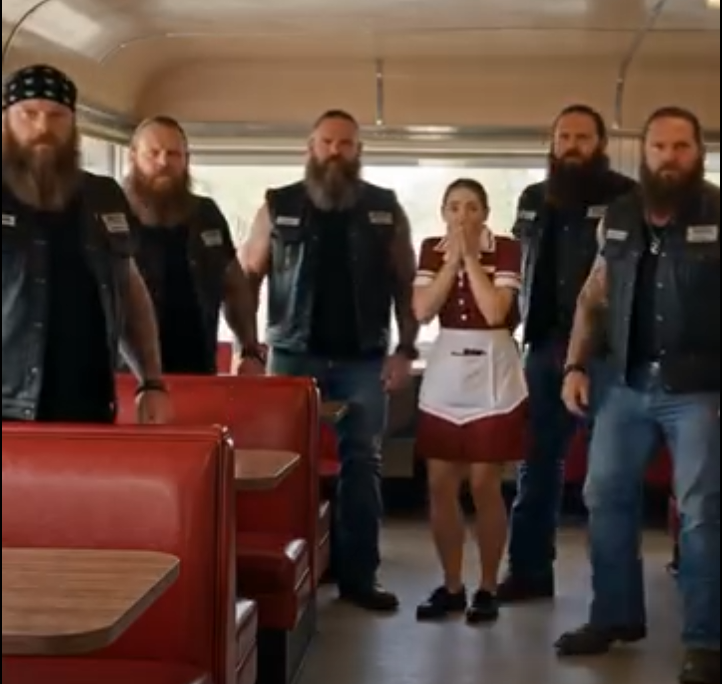
Then I noticed the patches on several leather vests.
The Iron Vipers.
A local motorcycle club.
These weren’t weekend bikers looking for attention.
They looked like men who were accustomed to getting their way.
I kept my eyes down.
“Stay close, Rex,” I said quietly.
He moved beside my leg as we walked toward a small table in the corner, as far away from the bar as possible.
I ordered a burger and coffee.
Then I looked at the young waitress.
“Could you bring a bowl of water for him too?”
She glanced nervously toward the bikers.
“Sir… those guys don’t like dogs in here.”
“He’s a service animal,” I said, pointing to Rex’s vest.
The words DO NOT PET were clearly printed across it.
“He won’t bother anyone. We’ll be gone soon.”
She nodded and hurried toward the kitchen.
For a couple of minutes, everything seemed fine.
Then the atmosphere changed.
I felt it before I even turned around.
The laughter near the pool table stopped.
Boots scraped against the wooden floor.
Someone was walking toward us.
Rex immediately lifted his head.
He didn’t bark.
He didn’t growl.
He simply watched.
He had been trained not to react to every noise.
He watched.
He assessed.
“Hey, soldier.”
The voice was rough and deep.
I took another sip of water before turning around.
“Can I help you?”
The man standing beside our table was enormous.
He was easily over six feet tall and built like a tank. A thick beard covered most of his face, and a scar ran through one eyebrow.
His vest had one name stitched across it.
BUTCH.
Five other bikers stood behind him.
“We don’t like dogs in here,” Butch said.
His eyes moved toward Rex.
“Especially ugly mutts like that.”
Rex didn’t move.
I looked at Butch.
“He’s cleaner than you.”
I hadn’t planned on saying it.
It just came out.
The diner suddenly became silent.
Butch’s face darkened.
He stepped closer.
“You’ve got a smart mouth, soldier.”
“I’m not looking for trouble.”
“Then take your dog and leave.”
“We’re eating first.”
Butch smiled.
“No. You’re leaving now.”
Then he looked down at Rex.
“The dog can stay, though.”
His friends laughed.
“We could use something new to throw darts at.”
That was the moment something inside me shifted.
I felt the old instinct returning.
The part of me I’d spent years trying to leave behind.
But I took a breath.
Then another.
I reminded myself of the promise I’d made to my family.
No more fighting.
“We’re going to finish our meal and leave,” I said calmly.
Butch slammed his hand against the table.
Rex didn’t move.
But I could feel the tension in him.
He was waiting.
Waiting for my command.
“I’m talking to you!”
Butch turned toward another table and grabbed a large pitcher of ice water.
I knew exactly what he was about to do.
He lifted it over his head.
“Let’s cool the mutt down!”
Then he tipped the entire pitcher.
The freezing water came crashing down.
Not on me.
On Rex.
Ice and water soaked his head, his back and his military vest.
The entire diner froze.
Rex slowly lifted his head.
He shook the water from his face.
Then he looked at me.
There was no fear in his eyes.
Only confusion.
He was waiting for me to tell him what to do.
Behind us, Butch started laughing.
His friends joined him.
“Look at that!”
“Not so tough now!”
Their laughter filled the diner.
I looked down at Rex.
Then I noticed the scar on his side.
And suddenly I remembered where it came from.
Years earlier, during a mission, our team had been trapped under heavy fire.
We were running out of ammunition.
Rex ran toward the danger while the rest of us moved to safety.
He was hit.
But he kept going.
Because that’s what he had been trained to do.
Because that’s who he was.
That night, several men made it home because Rex had bought them the time they needed.
He had saved lives.
And now this man had humiliated him simply because his friends thought it was funny.
I slowly pushed my chair backward.
The legs scraped against the wooden floor.
Everyone stopped laughing.
I stood.
Butch was taller than me.
He was heavier than me.
Yet when I looked directly into his eyes, he took a small step backward.
I bent down beside Rex.
I reached for his leash.
Then I unclipped it.
Click.
The tiny sound seemed to echo through the silent diner.
“Rex.”
He looked at me.
“Place.”
He immediately stood, shook the remaining water from his coat, and walked toward the wall.
He sat down.
Calm.
Obedient.
He knew what I was doing.
I turned back toward Butch.
“You just made a very bad decision.”
Butch cracked his knuckles.
“You and what army?”
“I don’t need an army.”
I stepped closer.
“I only need three minutes.”
Butch swung first.
A huge punch.
Fast enough to hurt badly if it landed.
But it was wild and predictable.
I stepped inside his reach.
The fight was over before most people in the diner even understood what had happened.
Butch stumbled and crashed to the floor.
His confidence disappeared instantly.
One of the other bikers shouted.
“Get him!”
I looked up.
Five men were moving toward me.
Some had grabbed weapons from around the diner.
The waitress ducked behind the counter.
Rex remained against the wall.
His body was tense.
Waiting.
I looked at him.
“Stay.”
His eyes never left me.
I took one slow breath.
Then I turned toward the five men coming at me.
My heart was calm.
My mind was clear.
And after years of trying to bury the soldier inside me…
I knew exactly what I had to do.
The five bikers kept coming.
For a second, nobody moved.
Then the first man charged.
I stepped aside and let his momentum carry him past me. He stumbled into a table, knocking over several glasses.
The second one came from my left.
I raised my arm, blocked the attack, and pushed him backward.
The third stopped.
He looked at his friends.
Then at me.
Something had changed.
They had expected a frightened soldier in an old uniform.
They hadn’t expected someone who knew exactly how to stay calm when everyone else was losing control.
“Back off,” I warned them.
They didn’t listen.
The biggest mistake people make in a fight is thinking anger makes them stronger.
Usually, it makes them careless.
One of the men grabbed a pool cue.
He raised it over his shoulder.
I didn’t wait for him to swing.
I moved forward, knocked the cue aside and forced him backward.
The wooden stick clattered across the floor.
Another biker rushed toward me.
I ducked beneath his arm and shoved him away.
He crashed into a chair.
Suddenly the entire diner was chaos.
Tables moved.
Chairs scraped across the floor.
People were shouting.
But through all of it, I kept hearing one thing.
Drip.
Drip.
Drip.
Water falling from Rex’s soaked coat.
I looked toward him.
He was still sitting exactly where I’d told him to stay.
His eyes followed every movement.
He wanted to help.
Every instinct in his body was telling him to protect me.
But he wouldn’t move without permission.
That was Rex.
Discipline.
Loyalty.
Trust.
I turned back.
The last two bikers stopped several feet away.
Neither looked quite as confident anymore.
Then Butch slowly got back onto his feet.
His face had completely changed.
The arrogance was gone.
He looked at the men around him.
“Get him,” he growled.
Nobody moved.
“Did you hear me?”
Still nothing.
One of them finally shook his head.
“No, Butch.”
Butch stared at him.
“What did you say?”
“I said we’re done.”
The man looked toward Rex.
Then toward me.
“This isn’t worth it.”
For the first time that afternoon, I saw something resembling fear in Butch’s eyes.
Not because of me.
Because he had finally realized something.
He had picked the wrong target.
I reached into my pocket and pulled out my phone.
“I called the police before things got worse,” I said.
Butch laughed nervously.
“You think the cops are going to believe you?”
I pointed toward the ceiling.
A small security camera was mounted above the counter.
“They won’t have to believe me.”
The waitress slowly stood up.
Her hands were still shaking.
“I saw everything,” she said.
The room became silent again.
Then an older man sitting near the window spoke.
“So did I.”
Another customer nodded.
“Me too.”
Then another.
Suddenly, Butch looked around the diner and realized he was alone.
Not a single person was willing to stand beside him.
A few minutes later, police lights appeared through the front windows.
The bikers stopped talking.
The waitress stepped from behind the counter.
The officers entered and immediately separated everyone.
I gave them my statement.
The waitress gave hers.
Then the customers did the same.
But when one officer walked toward Rex, he stopped a few feet away.
“Is that your dog?”
“Yes.”
“He okay?”
I looked at Rex.
He was still wet.
Still tired.
But calm.
“He’s been through worse.”
The officer crouched down slightly.
“What’s his name?”
“Rex.”
The officer smiled.
“Good boy.”
Rex looked at him.
Then at me.
I reached down and gently rubbed the top of his head.
For the first time all afternoon, his body relaxed.
One of the officers looked at the scars on Rex’s side.
“Military?”
“Retired.”
The officer nodded slowly.
Then he looked toward Butch, who was being escorted outside.
“You know,” he said quietly, “some people spend their entire lives trying to prove they’re tough.”
He glanced at Rex.
“Real courage usually doesn’t need to prove anything.”
I didn’t answer.
I just picked up Rex’s leash.
Before we left, the young waitress approached us.
She was holding a clean towel.
“I thought he might need this.”
She knelt down and carefully offered it to me.
“I’m sorry.”
I smiled.
“You don’t have anything to apologize for.”
She looked at Rex.
“He really is a hero, isn’t he?”
I looked down at my old partner.
Rex tilted his head.
“You have no idea,” I said.
Outside, the sun was beginning to set.
The highway waited.
I opened the truck door.
Rex climbed inside and curled up on the passenger seat.
Before starting the engine, I looked at him one more time.
His fur was still damp.
The scars were still there.
The missing patch of hair would probably never grow back.
But none of that mattered.
Because scars don’t make a hero.
What you do for others does.
I started the engine.
Then I heard a soft sound from the passenger seat.
Rex rested his head against my arm.
I smiled.
“Ready to go home, old man?”
His tail moved once.
And that was all the answer I needed.
We pulled onto the highway and disappeared into the evening.
Neither of us looked back.
Because sometimes the strongest response to cruelty isn’t revenge.
It’s walking away with your dignity intact.
And knowing that the person beside you would follow you anywhere.
