PART 1
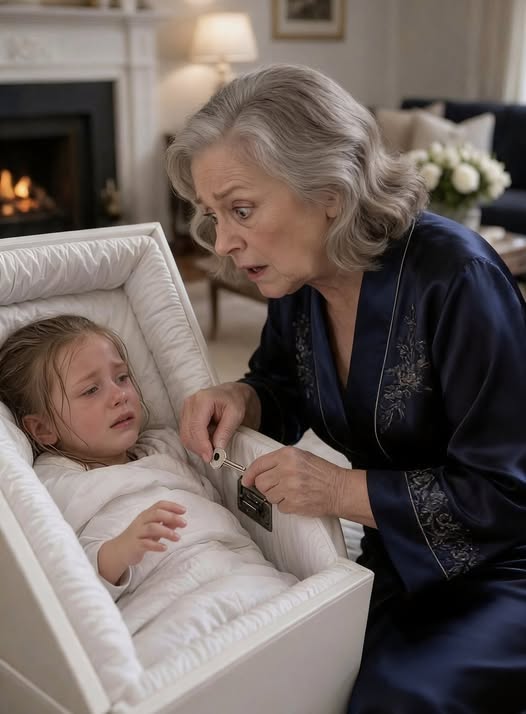
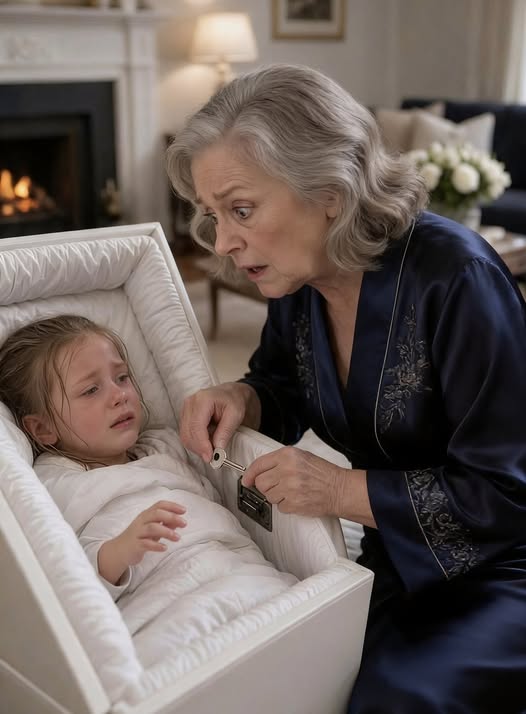
It was almost eleven o’clock at night. My son Arthur’s elegant home outside Chicago had gone completely quiet, with Jessi’s casket sitting in the middle of the living room among white lilies, candles, and flowers sent by people who believed she had died from a sudden respiratory illness.
Arthur and his wife, Patricia, had already gone upstairs. They said they were exhausted. They said they needed sleep before the funeral the next morning. They said I should go home too.
I couldn’t.
I had stayed because I needed one last goodbye. But when I carefully raised the lid, Jessi’s eyelids moved. I touched her cheek. I watched her chest. I felt a weak breath against my hand.
She was alive.
Her face was pale and hot with fever. Her lips trembled beneath the soft light from the living room, and then I realized something even worse: Jessi had been secured inside the casket in a way that kept her from moving freely.
“”Grandma,”” she whispered. “”I was good. I stayed quiet.””
My hands started shaking so badly I could barely work. I tried to free her, but whatever had been done to keep her in place would not release at first. That was when the truth became impossible to avoid. This was not some terrible mistake at a funeral home. Someone knew Jessi was alive when she was placed there.
I forced myself to stop pulling and search instead. Beneath the padded lining, my fingers brushed something hard and cold. I reached deeper and found a small metal key hidden under the fabric.
The key worked.
I released Jessi and lifted her against my chest. She wrapped her arms weakly around my neck while every excuse Arthur and Patricia had given me during the previous months came rushing back.
“”Jessi is sleeping.””
“”The doctor says she needs privacy.””
“”She becomes anxious around visitors.””
“”You need to respect our parenting choices.””
I had believed Patricia was controlling and Arthur hated confrontation. I had told myself I was being the difficult mother-in-law, the worried grandmother who needed to back off.
Now my granddaughter was trembling against me inside the room where everyone expected to mourn her the next morning.
I wrapped Jessi in my black wool shawl and started toward the back hallway. My handbag and phone were still near the living room, but the old telephone in the laundry room was closer. I could feel Jessi’s breathing against my shoulder as I hurried away from the casket.
“”Please don’t let them take me,”” she whispered.
I got inside the laundry room, locked the door, and called emergency services. I told the dispatcher my granddaughter had been declared dead but was alive, feverish, and had been found inside her casket. I said I believed she might have been given medication.
Before the dispatcher could finish answering, a bedroom door opened upstairs.
“”Mom?””
Arthur’s voice carried down the staircase.
I pulled Jessi tighter against me. His footsteps came faster, crossed the hallway, and then Arthur rushed straight toward the locked laundry-room door.
PART 2
The laundry-room doorknob jerked so violently that Jessi buried her face against my shoulder. Arthur hit the door with the flat of his hand. “Mom, open this door.” His voice sounded different now. There was no exhaustion in it. No grief. No confusion. Just urgency. I pressed the telephone tighter against my ear while the dispatcher told me officers and paramedics were already on their way.
“Stay where you are,” I called through the door. “The police are coming.” For several seconds, Arthur said nothing. Jessi’s fingers tightened around the collar of my blouse. Then my son lowered his voice. “Mom, you don’t understand what you’re doing.” Those words frightened me more than if he had threatened me. An innocent father would have asked whether his daughter was breathing. Arthur had not asked once.
The dispatcher must have heard him because she told me not to unlock the door under any circumstances. I looked around the laundry room for another exit. There was a narrow window above the utility sink, but it was painted shut and too small for me to climb through while carrying Jessi. The only way out was the door, and Arthur was standing on the other side.
“Daddy knows,” Jessi whispered. I looked down at her. Her eyelids were heavy, and sweat darkened the hair along her forehead. “Knows what, sweetheart?” Her gaze moved toward the door. “That I woke up before.” My stomach tightened. “Before tonight?” Jessi gave the smallest nod. “In my bed. Daddy gave me more pink medicine.” Every remaining excuse I had been trying to invent for Arthur disappeared.
Arthur struck the door again. “Mom, listen to me. Patricia is upstairs. She’s panicking. You need to give Jessi to me before Patricia comes down here.” I almost laughed from disbelief. “Give her to you?” I said. “You put your living daughter inside a coffin.” The silence outside lasted so long that even the dispatcher stopped talking for a moment. Then Arthur whispered, “It wasn’t supposed to happen like this.”
Jessi began shaking harder. I removed my shawl and wrapped it more tightly around her. “What was supposed to happen?” I asked. Arthur did not answer. Instead, I heard him walk several steps away from the door. Cabinets opened in the kitchen. A drawer slammed. The dispatcher asked if I could identify the sounds. I told her I couldn’t. She instructed me to move away from the door and stay low.
Then Patricia screamed from somewhere upstairs. “Arthur!” Her voice echoed through the house. “Where is she?” Jessi whimpered. I had heard Patricia angry before, but never like that. Her footsteps came rapidly down the staircase. Arthur said something too quietly for me to hear. Patricia responded, “You were supposed to check her.” Arthur snapped, “I did.” Patricia shouted back, “Then how did your mother get her out?”
The dispatcher heard every word. “Ma’am,” she said, “units are less than two minutes away.” Less than two minutes felt like an hour. Patricia reached the hallway. The door handle shook again, harder than before. “Diane,” she called. “Open the door. Jessi is extremely sick. You’re exposing yourself. You’re exposing everyone.” I stared at my granddaughter breathing against my chest. “Stop lying to me,” I said.
Patricia’s voice instantly changed. The fury disappeared, replaced by a trembling softness. “I know this looks terrible.” That sentence told me everything. Not “You’re mistaken.” Not “The funeral home made an error.” Not “Thank God she’s alive.” She said it looked terrible. I suddenly understood that both Arthur and Patricia knew exactly what had been done. Whatever explanation they intended to give police had already been rehearsed.
“Grandma,” Jessi whispered again. “They said tomorrow would be fire.” For a second, I could not understand her. “What fire?” Her dry lips barely moved. “Mommy said after everybody leaves, nobody can wake me because fire makes everything gone.” The room seemed to tilt beneath my feet. I knew the funeral schedule. After the morning service, Jessi’s casket was supposed to go directly to a private crematorium.
My hand clamped around the telephone receiver. This had never been intended to end with burial. They were planning to destroy the evidence. Patricia must have realized from my silence that Jessi had told me something because she suddenly began pounding the door. “She doesn’t know what she’s saying!” she screamed. “She’s been hallucinating for days!” Arthur shouted at her to stop talking. Their performance of grieving parents was collapsing in real time.
Then came a sound from outside that nearly made my knees give out: sirens. At first distant, then rapidly growing louder. Red and blue light began flashing against the laundry-room window. Patricia stopped pounding. Arthur cursed under his breath. I heard running footsteps moving away from the hallway. The dispatcher told me officers were arriving and instructed me not to open the door until they identified themselves.
Someone began shouting at the front entrance. “Police! Open the door!” Another officer moved around the side of the house. Arthur called out that everything was under control. A second voice ordered him to put his hands where they could be seen. Patricia started crying. Not grieving. Not frightened for Jessi. She was begging Arthur to “fix it.” I will never forget those words. She wanted him to fix the fact that their daughter was alive.
Thirty seconds later, someone knocked three times on the laundry-room door and identified himself as Officer Ramirez. The dispatcher confirmed the officers were inside. I unlocked the door. Ramirez froze when he saw me holding Jessi. Behind him stood another officer with one hand near his radio. Arthur was kneeling beside the kitchen island with his hands visible. Patricia stood against the wall in her robe, staring at Jessi like she was seeing a ghost.
“Please,” I told Ramirez. “She needs a hospital.” He touched Jessi’s wrist, then immediately called the paramedics inside. Two firefighters entered carrying medical equipment. The moment one of them reached for Jessi, she began struggling weakly. “No medicine,” she cried. “Please, no medicine.” I had to promise her repeatedly that these people were helping her before she finally let them place an oxygen mask near her face.
Patricia suddenly pushed away from the wall. “I’m her mother. I’m going with her.” Jessi screamed. The sound came from someplace deeper than fear. She twisted toward me and grabbed my blouse. “No! Grandma! Don’t let her!” Every person in that hallway stopped moving. Officer Ramirez immediately stepped between Patricia and the paramedics. “Ma’am, stay where you are.” Patricia’s expression changed again, becoming hard and calculating.
Arthur looked at the floor. I watched him carefully because some part of me still wanted my son to look horrified by his daughter’s terror. Instead, he looked defeated. It was the expression of a man whose secret had been discovered, not a father whose child had nearly died. I realized the boy I had raised and the man kneeling in front of me might no longer be the same person.
The paramedic examining Jessi asked what medication she had received. Patricia said she did not know. Arthur said their pediatrician prescribed several things. I interrupted. “Jessi says Arthur gave her pink medicine.” The paramedic turned toward him. Arthur’s head came up sharply. “She’s confused.” Jessi immediately whispered, “Daddy put it in the strawberry cup.” Arthur went completely still.
An officer escorted Arthur and Patricia into separate rooms while the paramedics prepared to transport Jessi. I asked to ride with her. Officer Ramirez told me I could. As we passed through the living room, I saw the open casket beneath the flowers. White satin lining. Pink roses. A framed photograph of Jessi smiling beside it. Seeing that photograph while hearing her breathe against the oxygen mask felt like walking through someone else’s nightmare.
One of the detectives who had just arrived approached the casket without touching anything. She leaned over, examined the lining, and asked another officer to photograph everything. Beneath the flowers were condolence cards, a little stuffed rabbit, and a folded funeral program printed with the words CELEBRATING THE LIFE OF JESSICA MARIE HOLLOWAY, 2020–2026. My granddaughter had been given a date of death while she was still alive.
The ambulance doors closed behind us. Jessi’s small hand never released mine. As we moved through the dark suburban streets toward the hospital, she stared at the ceiling and whispered fragments that made no sense at first. “Blue room.” “Daddy’s papers.” “Mommy said Grandpa was bad.” “Don’t tell the lady with silver hair.” I told the paramedic to remember every word because I no longer knew which sentence might matter.
At the emergency department, Jessi was taken immediately into a secure pediatric room. Doctors drew blood, monitored her breathing, and began treating her fever and dehydration. They would not speculate about what medication might be in her system until laboratory results came back. I sat beside her bed holding her fingers while police stationed an officer outside the door. For the first time that night, I believed she might survive.
At 1:18 in the morning, Detective Lena Morales introduced herself. She was a compact woman in her forties with dark hair pulled into a low ponytail and the calmest voice I had heard all night. She did not bombard Jessi with questions. She spoke first with me in the hallway and asked me to recount everything from the moment I arrived at Arthur’s house until the police entered.
When I finished, Morales asked a question I had not considered. “Who pronounced Jessi dead?” I stared at her. Patricia had told me a doctor had confirmed it at home because Jessi’s supposed illness was contagious and moving her could endanger others. Funeral arrangements had been rushed. We had all been discouraged from seeing her body. I suddenly realized I had never spoken directly to the doctor.
“Dr. Samuel Kline,” I said. “That’s the name Arthur gave me.” Morales wrote it down. “Did you see a death certificate?” I shook my head. “Arthur handled everything.” She asked who owned the funeral home. I told her I only knew the name: Bellweather Memorial Services. Morales’s pen stopped moving for half a second. “You recognize it?” I asked. “I recognize the owner’s name,” she replied.
She would not tell me more yet. Instead, she asked whether Arthur or Patricia had financial problems. I nearly said no automatically. Arthur had a beautiful house, expensive cars, private schools, European vacations. Then I remembered something from Christmas. Arthur had asked whether I intended to sell the lake property my husband left me. He had laughed when I asked why he cared, saying he was merely curious about estate planning.
Another memory followed. Patricia once asked what would happen to the family trust if a grandchild died before reaching the distribution age. I had thought it was a morbid question and told her so. She claimed she had been reading an article about inheritance law. At the hospital, under fluorescent lights at two in the morning, the conversation no longer sounded theoretical.
My husband, Robert, had built a packaging company before he died eight years earlier. Most of his estate had passed to me, but he created separate trusts for our grandchildren. Jessi’s trust was substantial. However, the money did not belong to Arthur. If Jessi died before adulthood, her share would normally be redistributed among Robert’s other descendants. Arthur was our only child. Jessi was our only grandchild.
I felt sick. “If Jessi died,” I said slowly, “Arthur would eventually receive almost everything.” Morales did not react. “How much are we talking about?” I hesitated. “Between the company shares, property, and investments? Possibly eleven million dollars.” For the first time, the detective’s expression changed. She closed her notebook and said, “Mrs. Holloway, I need the contact information for the attorney who manages that trust.”
I called our family attorney, Martin Reeves, at two-thirty in the morning. He answered on the fourth ring with the confused voice of a man awakened from deep sleep. When I told him Jessi was alive, he thought I had suffered some kind of breakdown. Then I explained the casket. There was a long silence. “Diane,” he said finally, “Arthur called me yesterday.”
Every hair on my arms rose. “Why?” Martin said Arthur wanted confirmation about the survivorship provision in Robert’s trust. Specifically, he wanted to know how quickly Jessi’s assets would be redistributed if she died. Martin found the question inappropriate but assumed it came from grief. Arthur had told him Jessi was already dead. I closed my eyes. “When did he call?” Martin answered, “Nine forty-two yesterday morning.”
Jessi had whispered that she woke up in her bed and Arthur gave her more medicine. If she had been alive yesterday morning, my son had been discussing how quickly he could access money while his daughter was still breathing. Detective Morales asked Martin to preserve every email, voicemail, and document connected with Arthur’s inquiry. Martin agreed immediately.
At three-ten, a doctor came into the waiting room. Jessi was stable. Her fever was coming down, and she was responding well to fluids and supportive treatment. Laboratory results indicated she had been exposed to more than one prescription sedating medication, but the doctor emphasized that a full toxicology assessment would take time. He could not tell me exactly how much she had received or when.
The doctor also told me something that made me grip the edge of my chair. Jessi had no evidence of the respiratory contagion Arthur and Patricia claimed had killed her. She had a common viral infection and dehydration, serious enough to require care but not remotely consistent with the extraordinary quarantine story they had told relatives. Someone had taken an ordinary childhood illness and built an elaborate death around it.
Just before dawn, Detective Morales returned with another detective named Grant. They had searched Arthur’s house after obtaining emergency authorization based on the circumstances. In the kitchen, officers found prescription bottles with damaged labels. In Arthur’s study, they found funeral paperwork, financial documents, and printouts concerning Robert’s trust. In the garage, they found something even stranger: several brand-new prepaid phones.
Morales placed a clear evidence bag on the table. Inside was a tiny silver key identical in shape to the one I had found beneath the casket lining. “This was in Arthur’s desk drawer,” she said. “The funeral home says they didn’t install any restraint system inside the casket.” I stared at her. “Then who did?” Morales said, “That’s one of the questions we’re asking.”
Arthur and Patricia were both being detained, but neither had been formally charged yet. Patricia claimed Arthur planned everything. Arthur claimed Patricia manipulated him. Each said the other administered Jessi’s medication. Each insisted they believed she had stopped breathing before she was placed in the casket. Neither could explain why there had been a hidden key beneath the lining.
Then Detective Grant asked if I knew a man named Victor Bell. The name meant nothing to me. He explained that Victor Bell owned Bellweather Memorial Services, the funeral company handling Jessi’s cremation. Bell was also Patricia’s mother’s cousin. Patricia had never mentioned the relationship. Worse, Bell had personally transported the casket to Arthur’s house instead of using his regular employees.
Police went to Bellweather Memorial before sunrise. Victor Bell was gone. His office computer was missing, and security footage from the previous forty-eight hours had been erased. The overnight cremation technician told officers Victor had instructed him to prepare the private chamber unusually early for Jessi’s arrival. No viewing. No verification. No delay. The casket was scheduled to be cremated at eleven-thirty the next morning.
I sat there imagining what would have happened if I had obeyed Arthur and gone home. People would have arrived at ten, cried beside a sealed casket, and believed the warnings not to approach because Jessi had supposedly died of a dangerous illness. By noon there would have been nothing left for anyone to examine. Arthur and Patricia had not merely expected everyone to believe their story. They had designed the funeral to prevent anyone from checking.
At six in the morning, Jessi woke more fully. A pediatric forensic interviewer had arrived, but she explained that questioning would wait until Jessi was comfortable. I sat beside the bed and helped her drink a little water. She looked toward the window where sunrise had begun turning the sky gray. “Is the fire gone?” she asked. I swallowed hard. “There is no fire, sweetheart. You are safe.”
She stared at me for several seconds, deciding whether she believed me. Then she reached beneath her hospital blanket and touched her own chest. “Daddy said Heaven was like sleeping.” My throat tightened. “What else did Daddy say?” I asked carefully. Before she could answer, the interviewer gently raised a hand, reminding me not to ask leading questions. Jessi needed to tell her story in her own words.
Later that morning, Jessi spoke with the interviewer while I watched through one-way glass. She held a stuffed dog the nurse had given her. The interviewer asked simple questions: her name, age, favorite food, who lived in her house. Jessi answered quietly. When asked about the days before the casket, she became still and stared at the dog’s ears.
“I heard Mommy yelling,” she said. “Daddy said I wasn’t supposed to listen.” The interviewer asked what they were yelling about. Jessi replied, “Money from Grandpa Robert. Mommy said Daddy had lost it.” My heart skipped. Robert had been dead for years. What money could Arthur have lost? Jessi continued. “Daddy said Grandma could never know because she would call the police.”
Detective Morales immediately left the observation room. I followed her into the hall. “What does that mean?” She told me they were already examining Arthur’s finances. Several months earlier, Arthur had apparently taken loans using anticipated inheritance as collateral. That alone was not necessarily criminal, but investigators had also discovered transfers from a business account tied to one of Robert’s old companies.
I knew that company. Holloway Packaging Holdings still existed because I owned the controlling interest. Arthur managed several operating accounts. He had told me revenues were down because of supply costs. I had trusted him. Morales asked me to call Martin Reeves again. By lunchtime, Martin and our accountant were reviewing years of transactions. Before three o’clock, Martin called me back sounding physically ill.
Arthur had stolen far more than anyone initially suspected. Over three years, money had moved through consulting invoices, shell vendors, and unexplained transfers. Martin’s preliminary estimate was more than four million dollars. Some of it had disappeared into high-risk investments. Some had paid private debts. Some had funded the beautiful house where Jessi’s casket had been placed under lilies.
If Robert’s trust passed to Arthur after Jessi’s death, Arthur could replace much of what he had taken before the annual independent audit scheduled in six weeks. The impossible pieces suddenly connected. Jessi was not merely an obstacle. Her death was supposed to become Arthur’s rescue plan.
I walked into the hospital restroom, locked myself inside a stall, and finally cried. I cried because my granddaughter had almost died. I cried because my son had stolen from the company his father built. Most of all, I cried because I kept remembering Arthur at eight years old, carrying injured birds into our garage and begging me to save them. I could not reconcile that boy with the man who had put his daughter inside a coffin.
But the story was still worse.
At four-thirty, Detective Morales found me beside Jessi’s bed. “We recovered one of the prepaid phones,” she said. “It had been erased, but our technicians restored portions of its messaging data.” She asked me to step into the hallway. Her expression told me I was about to hear something I would never forget.
Messages had been exchanged between Arthur, Patricia, and Victor Bell for almost two months. They used initials instead of names and rarely described anything directly. But several messages referenced “the Tuesday deadline,” “the certificate,” “keeping D away,” and “making sure the morning transfer happens before questions begin.” D was almost certainly me.
One message from Patricia read: SHE KEEPS ASKING TO SEE J. WE NEED A REASON SHE CAN’T COME OVER.
Arthur replied: TELL HER THE DOCTOR SAID NO VISITORS.
Three days later Patricia wrote: FEVER HELPS. PEOPLE BELIEVE CONTAGION.
Arthur answered: JUST MAKE SURE SHE SLEEPS.
I leaned against the hospital wall. Those four words destroyed the final fragment of denial I had been carrying.
Detective Morales continued. There was another contact on the phone identified only as “SK.” Investigators believed it might be Dr. Samuel Kline, the physician Arthur claimed had pronounced Jessi dead. Kline worked at a private clinic thirty miles away. Police went to his home that morning. His wife said he had left unexpectedly during the night.
Two men connected to my granddaughter’s supposed death had vanished within hours of police arriving: the funeral director and the doctor.
“What if they’re running because they know Arthur and Patricia were caught?” I asked. Morales nodded. “Possibly.” But her tone told me she thought there was another possibility. “Or they’re afraid of whoever is above Arthur and Patricia.” I stared at her. “Above them?” She paused. “We don’t think your son invented this entire plan.”
Before I could ask what she meant, a nurse rushed from Jessi’s room. Jessi was crying and asking for me. I returned immediately. She had awakened from a nightmare. I climbed beside her and held her until her breathing slowed. Then she whispered something into my shoulder. “Grandma, the silver-haired lady came to the blue room.”
I remembered her words in the ambulance: Don’t tell the lady with silver hair.
“What lady?” I asked gently.
Jessi looked toward the closed door. “The grandma who isn’t you.”
Patricia’s mother.
Evelyn Mercer.
I had known Evelyn for twelve years. She lived in Florida most of the year and had told us she could not attend Jessi’s funeral because she was recovering from surgery. She had sent an enormous arrangement of white lilies and a note saying her heart was broken. Yet Jessi was telling me Evelyn had been inside Arthur’s house recently.
Detective Morales checked airline and toll records. Evelyn had not been in Florida. Her phone had been there, but her credit card had purchased gasoline outside Chicago four days earlier. A traffic camera captured her black Mercedes less than ten miles from Arthur’s neighborhood. She had lied about her location.
When police called Evelyn, she answered from her Florida house and calmly denied leaving the state. Morales mentioned the traffic-camera image. Evelyn hung up.
Officers reached her Florida residence forty minutes later. The Mercedes was gone. The house was empty.
Three missing adults.
The case was becoming something much larger than a desperate financial crime committed by my son.
That evening, Martin arrived at the hospital carrying a locked document case. He looked ten years older than he had at Robert’s funeral. We sat in a quiet family room while he opened the case. “There’s something I should have told you years ago,” he said.
I almost laughed from exhaustion. “Apparently everyone has something they should have told me.”
Martin did not smile.
Three months before Robert died, he had changed part of the trust structure.
I stared at him. “Changed what?”
“Jessi’s beneficiary designation.”
“That doesn’t make sense. Jessi wasn’t born when Robert died.”
Martin nodded. “Exactly.”
He slid a document toward me.
Robert had created what lawyers called a descendants’ trust. Future grandchildren would automatically become beneficiaries. But the amendment contained an unusual clause. If Arthur’s future child died before reaching twenty-five, that child’s share did not pass directly to Arthur.
It passed to me.
I looked at Martin in confusion. “Then Arthur doesn’t inherit eleven million dollars.”
“No,” Martin said. “He doesn’t.”
“Then why would he think he does?”
Martin’s eyes dropped to the document.
“Because someone gave him a forged copy of the trust.”
I could barely process the words.
Arthur had apparently been working from documents showing that Jessi’s death would transfer the trust assets to him. Those documents were false.
“Who forged them?” I asked.
Martin looked at me.
“That’s what frightens me.”
The forged version had been professionally prepared. It contained Robert’s signature, Martin’s old letterhead, and notarization stamps convincing enough that a bank had accepted them during a preliminary loan review. Whoever created the documents had access to Robert’s original estate records.
Only four people had ever possessed complete copies.
Martin.
Me.
Arthur.
And Robert’s former business attorney.
A woman named Evelyn Mercer.
Patricia’s mother.
The room became completely silent.
“You’re telling me Evelyn was Robert’s lawyer?”
“Twenty-eight years ago,” Martin said.
I stared at him. I had met Evelyn only after Arthur began dating Patricia. She had introduced herself as a retired corporate consultant. She never once mentioned representing my husband.
Martin explained that Evelyn had worked briefly for Robert during the early growth of Holloway Packaging. She left after a bitter dispute. Robert accused her of billing irregularities and unauthorized financial transfers. No criminal charges were filed because most of the money had been recovered privately. Robert wanted the matter buried to protect the company.
“And you knew?” I asked.
Martin nodded reluctantly.
“Robert made me promise not to tell you unless Evelyn ever approached the family again.”
“She married her daughter to our son!”
“I didn’t realize Patricia Mercer was Evelyn’s daughter until years later,” Martin said. “By then Arthur and Patricia were already married, and Robert was gone.”
I stood so quickly the chair scraped across the floor.
“You knew for years?”
“I suspected. I didn’t have proof.”
“You could have told me.”
“I should have.”
That betrayal was quieter than Arthur’s, but it still cut deeply.
Then Martin revealed the detail that changed everything.
Robert had not simply fired Evelyn because of money.
He believed she had tried to gain control of the company by manipulating him during a period when he was seriously ill.
“She wanted him to sign voting rights over to her,” Martin said. “Robert refused. Afterward he became obsessed with protecting the company from anyone who might use Arthur to reach it.”
My husband had seen a danger decades before I did.
And he had built the trust to stop it.
The forged trust given to Arthur had done the opposite. It convinced my son that killing his daughter would solve his financial disaster.
Someone had created a false financial motive and placed it directly in front of a desperate man.
Evelyn.
But Arthur still had a choice.
He had chosen the coffin.
Nothing could erase that.
The following morning, Arthur was formally charged with multiple serious offenses while the investigation continued. Patricia was charged as well. Their lawyers immediately began blaming each other. Patricia claimed Arthur threatened her. Arthur claimed Patricia and Evelyn controlled everything. Neither explanation matched all the evidence.
Then Patricia asked to speak with detectives without Arthur present.
Morales called me afterward.
Patricia had confessed to helping fake Jessi’s death.
But she claimed the original plan was not to kill her.
According to Patricia, Evelyn told them Jessi only needed to appear dead for twenty-four hours. A doctor would administer medication that would make her deeply unconscious. Victor Bell would provide a casket with a concealed release. After the funeral, before cremation, they would remove Jessi and send her overseas with false documents. Arthur would receive the trust money because legally Jessi would be dead.
It was monstrous, but Patricia insisted Jessi was never supposed to be harmed.
Then the plan changed.
Evelyn allegedly told them the fake death would never remain secret. A six-year-old could not disappear forever. The financial records would eventually expose them. Evelyn argued that “one tragedy” was safer than a lifetime of risk.
Patricia claimed she refused.
Arthur did not.
My stomach turned when Morales told me.
“Does Jessi remember any of that?” I asked.
“Some pieces.”
The worst piece came that afternoon.
During a second forensic interview, Jessi described waking in her bedroom and hearing her parents arguing.
“Mommy said, ‘I won’t let you do it.’”
“What happened then?” the interviewer asked.
“Daddy told Mommy Grandma Evelyn said there wasn’t another way.”
“And what did your mommy say?”
Jessi squeezed the stuffed dog.
“She cried.”
“What did your daddy do?”
“He brought my strawberry cup.”
I had to leave the observation room.
For hours afterward, I told myself Patricia’s tears mattered.
Then police found the video.
Jessi owned a little tablet used for games and cartoons. Weeks earlier, I had shown her how to record videos of herself singing. The tablet automatically backed short clips to a family cloud account Arthur had forgotten existed.
One recording began accidentally.
The camera showed mostly blankets because Jessi had placed the tablet on her bed.
But the audio was clear.
Patricia entered the room first.
Arthur followed.
They whispered for several minutes.
Arthur said, “My mother will ask for an autopsy.”
Patricia answered, “Not if Kline signs respiratory failure and Victor tells everyone the casket stays closed.”
Arthur said, “And afterward?”
There was a pause.
Patricia answered, “Afterward there’s nothing to test.”
Not Evelyn.
Patricia.
The woman who told police she had tried to stop Arthur had been discussing destruction of evidence before Jessi was even placed in the casket.
There was another voice in the recording.
Evelyn.
“Both of you stop,” she said. “You’re making this harder than necessary.”
Arthur replied, “She’s my daughter.”
Evelyn said something I still hear in my nightmares.
“Then start acting like a man who understands what survival costs.”
Patricia began crying.
Not because she wanted to save Jessi.
Because she was afraid Arthur would lose his nerve.
The recording ended with Jessi’s small voice asking from beneath the blanket, “Daddy?”
Silence.
Then Arthur said, “Sweetheart, you’re supposed to be asleep.”
The next recovered clip was recorded forty-three minutes later.
Jessi was crying quietly.
Patricia said, “You scared her.”
Arthur answered, “She heard us.”
Evelyn said, “Then she cannot wake up tomorrow talking.”
I gripped Detective Morales’s desk so tightly my fingers hurt.
There it was.
The moment my granddaughter became something they believed they needed to erase.
But Morales still looked troubled.
“What?” I asked.
She turned her computer monitor toward me.
“We found something else in the cloud account.”
It was a photograph.
Jessi had taken it accidentally while playing with the tablet three weeks earlier. In the background stood Evelyn beside Arthur’s desk. The desk drawer was open. On top of several papers lay the forged trust document.
Beside Evelyn stood a man.
Dr. Samuel Kline.
Except I recognized him.
Not from Arthur’s descriptions.
From my own past.
His real name was not Samuel Kline.
It was Daniel Cross.
Twenty-seven years earlier, Daniel Cross had been Robert’s junior financial officer at Holloway Packaging.
He had disappeared after Evelyn was fired.
My husband believed Daniel helped her move money through unauthorized accounts.
No charges were ever filed because both vanished before Robert’s investigators could prove it.
They had not vanished separately.
They had remained connected all these years.
Evelyn had built an entire second life around my family.
Her daughter married my son.
Her old accomplice became my granddaughter’s doctor.
Her cousin controlled the funeral home.
And my son had never questioned why every person needed to make his daughter “die” was somehow conveniently available.
Detective Morales leaned closer.
“We don’t think Evelyn came back into your family by accident.”
My mouth went dry.
“How long has Patricia known Arthur?”
“Since college.”
“That’s twenty years.”
Morales nodded.
“We’re looking at whether their relationship was engineered from the beginning.”
I laughed once, but there was no humor in it.
“You’re saying Patricia married my son because of Robert’s company?”
“I’m saying we’re investigating that possibility.”
That possibility soon became something worse.
Police searched Evelyn’s abandoned Florida house after obtaining a warrant. Behind a false wall in her home office, investigators found boxes of documents dating back almost thirty years.
Photographs of Robert.
Company reports.
Old financial records.
Copies of my signatures.
Copies of Arthur’s school records.
College applications.
Addresses.
Wedding photographs.
Birth announcements.
Pictures of Jessi.
It was not a file.
It was surveillance spanning decades.
In one folder was a photograph of Arthur at nineteen years old walking across his university campus.
On the back, someone had written:
TARGET STABLE. NO SERIOUS RELATIONSHIP.
The photograph was dated four months before Arthur met Patricia.
Another photograph showed Patricia at the same university.
On the back:
INTRODUCTION APPROVED.
I had to sit down when Morales showed me.
Arthur’s marriage had been arranged without him knowing.
Patricia had been placed in his path.
Whether Patricia understood the entire purpose from the beginning was still uncertain, but investigators found letters between her and Evelyn from Patricia’s college years.
One line destroyed any claim that the relationship began naturally.
Evelyn wrote:
DO NOT RUSH HIM. MAKE HIM BELIEVE HE CHOSE YOU.
Patricia responded:
HE ALREADY DOES.
Twenty years.
Twenty years of Sunday dinners, Christmas photographs, vacations, birthday parties.
I had welcomed Patricia into my home.
I had trusted Evelyn with Jessi.
I had watched my son build a family inside a trap that had been designed before he understood he was standing in one.
But again, the truth about Arthur did not become easier.
Being manipulated explained how he reached the cliff.
It did not explain why he jumped.
Two days later, he asked to see me.
His lawyer arranged the meeting in a secure interview room at the county detention center. I almost refused. Then I thought about Jessi whispering Daddy said if I woke up, I would ruin everything.
I needed to hear him explain those words.
Arthur entered wearing jail clothing instead of the tailored suits he loved. He looked older than forty-one. His eyes were red, and his hands trembled as he sat across from me.
“Is Jessi alive?”
It was the first time since police arrived that I heard him ask.
“Yes.”
He closed his eyes.
“Thank God.”
I stared at him.
“Do not thank God for saving her from something you helped do.”
His face collapsed.
For several seconds neither of us spoke.
Then Arthur said, “Mom, I never meant for her to die.”
“You put her in a coffin.”
“I know.”
“You gave her medication.”
“I know.”
“You planned to burn that coffin the next morning.”
His eyes opened.
“No.”
The certainty in his voice surprised me.
“That wasn’t my plan.”
I leaned forward.
“Then whose was it?”
“Patricia’s.”
I almost stood up.
Arthur quickly continued.
“The fake death was Evelyn’s idea. Patricia convinced me. I thought Jessi would be taken out before the funeral ended. I thought she’d stay with people Evelyn knew for a few weeks. We would fix the company accounts, then create some story about a kidnapping or records being wrong. It was insane. I know that now.”
“You knew it then.”
Arthur looked down.
“Yes.”
“What changed?”
He swallowed.
“Patricia.”
According to Arthur, two nights before the funeral he overheard Patricia speaking with Evelyn. Patricia said sending Jessi away was too dangerous because Jessi had heard them discussing the stolen money. Evelyn replied that Victor had arranged the cremation.
Arthur confronted them.
Patricia told him it was already too late.
Arthur claimed he decided to save Jessi secretly.
I stared at him.
“You expect me to believe you were saving her by putting her in a coffin?”
He leaned forward.
“The key.”
I froze.
“I put the key beneath the lining.”
My heart began beating faster.
Arthur said Patricia insisted Jessi’s wrists and waist be secured so she could not move if she regained consciousness during the viewing. Arthur agreed in front of Patricia.
Then, while Victor was outside carrying flowers, Arthur slipped a second release key beneath the fabric.
“Why?” I asked.
“Because I knew you wouldn’t leave.”
I stared at him.
Arthur began crying.
“I called you four times that week. Every time I told you not to come, you pushed harder. You always push harder. I knew if everyone told you the casket had to stay closed, eventually you would open it.”
I could barely breathe.
“You used me.”
“I was terrified.”
“You could have called police.”
“They had Kline. Victor. Evelyn said she had people in the company, people at the bank. Patricia told me if I confessed, she’d say I stole everything and tried to kill Jessi alone.”
“You did steal everything.”
Arthur lowered his eyes.
“I know.”
“So you gambled your daughter’s life on whether her grandmother would disobey funeral instructions?”
His answer was almost inaudible.
“Yes.”
I wanted to hate him completely.
It would have been easier.
Instead, I saw something worse than a monster.
I saw a coward.
A man who loved his daughter enough to hide a key, but not enough to stand between her and danger.
A man who hoped someone else would become brave on his behalf.
I stood.
Arthur grabbed the edge of the table.
“Mom.”
I stopped at the door.
“There’s something else.”
I turned.
“Evelyn didn’t only want the trust.”
My hand remained on the doorknob.
“What did she want?”
Arthur looked directly at me.
“The company.”
I almost laughed.
“She can’t have it.”
“She thinks she already owns part of it.”
“What are you talking about?”
Arthur wiped his face.
“Dad didn’t recover all the money she stole.”
I went still.
Arthur said he found old records while moving funds between accounts. Robert had told everyone Evelyn’s scheme failed. It had not. Millions in early company shares had been transferred decades earlier into anonymous holding entities.
Those shares had grown tremendously in value.
Evelyn allegedly still controlled them through layers of corporations.
“How much?” I asked.
Arthur hesitated.
“Enough that if she got Jessi’s trust shares too, she could challenge your control.”
The funeral had not just been about covering Arthur’s theft.
Jessi’s death would trigger a sequence of transfers based on the forged trust everyone expected me to accept.
By the time the forgery was discovered, Evelyn intended to use the chaos to seize control of Holloway Packaging.
She had waited nearly thirty years to finish what Robert stopped.
I left the detention center with one question pounding through my head.
If Evelyn knew the real trust sent Jessi’s assets to me instead of Arthur, why create a forged trust that could never legally transfer the shares?
Martin answered that question when I returned to the hospital.
“She didn’t need the forged trust to survive forever,” he said. “She only needed Arthur to believe it.”
The forgery was bait.
Arthur’s financial desperation was the hook.
Jessi was the sacrifice.
But Evelyn’s real target was not the trust.
It was me.
If Jessi died, investigators would eventually uncover the forged estate documents.
Arthur’s theft would surface.
The company would descend into litigation.
My credibility as trustee and majority owner would be attacked.
And during that confusion, Evelyn’s hidden companies could challenge decades-old ownership records.
She had constructed a disaster designed to destroy my family and weaken my control simultaneously.
There was only one problem.
Jessi lived.
And I was still standing.
The investigation exploded publicly two days later.
Reporters surrounded the hospital after someone leaked that a child believed dead had been discovered alive inside her own casket. Cameras lined the street. News helicopters hovered overhead. The supposed contagious illness story disappeared within hours.
Arthur and Patricia’s names became national headlines.
Police asked me not to speak publicly because Evelyn, Victor, and Cross were still missing.
I agreed.
Then someone tried to enter Jessi’s hospital room.
It happened at 2:17 in the morning.
I was asleep in the chair beside her bed when the door opened slightly.
The uniformed officer outside immediately challenged the person.
A woman’s voice said she was from pediatric imaging.
The officer asked for identification.
The woman ran.
Security cameras captured her disappearing through a stairwell wearing hospital scrubs and a mask.
Police found the scrubs in a parking garage.
Inside one pocket was a disposable phone.
Only one number had been called.
Evelyn’s.
Jessi was moved before sunrise to another secure hospital under an alias.
Only six people were told the location.
I was one.
Detective Morales was another.
Martin Reeves knew because he was preparing emergency guardianship documents.
The others were medical staff whose names were kept confidential.
Arthur and Patricia were not told.
For the first time, I understood that saving Jessi from the coffin had not ended the danger.
It had started a race.
Evelyn needed something badly enough to keep coming.
“What?” I asked Morales.
She looked at the evidence photographs spread across the table.
“We think Jessi knows where something is.”
“A six-year-old?”
“Children notice things adults ignore.”
Then I remembered Jessi’s words in the ambulance.
Blue room.
Daddy’s papers.
At Arthur’s house there was no blue room.
At least none I knew about.
I asked Jessi the next afternoon while a child specialist was present.
“What is the blue room, sweetheart?”
She looked surprised.
“Grandma Evelyn’s room.”
“Where?”
“The house with the water.”
Evelyn owned several properties.
Police showed Jessi photographs.
Florida house.
No.
Condo downtown.
No.
A lake cottage in Wisconsin.
Jessi pointed immediately.
“That one.”
I stared at the photograph.
I had been there once.
Fifteen years earlier.
Evelyn had hosted an engagement celebration for Arthur and Patricia.
The cottage overlooked Lake Geneva.
Police obtained a warrant.
Inside the property, they found a bedroom painted pale blue.
Behind a wardrobe was a steel cabinet.
Empty.
Someone had removed everything recently.
But Jessi remembered more.
“Daddy put papers under the floor.”
The detectives searched again.
Beneath a loose floorboard they found a waterproof envelope.
Arthur had hidden it there months earlier.
Inside were copies of bank statements documenting his theft.
There were also emails between Patricia and Evelyn.
Arthur had secretly collected evidence against them.
One email contained a sentence that completely changed the investigation.
Patricia wrote:
ARTHUR STILL THINKS JESSI IS HIS.
Morales read the line twice.
Then she looked at me.
My entire body went cold.
“What does that mean?”
No one answered immediately.
Police recovered more messages.
Evelyn to Patricia:
HE NEVER NEEDS TO KNOW.
Patricia:
THE DATE WAS CLOSE ENOUGH. DIANE NEVER QUESTIONED IT.
Evelyn:
AND ROBERT’S TRUST ONLY CARES THAT SHE IS YOUR CHILD?
Patricia:
YES.
My mouth went dry.
Jessi might not be Arthur’s biological daughter.
For six years, I had loved her as my granddaughter.
That did not change.
Not one molecule of love changed.
But the revelation explained something investigators had not understood.
Evelyn’s obsession with Jessi’s trust.
If Arthur was not Jessi’s biological father, then under Robert’s trust she might never have been a legitimate beneficiary.
Unless someone falsified evidence establishing her as Arthur’s child.
The entire fortune surrounding Jessi could be based on another fraud.
Detectives obtained a court-authorized DNA comparison.
Arthur agreed immediately after his lawyer informed him.
The results arrived forty-eight hours later.
Arthur was Jessi’s biological father.
I laughed from sheer relief.
Then Morales said, “There’s another result.”
Patricia was not Jessi’s biological mother.
I stared at her.
“That’s impossible.”
Morales slid the report across the table.
The maternity comparison excluded Patricia.
Arthur was Jessi’s biological father.
Patricia was not her biological mother.
The woman who had raised Jessi since birth had lied about giving birth to her.
I thought of the hospital photographs from six years earlier.
Patricia holding a newborn.
Patricia claiming a difficult delivery.
Patricia refusing visitors for several days.
I had never seen her pregnant bare-bellied.
I had seen loose dresses, photographs, ultrasound prints.
Everything could have been staged.
“Then who is Jessi’s mother?”
Morales did not know.
But Evelyn did.
Police returned to the documents recovered in Florida.
One file contained medical records under another woman’s name.
Claire Mercer.
Patricia’s younger sister.
The sister I had always been told died in a car accident eight years ago.
Morales checked.
No death certificate existed for Claire Mercer.
There was only a missing-person report filed by Evelyn.
Then withdrawn.
Claire had vanished two years before Jessi was born.
And shortly before her disappearance, she had worked at Holloway Packaging.
Under Arthur.
I felt the world tilt again.
Police found an old employee photograph.
Claire looked startlingly like Patricia, but younger, softer.
I remembered her.
Not well.
A woman at a company Christmas party.
Arthur had introduced her as someone from accounting.
I remembered teasing him because she blushed when he spoke to her.
He denied anything was happening.
Apparently something had.
When detectives confronted Arthur with the DNA results, he broke down.
He admitted having a brief affair with Claire during a separation from Patricia.
Patricia had never known.
Or so he believed.
Claire resigned shortly afterward.
Months later Patricia announced she was pregnant.
Arthur never questioned the timing.
He thought the child was theirs.
But Patricia had never been pregnant.
Claire had.
According to records found later, Claire gave birth at a private clinic under an assumed name.
Then she disappeared.
Patricia returned home with the baby.
Jessi.
The obvious question became unbearable.
Where was Claire?
Evelyn had spent years telling people her younger daughter died.
There was no body.
No certificate.
No funeral.
Just a story everyone accepted.
Exactly like Jessi.
My granddaughter was not the first person Evelyn Mercer had declared dead.
That realization sent detectives racing back through twenty years of records.
Three people connected to Evelyn had supposedly died under unusual circumstances.
One former accountant.
One private investigator.
And Claire.
The accountant had been cremated.
The investigator’s body was never recovered after a boating accident.
Claire simply vanished.
Patterns that once looked unrelated began forming around one woman.
At the hospital that night, Jessi drew a picture.
Children were encouraged to draw because talking was difficult.
She drew herself, me, Arthur, and a woman with yellow hair standing beside a red house.
“Who is that?” the therapist asked.
Jessi said, “Aunt Claire.”
My heart stopped.
“You know Aunt Claire?”
Jessi nodded.
“Grandma Evelyn says I’m not supposed to.”
The room went silent.
Claire was alive.
Jessi had seen her.
“Where?” the therapist asked.
Jessi tapped the red house.
“With the horses.”
Police searched property records connected to Evelyn, Patricia, Victor, and Daniel Cross.
Nothing matched.
Then Martin remembered an old company property.
Holloway Packaging once owned a rural retreat outside Galena, Illinois.
Robert sold it twenty-five years earlier.
The buyer was a shell corporation.
That corporation eventually transferred the property to another company.
One tied to Evelyn.
Aerial photographs showed an old red farmhouse.
And horses.
Police assembled a team before dawn.
I was not allowed to go.
At 7:46 in the morning, Morales called me.
Her voice was shaking.
“We found Claire.”
Alive.
She was forty years old.
Thin.
Frightened.
And locked inside a converted caretaker’s cottage behind the farmhouse.
She had lived there for nearly seven years.
Not chained.
Not guarded every minute.
Controlled through fear, medication, forged legal documents, and the belief that Arthur wanted nothing to do with her.
Evelyn had convinced her she was mentally unstable and could lose Jessi permanently if she tried to leave.
Claire believed Patricia had legally adopted Jessi.
She believed Arthur knew.
She believed everyone had agreed she was dangerous.
Every few months Evelyn allowed Claire to see Jessi secretly and called it an act of mercy.
That was why Jessi knew her.
Aunt Claire.
Not Mommy.
Claire had been forced to pretend she was her own daughter’s aunt.
When police told her Arthur never knew, Claire collapsed.
When they told her Jessi was alive, she kept repeating one sentence.
“My baby is alive?”
Over and over.
“My baby is alive?”
Detectives soon learned why Evelyn had become desperate after Jessi survived.
Jessi had recently overheard Evelyn and Claire arguing at the farmhouse.
Claire threatened to contact me.
She had discovered old newspapers proving Patricia’s marriage to Arthur did not match the story Evelyn told her.
She had begun questioning everything.
Evelyn knew Claire might finally run.
Jessi had heard Claire say my name.
Diane.
That was why Jessi was suddenly isolated from me.
She was the bridge between two prisoners who did not know the other needed saving.
Claire’s existence also explained the surveillance woman at the hospital.
Evelyn was not only trying to reach Jessi.
She was trying to learn what Jessi remembered about Claire.
Because if police found Claire, twenty years of manipulation would unravel.
It had.
Victor Bell was arrested that afternoon trying to cross into Canada.
Daniel Cross was found two days later at a motel in Indiana.
He initially denied everything.
Then investigators showed him recovered messages proving Evelyn intended to blame the entire operation on him.
He began talking.
For fourteen hours.
Cross described Evelyn as patient, meticulous, and incapable of forgiving Robert.
After Robert fired her, she vowed she would one day take everything he valued.
Not just his company.
His family’s future.
Patricia had grown up hearing that the Holloways destroyed their lives.
Evelyn raised her daughter inside that resentment.
Arthur was not merely a wealthy young man Patricia happened to meet.
He was an assignment.
Patricia had been nineteen years old when Evelyn first sent her to Arthur’s university.
At first, Patricia resisted.
Eventually, according to Cross, she embraced the plan.
Then something unexpected happened.
Patricia genuinely fell in love with Arthur.
For several years, Evelyn’s revenge stalled.
They married.
Arthur was happy.
Patricia cut contact with Evelyn for nearly two years.
Then Claire entered the company.
Arthur and Patricia were struggling through a painful separation.
Claire and Arthur became close.
When Claire became pregnant, she intended to tell him.
Patricia discovered the pregnancy first.
Evelyn saw an opportunity.
Rather than destroy the marriage, she convinced Patricia to save it by taking Claire’s baby and passing the child off as her own.
It sounded impossible.
Until Cross explained how they did it.
Patricia staged a pregnancy with carefully chosen public appearances and false medical documents.
Claire was isolated during her real pregnancy.
After Jessi was born, Evelyn told Claire that Arthur had chosen Patricia and wanted the baby raised inside his marriage.
Claire, young and emotionally shattered, believed her mother.
Arthur believed Patricia had delivered his child.
Everyone received enough truth to accept the lie.
Jessi grew up inside it.
Then Arthur began stealing money.
Evelyn discovered the theft.
Instead of exposing him, she encouraged it.
Cross told police she quietly sabotaged two of Arthur’s investments through intermediaries, making his financial hole deeper.
When Arthur became desperate, she gave him the forged trust.
The trap closed.
Evelyn had finally created the son-in-law she needed: frightened, compromised, financially ruined, and willing to believe his daughter’s death could save him.
But Cross said something else.
Evelyn did not initially intend to kill Jessi.
She intended to use Jessi to destroy Arthur.
The original plan was to fake Jessi’s death, expose Arthur’s theft afterward, and force me to hand over company control in exchange for returning my granddaughter.
A kidnapping disguised as a death.
Then Claire threatened to escape.
Patricia panicked.
Arthur began questioning the plan.
Too many moving pieces.
Evelyn changed course.
She decided dead witnesses were simpler than living ones.
Claire was supposed to disappear permanently the same weekend as Jessi’s funeral.
Police had reached the farmhouse less than twelve hours before Victor was scheduled to move her.
My decision to remain beside the casket had saved two lives.
Jessi’s.
And Claire’s.
For several days, police still could not find Evelyn.
Every highway camera became important.
Every airport received her photograph.
Her bank accounts were frozen.
Her aliases circulated nationwide.
Nothing.
She had prepared for this possibility for decades.
Then I received a letter.
It arrived at my house without a return address.
Police opened it first.
Inside was a single page written in Evelyn’s unmistakable handwriting.
Diane,
Robert always believed you were the strongest person in the room.
He was wrong.
Strength is not goodness.
Strength is deciding what you can live without.
Ask yourself what Arthur decided.
Then ask yourself what you will decide.
There was no demand.
No threat.
Only those sentences.
Morales believed Evelyn wanted me frightened.
Martin believed she wanted me angry.
I believed something different.
Evelyn wanted me to look at Arthur and see only her creation.
She wanted the last thing she destroyed to be whatever remained between a mother and her son.
I refused to give her that satisfaction.
But forgiveness was not the same as pretending.
Arthur had hidden the key.
Arthur had also administered the medication.
Arthur had placed Jessi in the casket.
Arthur had stayed silent while a cremation was scheduled.
Whatever love remained between us would have to coexist with those facts forever.
Three weeks later, I testified at his preliminary hearing.
Arthur looked at me once.
I told the truth.
All of it.
When I described opening the casket and feeling Jessi’s breath against my hand, Arthur covered his face.
When I repeated Jessi’s words—Daddy said if I woke up, I would ruin everything—he began crying.
I did not stop.
Love could not become another place for lies to hide.
Patricia eventually accepted a cooperation agreement and provided investigators with dozens of locations Evelyn had used over the years.
She admitted she knew Claire was alive.
She admitted helping take Jessi after birth.
She admitted helping stage the death.
But she insisted she never wanted Jessi cremated.
Recovered messages contradicted her.
The prosecutors would decide what her cooperation was worth.
Claire slowly began seeing Jessi under supervision.
The first meeting took place in a quiet therapy room.
I watched through the glass.
Claire entered carrying no gifts.
She had been told not to overwhelm Jessi.
Jessi stared at her.
Then she smiled.
“Aunt Claire.”
Claire’s face crumpled.
She knelt.
“Hi, sweetheart.”
Jessi walked over and hugged her.
Claire closed her eyes and held her daughter without correcting the name.
Not yet.
There would be time for truth.
For once, nobody was rushing a child into a story she did not understand.
A month passed.
Jessi came home with me under temporary guardianship.
She slept with the hallway light on.
She hated closed doors.
She panicked when she smelled lilies.
We removed every white lily from my garden.
Some nights she woke screaming about the fire.
I would sit beside her until she fell asleep again.
One night she asked me whether her father was a bad person.
I struggled for an answer.
Finally I said, “Your daddy made terrible choices.”
“Does he love me?”
I looked at her.
“I believe he does.”
“Then why did he scare me?”
There was no answer simple enough for six years old.
“Sometimes people can love someone and still fail them very badly.”
Jessi thought about that.
Then she whispered, “You opened it.”
“The casket?”
She nodded.
“You opened it even when they said not to.”
I kissed her forehead.
“Yes.”
“Because you knew?”
“No.”
“Then why?”
I looked at her small face.
“Because I loved you enough to need one more goodbye.”
She smiled sleepily.
“That was lucky.”
I held her hand until she fell asleep.
It was not luck.
It was the one thing Evelyn never understood about Robert.
Or me.
Love does not always make people obedient.
Sometimes love makes people suspicious.
Sometimes it makes them difficult.
Sometimes it makes an old grandmother ignore everyone telling her to go home and open the one lid nobody wants opened.
Six weeks after Jessi came home, Detective Morales called at 5:12 in the morning.
“Diane,” she said. “We found Evelyn.”
I sat upright in bed.
“Where?”
“Chicago.”
My heart began pounding.
“She never left?”
“No.”
“Where has she been?”
Morales hesitated.
Then she said the last place I expected.
“Your company headquarters.”
I thought I had misheard.
Holloway Packaging occupied a twelve-story building downtown.
Evelyn had entered using identification belonging to a cleaning contractor who resembled her.
For nearly three weeks she had been hiding intermittently in an unused executive suite on the eleventh floor while accessing archived company records.
“What was she looking for?”
Morales answered carefully.
“Something Robert hid.”
Police surrounded the building before dawn.
Evelyn barricaded herself inside Robert’s old office.
She had no hostage.
No weapon was visible.
She simply refused to leave.
Then she asked for me.
Morales immediately said I was not required to go.
I looked down the hallway toward Jessi’s bedroom.
“I’m going.”
Police brought me to the building under heavy security.
The streets were still dark.
Robert’s old office had not been used in years.
I stood outside the conference-room doors while negotiators spoke to Evelyn through a telephone.
Eventually, she agreed to let me approach the glass wall while officers remained nearby.
I saw her for the first time since the nightmare began.
Her silver hair was unwashed.
Her expensive clothes were wrinkled.
But her posture remained perfect.
She smiled when she saw me.
“Diane.”
I felt nothing but cold.
“Where is Robert’s ledger?” she asked.
I stared at her.
“What ledger?”
Her smile faded.
“Don’t play stupid.”
“I don’t know what you’re talking about.”
“He told you.”
“No.”
For the first time, Evelyn looked uncertain.
She had spent thirty years believing Robert gave me every secret.
He had not.
She began laughing.
Softly at first.
Then harder.
“All of this,” she said through the telephone, “and he didn’t even trust you with it.”
I raised the receiver.
“You murdered our family for a document you don’t even know exists.”
“I didn’t murder anyone.”
“You tried.”
She stared through the glass.
“Arthur made his own decisions.”
“So did Patricia.”
“Yes.”
“So did you.”
Her eyes narrowed.
I continued.
“That’s the difference between you and Robert. Robert understood people were responsible for what they chose.”
Evelyn stepped closer to the glass.
“You worship him.”
“No.”
I thought about Martin’s secrets, Robert’s silence, the decades of problems hidden to protect appearances.
“He made mistakes too.”
That answer seemed to anger her more than praise would have.
She wanted Robert perfect so she could hate him perfectly.
Real people were harder to build revenge around.
Police eventually persuaded Evelyn to surrender.
As officers placed her in handcuffs, she looked at me and said, “You still don’t know what he did.”
I almost ignored her.
Then she added, “Ask Martin about October 1998.”
Martin went pale when I repeated the date.
We sat in his office that afternoon.
For nearly five minutes, he said nothing.
Then he opened an old safe.
Inside was a red ledger.
Robert’s.
Evelyn had been right.
It existed.
Martin had possessed it for twenty-eight years.
“Why?” I asked.
“Because Robert made me promise.”
I laughed bitterly.
“I am getting very tired of promises Robert made other people keep from me.”
Martin placed the ledger on the desk.
It documented the financial scheme Evelyn and Daniel Cross had operated inside Holloway Packaging.
But it also documented Robert’s response.
He had discovered Evelyn was stealing.
Instead of immediately reporting her, Robert secretly transferred several disputed assets into offshore accounts to stop her accessing them.
Some of those transfers violated financial regulations.
Robert eventually returned the money.
But for several months, he had broken the law while trying to protect the company.
Evelyn knew.
That was her leverage.
Robert forced her out quietly because exposing her would expose him too.
For decades, both sides carried evidence capable of destroying the other.
Except Robert died.
Evelyn remained.
The red ledger proved her original theft.
It also proved Robert had committed serious wrongdoing to stop it.
There was no spotless hero.
No single villain at the beginning.
Only choices that became darker each time someone decided secrecy was safer than truth.
I finally understood the inheritance Robert had truly left us.
Not the company.
Not the money.
Secrets.
Arthur learned from watching adults protect secrets.
Patricia was raised inside them.
Claire was imprisoned by them.
Jessi nearly died because everyone around her believed another lie could fix the previous one.
I looked at Martin.
“No more.”
“What?”
“No more secrets.”
We turned the ledger over to investigators.
Every page.
Every account.
Every signature.
If it damaged Robert’s reputation, so be it.
If the company paid penalties, we would pay them.
If shareholders sued, we would face them.
I would not build Jessi’s future on another locked drawer.
Months later, Evelyn Mercer stood in court.
So did Victor Bell.
Daniel Cross testified.
Patricia testified.
Claire testified.
I testified.
Arthur eventually pleaded guilty to charges connected with the fraud and endangerment rather than force Jessi through a prolonged trial focused on his role.
He received years in prison.
Before sentencing, he was allowed to make a statement.
He did not blame Patricia.
He did not blame Evelyn.
He did not blame the debt.
He looked directly at me.
“I spent my whole life believing being weak was the same thing as being harmless,” he said. “It isn’t. Weak people can do terrible things when courage becomes expensive.”
I closed my eyes.
For the first time since the casket opened, my son told the complete truth.
Patricia received a long sentence as well.
Evelyn’s case lasted longer because her crimes stretched across decades.
The evidence from the farmhouse, the forged documents, Claire’s confinement, the death conspiracy, and financial schemes created a case far larger than prosecutors first imagined.
She sat through every hearing with the same controlled expression.
Until Claire testified.
Claire walked past her mother without looking at her.
Evelyn leaned forward.
“Claire.”
The judge immediately warned her.
Claire stopped.
For one second, I thought she might turn around.
She did not.
That was the moment Evelyn finally looked defeated.
Not when police arrested her.
Not when the financial records appeared.
Not when Cross testified.
When the daughter she had controlled for forty years chose not to look back.
A year after I opened the casket, Jessi turned seven.
We held her birthday outside.
No lilies.
No candles she did not choose herself.
Claire attended.
So did Martin.
A few old friends from the company came.
There were balloons, strawberry cake, and a ridiculous inflatable castle Jessi insisted was necessary because, in her words, “Seven is a serious age.”
She laughed almost the entire afternoon.
At sunset, she brought me a folded piece of paper.
“I made you something.”
It was a drawing.
Two stick figures stood beside a large brown box.
One was small.
One had gray hair.
The lid of the box was open.
Above us Jessi had drawn an enormous yellow sun.
I swallowed.
“What is this?”
“The night you found me.”
I touched the drawing.
“You remember it?”
“Some.”
She pointed at the stick figure with gray hair.
“That’s you.”
“I guessed.”
Then she pointed at the open lid.
“And that’s the bad box.”
I laughed despite the tears in my eyes.
“Yes.”
She leaned against me.
“Grandma?”
“Yes?”
“Daddy said if I woke up, I would ruin everything.”
My breath stopped.
She had not repeated those words in months.
Then Jessi smiled.
“But I did wake up.”
I wrapped my arms around her.
“Yes, sweetheart.”
“And everything got ruined.”
I looked across the yard.
Claire was laughing with one of Jessi’s teachers.
Martin was arguing with the caterer about coffee.
The old company had been reorganized under independent management.
Arthur was in prison.
Patricia was in prison.
Evelyn was awaiting final sentencing.
Robert’s reputation was no longer perfect.
Neither was mine.
Everything built on lies had been ruined.
Jessi was right.
Then she tilted her head.
“But the good things didn’t.”
I looked down at her.
Children sometimes understand truth faster than adults.
The house was gone.
The marriage was gone.
The stolen money was gone.
The false histories were gone.
The perfect family photographs were gone.
But Jessi was breathing.
Claire was free.
And for the first time in decades, nobody in our family needed a secret to survive.
I kissed the top of her head.
“No,” I said. “The good things didn’t.”
That night, after everyone left, Jessi fell asleep upstairs with her stuffed dog tucked beneath her chin.
I walked into my study carrying her drawing.
For months I had kept the little silver casket key inside an evidence envelope after police returned it.
I took it out.
For a long time I held it in my palm.
Arthur claimed he hid it because he believed I would open the coffin.
Maybe that was true.
Maybe some part of him had been trying to save his daughter.
But a key is not courage.
A hidden escape is not the same thing as refusing to close the lid.
I placed the key inside a small wooden box beside Robert’s red ledger.
Then I locked neither.
Some things should never be hidden again.
I was about to leave the room when my phone rang.
Detective Morales.
My heart still reacted to her calls.
“Is everything okay?” I asked.
There was a pause.
“Diane, I need you to sit down.”
I closed my eyes.
“What now?”
“We received DNA results from material recovered at the farmhouse.”
I slowly lowered myself into the chair.
“What material?”
“Old personal items belonging to Claire.”
I waited.
Morales continued.
“During the broader investigation, we compared family DNA against an unidentified sample from a twenty-eight-year-old cold case.”
I did not understand.
“What cold case?”
“A man found dead near a warehouse owned by Holloway Packaging in 1998.”
My hand tightened around the phone.
October 1998.
The date Evelyn told me to ask Martin about.
Morales’s voice became softer.
“Diane, the unidentified man was related to Claire and Patricia.”
“How?”
“Very closely.”
I stared at Robert’s ledger.
Morales said, “We believe he was their biological father.”
Everything inside me went still.
I had always been told Evelyn’s husband abandoned the family when the girls were young.
Apparently that was another lie.
“What does that have to do with Robert?”
Morales hesitated.
“The warehouse where his body was found was the same warehouse Robert used during the night he moved the disputed company assets.”
I stopped breathing.
“What are you saying?”
“We don’t know yet.”
Then Morales added the sentence that opened another door I desperately wanted to keep closed.
“But Martin Reeves’s name appears on the original incident log.”
I looked through the open study door toward the dark hallway.
One year earlier, I had opened a coffin because something inside told me not to walk away.
Now that same feeling returned.
Robert’s red ledger sat beside the silver key.
Martin had told me he had finally revealed everything.
Perhaps he believed he had.
Perhaps he was lying.
Or perhaps the story Evelyn Mercer had spent thirty years telling herself—that Robert had destroyed her family—contained one final piece of truth buried beneath all the poison she built around it.
“Diane?” Morales asked.
“I’m here.”
“We can discuss this tomorrow.”
“No.”
I stood.
For the first time, the silver key no longer looked like something connected only to Jessi’s coffin.
It looked like a warning.
Every disaster in our family had begun when someone decided a closed door should remain closed.
A locked drawer.
A hidden account.
A sealed casket.
A buried report.
I picked up Robert’s ledger.
“Tell me where to meet you.”
Outside my window, the lights in Jessi’s room glowed softly above the garden.
My granddaughter was alive because I refused to accept the death everyone else handed me.
Claire was free because Jessi remembered a blue room.
Arthur was in prison because a hidden key could not erase his choices.
Evelyn was finally powerless because the secrets she controlled had become evidence.
And somewhere inside a twenty-eight-year-old police file was one final truth about my husband.
This time, nobody would have to whisper from inside a coffin before I opened it.
I carried the ledger toward the door.
And I went to find out what Robert had done.
