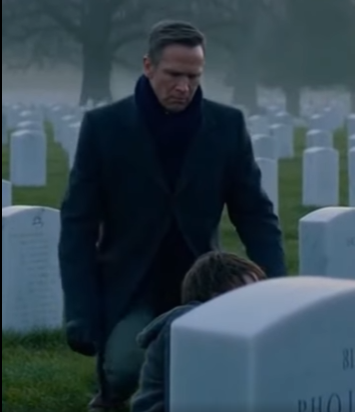
David Keller’s hands froze on the steering wheel as he approached the cemetery gate. Six years of monthly visits, and nothing had ever felt this wrong.
The gravel crunched under his feet. He walked the same path he always did, carrying only a candle and lighter. No flowers. No theatrics. Grief was supposed to be private.
Then he saw the shape on Lucinda’s grave.
A child. Curled against the white marble headstone. Barefoot, shivering, wrapped in a blanket too thin for the cold morning air.
David’s chest tightened. “What the hell?”
He stepped closer. The boy couldn’t have been more than eight, dark hair tangled, clutching something against his chest like a lifeline.
David bent down and saw it clearly. A photograph. Faded. Worn at the edges.
His breath stopped.
Lucinda smiled up at him from the picture. Her arm wrapped around a younger version of this same boy. That private smile she only gave him. Except she was giving it to someone else.
“Who are you?” David whispered.
The boy’s eyes opened. Dark. Tired. Too aware for a child.
“I’m sorry, Mom,” the boy murmured, his voice rough from cold. “I didn’t mean to fall asleep here.”
David’s knees nearly buckled. “What did you just say?”
The boy pulled the photo closer. “I said I’m sorry, Mom.”
“This isn’t your mother’s grave.” David forced the words out calmly, though nothing inside him felt calm.
“Yes it is.” The boy’s voice was quiet but certain. “Her name is Lucinda. She used to visit me.”
David reached for the photograph with shaking hands. “Where did you get this?”
“She gave it to me. She said to keep it safe.”
“Lucinda died six years ago.”
“I know.” The boy looked at him with heartbreaking clarity. “That’s why I come here.”
David stripped off his coat and wrapped it around the boy’s thin shoulders. “What’s your name?”
“Aaron.”
“How long have you been out here, Aaron?”
“Since last night.”
David pulled Aaron to his feet and led him to the car. The boy followed without protest, like he’d learned not to expect much from adults.
During the drive, Aaron explained he’d walked from a group home miles away. He’d slipped through a broken fence after dinner.
“Why?” David asked.
“I missed her.”
David booked a hotel room. He ordered food. Aaron stared at the plate without touching it.
“You can eat,” David said.
Aaron looked up, confused. “Am I allowed?”
That question broke something in David he didn’t know was still intact.
The next morning, they drove to the group home. A brick building with peeling paint and a rusted playground. A woman rushed out when she saw Aaron.
“Thank God you’re safe,” she breathed, then looked at David. “And you are?”
“David Keller. Lucinda’s husband.”
Her expression shifted. “Oh. Come inside, please.”
They sat in her cramped office. Ms. Reynolds folded her hands on the desk.
“Your wife was here almost every week,” she said. “She read to the kids. Brought supplies. But she was closest to Aaron.”
David’s throat felt tight. “Why him?”
“She wanted to adopt him.” Ms. Reynolds pulled out a folder. “She started the paperwork. Asked all the right questions. But she never finished.”
David stared at the forms. Lucinda’s handwriting. Dates from months before she got sick.
“Why didn’t she tell me?”
“I don’t know, Mr. Keller. Maybe she was waiting for the right time.”
David took Aaron home that night. The boy stood frozen at the entrance of the sprawling modern house.
“You can come in,” David said softly.
Aaron walked through the rooms like he was in a museum. Afraid to touch anything. Afraid to belong.
That night, David found a letter from Lucinda in her desk drawer. Addressed to him. Unopened.
“David, I’ve felt invisible for so long. I tried to talk to you about this, about Aaron, but you were always working. I hope one day you’ll understand why I wanted to give this boy a family. I hope you’ll forgive me for starting without you.”
David sat in the dark until sunrise.
Three days later, a lawyer called. Another family wanted to adopt Aaron. They’d been waiting longer. The paperwork was almost complete.
“I understand,” David said, then hung up.
That night, he found Aaron sitting on the hallway floor outside the guest room.
“Why aren’t you in bed?” David asked.
“The floor feels safer.”
David sat down beside him. The marble was cold through his pants.
“I’m scared,” David admitted. “I don’t know how to be a father. But I know I don’t want you to go back to feeling alone.”
Aaron studied him carefully. “Does that mean I can stay?”
“Yes. It does.”
David called the lawyer the next morning. “I’m filing for adoption. Aaron stays with me.”
“Mr. Keller, the other family—”
“I don’t care. This is what Lucinda wanted. It’s what I want. Make it happen.”
The process took four months. Home inspections. Background checks. Interviews with Aaron to ensure he felt safe.
David learned to cook meals Aaron actually liked. They did homework together at the kitchen table. Aaron laughed—really laughed—for the first time when David tried to help with his math homework and got it completely wrong.
“You’re terrible at this,” Aaron said, grinning.
“I know. Don’t tell anyone.”
The day the judge signed the final papers, Aaron stood beside David in the courtroom. When the gavel came down, Aaron grabbed David’s hand.
“You’re officially my son,” David said, his voice breaking.
“You’re officially my dad,” Aaron replied.
They drove to the cemetery together that afternoon. David placed fresh flowers on Lucinda’s grave. Aaron set the photograph gently beside them.
“Thank you,” David whispered, pressing his palm to the cold marble. “Thank you for showing me what I couldn’t see.”
Aaron slipped his hand into David’s. “Do you think she knows?”
“I think she always knew.”
They walked back to the car together. Father and son. The way it was always meant to be.
Six years ago, David had lost everything. Today, he’d finally found what Lucinda had been trying to give him all along.
A family. A purpose. A second chance to get it right.
