Doctors gave his son days to live… Then a janitor’s daughter snuck in with a golden bottle.
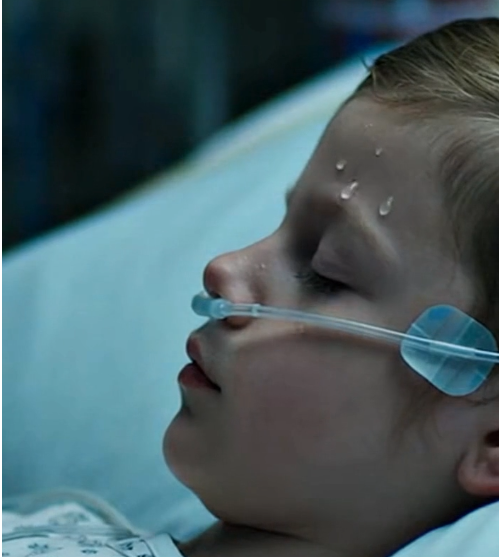
Brandon Keller hadn’t slept in three days. His four-year-old son Lucas lay dying in Room 417, wires taped to his chest, breathing mask fogging with each shallow breath.
Dr. Ivers closed his tablet. “We’ve exhausted every option. I’m sorry, Mr. Keller. A few days, maybe a week.”
“There has to be something,” Brandon said.
“Sometimes medicine reaches a wall.”
After the doctor left, Brandon pressed his forehead to Lucas’s hand. His wife Natalie was in Denver at a conference. He’d have to tell her their son was dying.
The door creaked.
A little girl in a worn school uniform walked in, carrying a tiny gold bottle. She was maybe seven, with brown hair in a loose ponytail.
“Who are you?” Brandon stood. “You can’t be in here.”
She climbed onto a stool beside Lucas. “I’m going to help him.”
Before Brandon could stop her, she poured water from the bottle onto Lucas’s forehead.
“Hey!” Brandon grabbed the bottle. “What are you doing?”
“It’s special water. It helps sick people.”
Brandon hit the call button. Two nurses rushed in.
“Ivy,” one nurse said. “What are you doing here again?”
A woman in a gray maintenance uniform ran in, panicked. “I’m so sorry. I’m Denise. I clean this floor. She shouldn’t have come in.”
The girl pulled against her mother’s hand. “I wanted to help Lucas. He’s my friend.”
Brandon froze. “How do you know my son’s name?”
“We played together at Sunny Steps,” Ivy said. “We built a tower with blocks.”
“My son has never been to any school,” Brandon said slowly. “He has a nanny at home.”
Denise’s face fell. “Please forgive her.”
They left quickly. Brandon stared at the damp pillow and the golden bottle.
That afternoon, he called the nanny. “Did you take Lucas to a kindergarten?”
Long silence. “Only twice a week, Mr. Keller. He was so lonely. I thought I was helping.”
“Where?”
“East Austin. Near the old rail yard.”
Brandon hung up, rage boiling through him.
That night, he woke to whispers. Ivy was back, holding Lucas’s hand, telling him a story about a brave knight.
“How did you get in here?”
“Through the staff entrance. I know where Mama keeps her card.”
“You can’t keep doing this.”
“Lucas needs someone to believe he’ll get better,” Ivy said. “Everyone else just looks sad.”
Lucas’s cheeks looked less pale. Brandon rubbed his eyes.
The nurse, Paige, entered quietly. “Mr. Keller, after she visited earlier, Lucas’s oxygen levels improved. Not much, but enough.”
Brandon looked at Ivy. “What’s in that bottle?”
“Water from the fountain behind the hospital. My grandma says it used to be a well where sick people went.”
“That sounds like a fairy tale.”
Ivy tilted her head. “Do you believe in doctors?”
“Yes.”
“And they said they can’t help him anymore. So why is it strange to believe in something else?”
Brandon had no answer.
When morning came, he dipped his fingers in the bottle and touched Lucas’s forehead. “If anything’s listening, I’m begging you.”
Lucas opened his eyes. “Daddy. Ivy came to see me.”
Brandon broke down.
Later that day, Dr. Ivers found him in the hallway. “Lucas’s blood counts are improved. Kidney function is better. I can’t explain it.”
“Is that good news?”
“It’s unexpected.”
When Natalie arrived that evening, she listened to everything. The kindergarten. Ivy. The water.
“If that girl makes him smile,” Natalie said, “she can come every day.”
And Ivy did. After school, she brought drawings and stories and refused to give up. Lucas laughed weakly at her jokes, reached for her hand in the dark.
Hospital administrators tried to stop her visits. Brandon arranged proper permissions. Ivy was allowed to stay.
One day Denise mentioned Ivy had anemia they couldn’t afford to treat. Brandon paid the bills quietly.
“Your daughter is giving us hope,” he told her. “Hope is worth more than money.”
Dr. Ivers tested the fountain water. “It’s just water.”
Yet Lucas kept improving.
First he sat up. Then he ate without help. Weeks later, he stood with Ivy supporting him. Nurses whispered. Doctors studied charts in disbelief.
“Spontaneous remission,” some said.
“Miracle,” others whispered.
Brandon stopped searching for explanations. He just lived each moment.
When Lucas was discharged, Natalie wept openly. Brandon carried his son into bright Texas sunlight. Ivy waited by the courtyard fountain, holding the golden bottle.
“I told you,” she said. “We’d play again.”
Lucas hugged her tight. “I’ll never forget you.”
Brandon changed everything after that. He left work early. He listened when Lucas spoke. He and Natalie rediscovered each other through bedtime stories.
He also funded Sunny Steps kindergarten with meals, supplies, scholarships. No plaques. No press releases. Just support.
But there was one more thing.
Dr. Ivers called him six months later. “Mr. Keller, Lucas’s latest scans are completely clear. No trace of the condition. I’ve never seen anything like it in thirty years.”
“What are you saying?”
“I’m saying your son is cured. Completely.”
Brandon sat down hard, phone shaking in his hand.
That night, he told Natalie. They held each other and cried.
A week later, they invited Ivy and Denise to dinner at their home. Lucas had set the table himself, insisting on using the fancy plates.
“Thank you,” Brandon said to Ivy. “You gave us our son back.”
Ivy smiled. “I just didn’t know how to give up.”
Denise wiped her eyes. “Mr. Keller, Mrs. Keller, you’ve done so much for us. The medical bills, the kindergarten—”
“You gave us everything,” Natalie said. “Your daughter walked into that room when everyone else had given up. That’s worth more than anything we could ever give you.”
Brandon pulled an envelope from his jacket. “Denise, we’d like to offer you something. A position managing community outreach for the foundation we’re starting. Real salary, benefits, college fund for Ivy.”
Denise’s hands trembled as she opened it. She gasped at the offer letter.
“You don’t have to clean hospital floors anymore,” Brandon said. “You can help other families like ours.”
Denise couldn’t speak. She just nodded, tears streaming down her face.
Years passed. Lucas grew into a healthy teenager. He kept the golden bottle on his desk, empty but treasured.
Ivy visited often, now dreaming of becoming a teacher. They sat in Lucas’s room one afternoon, looking at old photos from the hospital.
“It wasn’t the water, was it?” Lucas said.
“No,” Ivy replied. “It was just you believing when everyone else was afraid.”
Ivy laughed. “I just didn’t want my friend to die.”
Brandon stood in the doorway, listening. He still didn’t know if it had been medicine, chance, or something beyond explanation.
But he knew this: When the world said there was no hope, a little girl refused to accept that answer. She showed up. She believed. She fought.
And because of that, everything changed.
The foundation they started had helped forty-three families facing rare childhood illnesses. Denise ran it with fierce dedication. Ivy volunteered there every summer.
Lucas was planning to study medicine. “I want to help kids like me,” he told his parents.
One evening, Brandon and Natalie stood by the fountain behind the hospital. The old well that Ivy’s grandmother had told her about.
“Do you think it was really the water?” Natalie asked.
Brandon smiled. “I think it was a little girl with a big heart who refused to let my son die alone. The water was just her way of giving us permission to hope.”
They dropped coins in the fountain. Not for wishes. For gratitude.
Because sometimes the real miracle isn’t what saves you. It’s who refuses to walk away.
