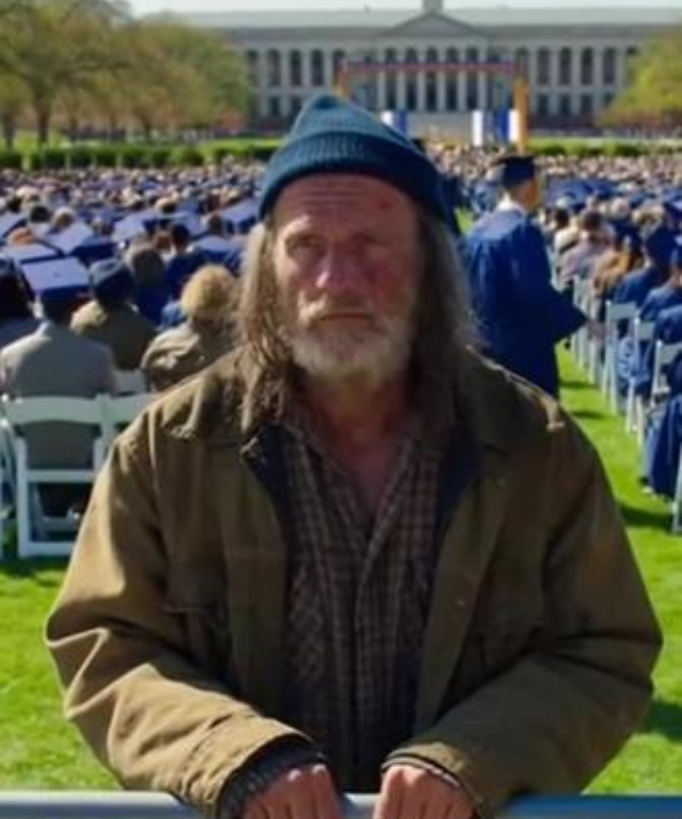
A homeless veteran crashed his daughter’s graduation… But when security grabbed his arm, a tattoo stopped everyone cold.
Marcus Hayes stood behind the barricade at Georgetown’s graduation ceremony, his torn jacket and matted beard marking him as an outsider. He wasn’t there to disrupt. He just wanted to see Emma and Sophia walk across that stage—his twin daughters, twenty-eight now, graduating medical school. He’d been gone four years. Four years of sleeping under bridges, four years of trying to forget the man he used to be.
Captain Derek Morrison saw him and made a decision. “You’re making families uncomfortable,” Morrison said, his voice cold. “Leave now, or I call the police.”
Marcus kept his eyes on the distant stage. “I’m in the public viewing area. I’m not bothering anyone.”
Morrison stepped closer, crowding him. “Not for people like you. Move along.”
“I served,” Marcus said quietly.
Morrison laughed, sharp and bitter. “Of course you did. They all say that. You got proof? Or just a story and a dirty jacket?”
When Marcus didn’t move, Morrison grabbed his arm and yanked him backward. The sleeve of his jacket slid up.
And there it was. Tattooed coordinates: 33.315N, 44.366E. Fallujah, Nov. 2004. The Force Recon emblem. Two small stars. The names Emma and Sophia.
Morrison’s hand fell away like he’d been electrocuted. His face went white. He whispered a single word—a call sign that was legend at Quantico.
“Reaper 6.”
Ten meters away, Colonel James Whitaker stood up. He’d been at Camp Fallujah in 2004. He’d read the after-action reports about the Gunny who went into the burning mosque alone and held it for fourteen hours to save six trapped Marines. He’d shaken this man’s hand at the Silver Star ceremony.
“Hayes? Marcus Hayes?”
Marcus turned slowly, his face hollow with shame. “Colonel Whitaker.”
Whitaker saluted him—protocol be damned. “Gunnery Sergeant Hayes. My God, man.”
Senator Castellano, a former Army Ranger, walked over. “Did I hear you say Reaper 6?”
“Yes, Senator.”
The senator looked at Marcus, then at Morrison. “Captain, did you mock this man when he told you he served?”
Morrison’s voice cracked. “I didn’t believe him, sir.”
The senator’s face hardened. “This ceremony will proceed. Gunnery Sergeant Hayes will be seated in the front row.”
But fifty meters away, two women in blue graduation gowns had heard everything. They heard the name Marcus Hayes. They turned to each other, faces draining of color.
“Did he just say—?” Emma began.
“He said Marcus Hayes,” Sophia finished.
They ran. They dropped their programs, their bouquets, their caps. They pushed through the crowd, past the shamed captain and the stunned colonel.
And they saw him. Their father, trying to shrink into himself, trying to disappear.
“Dad?” Emma’s voice was barely a whisper.
Marcus looked up. His eyes met theirs. “I wasn’t going to bother you. I swear. I just wanted to see you graduate. I’m sorry. I’m so sorry.”
Sophia shook her head, tears streaming. “Bother us? Dad, we’ve been looking for you for four years.”
She threw her arms around his neck. Emma followed. They held him between them, clinging to their father, this beloved ghost.
And Marcus Daniel Hayes—the man they called Reaper 6, the hero of Fallujah, the man who’d survived fourteen hours of hell but couldn’t survive his own grief—finally broke. He sobbed into their shoulders, four years of pain pouring out.
Behind them, Morrison stood frozen in shame. Whitaker saluted again, holding it. The senator bowed his head.
Morrison stepped forward, his voice shaking. “Gunnery Sergeant Hayes. I have no excuse. I was wrong.”
Marcus didn’t answer. He was holding his daughters, and for the first time in four years, he was home.
The ceremony coordinator approached quietly. “Sir, we’d like to reserve front-row seating for you and your family.”
Emma pulled back, wiping her eyes. “Dad, you’re staying. You’re watching us graduate.”
“I can’t,” Marcus whispered. “Look at me.”
Sophia gripped his hand. “We don’t care what you look like. You’re our father. You saved six Marines in Fallujah. You can sit through a graduation.”
Colonel Whitaker stepped forward. “Gunnery Sergeant, I have a car here. I have a clean uniform in my trunk—I always carry one. It’ll fit you.”
Twenty minutes later, Marcus Hayes walked back onto that lawn. He wore Whitaker’s dress blues, the Silver Star and Purple Heart pinned to his chest. His face was clean-shaven, his hair trimmed by a graduate’s father who happened to be a barber.
He sat in the front row between his daughters as they waited for their names to be called. Emma held his left hand. Sophia held his right.
When “Dr. Emma Hayes” echoed across the lawn, Marcus stood and cheered, his voice hoarse but strong. When “Dr. Sophia Hayes” followed, he cheered again, tears streaming down his face.
After the ceremony, Senator Castellano approached. “Gunnery Sergeant, I sit on the Armed Services Committee. We have programs for veterans in crisis. Let me help you get back on your feet.”
Morrison stood at a distance, his career effectively over. Whitaker had already made a call. By Monday, Morrison would be reassigned to a desk job pending review.
That night, Emma and Sophia took their father to their apartment. They ordered pizza. They sat on the couch, one daughter on each side, just like old times.
“Dad,” Emma said softly, “we’re not letting you go again.”
Marcus looked at them—these brilliant, compassionate women who’d become doctors despite losing their mother, despite losing him. “I don’t deserve you.”
“Maybe not,” Sophia said, a small smile breaking through. “But you’re stuck with us anyway.”
Three months later, Marcus Hayes moved into a VA housing program. He started therapy again. He attended AA meetings. He got a job as a security consultant—his old firm welcomed him back immediately when they heard what happened.
On Sundays, he had dinner with Emma and Sophia. They’d sit on their apartment balcony, and Marcus would pull out the old astronomy book, its pages worn and loved.
“That’s Venus,” he’d say, pointing to the evening sky.
“Still not twinkling, Dad,” Emma would tease.
“Definitely a UFO,” Sophia would add.
And Marcus would smile—a real smile, the first in years—because he was finally, truly home.
Captain Morrison, meanwhile, was dishonorably discharged after an investigation revealed a pattern of mistreating homeless veterans at events. His final act was writing a letter of apology to Marcus—a letter Marcus read once, then filed away.
Justice had been served. The man who’d forgotten what the uniform meant had lost the right to wear it.
And the man who’d never stopped being a Marine, even at his lowest, had found his way back to the only mission that ever really mattered: being a father.
