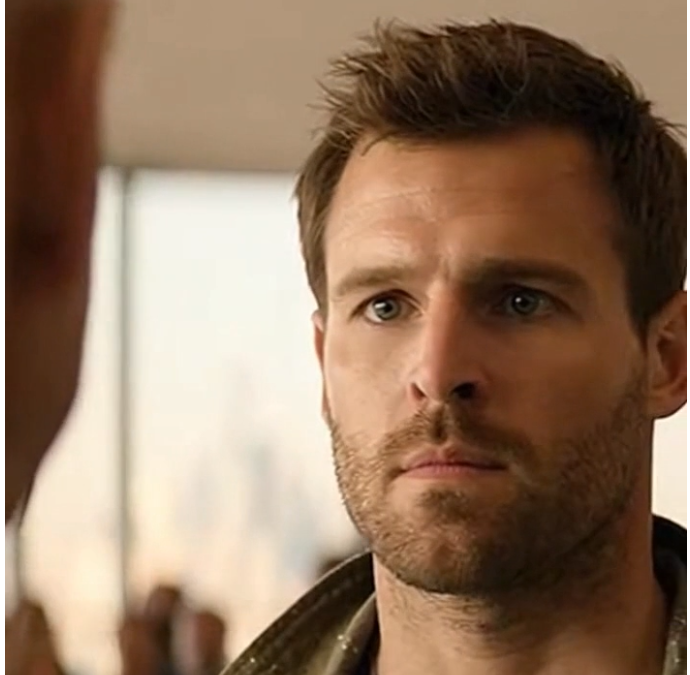
His adoptive father made him kneel on marble in front of buyers… But when a four-star general walked in and saluted, the room learned his real name.
The cane struck my chest. “Kneel. Apologize for dirtying the marble,” my adoptive father snarled. Buyers sipped champagne. Sales reps paused. Phones tilted up.
I wore a torn field jacket, road dust on my boots, dog tags cold against my throat. The medal in my palm bit deep—copper, frayed ribbon, weight of fire. I lowered one knee. The marble felt like teeth.
“Say you’re sorry for embarrassing our family, Jack,” her mother hissed, perfume masking something chemical.
My ex stood by the model kitchen in gunmetal gray, arms folded, red lipstick bright as paint. The crowd waited. “You were a stray we fed,” her father barked. “You’ll never be family. Today, you crawl.”
The double doors exploded open.
A four-star general strode in, boots pounding. He stopped in front of me—still on one knee—and snapped a salute so sharp the room flinched.
“Sergeant Jack Walker. On your feet, son.”
Champagne glasses froze. My ex’s lipstick trembled. Her father sputtered, “Why are you saluting a bum?”
The general didn’t blink. “He carried three men through fire while taking rounds. I’ve been trying to find you, Sergeant. The city’s waiting. And so is Chairman Sterling.”
Her mother went pale. “Sterling… the rival developer?”
I stood slow. Dust fell from my knee. “You fed a stray, but you threw out your adopted son. You never asked my real name.”
The general turned to the room. “Attention for Young Master Jack Sterling.”
Gasps rippled through the crowd. The sales director stammered, “Mr. Sterling… this entire tower… your family—”
Her father’s cane slipped. Her mother clutched her pearls.
I tilted my head. “About that apology.”
They’d blocked every call from Chairman Sterling for years. Told him I was unstable. Dangerous. Threatened harassment suits. They cashed checks from my trust fund while telling me gratitude was the only word I needed to know.
The DNA matched. The fire that killed my parents wasn’t an accident. Someone took me from a burning car seat. For years, my grandfather searched. Then the general found me—a sergeant with my mother’s jaw and my great-grandfather’s eyes.
In his tower office, the old man’s hands shook as he cupped my face. “You have your mother’s jaw,” he whispered. “I want you to be loved. And I want you to choose what you do with the power your name gives you.”
But first, we had work to do.
We filed an injunction. Her father’s luxury tower—built with my trust fund money—had cut corners. Thin rebar. Bribed inspectors. A worker fell and his family got a check marked “consulting.”
We brought in whistleblowers. A construction supervisor with dinner-plate hands. A woman with a snake tattoo. A painter who laughed like his lungs hurt. They told us about foundations that crack, mold like maps, exposed wires like sunning snakes.
My ex called. “They’re scared. They’re talking about running.”
“It won’t blow over,” I said.
“I know.” She held out her phone—a recording of her father: “Tell him to make it go away. I don’t care what it costs.”
She wore a wire to the next meeting. “If I’m going to burn,” she said, “I might as well make it fire.”
The district attorney assembled a grand jury. Subpoenas went out like unwanted party invitations. Her father sent a cease-and-desist. I wrote back one word: “No.”
At the hearing, her father’s lawyer said “baseless” and “political.” I gave them evidence—engineers’ reports, emails, photos of cracks like leaf veins.
My ex testified. The recording played. Her father closed his eyes halfway through.
The committee chair asked what I wanted. “A building that doesn’t fall. A city that doesn’t let people like them decide people like us don’t matter.”
Her father approached me on the courthouse steps. “After everything—”
“After everything,” I said. “Yes.”
I gave him terms. Three sentences into a microphone. “I was wrong. I am sorry. I will make it right.”
Step down from the company. Pay back the trust fund with interest. Fund veterans’ housing for ten years.
He stared at me. Tired. Shoulders lower than when he came in. “Tomorrow I say the words.”
He did. The room packed with cameras and bodies. He wore black. Stood at the podium.
“I was wrong.” He didn’t swallow it. “I am sorry.” He meant it as much as he could. “I will make it right.”
He signed papers. He stepped back.
The DA made statements about consequences. Chairman Sterling patted my shoulder. “We didn’t destroy them.”
“We didn’t need to,” I said.
A woman with a sleeping baby hugged me. “We live on eighth floor. I couldn’t sleep because I thought I felt the building move in the wind. I slept last night. Thank you.”
That’s what I wanted. Not headlines. Sleep.
The old man got sicker. We sat by windows and watched the river. He asked what I wanted.
“I want to build one building right,” I said. “I want my guys to come home safe. I want a woman on the eighth floor to take her baby on a balcony and not think about falling.”
“We can find the ones that need fixing,” he said. “Want to?”
We made a list.
My ex and I didn’t get back together. We had coffee once. “I’m moving across the river,” she said. “I’m going to school. Maybe buildings. Maybe bread.”
“Carb-positive architecture,” I said. She laughed.
Her father pled to charges. He paid. He stepped down. Her mother moved to a coastal town where the wind is supposed to be healing.
I built a building. Not alone. Never alone. Men poured concrete. Women measured beams. An engineer named Ana saved me from myself ten times in a month.
When families moved in, the elevators didn’t stall. A girl in a blue dress ran down a hallway and laughed. I touched the wall and felt it not move.
Chairman Sterling died in spring. He squeezed my hand and said, “Do better.”
I cried like a man whose body finally understands it’s allowed to be soft sometimes.
I saw her mother at a grocery store. Fancy kind, where basil gets misted. She looked older. Smaller without the house around her.
“I made a lot of mistakes,” she said suddenly. “I loved you. I loved you badly.”
Her hands shook. “I’m sorry.”
“Thank you,” I said. “I forgive you. And I don’t want to see you again.”
She closed her eyes. “Fair.”
She walked away, slightly bowed. She didn’t look back.
I walk past the showroom sometimes. Not to look in. To prove it exists and that it’s small now. Rooms lose power when your bones don’t buzz at their doorways.
The general retired, then unretired. He comes over. We fight about documentaries. He grows mean tomatoes and gives me sauce better than any fancy store.
My ex sends photos from her bakery. “Carb-positive architecture,” she captioned bread with blistered crusts. We’re fine.
I run in the mornings. Pass scaffold workers and suit-wearers. A kid on a skateboard almost knocks me down and laughs, pure and loud. I laugh too.
I stop on a bridge and look at the river. Birds skim the surface. The water keeps its own counsel.
I go home. Climb stairs that don’t creak. Unlock a door that doesn’t stick. Put my hand on a wall that’s straight.
I kneel sometimes now. Not on marble. On dirt where the general’s tomatoes will grow. On a rug where a kid builds block towers. The point is the building, the standing, the hands that hold you while you learn how height sits on a foundation.
A general saluted me in a room where I was small. Now I stand with men who were never going to find that room. We build other rooms. We open doors. We leave them open.
We wait in the doorway for the boy who thinks the floor is the only place he belongs. We tell him he can stand. We say his name.
