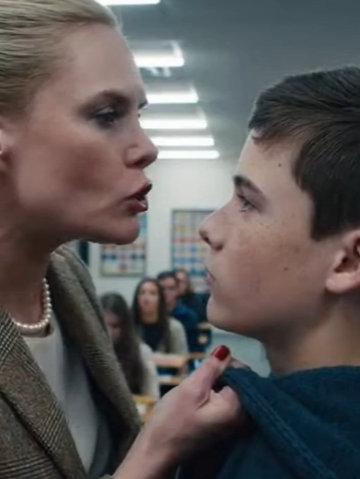
A teacher humiliated him for wearing cheap sneakers… But when his billionaire father’s helicopter landed on the school lawn, her world shattered.
Mrs. Vane’s blood-red nails dug into my neck. “Look at me when I’m speaking to you, Mr. Sterling.”
I stared at my desk. At Remington Hall Academy, silence had weight.
“You look like trash,” she hissed, yanking my collar. “A stain on this institution’s reputation.”
My fists clenched. She didn’t know I was the scholarship kid by choice. The Sterling billions built half this campus, but I wanted to know my worth without the money.
“Get out. Call your guardian to bring proper shoes, or don’t come back.”
I reached for the door. That’s when the vibration started—a deafening roar of rotors. The windows rattled. A matte-black Sikorsky helicopter descended onto the sacred lawn, bearing the Sterling Family Crest.
My father stepped out in a charcoal suit, fury blazing in his eyes.
Mrs. Vane’s face went white. The intercom crackled. “Mrs. Vane, please tell me Leo Sterling is okay.”
Marcus Sterling stormed into the classroom. He towered over her, then looked at my worn Converse and nodded.
“Get your bag, Leo.”
“Mrs. Vane says I’m a stain,” I said. “Because of these shoes.”
Dad turned to her slowly. “You called my son a stain?”
“It’s school policy—” she stammered.
“I wrote the policy in 1998 when I funded this wing,” he said coldly. “You grabbed him. My security watched the cameras. You’ve made the last mistake of your career.”
He turned to Principal Higgins. “How much is the History Department endowment?”
“Four million, sir.”
“Cancel it. Unless this woman is banned from campus in ten minutes. If she steps on Sterling property again, I’ll bulldoze this building.”
Mrs. Vane wept, mascara running. Dad looked at her with disgust. “You called him a stain. Look at you now.”
We walked out, my squeaky Converse echoing beside his Italian leather.
“Why the sneakers?” he asked at the helicopter.
“I wanted to see who they really were without the money.”
“And?”
“They’re fake. All of them.”
He opened the door to the chopper. “Get in, Leo. We have a problem. Your mother didn’t die in a car accident.”
My blood froze.
At the Aviary—a glass fortress in the Catskills—Dad explained. “Your mother testified against cartels. They found her. The accident was staged, but she had brain trauma. She’s been here, locked in the West Wing.”
“I want to see her.”
Dr. Thorne, a neuropsychologist, led me down white corridors to a cell. Mom turned around, her eyes wild.
“Leo?” She scrambled backward. “No! It’s a trick! Leo is dead! I saw his shoes burning!”
“She thinks I’m dead?” I stared at Dad, horrified.
“To keep her compliant,” he said. “To keep her here without trying to escape.”
That night, I met Jules—the housekeeper’s daughter with blue hair. “Your mom writes on the glass late at night,” she whispered. “She writes: ‘MARCUS IS THE MOLE.'”
Next morning, Dad revealed his plan. “I’m brokering a peace treaty. Trading your mother’s encryption keys for our safety. The buyers arrive at dusk.”
“You’re selling her?”
“I’m being pragmatic!”
I found Jules. “Help me get her out.”
She rigged a fake gas leak. At 2 PM, the alarms wailed. The West Wing doors unsealed.
I burst into Mom’s room. “Look at my shoes!” I pointed to my Converse. “These aren’t burnt. I’m real. I’m here.”
She touched my sneaker, clarity dawning. “Leo… you got so tall.”
“Dad’s selling you. We have to go.”
“There’s no money,” she said. “The ‘key’ opens a server with evidence of his illegal arms dealing. He IS the cartel’s partner.”
We ran. Dad appeared with a gun. “Step away from her.”
“I know what you are.”
He raised the gun at me. “Move, Leo.”
I grabbed a fire extinguisher and smashed the glass wall. “Jump!”
We fell onto the lower roof, sliding toward the edge. I caught the gutter with my Converse, holding Mom as she dangled over a three-hundred-foot drop.
Dad aimed at my hand. “Tell me where the server is, or watch him fall!”
“Geneva! Box 404!” Mom screamed.
He smiled and aimed at her head. “Loose ends.”
THWACK. Jules hit him with a wrench from behind.
“Run! The buyers are here!”
Three black helicopters crested the trees, rockets mounted. They weren’t paying—they were taking.
We scrambled to Dad’s helicopter. Mom jumped in the pilot seat, her hands flying over controls.
We dove off the cliff, nose-first toward the river. At the last second, she pulled up, skimming the water.
“We’re going to finish this,” she said. “Release the data and the asset becomes worthless.”
“The school,” I said. “Remington Hall has Dad’s backup satellite array.”
We landed on the football field at 4 AM. Jules and I sprinted to the Science Wing, smashing through the doors.
In the server room, I plugged in Mom’s signal. The upload started.
Dad appeared, bloody and desperate, holding a submachine gun. “Stop it! If that data goes out, I’m dead!”
“Better you than Mom.”
“I’m your father! I gave you everything!”
“You gave me money for shoes so I’d look like everyone else. But you never saw me.” I looked down. “These are the only things I own that you didn’t buy. And I’m standing in them while I watch you fall.”
UPLOAD COMPLETE.
Dad slumped against the wall. “You’ve killed us all.”
“No. I just killed your ghost.”
FBI sirens wailed. The cartel choppers fled. We escaped in the helicopter as police swarmed the campus.
Three months later, we sat in a New Mexico diner—Mom, Jules, and me. Poor. Actually poor. No hidden accounts.
The bell jingled. Sarah walked in, found us from a sketch I’d posted online.
“Nice shoes,” she said, looking at my twelve-dollar Walmart sneakers.
“They’re just shoes,” I smiled. “They cover my feet. That’s what they’re for.”
I looked at Mom sipping coffee peacefully, Jules stealing my bacon, Sarah who’d crossed the country to find me.
Mrs. Vane was wrong. Dad was wrong.
You aren’t defined by what you wear or own. You’re defined by who sits beside you when the world burns, and who helps you rebuild from the ashes.
“Sarah, want some pancakes?”
She smiled brighter than any searchlight. “Yeah. I’m starving.”
