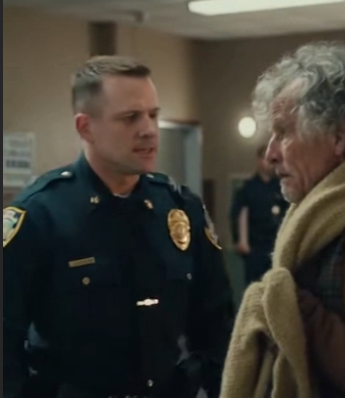
A cop slapped a homeless veteran in front of everyone… But when a biker stepped forward, his past shocked the entire station.
The fluorescent lights hummed in the police station lobby. Henry stood at the front desk, clutching a frayed blanket, his voice barely above a whisper.
“I just need my papers back, Officer. They’re all I got.”
The officer’s patience snapped. He leaned forward and slapped Henry hard across the face. The crack echoed through the room. Conversations died. Henry stumbled back, hand flying to his cheek, eyes filling with humiliation.
Across the lobby, a biker in worn leather froze mid-sentence. His jaw clenched. The pen slipped from his fingers and clattered to the floor.
He didn’t run. He walked. Each boot strike deliberate, heavy, final.
Officers shifted nervously. Hands moved toward radios. The room held its breath.
The biker stopped between the officer and Henry. He set his helmet on the desk with a dull thud.
“That’s enough.”
The officer scoffed. “Step back. This doesn’t concern you.”
“It does when I see someone being hurt for no reason.”
Tension crackled. Another officer stepped forward. “Hey, easy now.”
The officer who’d struck Henry straightened, hand drifting to his belt. “You threatening me?”
“No,” the biker said quietly. “I’m stopping you.”
Several officers stiffened as the biker reached into his jacket. He pulled out folded papers and held them up calmly.
“I used to stand where you’re standing. I know the power you carry. I know what happens when you forget what it’s for.”
He unfolded the documents one by one. A commendation letter. A discharge notice. A photograph—him, younger, in uniform, surrounded by fellow officers.
Murmurs spread. The officer’s confidence cracked.
“That doesn’t mean anything,” he muttered weakly.
“It means everything.”
The biker knelt beside Henry. The room watched in stunned silence as this rough-looking man lowered himself to eye level, not in dominance, but respect.
He pulled out a water bottle and unscrewed the cap. “Here. Take a breath.”
Henry’s hands trembled as he accepted it. “Thank you,” he whispered, meeting the biker’s eyes for the first time since the slap.
The biker stood and faced the room. “His name is Henry. He served this country. Two tours. Came home different—nightmares, panic, nowhere to land.” He paused. “He didn’t lose his worth when he lost his address.”
A senior sergeant stepped forward, examining the documents. His jaw tightened.
The officer tried to interrupt. “Sarge, this guy was causing—”
“Enough,” the sergeant snapped.
The biker continued. “This uniform doesn’t give us permission to humiliate people. It gives us responsibility. Every one of you knows that.”
Phone cameras clicked on around the lobby. The truth hung in the air, undeniable.
Henry wiped his eyes. The biker’s hand settled on his shoulder, steady and sure.
The sergeant exhaled slowly, years of experience in that single breath. He looked from the biker to Henry, then to the officer who’d thrown the slap.
“Officer, step aside.”
The words landed like a gavel.
“What? Sir, with respect—”
“Now.”
Color drained from the officer’s face. Under watchful eyes, he moved away from the desk.
The sergeant turned to another officer. “Call Internal Affairs. Get medical to check on Mr. Henry.”
A gasp rippled through the lobby. Accountability. Public. Undeniable.
The biker helped Henry to his feet, steadying him. “You’re okay. You’re not alone anymore.”
Henry nodded, clutching the water bottle like a lifeline. “Didn’t think anyone would care.”
“I do. And I know people who can help.”
The sergeant approached, extending his hand. After a pause, the biker shook it.
“For what it’s worth,” the sergeant said quietly, “you did the right thing today.”
“So can you.”
Together, the biker and Henry walked toward the exit. Officers stood silent, forced to sit with what they’d witnessed.
Outside, sunlight warmed Henry’s face for the first time in weeks. The biker made three calls—a veterans’ shelter, a legal aid office, a buddy who ran a halfway house.
“Got a spot opening next week,” the voice on the phone said. “Can he wait?”
The biker looked at Henry, standing straighter now, hope replacing shame in his eyes.
“He’s waited long enough. I’ll cover the motel until then.”
Henry’s eyes welled up. “You don’t have to—”
“I know.” The biker clipped his phone to his belt. “But I’m going to.”
Inside the station, the officer who’d struck Henry sat in an interrogation room, badge and gun already surrendered. The cameras hadn’t stopped recording. The witnesses hadn’t stopped talking.
By evening, the story had spread through three precincts. By morning, Henry had a bed, three meals, and an appointment with the VA. The officer faced suspension pending investigation.
The biker never asked for recognition. He’d simply done what the badge had once taught him—protect those who couldn’t protect themselves.
Henry stood in the doorway of his temporary room that night, clean clothes folded on the bed, walls around him for the first time in months. He pressed his palm to the window, watching traffic lights change in the distance.
He wasn’t invisible anymore. Someone had seen him. Someone had cared.
And that officer? He learned the hardest lesson of all—power without compassion isn’t strength. It’s just cruelty with a uniform.
Justice had been served, witnessed by everyone in that lobby. The slap had consequences. The defense had results. And Henry finally had hope.
