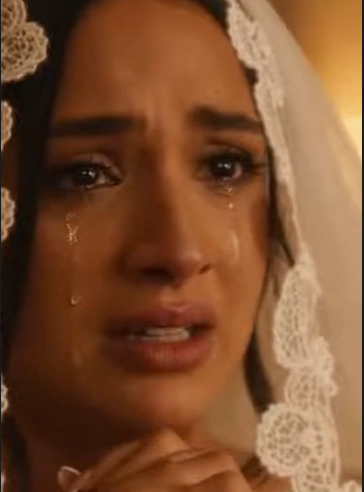
A single dad heard a bride screaming inside a burning wedding hall… But the groom who swore to protect her was the first one out the door.
The wedding hall was everything the brochure promised. White drapes cascaded from vaulted ceilings. Guests in silk and gold filled every chair, champagne already sweating in their glasses. Two hundred people had come to watch Aisha Chen become Aisha Merritt, and not a single one of them suspected that the man she was about to marry had already started looking for the exit.
Aisha stood at the base of the aisle, bouquet trembling in her fingers. The veil was heavy. The dress was heavier. She breathed in, slow and controlled, the way her mother had taught her when the nerves got bad. Just walk. Just smile. Just say yes.
Three rows back, Omar Reyes sat at a corner table near the service entrance, a tray of champagne flutes balanced on one hand. He wasn’t supposed to be watching the ceremony. But the music had started, and something about the way the bride’s shoulders were shaking made him pause.
He set the tray down quietly and watched.
Aisha’s father offered his arm. She took it. The crowd rose.
Then the lights flickered.
At first, nobody moved. A collective murmur passed through the guests, the kind of sound a crowd makes when it doesn’t want to believe something is wrong. Aisha’s smile stayed locked in place. Her father squeezed her arm.
The smell hit next. Acrid. Chemical. Wrong.
A spark cracked above the stage, small and bright, and for one frozen second it hung in the air like a firefly. Then it caught the decorative draping. Flame bloomed fast, hungrily, racing upward along the fabric in a seam of orange light.
Someone screamed. That was the signal.
Chairs toppled. Glasses shattered. Two hundred people lurched to their feet at once, a stampede forming in the space of a single breath. The music cut out. The hall filled with shouting, crying, the sound of bodies colliding.
Aisha’s father vanished into the crowd. One moment he was beside her, the next he was gone, carried by the current of panic, and she was alone at the base of the aisle with fire crawling across the ceiling above her.
She didn’t move.
Her body locked. The veil billowed as superheated air surged through the hall. Smoke pooled low, fast, stinging her eyes. She lifted her skirt instinctively, stumbled backward, and felt heat kiss the hem of her dress.
“Help me!” The words tore out of her, raw and cracked, swallowed by the noise around her.
She searched the crowd for Merritt. For the man she was about to marry. The man who had promised, in front of her family, in front of God, to be her person.
He was gone.
Omar heard her scream from the doorway.
He was already outside. Already breathing clean air. His lungs burned from the smoke he’d inhaled on the way out, and his hands were shaking from the adrenaline still flooding his system. Around him, guests were crying, grabbing each other, checking phones, calling names. Sirens wailed somewhere distant.
He should have kept walking. He had a daughter at home. Mia, seven years old, still wearing her school backpack when he’d left that morning, waiting for him to come back so she could show him a drawing she’d made.
He turned back toward the fire anyway.
The doors were thick with smoke. He shoved through them, one arm over his face, eyes already streaming. The heat was a physical thing, a wall that pushed against him with every step. The hall was unrecognizable. Flames ate across the ceiling in long, lazy tongues. Burning debris rained down in slow arcs.
Near the entrance, a fire extinguisher lay on the floor where someone had dropped it in their panic. Omar grabbed it, gripped it with both hands, and ran toward the stage.
He found her on the floor.
Aisha was tangled in scorched fabric, coughing in short, violent bursts. Fire curled along the edges of her dress like it was alive, like it was feeding. Her veil was gone. Her hair was singed. Her eyes were closed.
Omar dropped to his knees beside her and pulled the pin on the extinguisher. White foam blasted across the flames in a wide arc. The fire hissed, recoiled, died in patches. He sprayed again, wider, coating the dress, the fabric pooled around her.
Then he set the extinguisher down and took off his jacket.
He pressed it over her, smothering the last of the flames with his bare hands. Pain erupted across his palms, white-hot and immediate. He didn’t stop. He kept pressing, kept smothering, kept going until the last ember on her dress went dark.
“Stay with me,” he said. His voice came out rough, barely audible over the roar of the fire still burning around them. “Please.”
Her eyes opened. Glassy. Terrified. She tried to speak and only smoke came out.
Above them, the ceiling groaned. A beam shifted, cracked, and crashed down ten feet away, sending sparks scattering across the floor like thrown coins. The main exit was gone. Flames and collapsed furniture had sealed it shut entirely.
Omar looked around, fast, scanning through the smoke. His chest was tight. His hands were ruined. Every breath felt like swallowing glass.
Then he saw it. A side window, cracked from the heat, near the back wall.
He lifted her into his arms. She was lighter than he expected. Too light, like the fire had already taken something from her. He held her close, tucked her face against his chest, and moved.
Each step was a fight. His lungs screamed. His legs shook. Smoke filled his vision until he was navigating by feel, by instinct, by the faint gray light coming from the direction of the window. He reached it. Kicked out the remaining glass with his foot. Turned his body so his back took the frame.
They hit the ground outside hard.
Cool air slammed into him, shocking and sudden, like being plunged into water. Firefighters were already there, shouting, moving fast. Someone pulled Aisha from his arms. Someone else was pressing on his chest, saying words he couldn’t process.
The last thing Omar thought before the darkness took him was his daughter’s face.
Mia, with her gap-toothed smile, and her school backpack, and her drawing that he hadn’t seen yet.
He woke in a hospital room.
Heart monitor beeping. Antiseptic smell. His hands were wrapped in white bandages so thick they looked like oven mitts. Pain radiated from his palms, his forearms, the backs of his knuckles, a deep, pulsing burn that flared every time he tried to move his fingers.
A nurse was adjusting his IV. She noticed his eyes open and stepped closer. “Easy,” she said. “You’re safe.”
Safe. The word sat strangely in his chest.
“The bride,” Omar croaked. His throat felt like he’d swallowed gravel. “Is she—”
“She’s alive.” The nurse’s voice was gentle, careful, the tone people use when they’re delivering news they know matters. “She’s in the ICU. Third-degree burns on her arms and neck. But she’s alive, Mr. Reyes. Because of you.”
Omar closed his eyes.
The relief hit him so hard it made his body shake. He turned his face into the pillow, pressing his forehead against the rough cotton, and let the tears come quietly. Nobody saw.
He thought about Mia again. About how close she had come to a phone call that would have changed everything. About the drawing, still unseen on the kitchen table.
The guilt settled in his chest like a stone.
News traveled fast.
By the second morning, reporters lined the hallway outside his room. Nurses whispered when his gurney rolled past. Someone had already uploaded a shaky video from outside the hall, the crowd streaming out, smoke pouring from the doors, and a figure disappearing back inside. That figure was Omar. The video had forty million views by lunch.
They called him a hero on every channel.
He didn’t feel like one. He felt exhausted and afraid and sore in ways he didn’t know a body could be sore. He felt like a man who had made one decision in one second and was only now beginning to understand what it had cost him.
His sister brought Mia to the hospital on day two.
The girl walked into the room slowly, clutching a folded piece of paper. She stopped at the foot of his bed, stared at his bandaged hands, and her face went through something complicated, something caught between fear and fierce pride.
“Mom said you went back in,” Mia said.
“I did.”
“Why?”
Omar looked at his daughter for a long moment. “Because someone needed help.”
Mia considered this with the gravity that only a seven-year-old can give to a simple statement. Then she unfolded the paper and held it up. A crayon drawing: a stick figure in orange, standing in front of a building with flames coming out of it, and another stick figure beside him, smaller, waving.
“I made it this morning,” she said. “For you.”
Omar reached out with his bandaged hands and took it carefully, the way you hold something you already know you’ll keep forever.
On day four, Aisha requested to see him.
A nurse wheeled her in late in the afternoon, when the light through the window had gone amber and soft. She looked nothing like the woman who had stood beneath the arch of roses. Her hair was cropped short, uneven in places where the fire had taken it. Bandages wrapped her arms, her neck, the left side of her face. But her eyes were clear. Steady. Present.
When she saw Omar, they filled with tears.
She didn’t cry. She just let them fall, quietly, while she held his gaze.
“You came back,” she said.
Omar nodded. “I heard you scream.”
She was quiet for a moment. Her bandaged hand moved across the blanket, reaching toward his. She stopped just short of touching him, aware of the damage beneath the white wrapping. “Everyone ran,” she said. Her voice was steady, but something underneath it trembled. “Everyone. Including the man I was supposed to marry.”
The room was very still.
“He didn’t even look back,” she continued. “They told me afterward. He made it out in the first wave. Didn’t call. Didn’t text. Didn’t ask if I was alive.”
Omar didn’t say anything. There was nothing to say that wouldn’t sound hollow.
“I thought I was going to die in there,” Aisha said. “And then I saw you.”
Omar swallowed. “I have a daughter,” he said quietly. “I couldn’t imagine someone just… leaving her behind.”
The words settled between them. Simple. Heavy. True.
Neither of them spoke for a while after that. They didn’t need to.
The donations started arriving on day three and didn’t stop.
Strangers sent money. Small amounts, mostly, but there were hundreds of them. Some people sent letters. Handwritten ones, on notebook paper and card stock, thanking Omar for what he had done. A few of them made him cry again, though he would never have admitted it.
When the story spread that he was a single father working catering shifts and weekend warehouse jobs just to keep the lights on, the response doubled. Tripled. A local grocery chain sent weekly deliveries. A church organized a fundraiser that raised more in one evening than Omar had earned in six months.
He tried to refuse all of it. Every check, every gift, every offer of help. His pride was a hard thing to move.
Aisha’s family got to him first.
Her mother came to his room on day five, dressed simply, no jewelry, no performance. She sat in the chair beside his bed and looked at him for a long time without speaking. Then she said, very quietly, “We want to help. Not as a transaction. Not as debt. As gratitude.”
Omar shook his head. “I didn’t do it for—”
“I know,” she said. “That’s exactly why we want to.”
They talked for an hour. About Mia. About school. About the future that a seven-year-old deserved and that a man working double shifts could barely afford to dream about.
When they left, Omar sat in the silence for a long time, staring at the ceiling.
Then he said it, quietly, to no one in particular. “I’ll accept it. For her.”
And he meant it.
The weeks after the hospital were slow and strange.
Omar’s hands healed unevenly. The left was worse than the right. He could grip things, eventually, but fine motor control came back in fragments, like a signal fading in and out. Physical therapy was long and painful and boring in a particular way that only repetitive, necessary suffering can be.
Mia came to every session she could. She sat in the waiting room with a book or a coloring sheet, and when he came out, she walked beside him, one hand on his arm, steadying him in a way that felt reversed, like she was the parent and he was the child.
“Does it hurt?” she asked one afternoon, watching him flex his fingers around a stress ball.
“A little.”
“Liar,” she said.
Omar almost laughed.
The insurance covered the hospital. The donations covered the rest. And slowly, piece by piece, the shape of his future began to change.
He gave notice at the catering company on a Tuesday. The warehouse on Wednesday. It felt less like quitting and more like finally being allowed to stop running.
The café idea came from Mia.
They were walking home one evening, past the same stretch of storefronts Omar had walked past a thousand times without really seeing. One of them was empty. Small. A single window facing the street. The kind of place that could be warm and quiet and belong to someone.
“What about that one?” Mia asked, pointing.
Omar looked at it. Really looked at it.
“What about it?”
“You could make food there,” she said, as though this were the most obvious thing in the world. “People would come.”
He didn’t say no. That was the first sign.
Two months later, the café opened.
It wasn’t fancy. No Instagram-worthy décor, no overpriced latte art. Just a clean counter, a few small tables, good bread baking in the back, and a smell that drifted out onto the street every morning like an invitation. Omar named it something simple. Something that didn’t need a story behind it.
Every morning before school, Mia sat at the counter on a stool that was slightly too tall for her, legs swinging, eating toast with jam while Omar worked the espresso machine behind her. The regulars learned her name within the first week. Some of them brought her stickers. One old man brought her a paperback novel every Friday.
It was, in every quiet way that mattered, the life Omar had been working toward without knowing it.
The nightmares didn’t disappear.
Some nights he woke gasping, the heat still on his skin, the sound of the ceiling groaning still echoing in his ears. He would lie in the dark, hands throbbing with phantom pain, and stare at the ceiling until his breathing slowed.
But every morning, Mia’s voice carried through the apartment, singing off-key while she brushed her teeth, and the sound of it pulled him back every single time.
He was okay. He was more than okay.
Meanwhile, Aisha Chen was becoming someone new.
The rehabilitation center was quiet and methodical. Physical therapy, skin grafts, counseling sessions in small rooms with soft lighting. Every day was a negotiation between her body and her will, and her will won, slowly, inch by inch.
She looked at herself in the mirror often. Not out of vanity. Out of necessity. The woman looking back at her was not the woman who had stood beneath the arch of roses. The skin on her arms was scarred and tight. The left side of her face bore marks that would never fully fade. Her hair grew back uneven, shorter than she’d ever worn it.
She didn’t look away.
The wedding was over. Merritt had sent a single text message three days after the fire. Glad you’re okay. I think we should talk. Aisha read it once, deleted it, and blocked his number. Her lawyer handled the rest. The prenup was iron-clad. He walked away with nothing he hadn’t brought in.
The dissolution was quiet and fast and felt, in the end, like taking off the heavy dress for the first time.
Aisha’s therapist asked her once what she wanted now. What the future looked like, if she could build it from scratch.
Aisha thought about it for a long time.
“I want to make sure no one else dies in a room that was supposed to be beautiful,” she said.
The foundation came together faster than she expected.
Aisha’s family had resources and connections, but Aisha did the work herself. She researched fire codes in public venues across the state. She attended city council meetings. She sat in rooms full of bureaucrats and developers and spoke with a clarity and authority that surprised everyone in the room except herself.
The Aisha Chen Fire Safety Initiative, as it came to be known, pushed for mandatory sprinkler upgrades in wedding halls, event centers, schools, and community spaces. It funded inspections. It created public awareness campaigns. It was unglamorous work, slow and grinding, and it mattered enormously.
Within a year, three states had tightened their codes.
Within two, the initiative had been cited in federal policy discussions.
Aisha’s voice, once hidden behind a veil, now carried weight. When she spoke about fire safety, about the night the ceiling caught flame and two hundred people forgot someone was still inside, people listened. Not because she was wealthy or famous. Because she had been there. Because the scars on her arms were proof.
She never once mentioned Merritt publicly. She didn’t need to. The record spoke for itself.
On the first anniversary of the fire, Aisha drove to Omar’s café alone.
No cameras. No press team. No publicist trailing behind with a phone held up to capture the moment. Just Aisha, in jeans and a light jacket, walking through the door of a small café that smelled like fresh bread and coffee.
Omar was behind the counter. Mia was at her usual stool, reading something thick and serious-looking for a seven-year-old. When the bell above the door rang, both of them looked up.
Aisha smiled. It was a real smile, not a practiced one, and it transformed her face in a way that made Omar’s chest tighten for a reason he couldn’t quite name.
“Hi,” she said.
“Hi,” he said back.
They talked for a while. Not about the fire. About Mia’s school. About the café. About the weather, which was warm and unremarkable and perfect. Aisha ordered coffee and drank it slowly, both hands wrapped around the cup, and the conversation moved the way conversations do between two people who have already shared the worst moment of their lives and survived it together.
Before she left, she pulled something from her bag. A small brass plaque, no bigger than a paperback book. She walked to the wall near the door and held it up, considering the spot. Then she took a pen from the counter, wrote something on a napkin, and handed it to Omar.
He read it.
When everyone ran, one man returned.
Omar looked at the plaque. Then at Aisha. Then at Mia, who had stopped reading and was watching them both with the quiet attention of someone who understood, even at seven, that something important was happening.
“Put it up,” Mia said.
Omar nodded.
Aisha screwed the plaque into place herself, carefully, with a small toolkit she’d brought in her jacket pocket. When it was done, she stepped back and looked at it on the wall, brass catching the morning light, and something in her expression settled. Like a knot finally loosening.
“You didn’t just save my life,” she said, turning to Omar. Her voice was even, but underneath it ran something deep and unfinished, the kind of gratitude that doesn’t fit neatly into words. “You changed it.”
Omar watched her walk out the door and into the morning light. The city moved around her, indifferent and alive, unaware of how close it had come to one fewer person in it.
He felt Mia’s hand slip into his.
“Dad?”
“Yeah?”
“Are you still a hero?”
Omar looked down at his daughter. At her gap-toothed smile and the book still clutched in her other hand and the way the light caught the side of her face. He looked at the plaque on the wall. At the café that was his. At the life that had grown, quietly and stubbornly, from the worst night of his existence.
“I’m just your dad,” he said.
Mia considered this. Then she squeezed his hand, tight, and went back to her book.
Outside, the morning kept going. The bread kept baking. The coffee kept brewing. And on the wall near the door of a small café, a brass plaque told the truth that Omar would never say out loud: that courage wasn’t the absence of fear. It was the decision, made in one second, to turn back when everything in you said keep going.
That was the story. That was all of it.
And it was enough.
