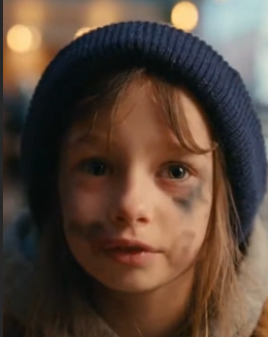
A homeless girl walked into an upscale café with a broken violin… The manager gave her one minute to play before kicking her out.
The café on Maple Street smelled like expensive coffee and exclusivity. Outside, dirty snowmelt streaked the windows.
The door opened. A small girl stepped inside, drowning in an oversized jacket crusted with grime. Her shoes squelched against the polished floor.
Heads turned. A woman whispered, “Seriously?”
The girl froze near the entrance, fingers clutching a battered violin case held together with yellowing tape.
“I’m sorry,” she said barely audible. “I don’t want to cause trouble.”
The manager’s smile vanished. “We’re full.”
Half the tables were empty.
“I know,” she said quickly. “Can I just play for food? One song?”
Someone laughed. “This isn’t a charity.”
Her cheeks flushed red. “I won’t beg. If you don’t like it, I’ll leave.”
The manager sighed. “One minute. Then you’re gone.”
She bowed deeply and opened the case. Inside lay a scratched violin, wood worn smooth by desperate hands.
Around her, people leaned back, already bored. A homeless girl with a broken instrument—nothing worth hearing.
Then the bow touched the strings.
The first note hung in the air, thin and trembling. A woman’s spoon slipped from her fingers and clinked against porcelain.
No one laughed now.
The girl closed her eyes. The melody unfolded—slow, aching, honest. Each note carried the weight of empty streets and nights spent counting stars instead of sleeping.
The café went silent. Phones lowered. The man who’d laughed shifted uncomfortably, his grin fading.
The music grew stronger, rising and falling like desperate breath. Sadness woven through with something unbreakable—hope.
A woman by the window felt tears blur her vision. “My daughter used to hum that song.”
The bow moved faster. The violin cried and laughed simultaneously, telling a story where loss refused to be the ending.
A man clenched his jaw. An elderly couple reached for each other’s hands. Even the manager felt his throat tighten.
The final notes drifted like snow settling after a storm.
Silence. Heavy and sacred.
The girl lowered the violin, lashes wet. “I’m sorry. I know it wasn’t very good.”
A chair scraped. “Wait.” The woman by the window stood, tears streaming. “Please don’t go. That was my child’s favorite song. She died last winter.”
The girl’s hands stilled. “I used to play it for my little brother. Before he got sick.”
The café wasn’t just listening anymore. It was breaking open.
The manager cleared his throat. “You don’t have to go.”
He pulled out a chair. A server appeared with hot soup, then bread, then a sandwich.
“For you,” the server said softly. “No conditions.”
The girl’s hands shook as she lifted the spoon. The first taste made her eyes close.
Around her, wallets appeared. This wasn’t charity—it was apology.
An elderly man spoke quietly. “I used to play violin. Stopped when life got loud.”
“My mother taught me,” the girl said. “She said music helps you remember who you are when everything else is gone.”
The woman who’d laughed earlier knelt beside her, mascara streaking. “Why were you out there alone?”
The girl swallowed. “My mom worked three jobs. Still couldn’t pay for her medicine. When she passed, my brother and I stayed with neighbors. Then he got sick too.”
Silence gripped the room.
“I promised him I’d keep playing,” she continued. “He said when I play, it doesn’t hurt so much.”
“Why didn’t you ask for help?” the woman whispered.
The girl’s answer cut deeper than any accusation. “People don’t listen when you’re dirty.”
The manager turned away, wiping his eyes. He disappeared into the back and returned with an envelope.
“There’s a music school nearby. I know the director. Scholarships, lessons, a warm place.”
Her eyes widened. “You mean really?”
He nodded, voice thick. “Really.”
For the first time, she smiled.
Three months later, spring sunlight spilled through the café windows. A small sign read: “Live Music This Afternoon.”
The room was packed. People held tissues, remembering the day sound turned into truth.
When she stepped forward, the girl looked different. Clean dress, braided hair, polished violin. But her eyes remained the same—deep and carrying more life than most adults ever would.
She raised the violin.
This time, the notes didn’t ache. They bloomed.
The melody danced bright and sure, speaking of second chances and opened doors. People smiled through tears. The woman by the window breathed slowly, remembering her daughter without the sharp edge of pain.
When the final note faded, applause erupted—loud, honest, unstoppable.
Afterward, the manager approached her. “I almost didn’t let you play that day.”
She nodded. “Most people don’t.”
He swallowed hard. “I won’t make that mistake again.”
She smiled—small and forgiving.
Before leaving, she paused at the door and looked back at the room full of people who were finally listening.
“Thank you for hearing me.”
Outside, sunlight warmed the street where she’d once stood invisible.
Inside, the manager pulled the “No Soliciting” sign from the window and threw it in the trash.
The café’s new policy was simple: every Friday, local musicians could play for tips and a hot meal. No auditions. No judgment.
Within weeks, the Friday concerts became legendary. Students, buskers, elderly pianists who thought they’d forgotten—all found a stage.
The girl returned often, sometimes playing, sometimes just listening. She enrolled at the music school on full scholarship and joined their youth orchestra.
One year later, she performed at the city concert hall. Front row: the manager, the woman by the window, the elderly violinist, the server—everyone who’d been there that winter day.
When she took her bow, she looked directly at them and mouthed two words: “You listened.”
The manager’s eyes filled. He’d framed the photo from that first day—the one a customer had captured of her standing alone with her battered case, about to be turned away.
Below it, he’d hung a new photo: her on stage, violin raised, surrounded by applause.
Between them, a small plaque: “Some things aren’t solicitation. Some things are survival. Sometimes all it takes is one person willing to listen.”
The café on Maple Street never forgot. And neither did the girl who taught them that dignity sounds like music when you finally let someone play.
