A billionaire’s paralyzed daughter gave up on walking… Until a janitor’s son taught her the one thing money couldn’t buy..
Emily Hail stared at the hospital ceiling, her legs motionless beneath sterile blankets. Six months since the accident. Six months of silence.
Victor Hail stood by the window, phone buzzing with ignored calls. Board meetings. Mergers. Markets. None of it mattered anymore.
“The neurologist from Zurich is here,” Victor said gently. “He wants to try a new protocol.”
Emily didn’t look at him. “They all say that.”
Her voice wasn’t angry. It was worse. It was empty.
Victor sat beside her, a chair that felt foreign beneath a man used to standing. “This one is different. He’s had success—”
“Dad, please stop.” Emily finally met his eyes. “Hope hurts more than pain now.”
The words fractured something in Victor’s chest. He’d bought this room, these machines, this silence. Money couldn’t outrun fate.
Days blurred together. Then Victor noticed them in the hallway.
A man knelt on the floor, tying a small boy’s sneakers. The boy wobbled on weak legs, laughing as he caught himself.
“Falling doesn’t mean failing,” the man said softly.
Emily sat unnoticed in her wheelchair nearby. For the first time since the accident, something stirred. Not hope. Curiosity.
Daniel Reyes had learned to become invisible in places like this. Polished floors. Hushed voices. Men like him kept their heads down.
But with his son Leo, Daniel was unshakable.
Leo sat on the therapy mat, small hands trembling as he tried to lift his foot. He failed. Slumped forward.
Daniel hugged him. “Falling is data. It tells us what to fix next time.”
Across the room, Emily watched. Most people spoke to her like fragile glass. This man spoke to his son like struggle was normal.
Daniel noticed her gaze and nodded. Not pity. Just acknowledgment.
“Morning,” he said.
Emily hesitated. “Morning.”
The word felt strange. Like using a muscle she hadn’t flexed in months.
They shared the therapy room for days without really talking. Then one afternoon, the staff rushed out early. The room emptied.
Emily remained, staring at her useless legs.
“You don’t have to pretend you’re okay,” Daniel said suddenly, his back still turned.
Emily stiffened. “I’m not pretending.”
He faced her. His eyes were tired but steady. “You don’t look okay.”
She laughed once, bitter. “Congratulations. You figured out I’m broken.”
“No. You’re injured. Broken things don’t heal. People do.”
Silence stretched between them.
“My son may never be what doctors call normal,” Daniel continued quietly. “But I refuse to let that be the end of his story.”
Emily looked at Leo, laughing at his own clumsy stretch. “What if this is the end of mine?”
Daniel walked closer. “I’ll help you. If you let me.”
No promises. No speeches. Just a hand extended into the dark.
For the first time, Emily didn’t pull away.
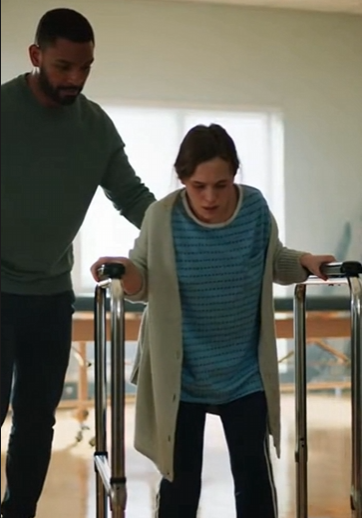
Progress came like exhaustion. Emily gripped the parallel bars, arms shaking, sweat dampening her hairline.
“Again,” Daniel said calmly.
“I already did it,” Emily snapped, breathless.
“You stood for eight seconds last time. Let’s make it nine.”
She hated that he remembered numbers. Hated that part of her wanted to beat them.
She inhaled. Tried again. Eight seconds passed. Then nine.
She collapsed back, half laughing, half crying.
“See? Not nothing.”
Across the room, Victor watched through glass. He’d started leaving meetings unfinished, ignoring sacred calls.
That afternoon, Victor confronted Daniel in the hallway.
“What exactly do you think you’re doing?” Victor asked, voice sharp.
Daniel wiped his hands. “Helping.”
“You’re not licensed. You’re not a specialist. You’re filling her head with hope doctors couldn’t justify.”
Daniel met his gaze. “Doctors measure risk. Parents measure necessity.”
“You don’t understand what’s at stake.”
“I understand watching someone you love disappear while still breathing.”
The words hit harder than Victor expected.
Inside, Emily fell. Metal braces clanged. Breath knocked from her lungs.
Victor rushed forward, panic surging.
But Daniel was already there, kneeling beside her. “Stay with me. Breathe first.”
Emily gasped, tears streaking down her face. “I can’t do this.”
Daniel placed her hand over her chest. “You already are.”
Minutes later, Emily stared at her foot. It trembled. Then moved. Barely a twitch.
“Did you see that?” Emily whispered.
Daniel nodded once, slow and certain.
Victor’s heart stopped.
Doctors called it a neural anomaly. But Emily knew the truth. It wasn’t magic. It was permission to try.
Months passed. Morning stretches. Afternoon therapy. Evenings filled with exhaustion.
Emily learned the geography of effort. The difference between pain that warned and pain that taught.
The first time she stood at the mat’s edge without Daniel beside her, her hands trembled. Not from weakness. From fear.
“I’m here,” Daniel said. “But this one’s yours.”
She stood. Three seconds. Then five.
When she sat back down, she laughed, breathless. “I did it.”
Daniel grinned. “You keep doing that.”
Victor watched his daughter reclaim pieces he thought were gone forever. The girl who argued. Who teased. Who planned.
She hadn’t needed more money. She needed someone who stayed.
One evening, Victor found Daniel in the cafeteria with Leo.
“I want to pay you,” Victor said quietly. “For everything.”
Daniel didn’t look up. “No.”
Victor hesitated. “Then tell me what you want.”
“Make this place better for families like mine. For kids who don’t have names donors recognize.”
Six months later, the rehabilitation center opened. Bright. Accessible. Built for long fights instead of short optimism.
At the entrance, a plaque read: “Progress is not measured by how far you walk, but by how often you choose to stand.”
On opening day, Emily addressed the crowd from a supported stand. Her voice shook but didn’t falter.
“I lost the future I imagined,” she said. “But I found one that’s real. And I found it because someone believed when I couldn’t.”
Her gaze found Daniel and Leo.
Daniel squeezed his son’s hand. “See? Standing comes in many forms.”
Emily smiled.
The new center’s waiting list hit capacity in three weeks. Families traveled from across the country. Children who’d been told “maybe someday” were now told “let’s try today.”
Victor stepped down from two boards to chair the foundation full-time. He learned the names of every family. Sat in on therapy sessions. Listened.
Daniel was offered the director of family services position. He accepted on one condition: Leo stayed in therapy there, treated like everyone else.
Emily never walked without braces. Never ran. Never danced at her wedding the way she’d once imagined.
But she stood at the ribbon cutting for the center’s expansion. Stood at the podium when the foundation won national recognition. Stood beside her father when they broke ground on the pediatric wing.
And on the day Leo took his first unassisted steps across the therapy room, Emily stood with Daniel, both of them crying as the little boy laughed and stumbled forward into their arms.
Victor watched from the doorway. For years, he’d believed control was power. That money solved everything.
He’d been wrong.
Power was watching your daughter choose to stand when falling was easier. Power was a father teaching his son that effort mattered more than outcome.
Power was building something that outlasted your fear.
The center’s tenth anniversary fell on a bright September morning. Emily stood at the entrance, greeting families. Some she knew. Some were new.
A young woman in a wheelchair rolled up, eyes wide with nervous hope.
Emily knelt beside her. “First day?”
The woman nodded.
Emily smiled. “Let me tell you what’s possible here. Not miracles. Something better. Progress. One second at a time.”
Behind her, Daniel guided a group of children through stretches. Leo, now a teenager, assisted, demonstrating movements with the easy confidence of someone who’d earned every inch of ground he’d gained.
Victor placed a hand on Emily’s shoulder as she stood.
“You did this,” he said quietly.
Emily shook her head. “We did this. All of us.”
That night, after the celebration ended, Emily found Daniel on the therapy room floor, reorganizing equipment.
“You never told me why,” she said.
Daniel looked up. “Why what?”
“Why you helped me. Why you stayed.”
Daniel was quiet for a moment. “Because someone stayed for Leo once. When I had nothing to offer but desperation, a therapist stayed late. Didn’t charge me. Just stayed.”
He stood, dusting off his hands. “You don’t save people by being extraordinary. You save them by showing up.”
Emily felt tears prick her eyes. “Thank you.”
“Thank you,” Daniel replied. “For letting me.”
The rehabilitation center continued to grow. Expanded programs. New wings. Research partnerships.
But the heart of it remained unchanged: parallel bars where people learned to stand, mats where children learned that falling was data, and walls lined with photos of families who’d chosen to try.
Emily Hail never got her old life back. The one where walking was thoughtless, where her body obeyed without question.
She got something else instead. Purpose. Community. Proof that the end of one story could be the beginning of another.
And every morning, when she stood with braces and support and shaking hands, she remembered Daniel’s words: “Falling doesn’t mean failing.”
Standing comes in many forms.
She’d found hers.
