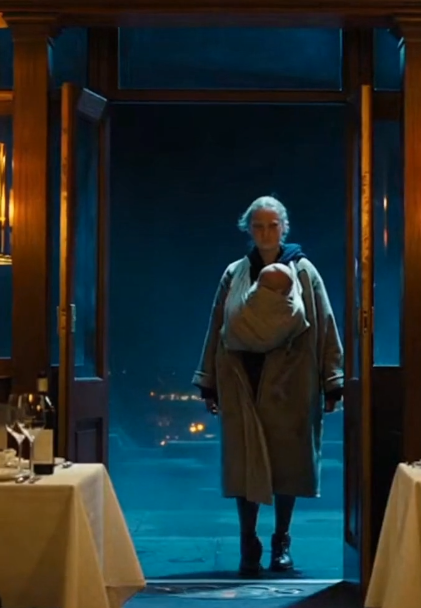
illiam Parker owned the kind of silence money could buy: climate-controlled, perfumed with truffle oil, insulated by double-paned glass from the November wind savaging Manhattan outside. He sat alone at the best table in Le Jardin, a $200 Wagyu in front of him, untouched, his phone face-down next to a glass of Pinot Noir older than his waiter.
The Henderson merger had died at 4 PM. Six months of engineering—gone. They’d used his offer as leverage to squeeze a better deal from a competitor. William had walked out of the boardroom with his face like carved marble, but inside he was burning wire-to-wire, a silent, white-hot rage that had nowhere to go in a room full of people paid to agree with him.
He checked his phone: 8:15 PM. Nothing from Victoria, his Marketing Director, his occasional companion—and today, of all days, a woman who clearly understood that in their world, you don’t comfort the wounded. You step over them.
The front door chimed. A gust of cold air hit the room carrying the smell of wet asphalt and something that didn’t belong here: desperation.
William looked up.
She was maybe ten or eleven, drowning in a gray sweater with holes at both elbows. Her blonde hair was pulled back severely. Her face was too thin, too pale—but her chin was up, and her eyes were scanning the room with the methodical focus of someone who had learned very early that you don’t get second chances to read a room. Strapped to her chest in a sling fashioned from a bedsheet was a sleeping infant.
The crystal chandeliers above her caught every diamond and designer watch in the room. The murmur died. Heads turned. Expressions curdled from curiosity to disgust.
Jean-Luc, the maître d’, closed the distance in six strides, his voice a low, vicious hiss. “Out. Now. We don’t do handouts. Move before I call the police.”
She stepped back. Her hand flew up instinctively to cup the baby’s head. But she didn’t run. Her eyes moved past the hostile faces, skipped Jean-Luc entirely, and locked onto William—the only person in the room sitting alone, the only one watching her with something other than contempt.
She moved. She ducked under Jean-Luc’s arm like smoke through a window and reached William’s table in four seconds flat.
Close up, he could see the chapped skin on her knuckles. The dark circles under eyes that were ancient in a child’s face.
“Excuse me, sir.” Her voice didn’t whine. It was urgent, controlled. “Please. Just one question.”
Jean-Luc’s hand clamped her shoulder. “I am so terribly sorry, Mr. Parker—”
The baby woke. A thin, reedy cry sliced through the dining room.
The girl winced under Jean-Luc’s grip, but she planted her heels and stared straight at William, who had gone absolutely still.
“Sir,” she said, louder now, her voice steady in a way that cost her everything she had. “When you’re finished—could we have what’s left on your plate?”
The question landed like a shot. Absolute silence swallowed the room. She wasn’t asking for money. She wasn’t asking for a hot meal. She was asking for his scraps—cold leftovers from a stranger’s plate—and she was asking with her chin up and her eyes clear, as though this were a perfectly reasonable business proposition between equals.
William looked down at his Wagyu. One bite taken. $200. To him, a disappointment. To her: survival.
A man at the next table slammed his wine glass down. “Get her out of here! I’m trying to—”
Jean-Luc pulled harder. The girl gasped, a small, controlled sound, but her eyes never left William’s face.
Something inside him—something that had been calcifying for twenty years of boardrooms and black-car rides and dinners he couldn’t taste—cracked open.
“Let her go, Jean-Luc.” William’s voice was quiet. It was the voice he used to fire senior vice presidents. The room went still. “I said unhand the child. Unless you’d like me to buy this building tomorrow and convert it to a parking structure.”
Jean-Luc’s hand snapped back like he’d touched a burner.
William looked at the girl. The adrenaline was fading from her face, replaced by the tremor of someone who had used every last ounce of courage and wasn’t sure what came next.
“Sit down,” he said, gesturing to the velvet chair across from him. “You’re not eating leftovers. You’re my guest.”
She hesitated. Looked at the hostile faces. Looked down at the baby, who was fussing. Hunger won.
She slid into the chair. He signaled the waiter. “Children’s menu. And tell the chef I need a pureed vegetable soup for an infant—warm, not hot. Now.”
Her name was Emma Reynolds. The baby was Noah. Her grandmother, Martha, was upstairs at a Bronx apartment dying by inches from heart failure because a scammer at an ATM had swapped her card last week and taken everything—rent, food, the medicine that was keeping her alive.
“I wasn’t going to steal, Mr. Parker,” Emma said, watching the table. “I just thought, if you weren’t going to finish it anyway—”
The food arrived. Emma didn’t eat. She picked up the spoon, blew on the infant soup, and fed Noah first—patient, methodical, completely focused—while her own stomach made a sound audible across the linen tablecloth. She didn’t take a single bite of her pasta until the baby was full and asleep.
“My grandmother was a teacher. She says manners matter, even when you’re poor.”
William pushed his untouched plate away. He had lost his appetite—but in a way that felt like waking up.
He made a decision. It was irrational. It was dangerous. It was exactly what he needed.
“Emma,” he said. “I want to help. Not just tonight. I want to help you, and Noah, and your grandmother.”
The walls came up instantly. “Why? Rich people don’t help for free.”
“Usually, we don’t,” he admitted. “But tonight is different. I’m helping you because you had the guts to ask. And because I have the power to answer.”
He stood, buttoned his jacket, and paid the bill. His driver, Daniel, held the limousine door open with widened eyes as Emma climbed in, tucking Noah against her chest. They crossed into a different city—no chandeliers, broken streetlights, cracked sidewalks—until Emma whispered: “Morris Avenue. Apartment 4B.”
He followed her up four flights of graffiti-stained stairs, smelling of damp concrete and old cooking oil. The apartment was tiny. But it was spotless—scrubbed floors, bare essentials, and a woman propped on pillows in the bedroom who opened her eyes and looked at William with the focused sharpness of someone who had been a professor in another life.
“They call you the ‘Iceman’ of Wall Street,” Martha wheezed, scanning him up and down. “What does a shark want with minnows like us?”
His phone vibrated. He glanced at the screen. A photo: him at the restaurant, holding Noah while Emma ate. Taken from a distance, grainy, but unmistakable. And below it, Victoria’s caption: Playing daddy with street trash, Will? The Board is going to love this. Don’t make me destroy you.
He looked at Emma, holding her grandmother’s hand. He looked at Martha, fragile and waiting. He looked at Noah asleep in a dresser drawer lined with towels.
He shoved the phone back into his pocket. He looked Martha in the eye and said, steadily, “Tonight I’m just a man who wants to make a customized investment.”
He didn’t know it yet. He had just declared war. And the enemy was already inside the gates.
✦ ✦ ✦
Chapter Two
The Wolf in the Penthouse
Dr. Evans, William’s concierge cardiologist, arrived in thirty-eight minutes. He stabilized Martha, administered her medication, and hooked her to a portable monitor. Then he pulled William into the kitchen—so small they were practically touching elbows—and said quietly, “She’s stable. But if she’d gone one more night without medication, she’d have gone into cardiac arrest.” He paused. “She also can’t stay here. The mold, the stairs, the stress—it’s a death sentence for someone in her condition.”
That night, William Parker slept on a lumpy, floral-print sofa in a $5,000 suit. His Egyptian-cotton penthouse bed seemed as distant and irrelevant as a photograph of someone else’s life. He slept better than he had in years.
He woke to the smell of burnt toast. Emma was standing on a stool to reach the stove, looking ashamed. “I tried to make you breakfast. I’m sorry. I burned it.”
“I like it burnt,” he lied, picking up a piece of charred bread and taking a bite. It tasted like charcoal and kindness. “It’s perfect.”
His phone buzzed. Victoria: Board meeting, 9 AM. Don’t be late. We have a lot to discuss.
It was 8:15.
He returned to the Parker Innovations tower in Midtown knowing something was wrong. The lobby hush wasn’t the usual deference—it was the quiet of people watching a car crash in slow motion. He took the private elevator to the top floor. The doors opened onto his executive suite.
Victoria Caldwell was in his chair. Her feet were on his desk. She looked like a queen who had just signed an execution order.
“You look terrible, Will,” she said, scanning his wrinkled suit. She held up her tablet. The restaurant photo filled the screen. “The Board has seen this. They’re concerned. ‘Erratic behavior.’ ‘Loss of focus.’ ‘Potential mental breakdown.’ Those are the phrases going around.”
“I bought dinner for a hungry child,” he said flatly.
“You blew a fifty-million-dollar merger to go play Savior in the slums,” she snapped, dropping the performance. She stood, heels sharp on the floor. “Investors are spooked. Henderson pulled out because they think you’re losing your edge. And now this? You look soft. Weak.” She stepped closer. “The Board is voting on a temporary leave of absence. I’ll handle operations while you ‘sort out your personal issues.’ Walk into that boardroom and deny the girl. Say it was a PR stunt. Distance yourself from them—or we vote to remove you for cause.”
She brushed past him, leaving expensive perfume that suddenly smelled like a threat.
He stood alone in his office. He had built this company from his twenties forward. He had sacrificed his marriage, his friendships, and every version of himself that wasn’t useful. Parker Innovations was his identity. Without it, who was he?
He thought about the burnt toast. Martha’s rattle-breath. Emma’s hand trembling on the spoon as she fed Noah first.
He straightened his tie and walked into the boardroom.
Twelve of the wealthiest people in New York surrounded the oval table. At its head sat Cyrus Vance, eighty years old, with eyes like a lizard sunning itself on a rock.
“Is it true?” Cyrus asked, sliding the printed photo across the polished wood. “Are you emotionally compromised?”
William picked up the photo. He looked at it. He looked at the faces around the table—men and women who would step over a dying stranger to retrieve a dropped quarter.
“I did take them to dinner,” he said clearly. “And I slept on their couch so the grandmother didn’t die of heart failure because she couldn’t afford a thirty-dollar prescription. A prescription, by the way, manufactured by one of our own subsidiaries.”
Gasps circled the table.
“We are a business, not a charity,” Cyrus growled.
“That’s the problem!” He slammed his hand on the table. “We build technology to ‘connect the world.’ That’s our slogan. But we’re so disconnected from reality that feeding a starving baby is considered a mental illness.”
Victoria smiled from the side of the room. It was a terrifying smile. “Go ahead and refuse, Will. We have the votes.”
He reached into his briefcase. “Before you raise your hands,” he said, sliding a folder toward Cyrus, “you should know something. Victoria told you the Henderson deal failed because I left early. But the timestamps in these emails prove Henderson had already signed a tentative agreement with our competitor two days before the meeting. Victoria knew. She sat on the intelligence. She let me walk into a trap so she could use my reaction against me.”
Victoria’s smile dissolved. “That’s a lie.”
“It’s in the metadata,” he said coldly. “You can vote to remove me. But if you do, I release this to the SEC. Insider sabotage is a federal crime. The stock won’t just dip, Cyrus—it will flatline.”
The silence in the room turned from power to fear. Victoria looked at Cyrus. Cyrus looked at the folder and closed it.
“Perhaps we have been… hasty,” Cyrus mumbled.
“I think so too,” William said. “Now, if you’ll excuse me, I have a lunch date. And I’m taking the helicopter.”
He made it to the elevator before his knees started shaking. He leaned against the metal wall, exhaling a ten-year breath. He had won the battle. But as the elevator descended, he understood: Victoria was wounded, not finished. Next time, she wouldn’t target him. She would target them.
His phone rang. Daniel. “Sir—you need to get here. Now.”
“Is it Martha?”
“No sir,” Daniel said, his voice tight as wire. “It’s the baby’s mother. She’s back. And she brought the police.”
✦ ✦ ✦
Chapter Three
The Mother’s Trap
The helicopter ride back to the Bronx was a blur of gray clouds and engine noise. Two NYPD cruisers were at the curb when William sprinted through the building’s front door. Blue and red light painted the brick walls in rhythmic emergency. Neighbors clustered on the sidewalk, whispering.
He burst into the fourth-floor hallway. A police officer put a hand on his chest. He flashed the authority in his voice: “I’m William Parker. I’m a friend of this family.”
From inside the apartment, a woman was wailing—not Martha’s fragile rattle, but a high, performative shriek. “They kidnapped my baby! I just went to get help and they locked the door!”
He pushed past into the living room. A woman—rough, harder-edged than any photo of Sarah he had imagined, leather jacket, too much makeup, eyes cataloguing every object in the apartment for resale value—stood in the center of the room.
Emma was in the corner, clutching Noah like he was the last solid thing in the world.
“He’s not your baby!” Emma screamed, her voice cracking. “You left him! You left him with a note and no milk—you didn’t come back for four months!”
Sarah spun to the officer, her face twisting into a mask of staged tears. “Look at this man in the suit. My aunt sold my baby to a billionaire!”
The officer looked at William. At Emma. At the squalid apartment. At the baby. “What’s your involvement here, sir?”
“I’m providing medical and financial assistance to Mrs. Reynolds,” William said, ice in every syllable. “If you check the records, you’ll find no kidnapping report. You will, however, find a compelling case for child abandonment if my legal team examines the timeline.”
Sarah’s face went cold. “I have rights. I’m the mother. I want him back. Now.” She moved toward Emma.
William stepped between them. “You’ve been absent for four months. You don’t get to walk in and reclaim a life you threw away.”
From the bedroom doorway came a voice that shouldn’t have had the strength to carry. Martha was upright—barely—gripping a walker with both hands, her face white as the sheets she’d just left. “She is not taking him,” Martha rasped. “Over my dead body.”
The stress hit her like a wave. Her hand flew to her chest. Her knees buckled. William lunged forward and caught her before she hit the floor. The officer called for an ambulance. In the chaos, Sarah lunged for Emma, grabbing at Noah’s arm. “Give him here, you brat—”
William roared—a sound that startled everyone in the room into stillness. He had both arms around Martha, but his eyes found Sarah’s with a coldness that made her flinch. “Touch her again and I will make it my personal mission to ensure you spend the next decade learning what prison smells like. Daniel.”
Daniel stepped in from the hallway and walked Sarah out. She screamed the whole way: “I’ll call the papers! I’ll tell everyone William Parker is a kidnapper!”
Two hours later, William sat in a hospital waiting room. Martha was in the ICU—a minor heart attack, stress-triggered. Emma sat beside him, Noah finally asleep in her arms. She was shaking, a fine, constant tremor she couldn’t stop.
“She’s coming back, isn’t she?” Emma whispered to the floor.
“She might try. But she won’t succeed. I’ve already filed for emergency custody.”
“But she’s his mother,” Emma said, a single tear dropping onto Noah’s forehead. “The law cares about blood. It doesn’t care that I’m the one who knows he likes to hold my thumb when he sleeps.”
“I care,” William said, putting an arm around her. For the first time, she didn’t stiffen. She leaned into him. “And I’m the one with the checkbook. In this city, that carries weight.”
His phone lit up: a news alert. BILLIONAIRE WILLIAM PARKER ACCUSED OF CHILD SNATCHING IN THE BRONX. EXCLUSIVE VIDEO. The quote from an “anonymous Parker Innovations source” read: “We are deeply concerned about Mr. Parker’s mental state.”
Victoria. She hadn’t waited. She had teamed up with Sarah—the shark and the bottom-feeder finding common cause.
As Emma drifted to sleep against his shoulder, William understood something with new, brutal clarity: Victoria didn’t just want his job. She wanted to prove that no one—especially someone like him—could genuinely be good. That every act of kindness was a performance, every promise a manipulation.
She was wrong. He pulled out his phone and dialed a number he hadn’t called in three years. “Mother,” he said when the voice answered. “It’s William. I need your help. And your lawyers. The real ones.”
✦ ✦ ✦
Chapter Four
The Price of Truth
William’s mother, Elizabeth Parker, stood in the grand foyer of her Connecticut colonial as Emma and Noah came through the door, and looked at them as though they were dispatches from another planet. She was elegant and sharp, a woman who treated sentiment with the same suspicion she applied to bad investments.
Emma, exhausted and terrified, squared her shoulders and looked Elizabeth directly in the eye. “It’s a very nice house, ma’am. Thank you for letting us stay.”
Elizabeth’s composure softened—just a fraction, as though a single brick had shifted in a long-standing wall. “Manners,” she said to William. “At least you haven’t brought savages into my home.”
The next morning, Victoria held a press conference in front of Parker Innovations. She was flawless in a navy power suit, flanked by Sarah, who dabbed silk-handkerchief tears into a camera. “Our CEO has suffered a severe emotional breakdown,” Victoria said. “He has disappeared with two minors, one of whom is the subject of an active custody dispute. We are cooperating fully with authorities.”
Emma stood in the doorway of the library, watching the screen. She had been there long enough to hear all of it. “They’re lying,” she said quietly.
“They are. But the world believes loud lies over quiet truths,” William said, muting the television.
She was silent for a long time. Then: “If I tell them the truth—will they listen?”
“It’s your word against a mother’s. The law is old-fashioned.”
“But I have the note,” she whispered.
He went very still. “What note?”
“The note Sarah left when she abandoned Noah. Grandma told me to throw it away. I hid it. It’s in the lining of my backpack.” She paused. “And I have a recording. Three months ago, Sarah came to the apartment and told Grandma to give her a hundred dollars or she’d call the cops and say we snatched the baby. I recorded it on my phone.”
William felt hope so sharp it was almost painful. Victoria had played a high-stakes poker game, certain she held every card—and hadn’t noticed the eleven-year-old girl she’d dismissed as “trash” was holding the ace of spades.
Three hours later, his limousine pulled up to the New York Chronicle. Arthur Vance, the editor-in-chief, met them in the elevator. “William Parker. You’ve got half the NYPD looking for you.”
“Then let’s give them something better to look at,” William said.
Emma sat at the head of the conference room table. She laid a crumpled piece of yellow notebook paper in front of Arthur: To Martha—I can’t do this. He cries too much. Take him or give him to the state. Don’t look for me. — Sarah. Then she set her phone on the table and hit play. Sarah’s voice came through clearly: “Look, Auntie, I don’t care about the kid. Just give me two hundred bucks and I’ll vanish for another month. If you don’t, I’ll call the cops and say you snatched him. Who are they gonna believe—a junkie or an old lady with no money?”
Arthur Vance leaned back and let out a low, slow whistle.
Then the lights came on. The camera rolled. Emma Reynolds—the girl who had once asked for scraps—sat under studio lights that didn’t intimidate her. She looked like a witness, not a victim.
“My name is Emma,” she said, her voice clear and level. “Mr. Parker didn’t take us. He saved us. He was the only person in this whole city who saw us when we were invisible. The people on TV saying he’s a bad man? They’re the ones who want Noah to go back to a mother who didn’t want him. I’m not a ‘minor in a dispute.’ I’m a sister. And I won’t let them take my brother.”
As the interview ended, William’s phone rang. Victoria.
He picked up and said nothing.
“You think this changes anything?” she hissed. “I’ll tie you up in court for years. I’ll drain every cent of your personal wealth. The board just voted—you’re out. Permanently.”
“Keep the chair, Victoria,” he said, watching Emma walk toward him through the glass partition. “You’re the CEO of a company. I’m the head of a family. Between the two of us, I know who’s richer.”
“You’ll regret this,” she spat.
“Check the stock price,” he said. “It just dropped forty percent in ten minutes. The shareholders saw Emma. Turns out they don’t like bullies.”
He hung up. Emma reached him and wrapped her arms around his waist. He lifted Noah, who grabbed his tie and pulled with cheerful, absolute authority.
✦ ✦ ✦
Chapter Five
The Storm Before the Calm
Emma’s interview was everywhere before they reached the car. Trending on every platform. Playing on the screens in Times Square. The “Iceman” wasn’t a kidnapper—he was a shield. But William knew better than to relax. In his world, when the light is brightest, the shadows are deepest.
“Daniel,” he said, leaning toward the front seat. “The black sedan.”
“Already on it, sir. It tailed us two blocks, then peeled off when we passed the precinct. Sarah. Or someone she hired on Victoria’s money.”
They reached St. Jude’s Medical Center for Martha’s evening visit. The ICU hum and the nurses’ hushed tones usually made William feel clinical, detached. But as Emma ran toward the glass partition, the hospital felt like a battlefield they were finally winning.
Martha was sitting up. Her skin was still pale, but the fire was back behind her eyes—and when she saw Emma and the baby, her face transformed. “My babies,” she whispered. “I saw you. I saw you on the television.”
Emma leaned gently against the hospital bed, sobbing quietly. William stood at the foot of the bed.
“My daughter Sarah isn’t going to stop,” Martha said, her gaze finding his. “She doesn’t want the child. She hates to lose.”
“I know,” William said. “Which is why tomorrow morning we go to Family Court. I’ve filed for temporary emergency guardianship for both children, with your consent.”
Martha’s hand trembled. “You’d take on an old woman’s burdens permanently?”
“It’s not a burden, Martha. It’s a legacy.”
The parking garage of the hospital was two levels underground. As they walked to the car, Daniel stopped. His hand went to his jacket.
Sarah stepped out of the shadows between two concrete pillars. She wasn’t alone. Two men in hooded sweatshirts stood behind her, hands buried in their pockets. Her eyes were bloodshot, her hair a mess—and in them, no love for the baby. Only the hard arithmetic of someone calculating what they’d lost.
“You think you’re so smart, Parker?” she said, stepping into the dim overhead light. “It’s gonna cost you. Five million. Right now. Write me a check, I’ll tell the judge I’m unfit, I’ll tell the papers I lied. Then you get the kid clean.”
The disgust hit him like a wave. She was bargaining for her own son’s life in a parking garage.
“No,” he said. “Not a cent.”
She looked at the men behind her. One pulled a knife—a small, wicked blade that caught the overhead light. Emma let out a muffled scream, her hands crushing his jacket. Noah started crying—sharp, frightened sound bouncing off concrete.
William didn’t flinch. He looked directly at Sarah. “You think Victoria is your friend? She’s using you to commit three federal felonies. The moment that interview aired, she blocked your number. Check your phone.”
Sarah’s hand went to her pocket. Her face went through rage, then confusion, then realization as she stared at the screen. “She… she didn’t pick up,” she whispered.
“Because you’re a liability now,” William said. “I’m giving you one chance. Drop the knife, walk away. If you show up at court tomorrow, I will ruin you. If you leave now—I don’t tell the police about this conversation.”
The man with the knife looked at Sarah. He looked at William’s face—the Iceman’s face, the one the papers wrote about. He folded the blade and walked away. His partner followed without a word.
Sarah stood alone in the pool of fluorescent light, looking at Noah one last time. There was no love in her expression. Only the cold regret of someone who had missed a payday. She turned and ran into the dark.
That night, in a secure hotel suite, William sat on the edge of the bed and watched Emma tuck Noah into a travel crib. The adrenaline was gone. He was just tired in a way that felt clean.
“Why didn’t you give her the money?” Emma asked, sitting beside him. “You have so much of it. It would have made her go away.”
“Because if I bought him, then he really would be something I purchased,” William said. “He’s not a commodity. He’s a human being. You can’t build a family on a bribe. We had to win the right way.”
His phone lit up. His mother: The board has called an emergency meeting for 8 AM. They’ve seen the interview. They’ve seen the stock crash. Victoria is being escorted from the building as we speak. You’re back in, William. If you want to be.
He looked at the message for a long moment. Two days ago, this would have been the greatest victory of his life.
“Will?” Emma looked up. “Are you going back to your big office tomorrow?”
“For a little while. To finish something.” He looked at her. “Then I think we’re going to find a house with a yard. A place where Noah can learn to walk and Martha can sit in the sun.”
Her eyes lit up like he’d handed her the world.
✦ ✦ ✦
Chapter Six
The Legacy
The Family Court of New York was packed the next morning. Reporters three deep. Victoria Caldwell in the back row, her face a mask of bitter resentment—no longer the queen of Parker Innovations, but a woman staring down an internal SEC investigation and a defamation lawsuit she had handed them herself by going to the press.
Sarah never showed up.
Judge Watkins looked over every document without expression. She read the note. She listened to the recording. She looked at Emma. Then she looked at William.
“It is highly unusual,” the judge said, “for a single man with your demanding career to seek guardianship of two children unrelated to him by blood.”
“I understand that, Your Honor,” William stood. “But blood isn’t what makes a family. Responsibility is. Love is. I’ve spent my life building things that can be bought and sold. I want to spend the rest of it protecting something that is priceless.”
“Emma,” the judge said. “Come here.”
Emma walked up to the bench. She looked small against the dark wood of the courtroom. The judge leaned forward. “Do you want to stay with Mr. Parker?”
“He’s the only one who ever stayed with us,” Emma said. Her voice didn’t waver. “Yes. More than anything.”
The gavel came down.
“Emergency temporary guardianship is granted to William Parker. A permanent hearing will be scheduled following the grandmother’s recovery and a home study. This court is adjourned.”
The room erupted. Flashes fired. William didn’t look at the cameras. He looked at Victoria. She leaned in close as he passed her.
“You think you’ve won, Will? You’ve traded a billion-dollar empire for a diaper bag and a sick old woman. You’ll grow bored of them in a month. And when you do, I’ll be waiting.”
He didn’t argue. He looked at her with something he had never expected to feel for Victoria Caldwell: pity. Clean, uncomplicated pity, the way you might feel for someone who had been handed every advantage and had spent all of it on herself.
“You’re wrong,” he said. “I didn’t trade the empire. I just finally figured out what the empire was for.”
He walked out of the courtroom holding Emma’s hand.
A year later—
The brownstone in Brooklyn Heights is not perfect. There are toys near the sofa. A half-finished model of the solar system on the dining table. Photos on the mantle of a family at the beach, laughing, windswept, real. Martha sits in the sunroom every morning, ten years younger in every way that matters. Emma is nearly twelve now, three inches taller, leading her school’s debate team, unafraid. Noah—fifteen months old, walking with drunk-sailor confidence—grabs William’s tie every morning and tugs it hard, and William laughs every time.
Victoria Caldwell is still at Parker Innovations, relocated to a community engagement role in a remote office, swimming in a much smaller pond.
Sarah never appeared at the permanent custody hearing. The judge made the order final.
On the one-year anniversary, they went back to Le Jardin—same white linen, same chandeliers, same table. Emma looked at the spot where she had stood eleven months before, a baby strapped to her chest, asking for scraps. “I was so scared,” she said.
“I was too,” William admitted.
“You? The Iceman?”
“I was scared because for the first time in forty years I realized I had everything and nothing that mattered. You were the brave one, Emma. You walked into a room full of giants and asked for exactly what you needed.”
The waiter brought a family-style platter—the finest the kitchen could produce. No one asked for leftovers.
As they left, a local photographer caught them on the sidewalk: a man, an old woman, a girl, and a baby, huddled together against the evening chill. The caption the next morning didn’t mention stock prices or board rooms. It just read: The Parker Family: Home at Last.
William Parker used to think his legacy would be a skyscraper. A software empire. A line in a Forbes list.
His legacy is a twelve-year-old girl who isn’t afraid anymore. A grandmother who sleeps through the night. A little boy who will never know what it means to be abandoned.
It all began with a question from a girl who had nothing, to a man who had everything—and neither of them knew they were both about to become the richest people in the world.
