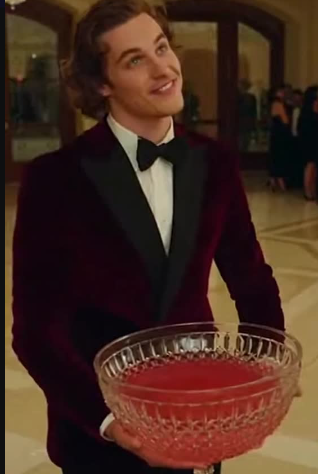
A veteran dropped a tray of champagne at a Christmas party… and a rich kid poured an entire punch bowl over his head. The next morning, the Vance family wasn’t returning calls — and their Ferrari had a new skylight.
The sound of the balloon popping hit Lucas like a round going off at close range.
His body moved before his brain caught up. The silver tray left his hand. Twelve crystal flutes of vintage Moët hit a twenty-thousand-dollar Persian rug and shattered into a wet, glittering disaster.
The music stopped. Four hundred thousand dollars of Christmas party froze.
Julian Vance stepped through the crowd. Twenty-five, velvet jacket, the face of someone who had never missed a meal or made his own bed. He looked at the punch stain spreading across the white wool, then at Lucas — still crouched, still vibrating from the phantom combat response — and he smiled.
“You look overheated, soldier,” Julian said, picking up the crystal punch bowl. It took both hands. “Maybe you need to cool down.”
He tipped the whole bowl.
Gallons of ice-cold, sugary liquid hit Lucas like a wall. The shock punched the air from his lungs. Ice cubes clattered off his skull. His cheap white shirt turned translucent pink.
The guests laughed. Not a roar — something worse. A polite, tittering amusement. The laugh of people who see a broken toy.
“Get him out,” Mr. Vance boomed from across the room. “And don’t pay the agency.”
Julian leaned down, close enough that Lucas could smell his scotch. “You heard him. Go find a shelter.”
Lucas stood up. He was dripping, shivering, humiliated down to the bone. He looked Julian dead in the eye for exactly three seconds.
Then he walked to the door and stepped out into ten-degree Connecticut darkness.
The cold hit him like a fist.
He stood at the base of the stone gate pillars, the mansion blazing warm and gold behind him. His cut on his thumb had already sealed in the freeze. His hands were turning blue.
He pulled out his cracked phone. The contact list was short. Most of those names were dead.
He pressed Commander.
It rang once.
“Report,” the voice answered. Gravel in a cement mixer. Alert before the first syllable was done.
“Dad,” Lucas whispered. His voice broke on the single word.
Silence. The Commander never paused unless something was wrong.
“Where are you?”
“Oakbridge Estates. House 12.” Lucas choked it down. “They poured punch on me, Dad. They laughed at the shakes. They threw me in the snow.”
What followed wasn’t a gasp or a curse. It was something far more dangerous — a loaded silence. The silence of a targeting system acquiring a lock.
“Are you injured?”
“Just cold. And hurt inside.”
“Stay where you are,” the Commander said, his voice dropping to a frequency that felt like tectonic plates shifting. “Put the phone in your pocket. Do not move. Do not engage. We were already in the tri-state for the Toy Run. We are close.”
“Dad, don’t do anything crazy—”
“Lucas.” He could hear the smile in the voice. Not a warm smile. A wolfish one. “I’m not coming to get you. We are coming to bring you home. The Regiment is with me.”
The line went dead.
Lucas slid down the pillar and sat in the snow. He pulled his knees to his chest.
Ten minutes.
He felt it before he heard it — a vibration in the ground. The snow around his boots began to tremble.
Then came the sound.
Not the high whine of sport bikes. This was a baritone frequency that hit the chest cavity before it reached the ears. Low, guttural, biblical. It sounded like judgment approaching on four hundred cylinders.
Headlights appeared down the dark road. Two. Then ten. Then a hundred. The falling snow caught the beams and turned the flakes into diamonds.
The lead bike was a massive, matte-black bagger. The rider was built like a bunker in leather. He pulled up to the gate and killed his engine. One by one, down a column that stretched as far as Lucas could see, four hundred Harley-Davidsons went silent.
The resulting quiet was heavier than the roar had been.
The front door of the mansion opened. Julian stepped onto the porch, glass in hand.
“What is this racket?” he called into the dark. “You’re blocking the driveway! I’m calling the police!”
The Commander didn’t look at him. He walked to Lucas, reached him, and without a word, unbuttoned his heavy fur-lined coat — a coat that had seen three countries and a dozen kinds of hell — and wrapped it around Lucas’s shoulders.
It was warm. It smelled like leather, oil, and tobacco. It smelled like safety.
“You’re freezing,” the Commander said quietly.
“I’m sorry, Dad,” Lucas whispered.
The Commander put a massive hand on the back of his neck and looked up at the mansion — at Julian standing small and confused on his illuminated porch.
“Don’t apologize, Prince,” he said. “You didn’t know your worth. But I think it’s time we taught them the exchange rate.”
He raised one fist toward the darkness behind him.
Four hundred engines ignited at once.
The windows of House 12 rattled. Julian dropped his glass.
The Commander turned back to Lucas. His expression was calm. Certain. Final.
“Let’s go inside,” he said. “I believe they have my son’s paycheck.”
The foyer of House 12 was designed to make people feel small.
It failed completely with forty Iron Legion brothers filling it behind the Commander.
The party had frozen into a tableau of terrified wealth. Mrs. Vance clutched her throat by the ruined rug. Guests in evening wear pressed themselves against walls hung with commissioned portraits of the Vance family. The pink stain on the Persian wool was the only honest thing in the room.
They brought the outside in with them — the smell of exhaust and road salt and cold air swamping the expensive pine-and-cologne atmosphere. Steel-toed boots thundered against the marble like a slow drumbeat.
Julian stood at the bottom of the staircase, phone out, thumb hovering.
“I’ve called the police!” he announced, his voice pitched too high. “They’ll be here in five minutes! You are trespassing!”
The Commander stopped three feet from Julian. The size difference was not subtle.
“Put the phone down, son,” the Commander said. He didn’t raise his voice.
Julian lowered the phone.
From the back of the group, a man stepped forward and pulled off his helmet. His face was a topography of burn scars — the work of an IED in Fallujah. “Sheriff Miller is blocking the road at the bottom of the hill,” Spider said pleasantly. “Something about a hazardous obstruction. You’d be amazed how much space four hundred bikes take up sideways.”
A current of panic moved through the guests. They were isolated. The bubble had popped.
Mr. Vance, the patriarch, shouldered through. A tuxedo that fit perfectly. The confident flush of a man used to buying his way through friction.
“Who is in charge here?”
“I am,” the Commander said.
“And who are you?” Vance sneered. “Some kind of gang leader?”
“Retired Master Sergeant, United States Marine Corps,” the Commander said. “The men behind me are engineers, mechanics, teachers, firefighters, and paramedics. Every one of them served this country while you were in this house counting dividends.”
He gestured toward Lucas, still dripping, the punch beginning to crust and itch in the heat.
“This is Lucas. You hired him to carry drinks. You paid him minimum wage to be invisible. And when he flinched at a loud noise, your son poured a party bowl on his head.”
“He was incompetent!” Julian shouted. “He dropped a tray on a twenty-thousand-dollar rug! He was shaking like a junkie!”
The Commander turned his head slowly toward Lucas. “Show them.”
“Dad, no—”
“Show them, Lucas.”
Lucas took a breath that hurt. He unbuttoned the top of the waiter’s shirt and pulled the wet fabric down from his left shoulder.
The scar tissue ran from his neck across his scapula — thick, ropy, pink and purple, a carved geography of violent impact.
“That,” the Commander said, “is where he took a sniper round to shield his squad leader in the Korangal Valley. The shaking is nerve damage. That is the price of your standards.”
He turned back to Julian. “You poured punch on a Purple Heart recipient because he flinched at a balloon. And then you laughed.”
Mrs. Vance made a small sound. Something in her face shifted — toward shame, but then defensive anger reasserted itself.
“We didn’t know,” Mr. Vance said stiffly.
“He shouldn’t have to wear his trauma on a billboard for you to treat him like a human being!” the Commander said — and when the volume hit, the crystal chandelier above them rang like a struck bell and every person in the room jumped three inches.
The silence that followed was absolute.
“You owe my son a paycheck,” the Commander said, quietly now, which was somehow worse. “For the night. And for his uniform.”
Vance reached into his tuxedo and produced a leather money clip. He peeled five hundreds, let them fall to the marble floor between them.
“Take your trash and get out of my house,” he said.
Nobody moved.
Lucas stared at the bills. Five hundred dollars. He needed that money. He knew he needed that money.
Nobody moved.
The Commander reached into his pocket and produced a battered silver Zippo. He clicked it open. The flame caught, orange and steady.
“We don’t want your charity,” the Commander said.
Julian’s voice cracked. “Then what do you want?”
The Commander snapped the lighter shut.
“Accountability.”
He turned to the Legion. “Gentlemen. Are we trash?”
“NO, SIR.” Forty voices in unison. The chandelier rang again.
“Are we broken?”
“NO, SIR.”
“Are we leaving?”
“NOT YET, SIR.”
The Commander walked to the buffet table and picked up a crystal plate of imported hors d’oeuvres. He looked at it with polite interest.
“Spider,” he called. “You hungry?”
“Starving, boss.”
“Help yourself. Mind the rug. It’s an antique.”
Forty bikers occupied the house of the Vances.
They didn’t throw punches. They sat on silk sofas in dusty jeans. They poured themselves drinks from the top-shelf bar. They ate caviar and truffle with their hands, chatting among themselves as though they’d been invited.
The guests huddled in corners, watching their sanctuary be overrun by the people they paid to keep out.
Julian found Lucas near the door. The arrogance was gone. He looked like a frightened child in a tuxedo.
“Please,” he whispered. “Make them stop. My father’s heart—”
“I can’t make them do anything,” Lucas said. “They’re not my employees, Julian. They’re my brothers.”
“I’m sorry.” The word was desperate. “I’m sorry about the punch. I’m sorry about what I said. Just make them go.”
“You’re not sorry you did it,” Lucas said, looking at him steadily. “You’re sorry you got caught by someone who can fight back.”
Before Julian could answer, the front door opened on a gust of cold air.
A woman stepped in — wool coat, snow boots, gray hair in a messy bun. She stood in the foyer, bewildered, until her eyes found Mr. Vance.
“Maria?” Vance whispered. He looked like he’d seen something he’d buried.
“I saw the lights,” Maria said. Her English carried the weight of Spanish underneath it. “I saw the motorcycles. I thought something happened.”
“Who is this?” the Commander asked.
Vance turned pale. “She’s the housekeeper. Nobody.”
“I am not nobody,” Maria said. Her voice trembled, but it didn’t break. “I have worked in this house for twenty years. I raised that boy.” She pointed at Julian. “I held him when he was sick because his mother was at a gala.”
She crossed to Lucas and touched his cheek. “Did they do this to you?”
He nodded.
She turned to Julian, her eyes full of tears. “I taught you to say please and thank you.”
Julian looked at the floor.
“I raised you better than this.”
She turned to Mr. Vance. “You fired me yesterday. Christmas Eve. Because I asked for a raise to cover my husband’s insulin.”
A murmur moved through the guests. Not from the bikers — from the polite society that had witnessed cheerful cruelty to a stranger but found this particular truth unbearable.
“She’s lying,” Vance said quickly. “She was stealing—”
“I never stole a penny!” Maria’s voice echoed off the marble. “I asked for help! You gave me two hundred dollars and told me to be grateful!”
The Commander looked at Vance with something colder than anger.
“You fired your housekeeper of twenty years on Christmas Eve,” he said, “because she needed medicine for her husband.”
“It’s a business decision,” Vance snapped. “It’s my money.”
The Commander nodded slowly. “You’re right. It is.” He turned to the Legion. “Boys. I think we’ve overstayed our welcome. We shouldn’t be eating this man’s food.”
The bikers set down their glasses.
“But,” the Commander said, “I think we need to help Maria move out.”
He looked at her gently. “Ma’am. Do you have belongings here?”
“In the servant’s quarters. My clothes. My photos. My grandmother’s bible.”
“Show us,” the Commander said. He looked at Vance. “We’re going to help her pack. While we’re doing that, I suggest you think very carefully about her severance. Because when I come back downstairs, I’m going to ask her if she feels fairly compensated.”
He put his arm around Lucas’s shoulders.
“Come on, Prince. Let’s see how the other half lives.”
The servant’s quarters were at the end of a narrow hallway where the marble stopped and cheap linoleum began.
The room was ten by ten. A twin mattress, a rusted radiator, peeling walls. Maria had been sleeping here during the week for twenty years to save herself the commute.
Lucas saw the photo on the nightstand. A young Marine in dress blues. The kind of official portrait that ends up at a funeral.
“That’s my son,” Maria said. “He died in Fallujah. 2004.”
The Commander stopped moving. He stared at the photo for a long moment.
“Spider,” he said quietly.
“Yeah, boss?”
“Get the boys from the truck. Get the tools.”
On the other side of the wall separating this closet from the climate-controlled garage, a 1962 Ferrari Testa Rossa slept in its waxed perfection.
The Commander looked at the wall. “We’re doing some remodeling,” he said. “I think this room is a little too small for a Gold Star Mother.”
The first swing of the sledgehammer hit the plaster like a gunshot. Dust bloomed white in the narrow space. The second swing opened a hole through which the gleam of Rosso Corsa red was visible.
Mr. Vance came running down the hallway with the color completely gone from his face.
“That is a 1962 Ferrari!” he screamed, grabbing the Commander’s arm. “If dust gets into the intake—”
The Commander looked at the hand on his arm. He didn’t move or speak. He simply looked at it.
Vance let go.
“It’s a partition wall,” the Commander said calmly. “And we’re removing it. Maria needs a view. You kept the mother of a fallen Marine in a closet while your cars slept in a palace.”
Spider swung again. The wall came down. A massive section of drywall collapsed into the garage.
The before-and-after was devastating: a twin mattress and rusted radiator on one side, a $4 million showroom on the other. A fine cloud of plaster dust drifted slowly and settled across the perfect hood of the Testa Rossa.
Vance fell to his knees. “You animals,” he whispered. “You jealous, broken animals.”
Then: “POLICE! Drop the tools! Now!”
Sheriff Miller stepped into the garage from the exterior bay doors, two deputies behind him. He was sixty, leather-faced, and exhausted-looking. He took in the scene — the sledgehammer, the hole, the Commander, the dust on the Ferrari.
“Commander,” he said.
“Evening, Jim,” the Commander said.
“You want to tell me why I have four hundred bikes blocking my county road and a hole in Mr. Vance’s wall?”
“Renovations.”
Vance scrambled to his feet. “Arrest them! They broke in, they’re destroying property, they’re holding us hostage—”
Miller looked around. He looked at Lucas in his soaked, punch-stained uniform. He looked at Maria in the doorway of her tiny room. He stepped through the hole and stood in the ten-by-ten space. He studied the water stains. The rusted radiator. Then he saw the photo.
He stopped.
“Maria,” he said softly. “I thought you commuted from the city.”
“I live here during the week,” she said.
Miller took off his hat. His professional demeanor quietly cracked open.
“That’s Luis,” he said, looking at the photo. “He played varsity football with my boy. Good kid.”
“The best,” Maria said.
He turned to Vance. The exhaustion in his eyes had been replaced by something sharp.
“Did you fire this woman?”
“Personnel matter,” Vance said tightly. “Asking for more money in a recession—”
“You have a three-million-dollar car five feet away,” Miller said, pointing through the hole, “and you won’t pay a living wage. You fired a Gold Star mother on Christmas Eve?”
“Your job is to protect property,” Vance snapped. “Do your job.”
Miller put his hat back on.
“I’m going to write a report documenting the property damage to your wall,” he said. “These men will be held responsible for that vandalism.” He paused. “However, I’m also going to call the fire marshal. This room has no egress window, no code-compliant ventilation, and wiring that would fail inspection. Keeping an employee in these conditions is a felony.”
Vance froze.
“And if I call the Department of Labor, I have a feeling they’ll find irregularities in how she was paid. Overtime. Benefits.” Miller stepped closer. “So. I can arrest these men for breaking a wall. Then I can arrest you for labor violations, reckless endangerment, and housing code felonies. I’ll make sure the three news vans outside get your mugshot before they get anything else.”
He let that land.
“Or,” the Sheriff said, “we settle this like men.”
The Commander stepped forward and produced a checkbook — one he had quietly lifted from Vance’s study on the way in. He slapped it into Vance’s chest.
“Write the check.”
“For what?”
“Severance. Twenty years of service. Loss of son. Emotional distress. And the punch you authorized your boy to pour on my son.”
“How much?” Vance asked. The fight had left him completely.
“Maria,” the Commander said. “What’s enough to go home? To your sister in Texas?”
Maria looked at the room one last time. She looked through the hole at the car.
“Fifty thousand,” she whispered. “For the debts. To start over.”
“Make it a hundred,” the Commander said. “The extra fifty goes to Veterans of Foreign Wars. Tax deductible.”
Vance uncapped his gold pen with hands that couldn’t stop shaking. He wrote the check. He tore it out and held it toward Maria.
She took it. She looked at it. She wept — not in sorrow, but in the overwhelming relief of a woman who had been holding her breath for twenty years.
The Commander helped Maria gather her few things. Her photos. Her grandmother’s bible. A small winter coat. Lucas carried the battered suitcase.
As they walked back through the main hall, it was empty. The guests had fled upstairs or out the back. The party was over. What remained was marble and silence and the pink stain of spilled champagne working itself permanently into an antique rug.
At the door, the Commander turned back to Vance, who stood alone in his great hall looking reduced to his actual size.
“The wall,” he said, nodding toward the back of the house. “Leave it. Every time you look at your cars, you’ll remember the night the world broke in.”
Then they walked out into the snow.
The ride from Oakbridge Estates to the town square took fifteen minutes and felt like traveling between planets.
The convoy rolled off the manicured lane of the one percent and into the working part of town — woodsmoke and diesel, dark storefronts with crooked Closed signs.
The town square held a fifty-foot spruce strung with municipal lights that had seen better days. It looked tired.
“Circle up!” Spider called.
It was military precision. Four hundred bikes fanned out, forming a tightening ring around the tree.
“Kill ’em!”
Four hundred engines died.
“Lights!”
The headlights stayed on. Four hundred beams of high-intensity LED cut through the darkness and hit the spruce from every angle. The tree exploded into brilliance — like something on fire with white light, snow-flakes dancing in the beams like diamonds.
It was the most beautiful thing Lucas had seen in four years.
The Commander stood next to him. His face looked carved and old and tired in the orange streetlight.
“You know why we come here?” he asked.
“To annoy the mayor?” Lucas tried.
“No.” He pulled a velvet bag from his saddlebag. “We come because this is the only time the world is quiet enough to hear us.”
He walked into the circle of light, opened the bag, and pulled out a silver dog tag. He hung it on a low branch. It spun slowly, catching the light of four hundred headlamps.
“Sergeant Miller,” he said softly. “Killed in action. 2009.”
Then the Legion moved.
One by one, men stepped out of the dark and into the light. They placed things on the branches without speaking — dog tags, Purple Hearts, unit patches, photos in laminate, spent shell casings tied with red ribbon. Big, bearded, terrifying men who touched the branches like they were handling china.
“We don’t have mantles,” the Commander said, standing back at Lucas’s side. “Most of these men don’t have families waiting. The war took the wife, or the PTSD took the marriage, or the bottle took the house.” He watched a man with a prosthetic leg reaching up to hang a photo. “This is our living room. This is our family.”
He turned to Lucas. He looked at the pink stain on the waiter’s shirt. He looked at the trembling hands.
“You tried to run away from this,” he said. “You thought if you put on a bow tie and served drinks to people like the Vances, you could scrub the war off your skin.”
“I just wanted to be normal,” Lucas said. His voice cracked. “I just wanted to stop shaking.”
“Look at them.” The Commander gestured at the circle. “Do you see anyone shaking?”
Men with scars that mapped their faces. Men who carried the weight of dead friends in every quiet moment.
“They’re not shaking because they aren’t holding it in,” the Commander said. “They aren’t pretending they’re not broken. They’re holding each other up.”
He reached into his jacket and pulled out a piece of leather.
A vest. Worn, soft, battle-scarred. A patch on the front that said PRINCE.
“You are not a waiter,” the Commander said. “You are not a victim. You are a warrior who got hurt. There is a difference.”
He held the vest open.
Lucas looked at it. He looked at the tree, heavy with the metal of the dead.
He peeled off the wet, sticky waiter’s jacket. He dropped it on the slush.
He slipped his arms into the vest. The leather settled onto his shoulders — heavy, grounding, cutting the wind.
He zipped it up.
“Better?” the Commander asked.
“Warmer,” Lucas said.
“Good.” The Commander turned to the road. “Because we have one more stop.”
The Commander had texted Julian from Lucas’s phone while they were in the garage.
Simple message: Meet us at the town square. Alone. Or the video of your father admitting to tax fraud goes to the morning news. You have 20 minutes.
Spider had put a body cam on for the whole mansion visit. The recording existed, and it was damning.
Julian arrived in twelve minutes, which said everything about how scared he was.
The Range Rover parked crookedly, two wheels up on the curb. Julian stepped out into the snow in his tuxedo shirt, no jacket, shivering violently — though not from nerve damage, and not from cold.
He saw the wall of four hundred silent men. He saw the tree blazing with white light and the weight of the dead. He saw Lucas standing in the center of it all in a leather vest with a patch he didn’t recognize.
He froze.
“You sent the text,” Julian said. “Where is the recording? Give me the phone. Please.” His voice had lost every structure. “If my father sees that footage before his lawyers do — if the IRS sees it — he’ll cut me off. He’ll—”
“You’re scared of your father,” Lucas said.
Julian’s voice cracked. “You don’t understand. I didn’t know about the labor violations! I didn’t know about the tax issues! I just live there! I just—”
“You just live there,” Lucas said. “Just like you just poured the punch. Just like you just laughed.”
He stepped closer. He was within arm’s reach.
“Look at me, Julian.”
Julian looked. He saw the scar above the vest collar. He saw the hands, which were not trembling.
“You called me broken,” Lucas said. “You called me trash. In front of your friends. In your mother’s house. On Christmas Eve.”
“I was drunk,” Julian whispered. “I was showing off. It didn’t mean anything.”
“That’s exactly the problem.” Lucas said it without heat. “Cruelty is just a party trick to you. You do it and it evaporates. But I’m still wearing the stain.”
He reached into his pocket and produced the phone. Julian reached for it immediately.
Lucas pulled it back.
“I’m not giving it to you,” Lucas said. “And I’m not releasing it. Not tonight.”
Julian stared. “Then what — what do you want?”
“Look at the tree.”
“What?”
“Look at it.” The command came out harder than Lucas intended, and it rang off the brick storefronts.
Julian flinched and looked.
“Those aren’t decorations,” Lucas said. “Those are names. Miller. Kowalski. Rodriguez. Men who went because someone had to. Men who died so you could stand in a velvet jacket and act like a king.”
He grabbed Julian’s shoulder and turned him toward the full ring of light — the bikers, the tree, the dog tags spinning in the wind.
“You are not a king. You are a tourist. You’re a tourist in a world built on blood you never spilled and borrowed time paid for by people you laugh at.”
Julian began to cry. It wasn’t a composed cry. It was a full collapse — fear and guilt and a lifetime of his father’s voice cracking open at once.
“I’m sorry,” he sobbed. “I’m scared. I’ve been scared my whole life.”
The anger drained out of Lucas as fast as it had come.
He saw it then — not a monster, but a hollow, frightened boy in a tuxedo, living in a glass castle built by someone else and terrified of what happens when the glass breaks.
Lucas looked at the phone in his hand. He looked at the tree.
“I’m keeping the recording,” he said. “Every time you think about throwing another punch bowl at someone who can’t fight back — remember that I have it. Remember that your world is made of glass and I know where the hammer is.”
Julian looked up, expecting more.
“Now get in your car,” Lucas said, “and go home.”
“You’re letting me go?”
“We’re not keeping you.” Lucas looked at him the way he might look at someone very young. “This is holy ground. You don’t belong here.”
Julian stumbled backward, found his door handle, fell into the driver’s seat. The engine caught. The tires spun on the ice.
He didn’t look back.
The taillights dwindled and disappeared into the dark.
The silence that returned to the square was different from every other silence that night.
Not charged. Not loaded. Not waiting for something to break.
Clean. Satisfied. Complete.
Maria stepped forward, wrapped in a borrowed leather vest, holding a cup of hot cocoa produced from someone’s thermos. She looked at Lucas.
“You look good in leather, mijo,” she said.
The Commander walked up and put a heavy hand on Lucas’s shoulder.
“You didn’t shake,” he said.
Lucas looked at his hands. Rock steady. He hadn’t noticed.
“The tremors come from holding back the storm,” the Commander said. “When you let the storm out, the hands get still.”
He looked at the dark street where Julian had fled.
“You showed him mercy. That takes more strength than punching him in the mouth.”
“I didn’t do it for him,” Lucas said. “I did it for me. I didn’t want his blood on my hands. I just wanted my dignity back.”
“You never lost it, Prince,” the Commander said. “You just forgot where you put it.”
He turned to the column.
“Mount up!” he shouted. “We have a sister to get home!”
Four hundred engines came to life.
Lucas climbed on the back of Spider’s bike. But before they rolled, he looked back at the tree one last time.
The dog tag the Commander had hung — Sergeant Miller — caught a beam of light. It spun slowly. Steadily.
He touched the Prince patch on his chest.
He wasn’t the waiter at House 12. He wasn’t the broken veteran trying to disappear.
He was the earthquake. And the earthquake was finally still.
Three days later, the Vances retained a crisis communications firm. The story of the Iron Legion’s Christmas Eve visit had reached the news vans that night and migrated from local to regional to national by morning. Maria’s twenty years of service, the conditions of her quarters, the firing-on-Christmas-Eve, the punch bowl — all of it became a story that people couldn’t look away from.
Vance’s attorney released a statement calling the check to Maria “a generous severance package reflecting our deep respect for her service.” The check cleared before the statement was released.
Julian Vance resigned his position at the family company in January. He went to work, quietly and without announcement, at a veterans’ support nonprofit in Hartford. Whether that was guilt, genuine change, or both, Lucas never knew. He didn’t need to.
Maria rode to Texas in the cab of a truck driven by a biker named Portillo, who talked the whole way and made her laugh for the first time in years. She called the Commander on New Year’s Day from her sister’s kitchen, and the Commander — who did not cry, ever, in front of anyone — stepped outside to take the call.
Lucas didn’t go back to the catering agency.
He moved into the apartment above the clubhouse, where the radiator clanked and the smell of motor oil never quite left the walls.
He learned, in the weeks that followed, that his hands were steadiest when they were busy — when they were torquing a bolt or gripping a throttle or resting on someone else’s shoulder. The tremors didn’t disappear. They just lost their power over him. They became a background noise, like traffic, like wind — something you noticed and then let go.
He was home.
And when the world outside decided to wake the earthquake again, four hundred brothers would be already rolling.
