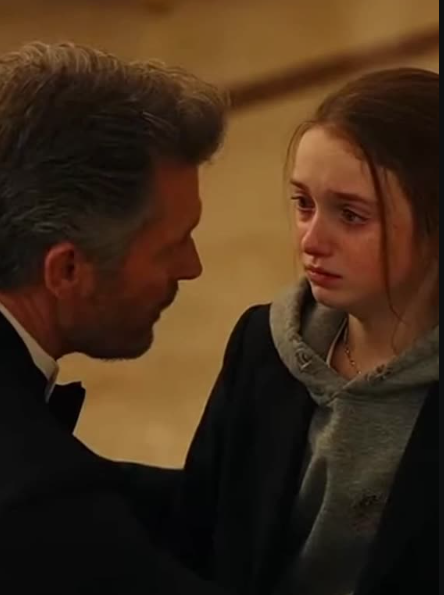
A homeless girl crashed a $10,000-a-plate charity gala and sat down at the Steinway… But the lullaby she played made a legend leap to his feet—and destroyed the room’s most celebrated woman in sixty seconds.
The Beverly Wilshire ballroom had never looked more expensive, or more hollow.
Crystal chandeliers. Designer gowns. A string quartet bleeding Debussy into air thick with money and performance. The annual Pathways for Young Futures gala was exactly the kind of night that told itself it mattered.
Vivian Ashford made sure of that.
She moved through the room like she owned the oxygen inside it—silk at her shoulders, heirloom diamonds at her throat, that magazine smile deployed at exactly the right moments. Philanthropist. Icon. Brand.
She had spent fifteen years building this image, and tonight it sat around her like armor.
Then the entrance doors banged open.
A girl—twelve, maybe thirteen—stood in the frame between two security guards who hadn’t caught her fast enough. Oversized hoodie with a torn elbow. Stained jeans. Sneakers wrapped in gray tape. Her face was streaked with grime, her hair pressed flat against her forehead, and she was so thin she looked like something the city had tried to swallow.
But her eyes.
Her eyes were burning.
The room registered her the way a ballroom registers a stray cat—briefly, with mild revulsion. Phones lifted in lazy arcs. Someone laughed, low and socialized, the kind of laugh that isn’t really a laugh.
Vivian was across the floor in twelve seconds. Her smile had frozen into something surgical.
“You don’t belong here,” she said quietly. Her voice didn’t need to be loud. The room was trained to listen. “This is a private event. You’re trespassing.”
She flicked two fingers. Security moved.
The girl didn’t step back. Didn’t beg. Didn’t shrink.
She lifted her chin directly into the chandelier light, squared her narrow shoulders, and said, “I came to play the piano.”
A stunned beat of silence.
“I’m going to play a song you’ll never forget.”
Laughter started—small, indulgent, the cruelty of people who’ve confused money with permission. Cameras tracked her now with the anticipation of recorded humiliation.
One guard had her by the arm, already angling toward the exit.
“Hold on.”
The voice came from a table near the stage. Not loud. Not theatrical. Just certain, the way a tuning fork is certain.
A man stood. Adrian Vale. Concert pianist. Living legend. The kind of figure who appeared at events so rarely that rooms recalibrated when he entered them. He was in his late forties, tuxedo worn like a second skin, and he was walking toward the commotion with the measured focus of someone who had heard a single wrong note in a perfect hall.
“Ms. Ashford.” His tone was nearly gentle. His eyes were not. “Tonight’s theme is opportunity. We’ve said that word approximately forty times this evening.”
The ballroom shifted. Donors exchanged glances. Journalists straightened.
“Give her one piece,” Adrian said. “Just one. If she’s wasting our time, she leaves with dignity. If she isn’t—” He let the silence do the rest.
Vivian’s jaw tightened by a fraction no one but a camera could catch. Refusing would be social suicide in front of every journalist and photographer in Los Angeles. She turned toward the stage where the Steinway gleamed under its spotlight.
“Of course,” she said, honey poured over a blade. “The stage is yours, sweetheart. Surprise us.”
In her mind, the narrative was already written: the child bangs the keys, the room winces politely, and the story becomes gossip over brunch. Charity tested and proven wise to its boundaries.
No one offered the girl water. No one asked her name.
She walked to the piano under a slow rain of camera flashes, her sneakers silent on the marble, the stage swallowing her small frame. She sat on the bench. Her feet barely reached the pedals. Her dirty fingers hovered above the keys.
She didn’t look at the audience. Didn’t search for mercy. She closed her eyes, drew in a breath that shook just slightly, and began.
The first chord was not a child’s attempt at a song.
It wasn’t the second chord, or the third. By the time the melody opened like a slow wound, the ballroom had become a different room entirely—because what poured from the Steinway was a lullaby braided with grief, the left hand dragging something heavy and ancient while the right hand lifted something luminous and fragile above it, and the sound felt too honest to be performance, too personal to be accident.
It crawled under the skin and stayed there.
The murmuring died. Champagne glasses froze midair. Someone in the front row let a crystal tumbler slip—it shattered on the marble with a crack that rang through the new silence like a gunshot—and the girl didn’t flinch, she played straight through the broken glass as if she had learned long ago that breaking things didn’t stop music.
At the center of the room, Vivian Ashford went rigid.
Her hand rose slowly to her throat. Her skin had gone the color of old paper. Because she knew that melody—knew it with the sick intimacy of a theft committed in private, a stolen page off a dead woman’s desk, a secret buried inside fifteen years of applause and award plaques and magazine profiles.
Across the ballroom, Adrian Vale rose from his chair so abruptly it toppled behind him. His face had gone somewhere that wasn’t this room. His hands were trembling at his sides.
The last note hung in the air.
The girl lifted her hands from the keys. She didn’t bow. She didn’t perform gratitude for being allowed to breathe the room’s expensive air.
She stood. Her chest heaved. Her eyes swept the room and landed on Vivian Ashford like a locked sight.
Adrian stepped toward the stage, moving through the silence the way a man moves through rubble. His voice came out rough at the edges, barely held together. “Where did you learn that lullaby?” he demanded. “That piece was never published. It was private. It was—”
“Do you recognize it, Ms. Ashford?”
The girl’s voice cut across him, sharp and cracked with something that had been held too long. She was pointing directly at Vivian—a twelve-year-old girl pointing at a dynasty.
Vivian blinked. Twice. The mask was reassembling itself in real time, piece by piece, but her hands were shaking and every journalist in the room could see it.
“I don’t know what you’re talking about,” she said. “It’s a little tune. Anyone could—”
“THAT’S MY MOTHER’S LULLABY.”
The words hit the ballroom like a thrown chair.
“The last song she ever wrote! The one you stole off her desk after you fired her—after you threw us out of the apartment you were renting us—after you told everyone she was delusional and jealous and nobody! You left us on the street!”
Tears cut clean lines through the grime on her face, and her whole body was shaking now, but her voice held, because grief and fury are their own kind of spine.
The room erupted. Cameras flashed in waves. Journalists surged from their seats. Chairs scraped. Donors became an audience and the audience became a mob and Vivian Ashford’s composure fractured—not cracked, fractured—into something raw and cornered.
“Lies!” she screamed, elegance stripped down to its ugly skeleton. “Get her out! She’s a con artist! Her mother was a nobody I helped out of charity! She was jealous of what I built! Get her OUT—”
“Enough.”
Adrian’s voice cut through the room like a blade through silk. Not loud—authoritative, the way silence before a concert is authoritative, and the chaos stuttered into stunned quiet.
He stepped between the girl and Vivian. He looked at the woman he had once known as a patron, as a colleague, as someone he had trusted to move in the same circles as decency.
“Her mother,” he said quietly, “was Marisol Vega.”
Vivian’s breath stopped audibly.
“She was my most gifted student. A composer whose talent terrified people who couldn’t match it.” He turned to face the reporters, the donors, the cameras, the entire architecture of Vivian Ashford’s reputation. “The compositions that built your career—the ones that earned your standing ovations and your humanitarian awards—were written by Marisol Vega. Every last one. You didn’t create them. You stole them.”
The sound that moved through the ballroom wasn’t gasping. It was something deeper—the collective recognition of a fraud that had been applauded for fifteen years.
Vivian’s face locked into something between rage and terror. “That’s slander. I’ll have lawyers—”
“I have recordings,” Adrian said. “I have correspondence. I have fifteen years of documentation I kept because Marisol asked me to, in case she ever needed it. She told me someone had taken everything from her. I didn’t know who. I do now.”
He turned toward the girl, and something in his expression changed completely.
He looked at her jaw. The set of her mouth. The intelligence burning behind eyes too old for her face.
He moved to the edge of the stage and slowly knelt, as if the weight of the last fifteen years had settled on his shoulders all at once.
“Your mother,” he said, his voice dropping to almost nothing. “Where is she?”
The girl’s composure—that fierce, burning, borrowed composure—finally buckled.
“She’s gone,” she said. The words came out small. She hated how small they came out. “She died two months ago. Pneumonia. We couldn’t afford medicine. We were in a shelter near Skid Row.”
Adrian’s eyes closed. A single tear moved down his face in a clean, precise line, like a signature.
When he opened his eyes, he was already reaching up to the girl’s shoulder. His voice had broken and been put back together into something harder and more permanent than it had been before.
“Marisol Vega was not only my student,” he said, loud enough for every camera in the room. “She was the woman I was going to marry. She disappeared while I was on tour overseas. I spent years believing she left me by choice. I never knew what had been done to her. To both of them.”
His hand stayed on the girl’s shoulder. “And this child—the one you laughed at, the one you called a con artist, the one your security was dragging toward the door—”
He looked at the girl, really looked at her, and she looked back at him with her mother’s eyes.
“—is my daughter.”
The silence that followed was the loudest sound the Beverly Wilshire had ever held.
People who had been standing beside Vivian stepped away from her in increments, quiet and instinctive, like separating from a fire before it spreads. Hotel security moved in with different posture—not escorting a guest but watching a suspect. Two reporters were already on their phones, thumbs moving fast.
Vivian Ashford stood at the center of the room that had been hers ninety seconds ago, and she was utterly alone in it.
Adrian took off his tuxedo jacket and draped it over the girl’s narrow shoulders. The fabric swallowed her whole. She clutched the lapels and pressed her face against his chest, and he wrapped both arms around her, one hand cradling the back of her head, his face buried in her tangled hair.
He held her the way someone holds something they had given up on finding.
She held him back. Small fingers clenched in the fabric of his dress shirt.
“Did you come here for food?” he murmured, the question barely a sound.
She shook her head against him.
“I saw your name on the guest list at the library. I went every day to use the computer.” Her voice came out muffled, pressed against his chest, but steady now—the steadiness of someone who had crossed a finish line they weren’t sure they’d reach. “I needed you to hear her song. I needed you to know what she made, and what was stolen, and who she was. I promised her I’d make the truth loud.”
He held her tighter.
Behind them, two police officers moved through the ballroom entrance. Behind them, a woman from the hotel’s management team was speaking quietly into a radio. Behind her, three journalists were already filing stories on their phones.
Vivian Ashford was escorted from the Pathways for Young Futures gala at 9:47 PM, flanked by hotel security, her face captured by forty-two cameras as her composure finally and completely gave way.
The criminal fraud and copyright theft case that followed would strip her of every award, every title, every residual payment from every composition attributed to her name. The civil suit, filed by Adrian Vale on behalf of his daughter, was settled in fourteen months for an amount that ensured the girl would never sleep in a shelter again.
Every composition was reclassified in the public record.
Written by Marisol Vega.
Adrian and his daughter walked out of the Beverly Wilshire together at 11:15 PM, the tuxedo jacket still around her shoulders, his hand resting at the back of her head. She was asleep against his arm before they reached the car.
She had kept her promise.
The truth had been loud enough.
